Book contents
- Frontmatter
- Dedication
- Contents
- List of Figures
- Acknowledgements
- List of Abbreviations
- Introduction
- 1The Merchant-King
- 2Majoritarian Culture
- 3The Merchant’s Wife: Reproducing Family Values
- 4Pragmatic Love
- 5The Shopkeeper’s Wife: Reinforcing Agarwal-ness through Self-Making Strategies
- 6Thresholds of Suffering: Himmat and Dheeraj
- Postscript
- Glossary
- Index
4 - Pragmatic Love
Published online by Cambridge University Press: 15 August 2026

Book contents
- Frontmatter
- Dedication
- Contents
- List of Figures
- Acknowledgements
- List of Abbreviations
- Introduction
- 1The Merchant-King
- 2Majoritarian Culture
- 3The Merchant’s Wife: Reproducing Family Values
- 4Pragmatic Love
- 5The Shopkeeper’s Wife: Reinforcing Agarwal-ness through Self-Making Strategies
- 6Thresholds of Suffering: Himmat and Dheeraj
- Postscript
- Glossary
- Index
Summary
This chapter shows how younger elite women choose endogamous marriages by actualising pragmatic love through the agency of their relationships with their mothers. I conceptualise pragmatic love as a state in which the object of love coalesces from the individual to the community. I show how, by embodying pragmatic love, younger Agarwal women learn to marry their own. This is not a given state but one that requires the careful manoeuvring of emotions, affects and meaning-making in mother–daughter relations, especially in the pre-marital stage. Emotion work ‘is the ability to control emotions and to experience the appropriate emotions at different times and places’ (Elias 1978 cited in Ahmed 2014: 7). Mother–daughter relationships are the basis for learning pragmatic love.
Pragmatic love helps marry neoliberal rationalities to caste endogamous marriages. Neoliberal rationalities that are anchored in the economically rational subject project themselves as a ‘natural’ or a universal condition by invisibilising other forms of self-hood (Gooptu 2013). When education and employment are actively discouraged by families, marriages become the sphere of enterprise. Making prudent marital choices occupies significance among the wealthy for the consolidation of wealth. This is understood through the importance of multigenerational kinship ties for elite persistence in the United States of America (USA) (O’Brien 2023). There are two dimensions to the strengthening of kinship ties in the Indian context that pragmatic love helps actualise: first, marrying ‘right’ means the reproduction of caste endogamous kinship ties; second, it involves having the ‘right’ affect while inhabiting the institution of marriage to support family and business and to ensure the durability of kinship networks.
Information
- Type
- Chapter
- Information
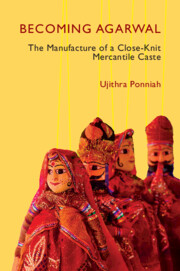
- Becoming AgarwalThe Manufacture of a Close-Knit Mercantile Caste, pp. 103 - 125Publisher: Cambridge University PressPrint publication year: 2026
Accessibility standard: Unknown
Why this information is here
This section outlines the accessibility features of this content - including support for screen readers, full keyboard navigation and high-contrast display options. This may not be relevant for you.Accessibility Information
Accessibility compliance for the PDF of this chapter is currently unknown and may be updated in the future.