
Skip to main content Accessibility help
×
  • Cited by 6
    • Show more authors
    • You may already have access via personal or institutional login
    • Select format
    • Publisher:
      Cambridge University Press
      Publication date:
      05 April 2013
      21 March 2013
      ISBN:
      9781139088077
      9781107018488
      Dimensions:
      Weight & Pages:
      Dimensions:
      (276 x 219 mm)
      Weight & Pages:
      1.15kg, 414 Pages
    You may already have access via personal or institutional login
  • Selected: Digital
    Add to cart View cart Buy from Cambridge.org

    Book description

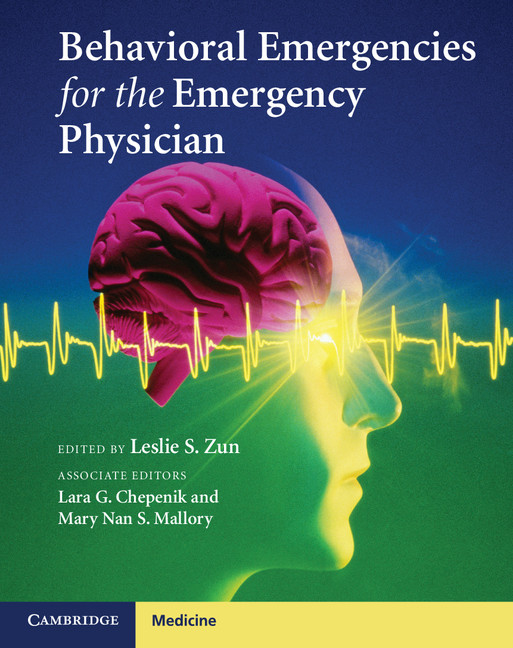
    Emergency physicians, in all practice settings, care for patients with both undifferentiated psycho-behavioral presentations and established psychiatric illness. This reference-based text goes beyond diagnostics, providing practical input from physicians experienced with adult emergency psychiatric patients. Physicians will increase their understanding and gain confidence working with these patients, even when specialized psychiatric back-up is lacking. Behavioral Emergencies for the Emergency Physician is comprehensive, covering the pre-hospital setting and advising on evidence-based practice; from collaborating with psychiatric colleagues to establishing a psychiatric service in your ED. Sedation, restraint and seclusion are outlined. Potential dilemmas when treating pregnant, geriatric or homeless patients with mental illness are discussed in detail, along with the more challenging behavioral diagnoses such as malingering, factitious and personality disorders. This go-to, comprehensive volume is invaluable for trainee and experienced emergency physicians, as well as psychiatrists, psychologists, psychiatric and emergency department nurses and other mental health workers.

    Refine List

    Actions for selected content:

    Select all | Deselect all
    • View selected items
    • Export citations
    • Download PDF (zip)
    • Save to Kindle
    • Save to Dropbox
    • Save to Google Drive

    Save Search

    You can save your searches here and later view and run them again in "My saved searches".

    Please provide a title, maximum of 40 characters.
    ×

    Contents


    Page 3 of 3


    • Chapter 49 - Law enforcement and emergency psychiatry
      pp 373-377
    • View abstract

      Summary

      As the prevalence of mental illness increases in the United States, emergency medical services' (EMS) role in the care of the psychiatric patient continues to grow. The goal of EMS systems is safe transport of the psychiatric patient to the hospital for further evaluation and care. The cooperative patient can usually be transported without physical or chemical restraint, or law enforcement assistance. In cases of the extremely violent or agitated patient in whom de-escalation techniques have proved futile, law enforcement may elect to use an electronic control device (ECD) to subdue the patient. Refusal of care in the psychiatric patient poses a challenging dilemma. The violent and agitated patient clearly lacks decision-making capacity. Thus EMS personnel need to determine decision making capacity in the difficult prehospital environment. Organic causes of abnormal behavior, such as hypoglycemia, should always be considered.
    • Chapter 50 - Research in emergency psychiatry
      pp 378-381
    • View abstract

      Summary

      Facilitating efficiency and safety, triage is the process by which multiple patients are rapidly assessed for risk and queued for care by the emergency department (ED) providers. Before conducting an assessment and formulating a treatment plan with psychiatric patients in the ED, clinicians are encouraged to obtain pre-arrival patient information whenever possible. Ambulatory patients with psychiatric complaints may present to triage alone or arrive with family or friends. It is advisable to have a protocol for determining the location of initial triage based on the circumstances of arrival. Continual reassessment of patient status is critical for clinical care. At various points in this chapter, the movement of patients from one clinical environment to another is discussed. Each transition includes an attendant hand-off between clinical providers. At times, a patient is sent to the emergency department en route to an inpatient psychiatric unit, for example, from a psychiatric clinic.
    • Chapter 51 - Administration
      pp 382-390
    • View abstract

      Summary

      The Emergency Medical Treatment and Active Labor Act (EMTALA) was enacted in 1986 as a component of the Consolidated Omnibus Budget Reconciliation Act of 1985. The emergency physician must ensure that a psychiatric presentation is not masking or coinciding with another illness, such as an occult head injury, metabolic disturbance, or toxic ingestion. It is commonplace for mental health screeners from the community to participate in the evaluation of patients with psychiatric emergencies and assist in locating inpatient availability when the emergency medical condition (EMC) is not stabilized and inpatient care is required. Failure to comply with EMTALA can lead to substantial consequences for hospitals and physicians. Emergency psychiatry involves a broad healthcare team and members vary in their level of responsibility and education. Understanding the requirements imposed by EMTALA is an essential compliance topic for each team member.

    Page 3 of 3


    Metrics

    Altmetric attention score

    Full text views

    Total number of HTML views: 0
    Total number of PDF views: 0 *
    Loading metrics...

    Book summary page views

    Total views: 0 *
    Loading metrics...

    * Views captured on Cambridge Core between #date#. This data will be updated every 24 hours.

    Usage data cannot currently be displayed.

    Accessibility standard: Unknown

    Why this information is here

    This section outlines the accessibility features of this content - including support for screen readers, full keyboard navigation and high-contrast display options. This may not be relevant for you.

    Accessibility Information

    Accessibility compliance for the HTML of this book is currently unknown and may be updated in the future.
