


%20--%3e%3c!DOCTYPE%20svg%20PUBLIC%20'-//W3C//DTD%20SVG%201.0//EN'%20'http://www.w3.org/TR/2001/REC-SVG-20010904/DTD/svg10.dtd'%3e%3csvg%20version='1.0'%20id='Layer_1'%20xmlns='http://www.w3.org/2000/svg'%20xmlns:xlink='http://www.w3.org/1999/xlink'%20x='0px'%20y='0px'%20width='64px'%20height='64px'%20viewBox='5.5%20-3.5%2064%2064'%20enable-background='new%205.5%20-3.5%2064%2064'%20xml:space='preserve'%3e%3cg%3e%3ccircle%20fill='%23FFFFFF'%20fill-opacity='0'%20cx='37.785'%20cy='28.501'%20r='28.836'/%3e%3cpath%20fill='%23595959'%20d='M37.441-3.5c8.951,0,16.572,3.125,22.857,9.372c3.008,3.009,5.295,6.448,6.857,10.314%20c1.561,3.867,2.344,7.971,2.344,12.314c0,4.381-0.773,8.486-2.314,12.313c-1.543,3.828-3.82,7.21-6.828,10.143%20c-3.123,3.085-6.666,5.448-10.629,7.086c-3.961,1.638-8.057,2.457-12.285,2.457s-8.276-0.808-12.143-2.429%20c-3.866-1.618-7.333-3.961-10.4-7.027c-3.067-3.066-5.4-6.524-7-10.372S5.5,32.767,5.5,28.5c0-4.229,0.809-8.295,2.428-12.2%20c1.619-3.905,3.972-7.4,7.057-10.486C21.08-0.394,28.565-3.5,37.441-3.5z%20M37.557,2.272c-7.314,0-13.467,2.553-18.458,7.657%20c-2.515,2.553-4.448,5.419-5.8,8.6c-1.354,3.181-2.029,6.505-2.029,9.972c0,3.429,0.675,6.734,2.029,9.913%20c1.353,3.183,3.285,6.021,5.8,8.516c2.514,2.496,5.351,4.399,8.515,5.715c3.161,1.314,6.476,1.971,9.943,1.971%20c3.428,0,6.75-0.665,9.973-1.999c3.219-1.335,6.121-3.257,8.713-5.771c4.99-4.876,7.484-10.99,7.484-18.344%20c0-3.543-0.648-6.895-1.943-10.057c-1.293-3.162-3.18-5.98-5.654-8.458C50.984,4.844,44.795,2.272,37.557,2.272z%20M37.156,23.187%20l-4.287,2.229c-0.458-0.951-1.019-1.619-1.685-2c-0.667-0.38-1.286-0.571-1.858-0.571c-2.856,0-4.286,1.885-4.286,5.657%20c0,1.714,0.362,3.084,1.085,4.113c0.724,1.029,1.791,1.544,3.201,1.544c1.867,0,3.181-0.915,3.944-2.743l3.942,2%20c-0.838,1.563-2,2.791-3.486,3.686c-1.484,0.896-3.123,1.343-4.914,1.343c-2.857,0-5.163-0.875-6.915-2.629%20c-1.752-1.752-2.628-4.19-2.628-7.313c0-3.048,0.886-5.466,2.657-7.257c1.771-1.79,4.009-2.686,6.715-2.686%20C32.604,18.558,35.441,20.101,37.156,23.187z%20M55.613,23.187l-4.229,2.229c-0.457-0.951-1.02-1.619-1.686-2%20c-0.668-0.38-1.307-0.571-1.914-0.571c-2.857,0-4.287,1.885-4.287,5.657c0,1.714,0.363,3.084,1.086,4.113%20c0.723,1.029,1.789,1.544,3.201,1.544c1.865,0,3.18-0.915,3.941-2.743l4,2c-0.875,1.563-2.057,2.791-3.541,3.686%20c-1.486,0.896-3.105,1.343-4.857,1.343c-2.896,0-5.209-0.875-6.941-2.629c-1.736-1.752-2.602-4.19-2.602-7.313%20c0-3.048,0.885-5.466,2.658-7.257c1.77-1.79,4.008-2.686,6.713-2.686C51.117,18.558,53.938,20.101,55.613,23.187z'/%3e%3c/g%3e%3c/svg%3e)
%20--%3e%3c!DOCTYPE%20svg%20PUBLIC%20'-//W3C//DTD%20SVG%201.0//EN'%20'http://www.w3.org/TR/2001/REC-SVG-20010904/DTD/svg10.dtd'%3e%3csvg%20version='1.0'%20id='Layer_1'%20xmlns='http://www.w3.org/2000/svg'%20xmlns:xlink='http://www.w3.org/1999/xlink'%20x='0px'%20y='0px'%20width='64px'%20height='64px'%20viewBox='5.5%20-3.5%2064%2064'%20enable-background='new%205.5%20-3.5%2064%2064'%20xml:space='preserve'%3e%3cg%3e%3ccircle%20fill='%23FFFFFF'%20fill-opacity='0'%20cx='37.637'%20cy='28.806'%20r='28.276'/%3e%3cg%3e%3cpath%20fill='%23595959'%20d='M37.443-3.5c8.988,0,16.57,3.085,22.742,9.257C66.393,11.967,69.5,19.548,69.5,28.5c0,8.991-3.049,16.476-9.145,22.456%20C53.879,57.319,46.242,60.5,37.443,60.5c-8.649,0-16.153-3.144-22.514-9.43C8.644,44.784,5.5,37.262,5.5,28.5%20c0-8.761,3.144-16.342,9.429-22.742C21.101-0.415,28.604-3.5,37.443-3.5z%20M37.557,2.272c-7.276,0-13.428,2.553-18.457,7.657%20c-5.22,5.334-7.829,11.525-7.829,18.572c0,7.086,2.59,13.22,7.77,18.398c5.181,5.182,11.352,7.771,18.514,7.771%20c7.123,0,13.334-2.607,18.629-7.828c5.029-4.838,7.543-10.952,7.543-18.343c0-7.276-2.553-13.465-7.656-18.571%20C50.967,4.824,44.795,2.272,37.557,2.272z%20M46.129,20.557v13.085h-3.656v15.542h-9.944V33.643h-3.656V20.557%20c0-0.572,0.2-1.057,0.599-1.457c0.401-0.399,0.887-0.6,1.457-0.6h13.144c0.533,0,1.01,0.2,1.428,0.6%20C45.918,19.5,46.129,19.986,46.129,20.557z%20M33.042,12.329c0-3.008,1.485-4.514,4.458-4.514s4.457,1.504,4.457,4.514%20c0,2.971-1.486,4.457-4.457,4.457S33.042,15.3,33.042,12.329z'/%3e%3c/g%3e%3c/g%3e%3c/svg%3e)
%20--%3e%3c!DOCTYPE%20svg%20PUBLIC%20'-//W3C//DTD%20SVG%201.0//EN'%20'http://www.w3.org/TR/2001/REC-SVG-20010904/DTD/svg10.dtd'%3e%3csvg%20version='1.0'%20id='Layer_1'%20xmlns='http://www.w3.org/2000/svg'%20xmlns:xlink='http://www.w3.org/1999/xlink'%20x='0px'%20y='0px'%20width='64px'%20height='64px'%20viewBox='5.5%20-3.5%2064%2064'%20enable-background='new%205.5%20-3.5%2064%2064'%20xml:space='preserve'%3e%3cg%3e%3ccircle%20fill='%23FFFFFF'%20fill-opacity='0'%20cx='36.924'%20cy='28.403'%20r='28.895'/%3e%3cpath%20fill='%23595959'%20d='M37.442-3.5c8.99,0,16.571,3.085,22.743,9.256C66.393,11.928,69.5,19.509,69.5,28.5c0,8.992-3.048,16.476-9.145,22.458%20C53.88,57.32,46.241,60.5,37.442,60.5c-8.686,0-16.19-3.162-22.513-9.485C8.644,44.728,5.5,37.225,5.5,28.5%20c0-8.762,3.144-16.343,9.429-22.743C21.1-0.414,28.604-3.5,37.442-3.5z%20M12.7,19.872c-0.952,2.628-1.429,5.505-1.429,8.629%20c0,7.086,2.59,13.22,7.77,18.4c5.219,5.144,11.391,7.715,18.514,7.715c7.201,0,13.409-2.608,18.63-7.829%20c1.867-1.79,3.332-3.657,4.398-5.602l-12.056-5.371c-0.421,2.02-1.439,3.667-3.057,4.942c-1.622,1.276-3.535,2.011-5.744,2.2%20v4.915h-3.714v-4.915c-3.543-0.036-6.782-1.312-9.714-3.827l4.4-4.457c2.094,1.942,4.476,2.913,7.143,2.913%20c1.104,0,2.048-0.246,2.83-0.743c0.78-0.494,1.172-1.312,1.172-2.457c0-0.801-0.287-1.448-0.858-1.943l-3.085-1.315l-3.771-1.715%20l-5.086-2.229L12.7,19.872z%20M37.557,2.214c-7.276,0-13.428,2.571-18.457,7.714c-1.258,1.258-2.439,2.686-3.543,4.287L27.786,19.7%20c0.533-1.676,1.542-3.019,3.029-4.028c1.484-1.009,3.218-1.571,5.2-1.686V9.071h3.715v4.915c2.934,0.153,5.6,1.143,8,2.971%20l-4.172,4.286c-1.793-1.257-3.619-1.885-5.486-1.885c-0.991,0-1.876,0.191-2.656,0.571c-0.781,0.381-1.172,1.029-1.172,1.943%20c0,0.267,0.095,0.533,0.285,0.8l4.057,1.83l2.8,1.257l5.144,2.285l16.397,7.314c0.535-2.248,0.801-4.533,0.801-6.857%20c0-7.353-2.552-13.543-7.656-18.573C51.005,4.785,44.831,2.214,37.557,2.214z'/%3e%3c/g%3e%3c/svg%3e)
2.1 Introduction
Elections of the post-financial crisis period were not kind to parties on the mainstream European left. Although experiencing a slight rebound in a few post-COVID elections, social democratic parties nonetheless remain substantially weaker than they were two decades ago. Next to this electoral decline of the moderate left, more economically and politically radical right populist parties as well as both green/left-libertarian and populist radical left parties have scored impressive victories.
While most of this volume examines the changing partisan affiliations of voters and their relation to social democratic party strategies in different contexts, this chapter takes a bird’s eye view and examines aggregate regional patterns of electoral realignment. It finds that shifts in voting patterns from moderate to radical parties manifest themselves in distinctive configurations across geographically varied regions. This regional variation reveals the structural dilemma in which social democratic parties find themselves, namely that they face different competitors across places. The combination of the transition to knowledge-based growth with the social sorting of voters places competing pressures on the social democratic mobilization strategy. Many newer left voters who are both culturally liberal and economically progressive have sorted themselves into vibrant metropolitan areas, while many of their past core voters with more moderate positions – at least on the cultural dimension – are residing in what are now lagging areas from the vantage point of vantage point of the knowledge society. The geographical dilemma evidenced in this chapter underlines two key contentions of the entire volume: it has become difficult for social democratic parties to devise programmatic appeals that effectively and successfully resonate simultaneously in their different distinctive core constituencies; and radical parties of the Left and Right – especially in proportional electoral systems – are more successful in proposing such distinctive programs.
I argue that social democrats’ traditional ‘national’ (i.e. regionally untargeted) policy approaches are increasingly less effective at holding together cross-regional support. Non-regionally targeted policies such as improved pensions and unemployment insurance are clearly still effective and popular redistributive instruments for the Left. However, in an era in which geographic regions (a) prioritize different economic policies and (b) cultural sorting creates different ‘second dimension’ demands, social democratic parties find themselves vulnerable to competitors that can offer more targeted appeals on both dimensions – particularly in proportional electoral systems.
A first empirical implication of this claim, which I develop in the chapter, is that social democratic parties increasingly struggle to either maintain historical regional strongholds or to capture more voters in economic regions where they have been hitherto weak, leading to cross-regional losses.
A second empirical implication is that social democratic parties lose to different parties in different places. Their cross-regional losses rest on different competitive dynamics within countries. Regions with more or less exposure to the knowledge economy and urban and non-urban areas have different political leanings. The result is a fragmentation of the political space. Cities in knowledge dense areas trend more to the green, left-libertarian and non-centrist left parties, while urban voting for populist parties is (relatively) higher in declining industrial cities. By contrast, suburbs, rural areas and towns have experienced a growth in both moderate and populist right voting, especially in post-industrial knowledge economies. The result is that different challenger parties mobilize voters across regions in ways that cost social democratic parties.
Third, as the new political geography meets the Left’s historic mobilization structures, it creates different competitive threats across countries. Where social democratic parties historically mobilized more urban areas – as they did in many European countries – then these new dynamics mean that they are more threatened by left challenger parties. Where the Left had a more agrarian or suburban base, then the rise of the Moderate and in some cases populist Radical Right, poses more of a threat.
While there is evidence from other work – which I review later – that regional dynamics are not entirely compositional (i.e. that localized geographic shocks/experiences have effects over and above the type of individuals who live within an area), this paper cannot adjudicate between contextual and compositional effects as drivers of variation. The argument of the chapter, however, does not hinge on this distinction. The core claim is that geographic changes reinforce existing accounts of individual cleavages and help explain why social democratic parties struggle to hold together political coalitions despite offering quite popular policy programs. Differences in economic growth models and legacies of mobilization help to explain varying patterns of social democratic adjustment in ways that complement the individual-level analysis.
The chapter provides a largely descriptive contribution to the volume, looking to trace patterns of adjustment across place. But this descriptive contribution rests on an underlying theorization, congruent with the framework of the volume, that sees medium-term competitive challenges for social democratic parties as varying across political economies. To show these trends, it draws on an original dataset of electoral results at the highly localized level.
2.2 Why Regions Matters: The Importance of Political Geography
This brief chapter cannot do justice to the extensive work on political geography (Rickard Reference Rickard2020). However, I want to highlight two broad approaches in this literature, which both point to the importance of geographic dynamics in shaping parties’ strategic options.
First, there is a large literature on the importance of geographically based institutions, such as the electoral system (Persson and Tabellini Reference Persson and Tabellini2005; Rodden Reference Rodden2019), federalism (Rodden Reference Rodden2002; Beramendi Reference Beramendi2012), and structure of local government (Trounstine Reference Trounstine2018; Freemark et al. Reference Freemark, Steil and Thelen2020) in shaping the distributive and mobilizing trade-offs for political parties. This literature suggests that parties have greater strategic incentives to provide policies targeted to voters in geographic areas that are electorally competitive than those that are not (Jusko Reference Jusko2017). While the Left was historically weaker in majoritarian system (Iversen and Soskice Reference Iversen and Soskice2006), there was nonetheless substantial variation, following, in part, from the spatial distribution of workers. Here, parties on the Left faced trade-offs between appealing to their base among workers and winning districts where the marginal voter was not necessarily a worker.
However, geographic trade-offs do not just emerge in majoritarian systems. Parties may face them in proportional systems if shared geographic experiences create strategic incentives for some parties to mobilize voters as geographic groups.
This claim brings us to a second literature, which comes from economic geography. This literature suggests that local economic experiences can vary in ways that are not entirely compositional – that is, there are both ‘agglomeration effects’ in local economies (e.g. successful firms attract other successful firms) and local macro-economic effects to shocks (e.g. the closure of plant can spill over into other areas) (Rosenthal and Strange Reference Rosenthal, Strange, Henderson and Thisse2004; Autor and Dorn Reference Autor and Dorn2013; Autor et al. Reference Autor, Dorn and Hanson2013). These contextual economic effects mean that people with similar jobs (e.g. factory workers, hairdressers and childcare workers) can have different economic experiences across places.
These geographic experiences can matter electorally if parties mobilize voters based on them. There are clear historical examples of this strategy. Most Scandinavian countries, for instance, had successful rural parties that mobilized agrarian voters with particular economic and cultural interests. These parties both drew on the support of those directly involved in agriculture (e.g. farmers) but also those that shared economic interests with voters in these areas (e.g. small business people). Classic work on the origins of the party systems stressed both the ways that traditional urban–rural cleavages materialized as political ones and how new industrial cleavages overlay onto geographical areas (Lipset and Rokkan Reference Lipset, Rokkan, Lipset and Rokkan1967).
Where varied economic geography combined with geographically oriented institutions, historically it created particular partisan and economic dynamics, as Rodden (Reference Rodden2019) outlines for the US case. In the majoritarian systems, nationalized parties had to broker cross-regional deals to hold together their base, often providing more targeted local expenditure or concessions. Katznelson (Reference Katznelson2013) shows, for instance, how Democrats in the US, in constructing early welfare policies through New Deal programs, provided racist regionally based economic concessions to secure the support of Southern Democrats.
In Europe’s largely proportional systems, the Left had more ability to pursue broad based policies emphasizing national solutions (e.g. welfare, pensions) that reduced geographic mobilization. Social democratic parties mobilized voters largely through policies aimed at securing the interests of the industrial working class, including expansive Keynesian policies, support for trade unions and labour rights and a growing welfare state (Hibbs Reference Hibbs1977). As winning elections required moving beyond narrow class appeals, social democratic parties both looked to create broader cross-class or cross-regional coalitions through these policies. The success of the Nordic social democratic parties lay, in many ways, in institutionalizing both, cutting into rural parties’ strength in the countryside by promising generous (national) welfare policies, which also appealed to parts of the urban middle class. The more tenuous position of some Continental social democratic parties followed in part from a less institutionalized approach, with Christian democratic parties playing a key role in mobilizing the working class in many industrial and agricultural regions.
Section 2.2.1 argues that Europe’s economic regions have undergone a dual change in the last thirty years, both towards a post-industrial economic model generally and urban growth model. These geographic shifts are central to Rodden’s (Reference Rodden2019) account of the transformation of the Left in majoritarian electoral systems. The places the Left mobilizes may be the same – urban areas – but the people are different, creating new forms of support. In majoritarian systems, Rodden argues that the Left’s voters are increasingly concentrated in cities, giving them an electoral disadvantage. In this account, the Left faces fewer penalties to different geographic distributions of support in Europe. However, the following sections argue that in even in proportional systems, the transition to knowledge economy can put pressure on social democratic parties’ traditional national economic and mobilizing strategies. The result is that changes in the economic and social geography contribute to new political divides. I first start with outlining the geographic transformations and then turn to their political implications.
2.2.1 The Dual Geographic Transformation of the Knowledge Economy
Defining the ‘knowledge economy’ is complex, but it generally involves a shift to both higher-skilled forms of production involving new technological innovations (e.g. ICT) and high-skilled forms of service provision (e.g. finance, business services) (Boix Reference Boix2019; Hope and Martelli Reference Hope and Martelli2019; Iversen and Soskice Reference Iversen and Soskice2019). The growth of the knowledge economy has meant both a shift in the underlying economic structure and, through mass educational expansion and changes in the nature of the work, dramatic changes in the class structure (Oesch Reference Oesch2008b, Reference Oesch2013).
These economic and class transformations have not been geographically flat. Indeed, changes in the nature demands for skill, and the subsequent distribution of types of work (and their associated cultural preferences), have taken on an increasingly varied geographic character, both across and within countries.
On aggregate, much high-skilled employment growth in the last decades has occurred in both the public sector and in what Eckert et al. (Reference Eckert, Ganapati and Walsh2019) label ‘skilled tradeable’ services. While the former often occurs across geographic regions, the latter is less evenly geographically distributed both across Europe’s higher-level geographic regions and within these broad regions across cities and suburbs – leading to what I label the ‘dual economic transformation’ of Europe’s regions.
To take broad economic regions first. People live and work in areas that make or do different things. For instance, in the United States, the city of Houston, is part of the broader economic area of Houston–Woodland–Sugarland, an economic area that is historically more dependent on petroleum natural resource extraction. By contrast, the city of Detroit, located in Detroit–Warren–Dearborn area, is historically an industrial producer of automobiles and other manufactured goods. San Jose, part of the Silicon Valley area of California, has, for the last decades, been a leader in new technology firms. The broader economic structure of Houston, or Detroit, or Silicon Valley then, depends in part on competitiveness of the US energy, automobile and technology sectors (Boix Reference Boix2019).
The same is true in Europe – both within and across countries. Historically, there are distinct regional economies that generally have different economic strengths even within a given country (e.g. Herrigel Reference Herrigel2000). In the face of post-industrial economic change, some regions of Europe have moved more extensively towards employment in the knowledge economy than others.
To show this outcome, I follow much of the literature in European regional political economy and look at NUTS-2 regions. NUTS-2 regions are high level units, with between 500,000 and 3,000,000 inhabitants. NUTS units are both the basis of the distribution of parts of European structural funds (Becker et al. Reference Becker, Egger and von Ehrlich2010) and other work shows that they are meaningful economically and political relevant units (Colantone and Stanig Reference Colantone and Stanig2018b; Rodríguez-Pose Reference Rodríguez-Pose2018).
Figure 2.1 develops a measure of the regional structure of the knowledge economy across European NUTS-2 regions, using three indicators: the share of the 25–64 year-old population with a higher degree (defined as ISCED 5–8), the number of patents per 1,000 population and the share of employment in the NUTS-2 region in finance and business services (all data taken from Eurostat). Each indicator is averaged across decades, and rescaled to run 0-1, with the regions at the 99th percentile and above scored as 1. Each of the three components counts equally in the overall index, which is itself rescaled to run 0-1. This regional index correlates at the national level with the World Bank’s 2005 Knowledge Economy Index at 0.82.Footnote 1 Figure 2.1 shows the distribution of regions across and within European countries (unfortunately, data on Switzerland is not available).
Knowledge economy index

What Figure 2.1 shows is that in many countries, there are regions that are extremely knowledge intensive – including in parts of UK, the Scandinavian countries, France, the Netherlands and Belgium. But that within these same countries, there are also much less knowledge-intensive regions. The growth of knowledge-intensive regions is, in some cases, associated with greater overall regional divergence, but in other regional divergence remains flat (Rosés and Wolf Reference Rosés and Wolf2019). However, where large and regionally redistributive welfare states have limited growing regional divergence – such as in the Scandinavian countries or the Netherlands – Figure 2.1 shows that many of the underlying structural trends are still present. By contrast, there are fewer knowledge-intensive regions in the European south and lower variation in the more industrial Germany and Austria.
However, there is also variation within regions. To return to the example of Houston, Detroit and San Jose. Within these broader economic areas, some people live in the centre of the core city, some live in a rich inner suburb or an (often poorer) exurb, and some live in an outlying rural area that is not directly linked to the city.
New economic sectors – finance, and parts of the knowledge economy are linked in particular to urban conurbations, with capital cities experiencing particular growth in these sectors (Odendahl et al. Reference Odendahl, Springford, Johnson and Murray2019). This sorting of high-skilled work into urban areas has both fuelled inequality among the high skilled – with workers in high-skilled jobs in high-skilled firms located, often, in high-skilled areas – being particular winners (Song et al. Reference Song, Price, Guvenen, Bloom and Von Wachter2019); at the same time, the sorting of high-skilled work into urban areas has had further knock on effects on other forms of inequality, such as housing wealth.
By contrast, both less knowledge-intensive industrial regions and new outlying suburban areas bordering knowledge-intensive areas may have higher concentrations of poverty or economic duress; the latter often including areas housing the lower-paid worker who service major cities but without the associated gains of urban growth (Kneebone and Garr Reference Kneebone and Garr2010). These areas have been hard hit by job losses and weaker rates of economic growth than the knowledge-intensive urban core (Rickard Reference Rickard2020).
Figure 2.2 draws a on different way of thinking about geography, based on the relationship between local units and cities. Many economists studying local economic effects examine areas defined ‘commuter zones’ or ‘travel to work areas’ rather than high level regions, as these areas are more closely linked to common economic experiences (Autor et al. Reference Autor, Dorn and Hanson2013). Figure 2.2 draws on an original dataset of highly localized data of educational attainment (Gingrich, McArthur and Cuibus Reference Gingrich, McArthur and Cuibus2023), aggregated to urban areas defined by commuter zone (broken apart by core city and suburbs) vis-à-vis those not attached to a commuter zone (rural and towns). The precise measures are discussed in the data section later.
Urban and rural areas

What Figure 2.2 shows is that in both knowledge and less knowledge-intensive regions, there are differences in the educational concentration of the population across cities and rural areas. In the Anglo-American economies and, to a lesser extent, the Scandinavian economies, economic growth in the last decades has generically benefited higher-skilled workers and particularly higher-skilled workers in either urban core areas or areas with high pre-existing levels of human capital (Moretti Reference Moretti2012). In cultural terms, Maxwell (Reference Maxwell2019) finds that major cities have become magnets for higher-skilled and culturally liberal voters, and substantial cultural sorting has occurred. Where the knowledge economy is less developed, either due to ongoing industrial or agricultural production, the gaps between the city and countryside are less stark, both because there are fewer centralizing urban pressures (i.e. de-concentrated forms of growth remain viable) and the gaps in economic and cultural experiences between the city and the countryside are less stark. Nonetheless, here too we see differences.
In other words, the geography of voters’ experiences differ both across types of economic growth models (knowledge-economy intensive or not) and their proximity to economic centres.
2.2.2 Changing Political Alignments
Do these shifts matter? Early work on the knowledge economy and party system change argued that changes in the class structure and nature of knowledge economy growth both created new pressures for social democratic parties. I argue later, that as the above-mentioned geographic shifts emerged, they magnified these difficulties.
The rise of knowledge-intensive work put pressure on social democrat’s traditional strategy of mobilization via broad based economic policy. Early work argued that the transition to the knowledge economy put increasing constraints on fiscal Keynesian demand side policies, limiting social democratic consumption spending, for example for pensions, health, and unemployment, while also making ‘supply side’ investment policies in skills to elevate the bottom half of the income distribution more imperative (Boix Reference Boix1998). At the same time, the rise of a new category of educated professionals – particularly in the sociocultural fields (education, culture, and health/wellness) – created a broad constituency calling for a societal liberalization in addition to demands for economic security and redistribution (Kitschelt Reference Kitschelt1994).
Social democratic parties that continued to primarily appeal to working-class voters on economic grounds were thus likely to face electoral decline. However, for modernizing social democratic parties, weaving together a coalition of their core base of voters with the new professional strata was increasingly difficult in the changing competitive space.
Subsequent work has vindicated many of these early claims. The changing class composition of the electorate has prompted a dramatic class realignment on the Left and Right (Kriesi et al. Reference Kriesi, Grande, Lachat, Dolezal, Bornschier and Frey2006, Reference Kriesi, Grande, Lachat, Dolezal, Bornschier and Frey2008; Kitschelt and Rehm Reference Kitschelt and Rehm2014, Reference Kitschelt, Rehm, Beramendi, Häusermann, Kitschelt and Kriesi2015; Gingrich and Häusermann Reference Gingrich and Häusermann2015; Häusermann and Kriesi Reference Häusermann, Kriesi, Beramendi, Häusermann, Kitschelt and Kriesi2015; Oesch and Rennwald Reference Oesch and Rennwald2018); the distinctiveness of traditional social democratic appeals – and policy – has declined (Huber and Stephens 2015; Raess and Pontusson Reference Raess and Pontusson2015), while moderation on new issues, particularly so-called ‘social investment’ has been critical to gaining new voters (Beramendi et al. Reference Beramendi, Häusermann, Kitschelt, Kriesi, Beramendi, Häusermann, Kitschelt and Kriesi2015; Abou-Chadi and Wagner Reference Abou-Chadi and Wagner2019) it has often been blocked by traditional labour market ‘insiders’ (Rueda Reference Rueda2005, Reference Rueda2007; Häusermann and Schwander Reference Schwander2012; Schwander Reference Schwander2012; Lindvall and Rueda Reference Lindvall and Rueda2014). The result has been an ongoing decline of social democratic parties and a competitive space that is increasingly fragmented not only across parties but also the dimensions of political competition.
However, as Boix (Reference Boix2019) and Iversen and Soskice (Reference Iversen and Soskice2019) argue, as these generic changes in skills and cultural values took on a geographic character that reinforced these broad shifts, sharpening the trade-offs for social democratic parties.
The growth of knowledge-intensive cities has the potential to further fragment the interests of working- and middle-class citizens across high- and low-productivity areas, making a singular policy appeal – whether on the demand or the supply side – increasingly difficult. This fragmentation follows from the geographic challenges that knowledge economy growth creates.
In one regard, regional economic divides are nothing new. In the postwar period, large parties, both on the Left and the Right, had to address deep economic disparities – Northern and Southern Italy, rural Wales and Manchester, and Stockholm and Northern Sweden, were all historically highly economically diverse. Both social and Christian democrats looked to appeal across regions with broad nationally based policies – with the expansion of the non-geographically targeted welfare state a method for doing so.
However, with the advent of knowledge society, there may be greater trade-offs. On the economic side, supply-side investments are likely to be less effective in lower productivity areas, absent some support for stimulating local growth. A redistributive supply-side policy (or ‘social investment’) is unlikely to meet the needs of these regions, where there are few high-paying employers demanding skills and where traditional industry is in decline. These deteriorating regions, therefore, demand social consumption policies – in the form of early retirement packages, higher pensions and greater unemployment payments – that fuel heterogeneity and disparity of wage earner demands across regions with different economic conditions. While working-class voters and professionals in knowledge-intensive cities often demand basic redistribution, they face specific pressure due to housing costs, childcare and transportation, making them more supportive of investment (Häusermann et al. Reference Häusermann, Pinggera, Ares and Enggist2019). Those in rural areas and outer suburbs, by contrast, face more pressure in terms of anaemic job creation, infrastructure investment and population aging. Creating a single economic package to address both – although not impossible (this was the attempt of US President Biden’s new revived industrial policy via the CHIPS and Science Act and Inflation Reduction Act) – often runs up against voters’ generic concerns about high taxation and social spending.
The same is likely to be the case for societal and cultural concerns with ecology, restrictions on automobile traffic, sociocultural pluralization and proliferation of art and entertainment. While urban areas and industrial districts – which Section 2.2.3 shows were often the traditional strongholds for the Left – were historically wealthy, the nature of production in these places has shifted away from traditional heavy industry with skilled crafts and manufacturing jobs, converting them into knowledge-intensive service job areas populated by professionals with tertiary education. As Rodden (Reference Rodden2019) shows, these shifts in the class structure produce a new cadre of urban voters increasingly willing to vote for the Left, but whose economic and sociocultural priorities may differ from those of the older outer suburban and industrial voters on questions of urban development and transportation, immigration, gender and climate issues. Taken together, these shifts mean that social democratic parties have a hard time to develop a unified strategy that appeals to all of these groups.
Put differently, there is a spatial disparity of the potential social democratic electorate between the new knowledge-intensive metropolitan areas and the more peripheral suburban and rural areas, but there is also a social and political disparity within each of these spaces between different potential constituencies which social democratic parties can no longer reach with the same appeals. There are unifying national issues left – such as support for an encompassing and generous national public pension system – but regional and group divides on other issues may overwhelm these bridging strategies.
2.2.3 New Geographic Competition
How geography shapes social democratic party strategies depends on the structure of party competition. This competition, in turn, is likely to vary across electoral system. Where electoral systems organize representation based on small geographical single-member constituencies with plurality or majority electoral formula, the strategic dilemmas of social democracy are often particularly intense.
In majoritarian countries, such as the US, Canada, UK and Australia, the electoral system magnifies geographic changes. While majoritarian systems insulate social democratic parties from new competitors, these electoral rules are associated both with both sharper geographic divides and a clearer transmission belt between geographic divisions and political conflict. As Iversen and Soskice (Reference Iversen and Soskice2019) argue, in (largely Anglo) countries with single-member district plurality systems parties have engaged little in redistributive policies that make regions reaping the benefits of the knowledge economy share them with those that do not. Majoritarian systems then, offer social democratic parties a particular dilemma. While the first-past-the-post system has protected them from shedding large proportions of votes to smaller radical left and green/left-libertarian parties, growing regional economic variation divides the social democratic base, making win-win urban-non-urban working-class coalitions hard to achieve. This pressure is compounded by urban malapportionment. As Rodden (Reference Rodden2019) argues, urban voters often deliver inefficient, over-sized electoral majorities to left parties, but few majorities in more suburban, peripheral districts. The result is that moderate left parties here have an increasingly urban base of victorious districts won with appeals conducive to attract professionals. But this makes it hard to win mixed suburban and rural districts with more working-class voters, with whom social democratic appeals that rally urban professionals will not resonate strongly.
Proportional systems would seem to avoid these problems. In these countries, the overall level of regional variation (and individual earning inequality) is much lower, with both larger welfare states, and more dispersed models of skill investment (through vocational training) continuing to redistribute resources and opportunities to more peripheral areas and the electoral system does not mechanically enhance urban–rural geographic disparities. Indeed, in such systems redistributive coalitions are more effectively viable (Iversen and Soskice Reference Iversen and Soskice2019), which may also cement more even interregional transfers (Beramendi Reference Beramendi2012). Moreover, proportional systems offer no (dis)advantage to concentrated support, hence they are not producing under-representation of left-party votes due to malapportionment across districts (Rodden Reference Rodden2019).
While systems of proportional representation enable parties to craft more cross-regional coalitions, and thereby reduce their electoral dilemma to serve different social constituencies, they also increase this dilemma in a different fashion. Because they pose low entry barriers to new contenders, such novel parties may seize upon locally concentrated political demands (De Vries and Hobolt Reference De Vries and Hobolt2020). After decades of cultural and economic sorting, parties representing a cross-region compromise face challenges from parties that are more directly targeted to the interests of particular areas. Social democratic parties can be outflanked in growing cities on the left by green-left parties catering primarily to sociocultural professionals, while in suburbs by parties of the Moderate Right or the Radical Right that pick up on traditional social democratic core voters’ lack of enthusiasm for libertarian societal innovations.
The result is that maintaining broad electoral support requires Social Democrats to compete with different demands in distinctive competitive spaces, both more or less knowledge-intensive areas and more or less rural and urban areas. Even when social democratic parties are broadly popular, they increasingly face distinct regional competitors that are more locally popular. The result is a loss on multiple fronts.
Table 2.1 lays out four different configurations. The competitive threat from the Green Left is likely to be strongest in knowledge-intensive cities (particularly those without a strong industrial past), which compositionally have more new professionals. In rural areas and outer suburbs of knowledge-intensive areas, particularly those with an industrial past, there will be more old-fashioned left voters disposed to follow Moderate Right or the Radical Right populist appeals to counter the rising influence of Green Left parties. Social democrats will be engulfed here by competition from all partisan directions.
| Urban | Suburbs and rural | |
|---|---|---|
| Strong knowledge economy | GL more competitive | RR more competitive |
| Weak knowledge economy | RL more competitive | MR more competitive |
Less knowledge-intensive urban and rural areas follow different patterns. Here, many wealthy rural semi-industrial areas remain, where moderate right parties continue to have strong support. There are many fewer large urban non knowledge-intensive areas (e.g. Naples) but many mid-sized cities fall into this category (e.g. the French mid-sized city of Dijon scores as much less knowledge intensive than Grenoble). In these areas, radical left parties, where they exist, have often mobilized in both cities and suburbs, picking up on young educated voters frustrated with their lack of economic opportunities.
In other words, the geographic shifts are part of the broader well-theorized class realignment around parties. Moving towards the urban strata of knowledge society professionals may alienate working-class wage earners from social democracy. The rise of knowledge society has the potential to magnify the tensions between both within-region as well as cross-regional divisions over economic and societal issue preferences, making it hard for social democratic parties to address these tensions with a single unifying appeal.
Table 2.1 summarizes the likely patterns of party system configuration, but glosses over complexities and overlaps. Consider industrially declining urban areas surrounded by a thriving knowledge economy. These may mitigate party alignments attributed to either strong or weak urban knowledge economies. The cells in Table 2.1 thus suggest relative (not absolute) patterns of competition, compared to other urban regional types.
In conjunction, then, the claim here is that in knowledge-intensive areas social democratic parties face a growing divergence between the competitive space across urban and non-urban voting base, with challenger parties targeting these particular geographic strongholds in different ways. In less knowledge-intensive areas, social democratic parties face the competitive challenge of retaining support in adjusting urban areas where Radical Left and Radical Right populists may be growing in support, while competing with more traditional parties in the rural periphery. Thus, even in proportional systems, Social Democrats face a challenge in holding together cross-geographic coalitions under the umbrella of a single mainstream left appeal.
2.2.4 Regimes of Vulnerability?
What do the above-mentioned claims imply for social democratic parties’ overall electoral vulnerability? It is difficult to generalize to the country level, given that there are many moving parts across competitive systems, however, a few implications from the preceding discussion emerge.
Historically, these parties mobilized voters in particular places. If social democratic parties face different competitive threats across economic structures, then all else equal, the extent of these threats to overall performance will depend on how vested they are in particular geographic economic structures. Structural changes thus may have different aggregate implications for Social Democrats depending on their historic strongholds of mobilization.
For instance, social democratic parties that historically mobilized in cities, will face more threat from the Green Left in knowledge economies than the Radical Right. But, where they historically mobilized in the countryside, they might face more relative threat from the Radical Right. Indeed, while Abou Chadi and colleagues’ chapter on vote switching suggest that the electoral threat of social democratic voters switching to the Radical Right is generally overstated, it may be that there are specific contexts, such as Sweden where mobilization was historically more rural and where knowledge economy divides are growing, the Radical Right does pose a threat to social democratic parties. In less knowledge-intensive economies, social democratic parties may face fewer competitive threats where they are strong in rural areas, however, those with stronger traditional supporting in urban areas or suburbs are likely to face more threat from new radical left parties. These features suggest that the optimal competitive strategies for social democratic parties vary across place: trying to outcompete the Green Left may be less crucial to them in Sweden than in the Netherlands, for instance.
These structural shifts are not fully determinative. Where social democratic parties mobilize cities or rural areas effectively, they may prevent the rise of competitors on the supply side. Latent vulnerability is not always manifest.
2.3 Examining Processes of Change
Section 2.2 suggested that it is increasingly difficult for social democratic parties to hold cross-regional alliances together, but that patterns of change vary across economic regions and the macro-implications of change vary across historic structures of mobilization. To test these arguments, I draw on an original dataset of election results at the level of local area units (LAU), the base unit for European geographic hierarchies for the 1980s to present.Footnote 2
This dataset has greater geographical coverage and much more granular election results than Kollman et al. (Reference Kollman, Hicken, Caramani and Backer2010), but spans a shorter time period. The LAU are generally municipalities, although the scope of geographic disaggregation varies widely across countries – from highly aggregated units in the UK to highly disaggregated units in France. LAU have the advantage that they can be matched to the OECD and Eurostat ‘functional urban areas’, which are equivalent to commuter zones that have been harmonized across Europe. The LAU are fully embedded in NUTS units. As such, in measuring electoral outcomes at the LAU level, I can directly examine localized electoral outcomes along the two dimensions outlined in Table 2.1 – by the extent of the knowledge economy and the type of urban area.Footnote 3 All analyses weight the results by the national share of voters in the unit to adjust for highly varied unit sizes.
The previous discussion made three claims. First, in proportional systems, that social democratic parties were likely to lose voters over time as it became more difficult to hold together cross-place electoral appeals, that is we would see a weakening of their appeal across areas, not a geographic realignment. Second, that this weakening rests on the geographically varied party competitive dynamics, outlined in Table 2.2. Third, the aggregate effect of these shifts on social democratic parties’ competitive position depends on the historic mobilization structure. I use the disaggregated electoral data to test each of these claims.
| (1) | (2) | (3) | (4) | (5) | |
|---|---|---|---|---|---|
| SD | MR | GL | RL | RR | |
| Knowledge index | −0.215Footnote *** | 0.107Footnote *** | 0.00117 | −0.0302 | 0.0958Footnote * |
| (0.0417) | (0.0343) | (0.0219) | (0.0395) | (0.0496) | |
| Suburbs | −0.00831 | −0.0271 | −0.0190Footnote ** | 0.0371Footnote *** | 0.0222Footnote *** |
| (0.0198) | (0.0250) | (0.00889) | (0.00997) | (0.00715) | |
| Mid and major cities | 0.0202 | −0.0247 | −0.0521Footnote *** | 0.0335Footnote ** | 0.0438Footnote *** |
| (0.0259) | (0.0285) | (0.0152) | (0.0136) | (0.0113) | |
| Suburbs × KE | 0.0211 | 0.0413 | 0.0496Footnote *** | −0.0484Footnote *** | −0.0594Footnote *** |
| (0.0357) | (0.0412) | (0.0168) | (0.0153) | (0.0183) | |
| Cities × KE | 0.0177 | −0.0279 | 0.142Footnote *** | 0.00317 | −0.124Footnote *** |
| (0.0484) | (0.0531) | (0.0353) | (0.0242) | (0.0319) | |
| Baseline share industry | 0.00828 | −0.0297 | −0.129Footnote *** | −0.135Footnote *** | 0.171Footnote ** |
| (0.0486) | (0.0538) | (0.0351) | (0.0306) | (0.0736) | |
| Employment in agriculture | −0.0244 | 0.229Footnote *** | −0.107Footnote *** | −0.114Footnote *** | 0.0502 |
| (0.0690) | (0.0669) | (0.0313) | (0.0296) | (0.0723) | |
| Log voters | 0.000391 | −0.00233 | 0.00560Footnote *** | −0.00162 | −0.00192 |
| (0.00276) | (0.00377) | (0.00168) | (0.00247) | (0.00249) | |
| GDP per capita | 0.00278 | −0.0120Footnote *** | 0.00254 | −0.00592Footnote ** | 0.000727 |
| (0.00343) | (0.00348) | (0.00180) | (0.00254) | (0.00286) | |
| Constant | 0.320Footnote *** | 0.347Footnote *** | 0.0940Footnote *** | 0.150Footnote *** | 0.0587 |
| (0.0421) | (0.0401) | (0.0180) | (0.0293) | (0.0566) | |
| Observations | 154,917 | 154,917 | 146,963 | 60,436 | 144,697 |
* 0.10, **0.05, and ***0.01.
I begin with the first claim, conducting a series of descriptive analyses, using the LAU dataset to show examine geographic patterns of electoral decline among social democratic parties: I show that they have lost voters across different types of areas and regions, without compensating for these losses in new areas.
To examine the second claim that social democratic parties face distinct competitors across areas, I follow two approaches. I first turn to the LAU dataset to measure changing party competitive patterns across economic regions and urban types. I match each LAU to several features of the NUTS-3 region, such as GDP per capita, share of employment in industry and agriculture. I further match each LAU to the NUTS-2 level knowledge economy indicators outlined in Table 2.1. For these analyses, I distinguish three types of areas, rural and towns that are non-commuter zone areas, outer suburbs of large and small cities and large and small cities. I combine large and small cities into a single category, despite important differences between them, because there are very few non-knowledge-intensive large cities. This three category classification allows me to distinguish those living in core urban areas, outlying urban areas and rural areas, across different types of broad regional structures and look at trends in electoral outcomes. I examine vote shares across the LAU for the five main party families examined in this volume, using the coding strategy outlined in the introduction.
Observing structural ‘challenges’ is often difficult. As most voters are creatures of habit, and systems of mobilization and partisanship, especially among older voters, are often entrenched, the link between both structural change and political outcomes can be strongly temporally lagged. Both Karreth et al. (Reference Karreth, Polk and Allen2013) and Evans and Tilley (Reference Evans and Tilley2017) show that at the individual level, an underlying weakening of support for social democratic parties often precedes defection. A similar effect can occur geographically. There may be a latent weakening of support for a party in a particular place before there is a large outright defection of voters. In order to tease out the longer-term structural weakening of social democratic support across different places, I conduct a second analysis focusing changes in local electoral outcomes in the post-great financial crisis period. Given the extent of economic distress and accompanying challenger entry that posed a shock to most systems, if structural changes are altering trade-offs in ways that vary across places but take time to manifest themselves, we would expect to see the financial crisis to be a particular important turning point for areas (and people) that have experienced longer-term underlying weakening of support. I thus look at changes in support across parties in this context.
Finally, to examine the third claim about overall vulnerability of social democratic parties, I look at the same dependent variables, now interacting the knowledge-urban configurations with their historic mobilizing structures. This analysis allows us to tease out the different underlying threats to social democratic parties across places.
2.3.1 Where Did They Lose?
The first claim mentioned earlier is that social democratic parties, over time, lose in nearly all geographic areas, without picking up new areas. To examine the question of losses descriptively, Figure 2.3 plots the vote shares for the main social democratic party in the early 1980s against their vote shares in post-2010 for the most disaggregated unit available in sixteen countries (data at this level of disaggregation is only available from early the 1990s in France and unified Germany). The small number of units for which data in the 1980s is missing are assigned the average in the NUTS-3 region. For each country, the solid black line represents the relationship between the early 1980s vote share and post-2010 vote share by local unit, and the dashed black line is a 45° line (i.e. the early 1980s vote share plotted against itself). In nearly all cases, we see either a uniform cross-regional decline (as in Sweden), or an accentuated loss of support in historically strong regions (i.e. the dashed and black lines cross much closer towards the origin). In France and Germany, for instance, the traditional strongholds have shifted substantially away from the PS and SPD, respectively. In Italy, there has a been an even dramatic decline for the Moderate Left – driven by the rise of new populist radical right and radical left parties in both cases – even the traditionally strong ‘red belt’. In Greece, the historically strong PASOK, now KINAL, shows an even more extreme collapse in regional support. Thus, while there remains a high correlation in historic vote share and current vote share, social democratic parties have almost universally lost traditional strongholds without gaining new ones – in other words, we are not seeing geographic realignment in their support.
Voting in the early 1980s and 2010s

The patterns discussed earlier suggest, descriptively, that social democratic decline is in large part driven by both these parties’ inability to maintain voters in traditional strongholds and to build new forms of regional support. In many ways, this outcome is not surprising. Benedetto et al. (Reference Benedetto, Hix and Mastrorocco2020) find an on aggregate relationship between declining industrial shares and long run social democratic support, a finding that resonates with the above-mentioned long line of work at the individual level theorizing the relationship between changing class structures and a political dilemma of social democracy (Kitschelt Reference Kitschelt1994). The industrial structure – and its associated organization of economic and political life in trade unions – that gave birth to social democratic parties has changed, and so too have traditionally strong social democratic regions (Rodden Reference Rodden2019).
However, when viewed from another angle, the patterns are somewhat surprising. Social democrat’s traditional strongholds varied substantially across place from the wealthier industrial and urban regions of Germany, Italy and Switzerland to the poorer and more sparsely populated regions of Northern Scandinavia and Finland. Moreover, the transformation of these regional economies has been profound – and yet vote shares in many European countries correlate at above 0.80 in the 2010s to the 1980s. The continuity of geographic support then is as striking as the general overall losses in the post-financial crisis era. In other words, social democratic parties have lost everywhere, including their past strongholds, without picking up new areas. This trend is relatively universal across countries.
2.3.2 Whom Did They Lose To?
To whom have social democratic parties lost voters? In order to examine these trends, I begin descriptively, looking at urban–rural divisions – using the highly localized data aggregated to functional urban areas – across the included European countries. Figure 2.5 shows that across Europe, mainstream social democratic parties historically had a more urban base, with more substantial support in major and small cities, and to a lesser extent suburbs, than in rural areas and towns. Over time, this support has collapsed across all areas, with marginally more resilience in smaller cities than other areas. The Moderate Right shows the reverse geographic pattern, with stronger support in rural areas and towns and suburbs, with historically less relative support in major and smaller cities. It too has experienced across the board decline, albeit less dramatic decline in the post-2010 period. When we look at competitor parties on the Left and Right however, a starker geographic pattern emerges. Green and left-libertarian parties and radical left parties have a strong urban core, particularly in Europe’s major cities. Right populists, by contrast, while gaining in all geographic categories, have gained much less in major and small cities than outlying areas and suburbs. On aggregate then, there are stark urban–rural divides in new parties, with suburbs often looking more ‘rural’ than their associated cities.
Party family vote share by urban type

Regional patterns of competition, post 2010

There are some key exceptions to these trends. In the post-2010 period, the non-mainstream Left grew substantially in support in Spain and Greece, compressing geographic differences; and, both M5S and Lega in Italy have a strong urban base, including in the major cities and inner suburbs. In both the Netherlands and France, ‘major cities’ do not differ that much from the rest of the population because they are internally heterogenous – Amsterdam and Paris are very different from Rotterdam and Marseille. However, as Figure 2.4 shows, on aggregate, green/left-libertarian and radical left parties have picked up disproportionately in urban areas, whereas populist radical right parties have gained outside them.
Does the structure of the knowledge economy shape these urban–rural partisan divides? To provide a suggestive test of the claims, in Table 2.2 I run a series of linear regressions, regressing vote share for Social Democrats, the Moderate Right, Green Left, Radical Left, and Radical Right at the LAU level, on the NUTS-2 knowledge economy index (Figure 2.1) interacted with the three-part urban classification. Each model includes a control for logged population in the LAU, and NUTS-3 historic industrial structure in employment (1980 baseline), employment share in agriculture (averaged over the decade) and GDP per capita. All context data is from Eurostat-ARDECO (2018). In each model, I include election-specific fixed effects – meaning that individual areas are being compared only to other areas in their country for a given election. I further cluster the standard errors by election and all analyses are weighted by population in the unit. Table 2.2 shows the results, with Figure 2.5 showing the results graphically.
We see that social democratic parties, on average, have a lower vote share in knowledge-intensive regions, and the gap between cities and other areas are larger in these regions. When the UK (with its majoritarian system) is excluded, the patterns are similar but the standard errors on the city*KE interaction are larger. The Moderate Right, by contrast, does worse in knowledge-intensive urban regions (compared to rural areas and suburbs), an effect that is somewhat reduced in size when the UK is excluded, but remains statistically significant. Green and left-libertarian parties do substantially better in urban areas in knowledge-intensive regions compared to both other types of areas and urban areas in non-knowledge-intensive regions. These results are not just from large cities, green and left parties have the strongest base in mid-sized cities. Here, the exclusion of the UK magnifies these effects (particularly as, in this volume, the SNP, with a more mixed geographic base is considered a green left party). Radical left parties only exist in several countries, and here suburbs differ across knowledge and non-knowledge-intensive regions, with a higher urban gradient but no differences across knowledge-intensive areas. Finally, the knowledge index is positively associated with radical right voting, and this effect is driven by rural areas and suburbs, which are much more likely to support radical right parties in knowledge-intensive regions. The Appendix replicates these results, here looking at the patterns of interaction with the 1980s industrial structure, rather than the knowledge economy measure. We see somewhat congruent patterns, with social democratic parties performing better in industrial cities than other areas, with the Moderate Right performing worse in industrial cities. Green and left-libertarian parties do best in less industrial cities, with radical left parties performing less well in industrial suburbs and rural areas. Finally, the Radical Right performs better in all types of industrial areas, with a weaker gap between cities and suburbs and rural areas here (additional analysis shows that this is particularly driven by mid-sized cities).
In short, largely in line with Table 2.1, the competitive space around party mobilization varies across both urban types and economic regions, creating distinct patterns of competition. The heightening of structural pressures created new geographic pressures, combined with tipping point of the financial crisis, pushed Europe’s regions into different directions. In cities, social democratic parties must compete with green and left-libertarian or radical left parties for both middle- and working-class citizens, in the country side, with the Radical and Moderate Right. The results here suggest ongoing difficulties in creating a cross-regional left coalition.
2.3.3 Historic Mobilization Meets New Pressures
What do these dynamics mean for aggregate differences across countries? Understanding how the regional dynamics translate into different national strategic threats, requires tracing the relative threat different competitors face.
Historically, social democratic parties had different areas of strength across countries. To measure historic patterns then across all the European countries, I return to the LAU dataset, which includes election results from the 1980s (and from 1993 for France and 1994 for Germany). Here I average voting through all elections 1980s measuring disproportionality in social democratic parties’ share across towns and rural areas, suburbs and cities. Disproportionality is measured as the proportion of a party’s total vote that comes from a type of geographic area relative to the population share of that area. For instance, about 54 per cent of Sweden’s population lived in rural areas and towns in the 1980s, but about 58 per cent of SAP voters were town dwellers (35 per cent of Swedes were city dwellers, compared to 31 per cent of SAP voters). This situation creates some mild rural disproportionality in Sweden. By contrast, in Austria, 46 per cent of SPO voters lived in towns, compared to 49.5 per cent of the population, creating a more urban base. The difference between these numbers is the rural disproportionality measure. For Italy, I count the Communist Party as the main social democratic party in the 1980s. Figure 2.6 plots this disproportionality measure on the x-axis, against total vote share for the party through the decade on the y-axis. While the differences are not large, we nonetheless see consistently different patterns of mobilization across place.
Mobilization in the 1980s

To find out how these historic structures intersect with economic change, I conduct one final analysis. Here I combine the knowledge index and the urban categorization, splitting the top and bottom half of those on the knowledge index, and further splitting urban areas from suburbs and rural areas. The result is four groups, urban more-knowledge-intensive local areas (Urban-KE), urban less-knowledge-intensive areas (Urban Non-KE), and rural and suburban more-knowledge-intensive areas (Rural-KE), and rural and suburban less-knowledge-intensive areas (Rural-Non KE). I then interact this categorization with the share social democratic parties received in the local area in the 1980s, with urban KE regions as the baseline. Each model uses country-year fixed effects and country-year clustered standard errors, and all results are weighted by the LAU vote share. This approach examines whether the places that social democratic parties traditionally mobilized have been more or less vulnerable to particular types of competitors, giving us hints at the aggregate threat they face.
Table 2.3 shows the results, with Figure 2.7 demonstrating the results graphically. We see that not surprisingly, social democratic parties do better in all types of places that they historically mobilized, with no major differences across the urban regional types. They do marginally better in urban areas that they were historically weak in, suggesting that on aggregate they have picked up some urban support outside of their core areas. When the UK is excluded, we see a small, but significant positive effect on vote share in rural strongholds, suggesting that outside of the UK, they have been marginally more effective at holding their rural and suburban strongholds. However, the effect size is small and the standard errors large, suggesting heterogeneous patterns.
| (1) | (2) | (3) | (4) | (5) | |
|---|---|---|---|---|---|
| SD | MR | GL | RL | RR | |
| SD share in 1980s | 0.547Footnote *** | −0.555Footnote *** | −0.0776 | 0.000139 | 0.0119 |
| (0.0468) | (0.0343) | (0.0525) | (0.0358) | (0.0356) | |
| Urban Non-KE | 0.106Footnote *** | −0.165Footnote *** | −0.0598Footnote ** | 0.0698Footnote ** | 0.0424Footnote *** |
| (0.0307) | (0.0207) | (0.0244) | (0.0327) | (0.0140) | |
| Rural-Sub. KE | −0.0417Footnote *** | 0.0274Footnote ** | −0.0425Footnote ** | −0.0353Footnote ** | 0.0443Footnote ** |
| (0.0138) | (0.0113) | (0.0164) | (0.0127) | (0.0213) | |
| Rural-Sub. Non-KE | 0.0166 | −0.0356Footnote ** | −0.0548Footnote *** | −0.00792 | 0.0317Footnote ** |
| (0.0163) | (0.0162) | (0.0191) | (0.0147) | (0.0142) | |
| Urban Non-KE × share | −0.193Footnote *** | 0.480Footnote *** | 0.0897 | −0.217Footnote ** | −0.0774Footnote * |
| (0.0699) | (0.0540) | (0.0630) | (0.0890) | (0.0413) | |
| Rural-suburb KE × share | 0.0756Footnote * | 0.0297 | 0.0340 | 0.0430 | −0.0592 |
| (0.0406) | (0.0346) | (0.0463) | (0.0319) | (0.0449) | |
| Rural-suburb Non-KE × share | −0.0222 | 0.204Footnote *** | 0.0825 | −0.0842Footnote ** | −0.0474 |
| (0.0425) | (0.0420) | (0.0536) | (0.0398) | (0.0351) | |
| Baseline share industry | −0.000928 | −0.0452 | −0.159Footnote *** | −0.0693Footnote * | 0.198Footnote ** |
| (0.0298) | (0.0534) | (0.0419) | (0.0352) | (0.0767) | |
| Employment in agriculture | 0.108Footnote *** | 0.161Footnote *** | −0.122Footnote *** | −0.101Footnote *** | 0.0321 |
| (0.0352) | (0.0433) | (0.0310) | (0.0213) | (0.0581) | |
| Log voters | −0.00446Footnote ** | 0.00232 | 0.00688Footnote *** | −0.000990 | −0.00207 |
| (0.00173) | (0.00216) | (0.00198) | (0.00193) | (0.00276) | |
| GDP per capita | 0.00213 | −0.0121Footnote *** | 0.00713Footnote *** | −0.00654Footnote * | 0.000837 |
| (0.00165) | (0.00293) | (0.00151) | (0.00351) | (0.00326) | |
| Constant | 0.0867Footnote *** | 0.503Footnote *** | 0.149Footnote *** | 0.145Footnote *** | 0.0734Footnote * |
| (0.0200) | (0.0301) | (0.0231) | (0.0321) | (0.0367) | |
| Observations | 149,094 | 149,094 | 141,158 | 55,065 | 138,986 |
* 0.10, **0.05, and ***0.01.
Historic mobilization and regional type

The Moderate Right shows the reverse pattern to social democratic parties. These parties perform best in the regions where social democratic parties were traditionally weak, especially rural areas, and are weak in historic social democratic urban knowledge strongholds. Green and left-libertarian parties are strongest in urban knowledge centres both in traditionally strong and weak social democratic areas. Only rural and suburban knowledge-intensive areas are more prone to radical left voting if they were social democratic strongholds, for other areas there is no strong association. Finally, while the previous analysis suggested rural knowledge-intensive regions were key to radical right parties’ strength, we see that this strength is attenuated when the Left had a stronger presence in the region.
These results suggest, in line with Section 2.2, that the aggregate threat to social democratic parties may vary based on historic mobilizing structures but not always in straightforward ways. Social democratic parties do, however, face different challenges in their historic areas based on their structure, with less relative challenge from the Moderate Right (although absolute moderate right voting remains the highest competitive group in all areas), strong challenge from the Green Left, and a more mixed pattern with the Radical Right.
2.4 Conclusion
This chapter has argued that geographic shifts reinforce the individual changes studied elsewhere in this volume. The structural economic and social transformations of the knowledge economy have created new geographic experiences, pushing Europe’s regions into different directions politically. In cities, particular knowledge-intensive ones, social democratic parties must compete with other left parties for both highly educated professionals and working-class voters, In the countryside, they face strong Radical Right and Moderate Right competitors. As voters are increasingly comfortable with defection this balancing act is more difficult, and party positioning to address it more constrained. The results here suggest ongoing difficulties in creating a cross-regional Left under the social democratic umbrella. What that implies for party strategy then, varies across countries. Where social democratic parties were historically strong in cities, then the advantages of green and left-libertarian parties in these areas make these parties a more important competitor. Where social democratic parties have rural advantages, they may both dampen right populist voting and be vulnerable to it, suggesting a different strategic challenge in mobilization.
3.1 Introduction
The starting point of this volume is that social democratic parties, which for much of the post-war period were a major force in West European politics, are currently facing a fundamental crisis. There can be little doubt that social democratic parties face an existential threat to their electoral and political relevance. Electorally, Figure 3.1 demonstrates clearly that social democratic parties have witnessed a steep decline in the past fifteen years. For example, the parliamentary elections in France and the Netherlands in 2017 saw the Parti Socialiste (Socialist Party, PS) and Partij van de Arbeid (Labour Party, PvdA) scoring below 10 per cent, some of the worst results for Western European social democratic parties in the post-war era. This electoral decline has obvious consequences for the broader political influence of Social Democrats, whose presence in European governments is much reduced, especially compared to the late 1990s.
Vote shares of social democratic parties in Western Europe
Notes: Vote shares computed for country−years of EU15 + 2 countries for years 1990−2018 based on data obtained from parlgov.org. Country−year data aggregated across countries and years using LOESS smoothing. Shaded areas around fitted curve depict 90 per cent and light-shaded areas 95 per cent confidence intervals, respectively.

In this chapter, we aim to address two widespread narratives about the decreasing vote shares of social democratic parties in the last fifteen years. The first account, the economic narrative, regards the electoral decline of social democratic parties largely as a backlash against their centrist and supposedly neo-liberal turn during the 1990s. Associated with labels such as New Labour, ‘die Neue Mitte’, or more generally the Third Way, social democratic parties embraced market principles as guiding themes for policy decisions. In government, social democratic parties indeed enacted far-reaching policy recalibration, especially of systems of social security (Häusermann Reference Häusermann2010; Gingrich Reference Gingrich2011; Schwander and Manow Reference Schwander and Manow2017). Initially, this arguably led to a certain level of electoral success. But – so the narrative goes – this was obtained by weakening these parties’ claim to represent the working class (Evans and Tilley Reference Evans and Tilley2017) – a dilemma that was already pointed out by Przeworski and Sprague (Reference Przeworski and Sprague1986). Over time, this is said to have led voters to abandon these parties (see also Karreth et al. Reference Karreth, Polk and Allen2013; Schwander and Manow Reference Schwander and Manow2017; Spoon and Klüver Reference Spoon and Klüver2019), not just to the Radical Left but also to the Radical Right (Kitschelt and McGann Reference Kitschelt and McGann1995; Spoon and Klüver Reference Spoon and Klüver2019). One story of social democratic party decline therefore places economic ideology and policy at the centre of a working-class backlash against the political decisions of the New Labour era.
The second account, the cultural narrative, focuses on the emergence of new issues in party competition, specifically cultural issues such as immigration, gender equality and European integration. The emergence and solidification of this two-dimensional space has arguably been a core development in political competition over the past decades. As argued by Inglehart (Reference Inglehart1977), Kitschelt (Reference Kitschelt1994) and others, from the late 1960s the ideological content of politics shifted towards more complex constellations of preferences. The simplest accounts of this rising complexity posit that a second dimension has been added to the first, economic dimension (though some argue that the second dimension has merely been transformed and reinterpreted; see Kriesi et al. (Reference Kriesi, Grande, Lachat, Dolezal, Bornschier and Frey2006)). This second dimension contains topics related to the basic principles of organizing societies and to cultural and moral issues and thus encompasses issue areas such as immigration, law and order, gender equality or LGBT rights. The dimension has been variously termed cultural, ‘new politics’, libertarian-authoritarian and Green/alternative/libertarian versus traditional/authoritarian/nationalist, but despite the varied nomenclature, these terms refer to the same phenomenon.
Within this transformed political space, the electoral decline of social democratic parties is then explained by the rise of the cultural dimension. Originally, it was suggested that Social Democrats have been challenged by parties taking liberal positions on this dimension, such as green and other left-libertarian parties (Kitschelt Reference Kitschelt1994). As a result, many voters deserted the centre-left Social Democrats in favour of these parties, which offered a credible left-libertarian alternative. However, the more recent version of the cultural narrative focuses on the defection of voters to right-authoritarian alternatives. This version of the narrative sees Social Democrats as taking up positions on second dimensions issues that are too progressive, and this is portrayed as having led to an exodus of their more authoritarian voters. In this account, these voters now support the Radical Right. This narrative is particularly prevalent in many recent popular science accounts of the decline of social democratic parties, such as Goodhart (Reference Goodhart2017), Eatwell and Goodwin (Reference Eatwell and Goodwin2018) or Lilla (Reference Lilla2018). However, there is also academic evidence that accommodating tough positions on migration may help the mainstream left maintain its electoral standing (van Spanje and de Graaf Reference Van Spanje and de Graaf2018; Spoon and Klüver Reference Spoon and Klüver2020).
At the core of these narratives lies the idea that social democratic parties, due to their policy positions, have alienated the working class, the electoral group that has historically been the main basis of their support. Moreover, this alienation has occurred due to Social Democrats’ own policy positions, which are either too economically centrist or too culturally liberal. These working-class voters are said to have found a new home with radical left and especially radical right parties. Both of these narratives are widespread among commentators, policy advisers and social democratic politicians themselves. For example, Sigmar Gabriel, the former head of the German Social Democrats, writes in an essay for Der Spiegel:
Us as social democrats and progressives too have felt too much at home within a post-modern liberal discourse. The environment and climate change were more important to us than industry jobs, data protection more important than security issues, and we celebrated the introduction of same-sex marriage as the basically biggest achievement of our party during the last administration […] Is the wish for a ‘Leitkultur’ really a conservative propaganda tool or does it represent – for our electorate too – the wish for orientation in a post-modern world? […] Winning over the hipsters in California cannot make up for losing the workers of the Rust Belt.Footnote 1
Implicitly or explicitly these diagnoses of the current state of Social Democracy are often accompanied by the advice to adjust policy positions towards an embrace of traditional welfare schemes, towards less emphasis on gender equality and LGBT rights and especially towards tougher immigration policies. Parties all over Europe are discussing if the ‘Danish Model’ could be the solution for the current crisis of social democratic parties.
In this chapter, we empirically investigate the decline in electoral support for social democratic parties in the past twenty years. We focus on eight countries with multiparty system in Western and Northern Europe (Austria, Denmark, Finland, Germany, Netherlands, Norway, Sweden and Switzerland). This means that our geographical focus is on advanced industrial democracies where social democratic parties were once major players and where several competitors with different ideological orientations exist within a multiparty setting. We explicitly excluded Southern and Central European countries due to the different crisis-driven economic context in the former and the post-communist historical context in the latter. Both Southern and Central Europe also have different socio-economic social structures than the countries we study. We also exclude the UK, whose majoritarian electoral system creates distinct dynamics for political parties. To study electoral choice in our eight countries, we use data from national election studies as well as the European Social Survey (ESS). Using this data, we analyse which voters left social democratic parties during this period, where they went and how we can explain vote choice between social democratic parties and their main competitors.
Our findings provide important empirical evidence on both the economic and the cultural narrative. First, we find that although social democratic parties have seen losses among all electoral groups, the voters who left social democratic parties were disproportionately centrist and educated. Second, we find that only a small share of former social democratic voters defected directly to parties of the Radical Right. Instead, social democratic parties lost their by far largest share of voters to parties of the Moderate Right and to green and left-libertarian parties.
These findings strongly indicate that the empirical reality of social democratic decline paints a different picture than that implied by both narratives presented earlier. If social democratic decline was caused by an exodus of voters alienated by the more centrist New Labour policies, then why did so many voters leave for parties of the Moderate Right? If this decline was caused by cultural positions that are too progressive, then why did so many voters leave for green and left-libertarian parties, also compared to those leaving for the Radical Right? Overall, the findings strongly contradict predominant narratives of social democratic party decline.
We additionally empirically demonstrate that the vote choice between social democratic and moderate right parties is largely determined by economic and not by cultural attitudes. We can also demonstrate that second-dimension attitudes such as preferences about LGBT rights and immigration are the defining factor that makes people chose green and left-libertarian parties over social democratic ones. Hence, in line with earlier formulations of the social democratic dilemma (Kitschelt Reference Kitschelt1994), but against many of the current narratives, we find evidence that losses in the left-libertarian quadrant of the political space are a main driver of the current crisis of social democratic parties.
In sum, we provide an account of the decline of social democratic parties that stands in stark contrast to the existing dominant narratives. Our evidence specifically contradicts a ‘backlash against liberal multiculturalism’ account and also does not provide much evidence for a ‘backlash against New Labour’. By contrast, our findings can be seen as an indication that losing the battle over economics to the Moderate Right and the battle over culture to more progressive parties are a more plausible way of explaining the current crisis of Social Democracy.
3.2 Data and Methods
Our first data source are national election studies. The great advantage of these surveys is that they generally ask for voting behaviour at the last and at the current election. Vote recall is not a completely valid measure of past voting behaviour: people might forget who they voted for, they might misremember their behaviour or they may feel uncomfortable saying that they changed their vote choice. Hence, vote recall probably leads to higher estimates of stability than there should be (Dassonneville and Hooghe Reference Dassonneville and Hooghe2017). Up to a quarter of respondents may recall their past vote choice incorrectly (Dassonneville and Hooghe Reference Dassonneville and Hooghe2017). However, other findings indicate that vote recall may not be that problematic. For instance, an analysis of panel data in the Netherlands shows broad overlap of around 90 per cent between vote reports directly after the election and recall three years later (van Elsas et al. Reference Van Elsas, Lubbe, van der Meer and van der Brug2014). Overall, it has been found that ‘the measurement error in recall data has a rather limited impact on the validity of research findings’ (Dassonneville and Hooghe Reference Dassonneville and Hooghe2017).
We collected surveys from the following countries (elections in parentheses): Austria (13, 17, 19), Denmark (01, 05, 07, 11, 15), Finland (03, 07, 11, 15), Germany (02, 05, 09, 13, 17), the Netherlands (02, 03, 06, 10, 12, 17), Norway (01, 05, 09, 13, 17), Sweden (02, 06, 14) and Switzerland (03, 07, 11, 15, 19).Footnote 2
To simplify comparisons across countries, we create five sets of competitors of social democratic parties: Moderate Right,Footnote 3 Liberals,Footnote 4 Greens and Left-liberals,Footnote 5 Radical LeftFootnote 6 and Radical Right.Footnote 7 All remaining parties are classed as ‘other’, including for instance parties such as the Christian Union or 50plus in the Netherlands.
Two points regarding this classification are worth noting. First, we treat the VVD in the Netherlands, Venstre in Denmark and the FDP in Switzerland as Moderate Right rather than Liberal given that they are key competitors in those party systems (and thus different from smaller liberal parties such as the FDP in Germany). Second, we group left-libertarian and green parties together, since both parties should attract a similar type of defector from social democratic parties (see also Kitschelt Reference Kitschelt1994).
In this chapter, we have decided to leave voters switching to abstention to one side. The question of mobilization is distinct to that of vote switching, and the mechanisms at work might be quite different. Social democratic parties in our data have not lost more voters to non-voting than other parties. Turnout patterns can thus not explain the dramatic shifts in vote shares that we have witnessed in the past twenty years. None of the general patterns that we demonstrate change if we include non-voters.
In each survey, we also coded key available demographics and focus on education, left-right (LR) self-placement and union membership. Other key variables are either not available in many datasets (such as class or occupation) or are plagued by missing values (such as income).
Our second data source is the European Social Survey (2020). We do not use this for our main analysis since this survey only ever asks for voting behaviour at the most recent election, so we are not able to assess voter transitions. However, the advantage of this survey programme is that it contains a stable set of attitudinal questions, which we can use to examine what attitudes are associated with the choice between social democratic and other parties, particularly the Moderate Right on the one hand and the green and left-libertarian parties on the other. In particular, we use survey questions on LR positioning, redistribution, homosexuality and immigration to see what kinds of preferences are associated with vote choice for each type of party.Footnote 8
3.3 Results
3.3.1 Who Left?
First, we show which groups have left social democratic parties since the 2000s. Specifically, we examine how LR self-placement, education and union membership are associated with voting for a social democratic party, conditional on whether respondents voted social democratic in the previous election. We thus separate voters into three categories: stay (social democratic vote at this and the last election), attract (social democratic vote at this but not the last election) and leave (social democratic vote at the last but not this election). All graphs convey two sets of information: How relevant a group is for the pool of social democratic voters, taking into account the group size within the whole electorate (Figure 3.2(a)) and how stay/attract/leave are distributed within that group of voters (Figure 3.2(b)).
Vote switching from social democratic parties conditional on LR ideology

Figure 3.2 shows which voters decided to turn their back on social democratic parties conditional on their LR ideology. Figure 3.2(a) shows the proportion of all voters in the stay/attract/leave pool. We can see that centrist and left voters make up about the same share of the overall pool of social democratic supporters in the eight countries under investigation. Voters who identify as right-wing constitute a barely relevant group for social democratic parties. Overall, social democratic parties lost most voters among people who identify as centrist.
In Figure 3.2(b), we condition on LR ideology, so this panel presents the proportion for stay/attract/leave within each group. This panel shows that the more right-wing a person is the more likely they left social democratic parties. Since right-wing voters constitute a small support group for social democratic parties overall, the consequences of their departure were arguably small. However, the large share of centrist voters that left social democratic parties plays a crucial role in their decline. This provides initial empirical evidence against the economic narrative. If backlash against centrist policies was the main driving factor behind the electoral decline of social democratic parties, why would we see that it is mostly centrist voters who leave these parties?
Figure 3.3 shows patterns of support for social democratic parties based on education. We can see (in (a)) that social democratic parties have significantly lost voters at all levels of education, with people in the middle category making up the most important group for social democratic support. The dilemma of Social Democracy that Kitschelt already outlined in 1994 is strongly visible in this graph. Social democratic parties’ electoral decline cannot be reduced to one of the three groups. The restructuring of the political space has made them less attractive to those with lower as well as those with higher education.
Vote switching from social democratic parties conditional on education
Note: Below UpSec = below upper secondary; UpSec/Voc = upper secondary and vocational.

Interestingly, Figure 3.3(b) shows for the highly educated group that both attract and leave are higher, indicating high levels of competition over educated voters. At the same time, Social Democrats have proportionally seen somewhat stronger losses among the higher educated, so their support has been in slightly higher decline among this group. This indicates that narratives that focus on the decline of Social Democracy purely through a lens of eroding working-class support fail to identify a main driver of their declining vote shares. It also means that social democratic parties face dwindling support in a group that has grown in post-industrial societies and will continue to do so.
In Figure 3.4, we can see the different patterns of changing social democratic support for people who are union members versus those who are not. As Figure 3.4 shows, union members remain a crucial source of support for social democratic parties. We can also see that union members showed a smaller tendency to leave social democratic parties than other voters. While losses are pronounced among both groups, unions thus seem to continue to act as a stabilizing factor in the social democratic electorate.
Vote switching from social democratic parties conditional on union membership

3.3.2 Where Did They Go?
In order to understand the electoral decline of social democratic parties, a crucial factor is not only which voters left, but even more importantly which parties they chose to support instead. Knowing which competitors former social democratic supporters left the party for gives us important insights into these voters’ reasons for leaving the Social Democrats. Both narratives discussed in this chapter provide us with some expectations about which parties former social democratic voters should support. The economic narrative is based on the idea that supporters of social democratic parties turn their back on them because these parties have become too neoliberal. Based on this narrative, we should thus expect voters to choose parties that are economically more left-wing than social democratic parties. A classic example of this would be former supporters of the German SPD who, as a response to the Hartz IV labour market reforms, defect from the party in favour of the left-wing populist Die Linke. The narrative that social democratic parties have lost electoral support because their cultural positions are too progressive is strongly linked to the idea that voters, especially in the working class, have switched to the Radical Right. Empirically investigating where social democratic voters went thus provides us with important evidence about the empirical plausibility of these narratives.
Figure 3.5 presents the distribution of party family support for voters who left social democratic parties during the last two decades. The percentages can thus be interpreted as shares of all voters who left social democratic parties for another party in this decade. We exclude those voters switching to abstention.
Vote switching from social democratic to other parties

The findings in Figure 3.5 provide important evidence about the dynamics of social democratic electoral decline. First, only a small share of voters – just above 10 per cent – went to parties that belong to the radical right party family. This finding stands in stark contrast to much public debate about the decline of Social Democracy that largely focuses on this group. Second, we find that many voters who left social democratic parties since 2000 switched towards moderate right parties, overall almost 30 per cent of defectors. Competition with the Moderate Right seems to be a decisive factor for the decreasing vote shares of social democratic parties. Third, social democratic parties lost most of their voters by far to progressive green and left-libertarian parties. A closer look at the data reveals that this is even more pronounced in the last ten years that include the watershed elections in France and the Netherlands in 2017. In sum, what stands out in this figure is that nearly 60 per cent of former social democratic voters either switched to a moderate right or a green and left-libertarian party.
Figure 3.6 shows the same vote switching analysis, but now conditional on voters’ level of education. Among voters with low levels of education, the highest share left for a moderate right party. The higher the education of a voter, the more likely it is that they left for a green and left-libertarian party. For voters with tertiary education, we can see that about as many people decided to switch to a green and left-libertarian party as to all other parties combined. Even among people with low levels of education, we only find very small shares of vote switching to the Radical Right.
Vote switching from social democratic to other parties, conditional on education
Note: Below UpSec = below upper secondary; UpSec/Voc = upper secondary and vocational.

These findings speak against the empirical expectations that follow from the economic narrative. The fact that in the aftermath of the Third Way period and during a time that saw a large-scale economic crisis, social democratic parties lost many more of their voters to the Moderate Right than to the Radical Left is strongly at odds with an idea of a direct backlash against Third Way policies. About a fifth of former social democratic voters opt for the Radical Left, who oppose social democratic parties mainly on economic issues.
The predominant cultural narrative that claims that social democratic parties are too progressive on second dimension issues finds even less support. First, only a small share of people who previously supported social democratic parties decided to vote for a radical right party. Second, during a period that saw increased attention to second dimension issues and particularly to immigration, social democratic parties lost most of their voters to parties that are more and not less progressive than they are. Losses come disproportionally from educated voters. None of these findings support the dominant narratives of the decline of social democratic parties.
In multi-party competition, social democratic parties of course do not unidirectionally lose voters to another party family but can also win voters back. Just focusing on losses might thus provide an incomplete picture of social democratic decline. In Figure 3.7, we thus show both social democratic gains and losses to other party families. Overall, we can see that social democratic parties have a negative balance with all other party families – there is no party family that social democratic parties gain more voters from than they lose to. The gains and losses patterns support our previous findings. The net losses to green and left-libertarian parties strongly outweigh all other net losses. For moderate right parties, we find a more balanced picture of gains and losses, but in absolute terms the net difference shows a strongly negative effect for social democratic parties. These findings also contradict the idea that party competition largely happens within and not between ideological blocks.
Vote switching between social democratic and other parties

Overall, our findings demonstrate that it is necessary to move away from a narrow focus on working-class and low-education voters and to incorporate the educated middle class into approaches studying the electoral fate of social democratic parties. We argue that a focus on this group at the centre of tripolar competition between moderate left, moderate right and green and left-libertarian parties is necessary to understand the electoral trajectory of social democratic parties and leads to an account of their decline that strongly differs from the economic and cultural narrative presented in this chapter.
These findings are based on data from countries with proportional representation electoral systems. One might indeed wonder how these dynamics play out in single-member district systems that provide stronger incentives against defecting to smaller green and left-libertarian parties. Additional analyses for the United Kingdom, however, show a pattern that is remarkably similar to the one presented in this chapter. Labour has only lost very few voters to United Kingdom Independence Party (UKIP). Losses to the Liberal Democrats play an important role and, in the UK, outweigh losses to the Greens. Losses to abstention are especially high in the UK. This indicates that in SMD systems, voters that are dissatisfied with the mainstream left might be more likely to abstain than to switch to a more progressive party. It is noteworthy that in SMD systems, smaller changes in votes might be more harmful to the mainstream left than in PR systems. Even small shifts in votes can translate into larger shifts in seats and vote losses to the Liberal Democrats or the Greens may even cause seat losses to the Conservative party.
3.4 What Determines Social Democratic Vote Choice?
Further evidence to support our explanation against the economic and cultural narrative of course needs to be based on analyses of voter preferences. After all, it might just be that, for example, social democratic parties lost voters to the Moderate Right due to cultural reasons and to the Green Left due to economic ones, and such findings would much more be in line with the economic and cultural narrative than with the one proposed by us. National election studies unfortunately do not provide attitudinal variables in a way that would allow us to systematically test their effect on vote switching away from social democratic parties. Instead, we turn to the ESS, which provides data for the period between 2002 and 2018 with a rich set of attitudinal variables for our eight West European countries. As the ESS does not allow us to measure vote switching (there is no question on previous but only on the most recent vote choice) we analyse decision pairs, that is voting decision between social democratic and moderate right parties on the one hand and between social democratic and green and left-libertarian parties on the other.
For nine waves of the European Social Survey (2020), we run logit regressions with two-way fixed effects for country and year and cluster our standard errors by country wave. We show how attitudes towards redistribution, homosexuality and immigration as well as LR ideology affect the predicted probability to vote for a moderate left instead of a moderate right or green and left-libertarian party. These preferences reflect the three potential dimensions of the political space in post-industrial societies (Kitschelt Reference Kitschelt and Rydgren2012). One could argue that we thus should not include LR self-placement, but it allows us to also tap into a deeper-seated ideological attachment that potentially goes beyond policy preferences; our findings remain unchanged if we exclude LR ideology. The same is true if we additionally control for socio-economic variables such as education, occupation, gender, age and religious attendance.
Figure 3.8 shows the average marginal effect of our four attitudinal variables on the predicted probability to vote for a social democratic over a moderate right party. We find that LR ideology is by far the strongest predictor of choosing between social democratic and moderate right parties. As all variables are standardized the coefficient shows us that a one standard deviation change in LR ideology to the right decreases the predicted probability of voting for a social democratic over a moderate right party by nearly 0.3. We can also see that attitudes towards redistribution significantly affect choosing between these two party families, while attitudes on immigration and homosexuality barely have any impact at all. In sum, we can show that economic attitudes by far outweigh cultural attitudes in determining the vote choice between social democratic and moderate right parties. This strongly speaks against the idea that questions of immigration or other second dimension issues were the driver behind the loss of former social democratic voters to the Moderate Right. By contrast, they support our argument that this dynamic was largely driven by economic concerns.
Determinants of vote choice between SD and MR

In contrast to the effects for the Moderate Right as shown in Figure 3.9, we find that cultural preferences are far more important in predicting the choice between social democratic and green and left-libertarian parties. A one standard deviation shift towards more pro-immigration and more positive attitudes towards homosexuality decreases the predicted probability of voting for a social democratic instead of a green and left-libertarian party by 0.1. By contrast, LR ideology and redistributive preferences only have a small effect on choosing between social democratic and green and left-libertarian parties.Footnote 9 In sum, our findings show that attitudes on second-dimension issues play a crucial role for the vote choice between social democratic and green and left-libertarian parties. Combined with our earlier findings – that losing former supporters to green and left-libertarian parties was a main driver behind social democratic losses especially in the 2010 years – this supports our account of the electoral decline of social democratic parties.
Determinants of vote choice between SD and Green

3.5 Conclusion
In this chapter, we set out to examine two accounts for social democratic party decline since the turn of the millennium: the economic narrative and the cultural narrative. However, we found that neither narrative can explain the patterns of voter transition we find in our data. It is inconsistent with the economic narrative that centrist voters and non-union members were more likely to leave social democratic parties. It is inconsistent with the predominant cultural narrative that voters did not leave social democratic parties for radical right parties. It is also not the case that authoritarian/nationalist Social Democrats went to moderate right parties instead, since attitudes on immigration and homosexuality do not explain the choice between moderate right and social democratic parties. Education levels are not strongly associated with defecting from the Social Democrats, but both the cultural and economic narrative focus on working-class disaffection.
Instead, a different account seems more plausible. On the one hand, Social Democrats lost voters to the Moderate Right over questions of economic and social policy. On the other hand, Social Democrats lost voters to green and left-libertarian parties that take stronger and more credible stances on cultural questions. This second finding is in fact in line with original discussion of the impact of the rise of the second dimension on social democratic party fortunes (Kitschelt Reference Kitschelt1994).
These results cast doubt on much of the recent public narratives that have surrounded the decline of electoral support for social democratic parties in the past years – narratives that have also found much support within these parties themselves. It is not our aim to postulate that decline in educated middle class support is the only driver of the electoral crisis of social democratic parties. After all, our findings show that Social Democrats have lost out among virtually all electoral groups. However, it is our aim to emphasize that explanations that only focus on the working class – or worse that equate the working class with national/authoritarian whites – provide an incomplete and deeply misleading image of how social democratic strategies have affected their fortunes. Only after abandoning these oversimplified narratives will social democratic parties be able to formulate successful strategies against their current crisis.
4.1 Introduction
While traditional support for the Social Democrats used to be firmly rooted in the industrial working classes, and social democratic party programs prioritized their interests, both the composition of the social democratic electorate and its programmatic appeal seem to have changed (Karreth et al. Reference Karreth, Polk and Allen2013; Gingrich and Häusermann Reference Gingrich and Häusermann2015; Abou-Chadi and Wagner Reference Abou-Chadi and Wagner2019). As discussed in the introduction of this volume, as a consequence of these developments social democratic parties are increasingly considered middle-class parties. In light of the transformation of the social structure of knowledge societies due to educational and occupational upgrading, we ask to what extent the current middle-class support for the Social Democrats is a legacy of early-life socialization in traditional working-class milieus, in the context of the family. Looking ahead, we ask: what would that imply for social democratic parties’ capacity to retain these voters in the long term, given patterns of occupational change? Which parental classes of origin increase support for the left in their offspring for younger generations?
Party competition in Western Europe has also increased due to the emerging success of radical right parties – with a support base among traditional working classes (Oesch Reference Oesch2008a) – and the growth of green and left-libertarian parties with a strong middle-class electoral base. This implies that, especially in PR systems, mainstream parties of the Left and Right face greater competition between and within ideological blocs(as evidenced in Chapters 3, 6 and 7 in this volume). Previous studies have identified the consequences of post-industrialization on cleavage politics and electoral alignments (Kriesi et al. Reference Kriesi, Grande, Lachat, Dolezal, Bornschier and Frey2008; Beramendi et al. Reference Beramendi, Häusermann, Kitschelt, Kriesi, Beramendi, Häusermann, Kitschelt and Kriesi2015) as well as the changes in the composition of the electorate of social democratic parties (Kitschelt Reference Kitschelt1994; Gingrich and Häusermann Reference Gingrich and Häusermann2015). These findings have direct implications for the relevance of social class for political behaviour in general, and Social Democracy in particular, as the core supporters of the Social Democrats are no longer the industrial workers, but increasingly socio-cultural professionals (SCPs) and other middle-class voters (Oesch and Rennwald Reference Oesch and Rennwald2018), also referred to as the new middle class.
However, what these studies do not consider is the intergenerational class mobility that current generations of middle-class voters may have experienced and the relevance of parental class of socialization. Due to processes of post-industrialization, specifically occupational and educational upgrading, many voters with working-class roots now find themselves in the middle class (Fernández-Macías Reference Fernández-Macías2012; Oesch Reference Oesch2013). We investigate to what extent the current levels of left-wing support among the working and middle classes are a legacy of these individuals having been socialized in a traditional social democratic milieu, the industrial working class, in the context of their families. Moreover, we ask what this parental legacy might mean for future levels of party support, given the numerical decline of the working class. If contemporary party support for the Left in general – and the Social Democrats in particular – is still heavily dependent on socialization in parental (working) class of origin, what does that imply for younger generations? Are new legacies being built by the new (middle-class) strongholds of the Left, that will sustain future levels of support? To answer these questions, we analyse support for the Social Democrats in contrast to other party families by parental class of origin and patterns of social mobility, for different generations in Western Europe, using European Social Survey (ESS) data from five rounds and for nineteen countries.
The results of our analyses indeed demonstrate a remaining legacy of parental class of origin in current party support. Respondents differ in their support for different party families depending on parental social class – irrespectively of their current class position. In the left field, social democratic parties receive higher support from voters socialized in the working classes, while green and left-libertarian parties are mostly supported by the offspring of SCP. Even though SCPs form a contemporary class base of the Social Democrats, being socialized in this class is not associated to relatively greater support for these parties, but rather for other left-wing alternatives. Taken together, we demonstrate that the legacy of workers’ social democratic support is passed on to the next generation, while among younger generations, SCPs only generate this legacy for the green and left-libertarian, and radical left party family. To a large extent, contemporary social democratic support from the SCP hinges on their working-class origins, while this class does not display patterns of remaining socialization into lasting social democratic support for future generations. The analyses by generations reveal a particularly strong social democratic legacy among voters with working-class origins in older generations, unparalleled by other effects of parental class of origin among younger generations. This speaks to a uniquely strong influence of past industrial alignments.
These findings contribute to the comparative literature on post-industrial class voting by demonstrating the lasting working-class legacy that still operates in the contemporary middle-class support for the Social Democrats. However, the fact that we do not find a similarly strong legacy through socialization of younger generations within the newer class constituency of the SCP implies that this particular intergenerational legacy is weakening. At the same time, there is no evidence for a general trend of dealignment, as parental class of origin continues to influence party preference also along post-industrially realigned patterns. What we conclude is that the lasting impact of class of origin among younger generations might be more geared towards socialization in the broader left field rather than specific to social democratic parties. This could potentially lead to more volatility in class–party alignments within the Left.
4.2 Theoretical Framework
In recent decades, substantive scholarly evidence has shown altered patterns of cleavage politics and corresponding electoral realignment in Western Europe due to processes of globalization, the expansion of the welfare state, educational upgrading, or the tertiarization of the occupational structure (Kriesi et al. Reference Kriesi, Grande, Lachat, Dolezal, Bornschier and Frey2008, Reference Kriesi, Grande, Dolezal, Helbling, Höglinger, Hutter and Wüest2012; Beramendi et al. Reference Beramendi, Häusermann, Kitschelt, Kriesi, Beramendi, Häusermann, Kitschelt and Kriesi2015; Oesch and Rennwald Reference Oesch and Rennwald2018). Within this literature, a strong focus has been placed on explaining new patterns of class voting in post-industrial societies (Houtman et al. Reference Houtman, Achterberg and Derks2008). Production workers are regarded the ‘old’ preserve of the Social Democrats but in most countries still show above-average support for the Left (Oesch Reference Oesch2008b). SCPs (and to a lesser extent service workers), on the other hand, appear as a new core electorate of social democratic parties (Kriesi Reference Kriesi1989; Güveli et al. Reference Güveli, Need and Dirk de Graaf2007; Oesch and Rennwald Reference Oesch and Rennwald2018). In light of these developments, social democratic parties have increasingly become ‘middle-class parties’ due to the changed composition of their electorate, in particular the decline of the working-class vote (Kitschelt Reference Kitschelt1994; Gingrich and Häusermann Reference Gingrich and Häusermann2015).
However, not only the size of the social democratic working-class electorate has decreased, the blue-collar working class itself has experienced a strong numerical decline, which is identified as one of the drivers for the declining electoral performance of social democratic parties (Benedetto et al. Reference Benedetto, Hix and Mastrorocco2020). Post-industrial transformations of the occupational structure, due to educational expansion and technological change, have altered the composition of the class structure and classes’ relative sizes. These developments have generally led to occupational upgrading and the growth of the service sector (Oesch Reference Oesch2006), albeit with variations across countries. Specifically, these post-industrial changes have materialized in a decline in low- and unskilled industrial jobs and a growth of professionals and low-skilled workers in the service sector (Wright and Dwyer Reference Wright and Dwyer2003; Oesch and Rodríguez Menés Reference Oesch and Menés2010; Fernández-Macías Reference Fernández-Macías2012, Oesch Reference Oesch2013). While the manufacturing sector has declined throughout whole Western Europe, countries in Northwestern Europe have particularly experienced fast occupational upgrading. In Anglo-Saxon and Southern European countries, on the other hand, post-industrialization has mainly led to polarization of the occupational structure, with a growth of low-skilled service sector jobs.
This means that, in a post-industrial context, we observe particular patterns of intergenerational social mobility in which growing post-industrial (middle) classes hold a different class location than their parents (Oesch and Rodríguez Menés Reference Oesch and Menés2010; Oesch Reference Oesch2013). Particularly relevant for our argument is the fact that consequently, many middle-class citizens have parents who were production workers (and as such, have experienced upward intergenerational social mobility). We relate these intergenerational trajectories to current patterns of class voting, by asking to what extent the middle-class support for social democratic parties is in part a continued legacy of socialization in the parental working classes.
Given the fact that the production workers were the traditional stronghold of the Left during the industrial era, with a strong collective class identity, we expect that generations socialized in that environment display a certain ‘stickiness’ of those partisan allegiances and are particularly more likely to support social democratic or other leftist parties. The field of political socialization identifies the parental home as the main socializing environment for the development of political preferences and behaviour during individuals’ ‘impressionable years’ (Sigel Reference Sigel1965; Jennings and Niemi Reference Jennings and Niemi1968; Percheron and Jennings Reference Percheron and Kent Jennings1981; Neundorf and Smets Reference Neundorf and Smets2017), of enduring influence until later in life (Jennings et al. Reference Jennings, Stoker and Bowers2009). Social learning is identified as a main explanation for this transmission process (Jennings and Niemi Reference Jennings and Niemi1968; Bandura Reference Bandura1977), as well as the inheritance of socioeconomic class and status (Beck and Jennings Reference Beck and Kent Jennings1982; Glass et al. Reference Glass, Bengtson and Chorn Dunham1986). In the latter mechanism, parents transmit a structural position or subjective identification therewith (Curtis Reference Curtis2016), which is linked to specific political preferences. In this framework, we expect that both mechanisms regarding the transmission of party preferences and the transmission of subjective class identity contribute to a so-called legacy of being socialized in the production working class for later partisan preferences – even after having experienced intergenerational social mobility to a middle-class position. Socialization in a working-class milieu may not only have distinct implications by generations as they have been socialized during different periods with corresponding stages of political alignment and realignment but also across countries. As such, we expect a stronger legacy of a working-class background in Anglo-Saxon and Northwestern European countries, as they are marked by stronger industrial class–party alignments compared to Southern Europe (Knutsen Reference Knutsen, Dalton and Klingemann2007; Evans and Tilley Reference Evans and Tilley2017).
We thus ask to what extent we can observe a continued impact of class of origin – independently from the class of destination – on partisan preferences among generations socialized under different contexts of party–class alignments: from older generations socialized in an industrially aligned opposition between a left-wing working class and a right-wing middle class, to younger generations in which class–party links have realigned. Who ‘continues’ (in intergenerational terms) to vote for the Left, in a context of increasing competition among different party families? Studying intergenerational mobility in a period in which party alignments have shifted entails that the party system in which individuals were socialized as young adults (in the context of their family) is likely to differ from the party system they face at the time of voting. Hence, even if parental class of origin might be a strong determinant of respondents’ class and party identification, these determinants of the vote might be affected by the configuration of the partisan supply at the time of voting. In the UK, for instance, working-class vote for the Labour party has decreased (mostly in favour of abstention) even if workers’ levels of identification with this class have remained constant (Evans and Tilley Reference Evans and Tilley2017). Hence, even a strong working-class and left-wing intergenerational attachment could be ‘demobilized’ if the supply side does not address workers’ demands at the time of voting. The analyses discussed later can get at some of these potential trends by comparing the impact of parental class of origin and respondents’ own class at the time of voting.
Moreover, related to contemporary patterns of class voting and the decline of the production working class, we ask what this would mean for future levels of party support among younger generations. If current levels of party support for the Left in general – and the Social Democrats in particular – are heavily dependent on socialization in parental class of origin, what does that imply for younger generations? Are new ‘legacies’ being built by the new stronghold of the Left, the SCP, that will sustain future levels of support?
4.3 Research Design
4.3.1 Data
The questions guiding this chapter pose quite high demands in terms of the data required to address them. To be able to assign individuals to their own and their parental social class, we need detailed information on their employment status and occupation, as well as their parents’ occupation when respondents were young. Therefore, we rely on data from ESS, merged with ESS-DEVO data (Ganzeboom Reference Ganzeboom2013) that provides a recoding of the answers to the open-ended question asking about parental occupation into four-digit ISCO codes. This is only available for ESS rounds 1–5, hence restricting our analyses to the period 2002–10. Our analytic sample consists of respondents aged 18 and over (eligible to vote) with information on their current occupation and parental occupation when respondents were young. We restrict the analysis to respondents from West European countries (nineteen in total), because occupational transformations and the structure of party competition differs for post-communist democracies. These countries are grouped into Northwestern Europe, Southern Europe, and Anglo-Saxon countries. In a second step of the analyses, when we zoom in on whether current patterns of class voting may be generating new ‘realigned legacies’ of left-wing support among the offspring of SCP, we restrict the analyses to the Northwestern European sample. Scandinavian and Continental European countries display stronger patterns of electoral realignment and, hence, represent a better sample to address the future of intergenerational transmission of left-wing support. In spite of this focus, additional analyses on all countries indicate that the trends here identified are largely consistent across Western Europe.
4.3.2 Variables and Operationalization
Our dependent variable captures whether the respondent voted for one of the following party families in the last national election: social democratic, green and left-libertarian, radical left, moderate right, and radical right, or other party families (including regionalist, agrarian and religious parties). For the recoding of party choice into these party families, we rely on the classification provided by the Chapel Hill Expert Survey. To characterize the full choice set, we also include a category for abstention, for respondents who indicate not having voted in the last national election. This means that our dependent variable for party choice is categorical, with seven non-ordered response categories. To facilitate interpretation, we restrict the presentation of the results to those outcome categories that are meaningful in the respective analyses (i.e. we frequently exclude abstention and ‘other parties’), but all categories are included in the model estimations.
The main independent variables are respondents’ class of origin and class of destination. Four-digit ISCO codes of occupations are used to classify occupations in different social classes. To minimize the number of observations without an assigned social class, we code class of the respondent based on their occupation and, when this is missing or the respondent is not in employment (as their main activity) we rely on partner’s class location, when the respondent is cohabiting with them. To code parental class, we rely on father’s occupation when the respondent was fourteen years old. If this information is missing (because the father was absent, not working, or because there is no information on his occupation), we rely on mother’s occupation. For the operationalization of social class, we use a simplified version of the Oesch eight-class scheme (Oesch Reference Oesch2006) – presented in Table 4.1, where the shaded cells indicate the six (aggregated) class categories used in the analyses.
| Interpersonal work logic | Technical work logic | Organizational work logic | Entrepreneurial work logic | |
|---|---|---|---|---|
| Middle class | Socio-cultural (semi-) professionals (University) teachers, journalists, social workers, medical doctors | Technical (semi-) professionals Engineers, architects, safety inspectors, computing professionals | (Associate) managers Public/business administrators, financial managers, tax officials | Large employers & self-employed professionals Firm owners, lawyers, accountants |
| SCP | TCP | OMC | ||
| Working class | Service workers Children’s nurses, cooks, shop assistants | Production workers Carpenters, assemblers, machinists, gardeners | Office clerks Secretaries, call centre employees, stock clerks | Small business owners (≤9 or no employees) Shop owners, hairdressers, farmers |
| Workers | CLERKS | SBO | ||
Note: Shaded cells indicate authors’ categories of (aggregated) classes used in the analyses.
We combine some of the classes into fewer categories because our main interest is in the class constituencies of the Left: the production and service workers – aggregated into ‘workers’ – and the SCPs. The old middle class (OMC) is operationalized by aggregating managers, self-employed professionals and large business owners and serves as a point of comparison in the analysis, as it represents a typical moderate right-wing constituency. Technical professionals (TCP) are kept separately as some research indicates that they are more left-leaning than the OMC (but less so than the SCP) (Kitschelt and Rehm Reference Kitschelt and Rehm2014). Office clerks (CLERKS) and small business owners (SBO) are kept as separate classes in the analyses without a specific partisan profile. The aggregation of certain classes simplifies the high number of potential intergenerational transitions between social classes, when we focus on different combinations of class of origin and destination, and their support for different party families. A respondent is socially mobile when their class of origin is different than their class of destination. To investigate our expectations regarding patterns of socialization and social mobility, specific combinations of class of origin and class of destination are used as categories of independent variables in the second set of analyses.
The analyses distinguish four generations of respondents: the silent generation (born 1928–45), baby boomers (1946–64), gen X (1965–80), and millennials (1981–96). While the silent generation and baby boomers have been socialized during periods of industrial alignments, the two younger generations have been socialized during post-industrialization periods. The median birth year in our sample is 1959 (mean: 1957); the 99th percentile is 1988. This means that most respondents are baby boomers, and that for the millennials, only relatively older respondents of that generation are included.
Control variables are included for gender, age, and marital status. To investigate whether part of the intergenerational transmission of left-wing support could act through a higher likelihood of being unionized, additional analyses (not shown) have been estimated that control for trade union membership of the respondents. The results remain unchanged with this additional control variable; so the figures here presented are based on the more parsimonious specification.
4.3.3 Analyses
Modelling the probability of voting for different parties or abstaining requires fitting a discrete choice model for non-ordered responses. Because not all respondents face the same choice set across the different countries under consideration (not all party families are represented in all countries), we implement a multinomial conditional logistic regression model that allows for varying individual alternative choice sets (Thurner Reference Thurner2000; Weber Reference Weber2011). To facilitate the interpretation of the results, and to avoid having to interpret log-odds relative to a reference category, we present the results from these analyses either as average predicted probabilities or as average marginal effects (AMEs) on probabilities. Standard errors are adjusted at the party-system (country) level to account for the different choice sets.
We estimate two sets of analyses. First, we analyse differences in party support by parental class of origin (and class of respondent, for comparison), using the OMC as a reference category. We further study differences in these patterns by estimating the model separately for the three geographical regions in Western Europe and four generations of respondents. These models are relatively restrictive because they include both class of origin and class of respondents in the same model, to estimate its impact net of each other. Second, we study how specific patterns of intergenerational social mobility (combinations of class of origin and class of destination) explain differences in party family support. We thereby focus specifically on transitions into the SCP and transitions out of the SCP (the latter for the two youngest generations of respondents only, because socialization in the SCP is less frequent among older generations). As mentioned earlier, this second set of analyses is restricted to North Western Europe, as the class–party realignment that this chapter builds on has started earlier there than in other regions within Western Europe.
4.4 Results
4.4.1 Party Family Support by Class of Origin and Class of Destination
Before presenting differences in party family support by class of origin, we present descriptive analyses of the class composition of the electorate, as the regression models we present next do not account for the size of the relative classes. Figure 4.1 displays the class composition of the electorate of different party families, for class of origin, and class of destination, respectively. The results indicate substantive differences in the class composition of the electorate of different party families (as already documented extensively by existing research), but, more importantly, that this heterogeneity is also manifested by class of origin (parental class). Differences between the class composition by class of origin and class of destination display the trends of occupational upgrading and tertiarization of the post-industrial employment structure, as well as the realignment of social classes and parties.
Composition of electorates of party families by respondents and parental class
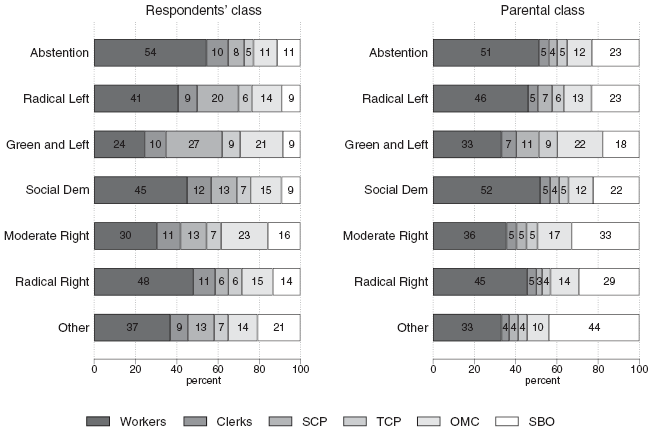
First, focusing on the composition of the electorates by class of destination (offspring class), it shows that social democratic parties rely to a large extent (45%) on support from production and service workers. The middle-class electoral base of the Social Democrats is also substantial with one-third (35%, the total of SCP, TCP, and OMC), but the green and left-libertarian parties rely much more on middle-class support (total of 57%, vs. 24% from workers), especially from SCP (27%). This relatively large middle-class social democratic support is in line with the changes in the electorate of Social Democracy documented in earlier work (Gingrich and Häusermann Reference Gingrich and Häusermann2015) and discussed in the introduction of this volume. Compared to the other party families, the Social Democrats rely more on working-class support than moderate right parties, or radical left parties. However, we see an even greater weight of workers’ support among the radical right and abstention categories (close to, or over 50%).
Second, we ask to what extent the support base of the Social Democrats stems from voters with working-class backgrounds in the parental class. When we contrast the foregoing figures with the composition of the electorate by class of origin rather than class of destination, 52 per cent of social democratic party support stems from offspring from workers (mainly production workers). Compared to other categories, the proportion of the social democratic electorate coming from a working-class background is similar to that of abstention, and larger than the one of the Radical Right. Radical left and green and left-libertarian parties also rely on substantial support from offspring from workers (respectively, 46% and 33%), but less so than the Social Democrats. Especially the green and left-libertarian parties have a relatively larger support base from middle-class offspring than the Social Democrats (42% compared to 21%).
Taken together, one of the most important conclusions is that social democratic parties draw over-proportionally on support from the offspring of the working class. By comparison, in their electoral base by class of destination, the support base among workers is lower, and among the middle class is higher. By class of destination, workers form a larger part of the support base of the Radical Right (or abstention). These differences can be attributed to compositional effects: due to the transformations of the occupational structure, class sizes differ in the parental and offspring class, which account for the differences in the composition of the electorate by class of origin compared to class of destination. This is most clearly illustrated by the large fraction of offspring of workers across all parties, compared to that by class of destination.
Put simply: many contemporary middle-class voters have a working-class background, which explains differences in the class base of parties between the two analyses. Class–party realignments and intergenerational social mobility thus go together in explaining change in the class base of parties in general, but the Social Democrats in particular. For the Social Democrats, middle-class voters currently comprise one-third of their electorate. The fraction of the electorate with a middle-class background is only likely to increase in the future, as the offspring of these middle-class voters are more likely to hold middle-class than working-class positions. What does that mean for the support for the Social Democrats in the long run? Are they able to retain the support of middle-class voters without the ‘legacy’ of the working class? We will focus on this question in the multivariate analyses.
Next, we present results of our regression analyses predicting party family support by class of destination and class of origin, respectively net of each other, with added control variables. In Figure 4.2, AMEs of support (reference: OMC) for the five party families of interest are displayed for our categories of social class of origin and destination. First, focusing on class of destination (respondent’s class), the results indicate some patterns of class voting documented by earlier research, showing that social class is associated with support for different party families. However, not all classes differ in support for the five party families of interest. Regarding the social democratic party family, workers, SCP, and TCP show similarly higher support levels than the OMC. Concerning green and left-libertarian parties, the new middle classes – particularly the SCP – show higher levels of support, while the working classes show much lower support than the OMC. This is the exact opposite pattern of what we observe for the Radical Right: relatively higher support from workers and lower support from the SCP. Support for the Moderate Right also shows a clear class pattern: the highest support comes from the OMC, as all other class categories show lower support levels.
AMEs of respondents and parental class on support for party families (reference category: OMC)
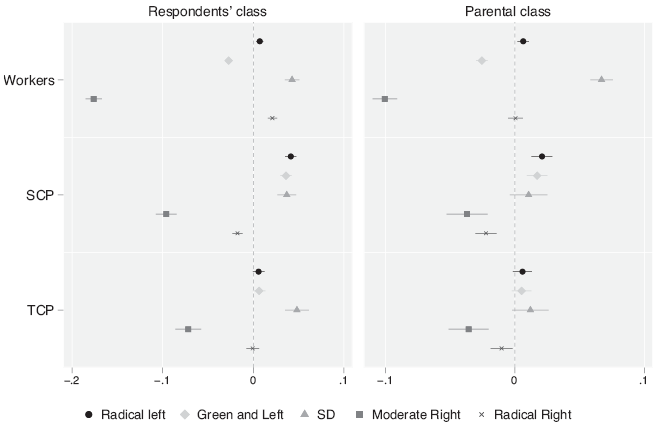
Second, when comparing support levels by class of destination with those by class of origin, some interesting differences and similarities in social democratic support become apparent, while support for other party families does not show many noticeable differences. Levels of social democratic support are quite similar across class of origin and destination when it comes to working-class voters and voters with working-class roots. However, social democratic support from offspring from SCP is not different from offspring from OMC, while the difference with working-class offspring is quite large. On the other hand, offspring of SCP and current SCP show similarly high support for green and left-libertarian parties. Offspring of SCP are also relatively more likely to support the Radical Left, a party family with a typically strong economically left-wing agenda – even to a greater extent than the offspring of workers. Given the trend of occupational upgrading, these findings may point at the fact that the relatively high social democratic support among contemporary SCP is mainly a legacy of their working-class background – and will decrease in next generations. Patterns of socialization in the SCP parental class of origin seem, however, to be related to left-wing support, but rather for green and left-libertarian and radical left alternatives. We take up the question of the SCP legacy further in Section 4.4.2, after we focus on differences in the effect of class of origin across regions and between generations of respondents.
In Figure 4.3, we present the AMEs of class of origin separately for the three regions of Western Europe. Northwestern Europe is the largest group of countries in our sample and therefore displays lower standard errors than the other two regions. The patterns across the three regions are relatively similar and mirror largely those from Figure 4.2, but there are some relevant differences. First, as expected, in Northwestern Europe we observe a relatively strong legacy of socialization in a working-class environment for left-wing support, particularly the Social Democrats. In the other two regions, we observe this as well, but the contrasts with an OMC background are smaller. Second, like concluded from Figure 4.2, having SCP roots does not have a similar effect as having working-class roots does (they do not show different levels of social democratic support than those with OMC roots, across all regions). However, in Northwestern Europe, socialization in the SCP does predict higher green and left-libertarian support, compared to socialization in the OMC. The fact that this difference is not present in the other two regions demonstrates the earlier transformation to post-industrial class–party realignments in Northwestern Europe, which is the reason why subsequent analyses focus on this region only.
AMEs of parental class (reference category: OMC) on support for party families, across geographical regions
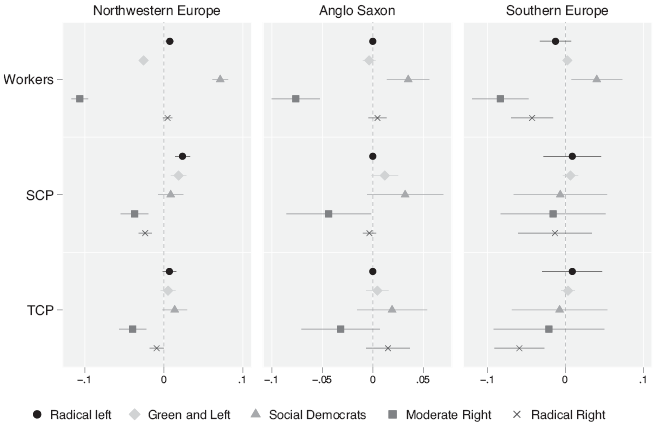
The results presented in Figures 4.2 and 4.3 suggest that parental class of origin generates a legacy in party leaning that persists over time and continues to influence offspring’s electoral behaviour, even net of respondents’ own class location. Moreover, some of the differences in the impact of parental class of origin and respondents’ class seem to indicate that current class–party alignments differ from those prevalent in the past. This is to be expected given the fast pace of post-industrial realignment. As different studies have manifested, the core electorates of left-wing parties have substantially changed over the past few decades (Gingrich and Häusermann Reference Gingrich and Häusermann2015; Benedetto et al. Reference Benedetto, Hix and Mastrorocco2020), and what were once their natural electoral preserve – workers – are now increasingly contested by radical right parties (Oesch and Rennwald Reference Oesch and Rennwald2018). This changing alignment between social class and parties could also affect the socialization into a specific partisan leaning. To illustrate this with an example, the kind of working-class left-wing legacy that was built in the 1960s – and the impact of socialization into this milieu – might take on very different nature in the early 2000s, as workers have increasingly realigned with the Radical Right. To explore this possibility, we disaggregate the effect of parental class of origin by different generations: from silent generation respondents to millennials.
Figure 4.4 presents AMEs of parental class of origin on support for different party families by generations. All coefficients indicate deviations from the reference category, offspring from the OMC. This figure presents some varying patterns of how the impact of class of origin differs across generations, which are exemplary for trends of realignment in which the class base of particularly parties on the left has changed. Focusing on parties in the left field and their core electorates, we observe that among voters from the silent generation there is a clear social democratic working-class legacy. Voters with working-class origins are almost 10 per cent more likely to vote for this party family than OMC offspring, while a similar impact is not visible for SCP offspring. On the contrary, the latter appear less likely to vote social democratic than voters with OMC roots. At the same time, a weak left-wing legacy in terms of support for radical left or green and left-libertarian parties is apparent for the offspring of SCP already in the silent generation.
AMEs of parental class (reference category: OMC) on support for party families, across generations, for Northwestern Europe
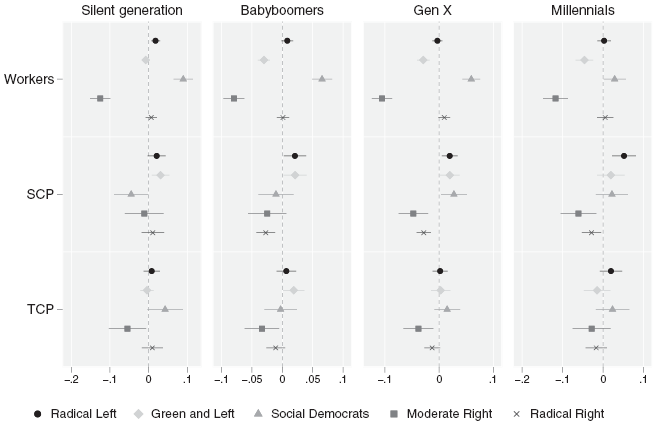
The picture, however, is quite different if we focus on gen X or millennial respondents, for whom patterns of class–party realignment are reflected in the impact of class of origin of new strongholds of the Left. In these younger generations, we find evidence for a left-wing legacy among the offspring of SCP, for all three party families in the left field. This points at offspring of SCPs having been socialized into generalized support for left-wing parties, from the Radical Left and the Green Left, to the Social Democrats. For millennials, some of these differences are not statistically significant, but this could be partly attributed to the lower frequency of observations in this generation. The fact that SCP offspring is not only more supportive of the New Left but also of the Radical Left compared to OMC offspring, displays a trend of increasing support for the Left in general, with a corresponding decline in support for the Moderate Right. This marks an increasing distinction of socialization in the OMC compared to the new middle class, the SCP. As some of the left-wing legacy becomes stronger for the offspring of SCP as we move to younger generations, we observe a parallel decline in these allegiances among workers’ offspring. In fact, among millennials, offspring of workers are as likely to vote social democratic as offspring of SCP. Interestingly, among the children of workers, we observe an increasing contrast in the lower likelihood to support green and left-libertarian parties in comparison to the offspring of the OMC.
While the left-wing impact of having a working-class origin appears to have diminished for younger generations, we do not observe a parallel increase in favour of a radical-right legacy. Moreover, the lower probability of voting for the Moderate Right among workers’ offspring (in comparison to the OMC) appears quite stable over generations. Hence, it appears that working-class origins have somewhat ‘de-aligned’ from the Left, but there has not been a parallel ‘realignment’ in support for the Right. Among SCP offspring, we do, however, find evidence of left-wing realignment, because, as explained earlier, support for the left field is higher among younger generations with this background. Among the offspring of TCP, we find little evidence of changing alignments. Their electoral preferences resemble those of the OMC across all generations.
Focusing on long-term legacies of left-wing support, these analyses clearly highlight that the kind of social democratic legacies apparent for the offspring of workers in older generations are not replicated for any other classes or generations. While SCP could be building a new left-wing legacy among its offspring (rather for green and left-libertarian and radical left alternatives), this is in no way comparable to the strong parental effects visible for silent generation respondents with working-class roots. This speaks to a certain unique imprint of having a working-class origin among older generations that is not replicated in current realigned patterns of class-party linkages.
4.4.2 Party Family Support by Patterns of Intergenerational Social Mobility
Previous analyses have shown relevant differences in party support across parental class of origin and respondents’ own class of destination but did not consider these two in conjunction with each other. Therefore, we now model specific combinations of class of origin and destination. To more precisely investigate to what extent the left-wing support of current SCP is contingent on their working-class background and explore whether a new model of SCP support is sustainable in the long run, we estimate regression models by different patterns of intergenerational social mobility. For the purpose of our analysis, we specifically focus on transitions into and out of the SCP class. In Figure 4.5, we present results for the former. The graphs display predicted levels of party family support.
Average predicted levels of support for party families by patterns of intergenerational mobility for Northwestern Europe (focus: into SCP)
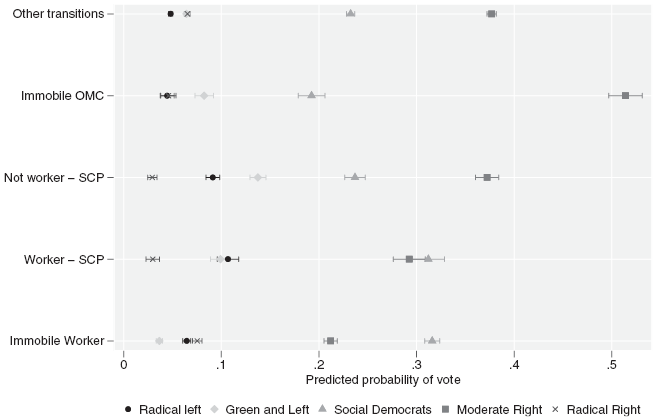
When comparing the social democratic support from SCP with and without a working-class background, it shows that SCP with working-class origins are not only more likely to support the Social Democrats, they also show a lower likelihood of voting for the Moderate Right. Hence, a working-class background is associated to a more distinct left-wing allegiance. Only immobile workers are less likely to support the Moderate Right compared to SCP with working-class roots – showing a certain pattern of so-called acculturation to the SCP class of destination (de Graaf et al. Reference De Graaf, Nieuwbeerta and Heath1995). Interestingly, SCP with a working-class background and intergenerationally immobile workers show similar levels of social democratic party support. In what concerns other types of left-wing allegiances, a working-class background aligns SCP more with radical left parties, and less so with green and left-libertarian parties. Hence, this working-class legacy appears more strongly related to party families pertaining to the left bloc on the economic dimension (rather than on the societal dimension).
When considering the different categories from the immobile OMC to the immobile workers, each category shows a decreasing level of support for the Moderate Right, and increasing support for the Social Democrats. While among immobile workers support for the Social Democrats is higher than support for the Moderate Right, this pattern is reversed for SCP with a non-working-class origin. Processes of adaptation to the class of destination for SCP mean that the Moderate Right is a direct competitor from the Social Democrats in the support from this class. In the long run, these results may point at decreasing social democratic support in the future, when the legacy of a parental working class is reduced over time by patterns of occupational upgrading. Other left-wing parties and the Moderate Right, on the other hand, hold relatively higher levels of support from SCP without working-class roots, a class that is likely to become larger over time.
In Figure 4.6, we explore the potential legacy of the SCP – the class displaying among the highest levels of social democratic and other left-wing party support – towards the next generation, by asking how being socialized in this class predicts levels of party support. To approximate what future patterns of intergenerational transmission of preferences might entail, we reduce the sample to the two youngest generations in the sample (Gen X and Millennials). These results need to be interpreted as a tentative answer to our question, since relatively few individuals have been socialized in the SCP (class of origin), compared to the current size of this class (as class of destination), and therefore the size of the sample is reduced (which also explains the larger confidence intervals). The findings indicate that those socialized in the SCP that moved to a different middle-class position (OMC) – a common transition of intergenerational social mobility in the post-industrial era – are not very likely to support the Social Democrats, displaying similar levels of social democratic support as the immobile OMC, and lower than the immobile SCP. These findings, together with the high support for the Moderate Right, mainly point at a process of acculturation to the class of destination.
Average predicted levels of support for party families by patterns of intergenerational mobility among Gen X or Millennial respondents for Northwestern Europe (focus: out of SCP)
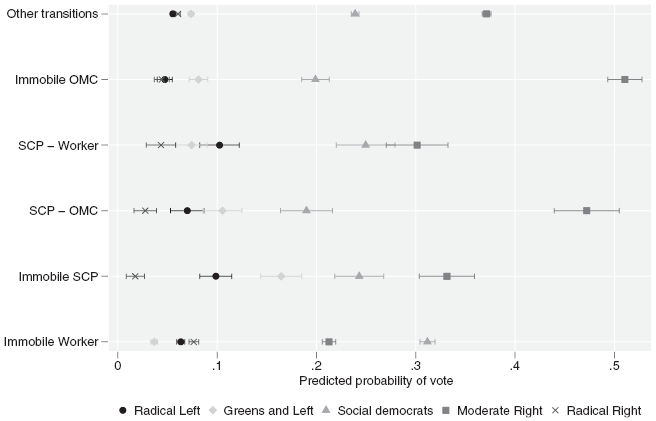
If we focus on other parties within the left-wing bloc, we see some indications of a slightly stronger left-wing legacy among SCPs offspring, but not to the extent of the left-wing alignment we observe among intergenerationally immobile SCPs. The immobile SCPs display highest support levels of all classes for the green and left-libertarian parties and the Radical Left. The probability to vote for these parties is lower for SCP-origin voters in the OMC but remains slightly larger than those displayed by the intergenerationally immobile OMC. We observe similar patterns among workers with SCP roots: they show higher green and left-libertarian and radical left support than immobile workers. These results are an indication of modest SCP-origin socialization effects, when offspring holds a different class. If being socialized in the SCP has any left-leaning legacy, it seems like its allegiance lies more with the Radical Left and green and left-libertarian parties, than with the Social Democrats.
Taken together, these findings indicate that, as the offspring of workers are likely to become less numerous over time, the same goes for the legacy of this class in retaining social democratic (and other left-wing party) support, predicting likely lower levels of social democratic support among future generations.
4.5 Discussion
In this chapter, we set out to study the extent to which different parties, particularly within the left, are successful in mobilizing the offspring of key social class electorates. The interest in parental class of origin and intergenerational class mobility stems from the recent transformations in the social structure and the importance of early political socialization in the family environment. The two lead us to expect that current patterns of class–party alignments are, in part, grounded on a legacy of socialization in an older class structure.
While several studies have documented, separately, a process of occupational upskilling and increasing support for the left among the middle classes, none of them have addressed whether this left-wing turn among professionals is dependent on them having been socialized in the working class in the context of their families. Our analyses suggest that this is, to a large extent, the case in Western democracies. The parental class of origin appears to exert a lasting impact on party preferences beyond individuals’ own class trajectories. Our analyses suggest that, indeed, many professionals have their roots in the working class and that social democratic parties draw their vote over-proportionally from the offspring of the working class.
Analyses predicting the impact of parental class of origin on left-wing party vote (net of respondents’ own class of destination) indicate that workers’ offspring are more likely to vote for the Social Democrats, while those with SCP roots are more likely to support other left-wing parties. While results are relatively similar across regions in Western Europe, we observe this pattern most strongly in Northwestern Europe, countries with early shifts to post-industrialization and corresponding class–party alignments. The comparison of class of origin and destination effects returned another interesting finding: while SCP are as likely as workers to vote for the Social Democrats when considering class of destination, this pattern is not replicated by parental class of origin. Hence, in terms of the ‘legacy’ that left-wing parties are able to mobilize, Social Democrats are able to ‘retain’ the vote from offspring from workers, while the alternative left is more successful in retaining those with SCP roots.
By disaggregating analyses by generations, we sought to approximate what post-industrial class–party realignments entail for the intergenerational transmission of party allegiances. This also allowed us to look into the future and identify the kind of intergenerational legacies that are being built in the present. Generational differences in how parental class of origin relates to political preferences tell a story of progressive dealignment of working-class origins from the Left, while a comparable realignment is not apparent among the offspring of the SCPs – at least in what concerns the strength of this association. The analyses return a particularly strong social democratic legacy for workers’ children in older generations, that is not replicated for other parties of the Left among younger respondents. Moreover, this working-class legacy appears rather related to parties categorized as left-wing on the economic dimension, but not necessarily for socio-culturally liberal parties (like the green and left-libertarian parties). Offspring from SCP, on the other hand, do display relatively higher support for green and left-libertarian and radical left parties. This new left legacy in the SCP parental class is apparent in Northwestern Europe but not replicated in Anglo-Saxon or Southern European democracies. This could be due to post-industrial realignment taking place later in these countries but also to the lower success of challenger left-wing parties in the majoritarian systems that characterize the Anglo-Saxon systems.
Further disaggregating party choice by specific intergenerational class trajectories indicated that support for the Social Democrats is more likely among SCPs with working-class roots, to a level that is similar to that of immobile workers. However, these support levels decrease substantively among these professionals when they have a different class of origin. These analyses provide further evidence for the conclusion that other left-wing parties seem better positioned to mobilize the SCP offspring than the Social Democrats.
Overall, our analyses indicate that early socialization in a social class and specific intergenerational class trajectories are associated with different patterns of electoral behaviour, and that this has varied with class–party realignment. In what concerns support for left-wing parties, the upskilling of the electorate can have important implications for parties’ strategies. Social democratic parties appear equally successful in mobilizing workers and SCPs in the class of destination, but, as the different analyses suggest, this is to a large extent grounded on the working-class origins of SCP. SCPs with different classes of origin are less likely to vote social democratic. Hence, the analyses return a picture of strong industrial legacy, particularly among the older generations.
What do these patterns entail for the future of the Left? First, there are clear signs that the type of intergenerational left-wing attachment present for respondents with working-class origins in older generations is not replicated for the offspring of SCP, nor for workers in younger generations. This would suggest higher levels of electoral volatility. Second, while current SCPs are relatively likely to vote for all left-wing parties – social democratic, green and left-libertarian or radical left, the ‘legacy’ they are likely to build for those socialized in this class is rather in favour of the latter alternatives, not the Social Democrats. It is important to emphasize that this left-wing attachment also includes radical left parties and hence is not exclusively related to socio-culturally left-wing issues. Third, our last analyses zooming in social mobility patterns among younger generations allowed us to identify that while immobile SCP display such left-wing legacy, this is much weaker among respondents socialized in the SCP parental class who moved into an OMC occupation. In sum, the SCP legacy – in favour of green and left-libertarian and radical left parties – is weaker than the one found for working-class offspring, and it is dependent on individuals remaining intergenerationally immobile in the SCP (and dilutes if they move to the OMC). All in all, this suggests a future of weaker (realigned) patterns of lasting socialization in classes of origin.
5.1 Introduction
Originating from one of the key cleavages of political contestation (Rokkan Reference Rokkan1970), Social Democrats have been at the heart and center of politics in Western Europe and so has their voter appeal and base. Yet their place at the center of voters’ minds changed fundamentally with many social democratic parties losing large vote shares at least since the early 2000s for various reasons.Footnote 1
From this perspective, an enormous amount of research has been created analyzing how party competition in general, elite responses to public opinion shifts, coalition formation processes, and more exogenous events such as climate change have minimized the electoral appeal of social democratic parties. Overall, thus, we have a quite rich understanding about the factors contributing to the decline of Social Democracy – be they cultural or economic. Interestingly, though, we still lack an answer to one of the key questions implicitly standing behind all these research questions: With which parties did former social democrats end up with? Put differently: Where are all the social democrats today?
While empirically few answers have been given, scholarly and journalistic work is rich in allegations. The most common public narrative is that former social democrats first got dealigned from the party and in the next step defected to the Radical Right. Social Democrats themselves have also been taken in by many of these perspectives when their party leaders suggest that listening to some specific voter segment – be they the left behind, the unemployed, the rural regions, or the cosmopolitans – will eventually enhance their electoral fortunes.
Many of these allegations are not based upon theoretically founded scholarly work (for more on this, also see Chapter 3) but appear to be rather ad hoc post-theorizing of Social Democrats’ losses. In essence, two perspectives exist on what has happened to social democratic support. These perspectives have in common that they build on a key empirical observation about Social Democracy: The idea that the classical working-class voter we have in mind when talking about social democratic voters no longer exist (Betz Reference Betz1994; de Lange Reference De Lange2007; Gingrich and Häusermann Reference Gingrich and Häusermann2015; Kurer Reference Kurer2020). This in turn provided a challenge for Social Democrats, their leaders and programmatic appeals; namely, the challenge to provide a unified programmatic offer for an ever more heterogeneous voter base. This challenge is then understood as the key cause leading to decline of Social Democracy.
The first perspective then suggests that due to Social Democrats’ programmatic appeals becoming ever more liberal on the second, societal dimension, Social Democrats have lost their base within the remaining working class. These working-class voters were then eventually picked up by the Radical Right – also because of their welfare chauvinist offers. This argument has become an often recited “fact” by both the media and Social Democrats themselves.
The second perspective, admittedly far less prominent, is that Social Democrats lost voters to abstention – fairly independent of their programmatic appeals (Schäfer and Streeck Reference Schäfer and Streeck2013; Evans and Tilley Reference Evans and Tilley2017; Schäfer and Zürn Reference Schäfer and Zürn2021). Building on theoretical arguments on dealignment (Dalton et al. Reference Dalton, Flanagan and Allen Beck1984; Dalton and Wattenberg Reference Dalton and Wattenberg2000), the mechanism standing behind this hypothesis is that social democrats simply got dealigned from their party and either never realigned or moved on to various parties.
In this chapter, we seek to speak to this debate by introducing – to the best of our knowledge – for the first time valid empirical evidence to this debate by relying on long-run individual-level panel data. We study the individual-level voting flows of the Social Democrats’ core voters using panel data from Germany (1983–2018), the United Kingdom (1990–2018), and Switzerland (1999–2018). In a first step, we identify the original voters of Social Democrats in all three countries and descriptively follow their voting transitions until today. In a second step, we estimate regressions correlating switching away from social democratic parties with individual-level factors heavily discussed in the literature to be responsible for social democratic voters’ decisions at the ballot box.
In contrast to the public narrative, we find little support that social democrats are defecting to one particular party. Our findings indicate that Social Democrats lose their voters in all directions, but that most former social democrats appear to be the demobilized voters of today. If anything, social democrats in all three countries flowed to progressive options – the Greens in Germany, the Liberal Democrats in the UK, and the Green Liberal Party in Switzerland. Even more worrisome: In all three countries, the Social Democrats struggle to attract “new voters.” This pattern is strongest for the German SPD: The SPD loses its core without finding means to attract “new voters.” In line with these descriptive trends, we show in our regression models that Social Democrats struggle to attract younger voter cohorts of the generations born after 1970 – generations X, Y, and Z. Social Democrats live from the old and die from the young. By contrast, often discussed factors such as occupation, education, or unemployment have much smaller effects on leaving or staying with Social Democrats.
5.2 Where Are All the Social Democrats: Mechanisms behind the Decline
A fundamental mechanism in work on party behavior is the idea that through their programmatic offers – but also through personal and other means – political parties can attract voters (Downs Reference Downs1957a; Strøm Reference Strøm1990; Müller and Strøm Reference Müller and Strøm1999). Most prominently, Downs (Reference Downs1957a) introduced political science to the idea that much like product offers in an economy, political offer via ideological positions is the key means to attract voters (customers). The idea standing behind such arguments is simple: Parties provide a program and voters decide which programmatic offer fits their interests best.
Building on this original work, a rich body of research investigates how parties’ programmatic offer relates to voters (for an overview: Adams Reference Adams2012). Leaving methodological challenges and questions of cause and effect aside, this research finds that in many ways political parties are mostly in an equilibrium with their voters (Adams et al. Reference Adams, Clark, Ezrow and Glasgow2004); and if they are not, parties eventually seem to adapt to the interest of the masses (Adams et al. Reference Adams, Haupt and Stoll2009; Bischof and Wagner Reference Bischof and Wagner2020; for a contrary finding, see O’Grady and Abou-Chadi Reference O’Grady and Abou-Chadi2019).
In the case of Social Democrats, however, pundits and scholars emphasize that the strong ties between their voters, programmatic appeals, and leaders have been seriously damaged in the last thirty years. Social Democrats have been facing a long-running electoral crisis: Starting in the 1980s, their slow but steady decline started (Przeworski and Sprague Reference Przeworski and Sprague1986; Kitschelt Reference Kitschelt1994), interrupted by a peak during the late 1990s; the Social Democrats today are no longer the mass parties classical work on party cleavages had in mind when referring to them. Admittedly, the Social Democrats still are at the center of policy making in coalition governments but frequently as junior coalition partners. Even if they win elections – such as the German national elections in 2021 – they tend to be far away from being what once was called a “mass party.”
Current research provides several explanations as to why Social Democrats are losing: the decline (and split) of the working class (Gingrich and Häusermann Reference Gingrich and Häusermann2015; Evans and Tilley Reference Evans and Tilley2017; Kurer Reference Kurer2020), the politics of capitalism more generally (Beramendi et al. Reference Beramendi, Häusermann, Kitschelt, Kriesi, Beramendi, Häusermann, Kitschelt and Kriesi2015), globalization shocks (Kriesi et al. Reference Kriesi, Grande, Lachat, Dolezal, Bornschier and Frey2008; Colantone and Stanig Reference Colantone and Stanig2018a, Reference Colantone and Stanig2018b), “backlash” to market liberal politics (Schwander and Manow Reference Schwander and Manow2017), more general patterns of de and realignment to new competitors (Koelble Reference Koelble1991; Kitschelt Reference Kitschelt1994; Gidron Reference Gidron2022), and programmatic adaptation to new competitors (Hjorth and Larsen 2022; Krause et al. Reference Krause, Cohen and Abou-Chadi2020).
Interestingly, existing scholarly work leaves one important question aside: Where are all the former social democrats today? In our reading of the literature, the answer to this question lies at the heart of the entire research agenda on the decline of Social Democrats. The few exceptions that address that question rely on data – mostly cross-sectional data – and methods that make it hard to learn about the voting history of former social democrats. Much like Chapter 3, current research relies on voting recall questions (Karreth et al. Reference Karreth, Polk and Allen2013; Krause et al. Reference Krause, Cohen and Abou-Chadi2020, Cohen et al. Reference Cohen, Krause and Abou-Chadi2023). By nature, such data only allows us to learn about the short-term voter flows between two elections, but the question at hand seems particularly interesting from a long-term perspective. Some scholarly work even relies on geographical clustered data – such as election results on the district (Schwander and Manow Reference Schwander and Manow2017) or national level (Benedetto et al. Reference Benedetto, Hix and Mastrorocco2020) – and draws conclusion about transitions. Such approaches are prone to ecological fallacies and cannot feasibly make claims about voter transitions.
5.3 Where Are All the Social Democrats: Theoretical Perspectives
Theoretically, answering this question is fundamental to draw conclusions on how Social Democrats can deal with their decline. After all we need to know with which parties former social democrats ended up with in order to understand how Social Democracy can return to the electoral center of politics.
The decline of Social Democracy was already foreshadowed in classical work by Przeworski and Sprague (Reference Przeworski and Sprague1986) and Kitschelt (Reference Kitschelt1994). Most prominently Kitschelt emphasized the increasingly heterogeneous social and economic backgrounds of the former working class (Kitschelt Reference Kitschelt1994: 23–27). This in turn – but also other factors such as generational change – he argued, should lead to an increasing polarization of political preferences, in particular to the raise of a second dimension of political conflict – what we here call the societal dimension.
The most significant change coming along with the societal dimension are new challengers: All across Western Europe, green and left-libertarian and new radical right parties emerged. In addition, some Social Democrats face challenges from left-wing competitors on the economic dimension as well – for example, the German SPD is confronted with the Linke. Furthermore, all Social Democrats are affected by patterns of dealignment (Dalton et al. Reference Dalton, Flanagan and Allen Beck1984; Dalton and Wattenberg Reference Dalton and Wattenberg2000), which means that fewer and fewer core voters still reliably support the Social Democrats. The traditional class cleavage, on which their core voting potential has historically been based upon, no longer exists and has undergone profound reconfiguration.
A first theoretical perspective in line with the public narrative is the idea of a detour effect to the Radical Right. As it seems unlikely that social democrats directly flock toward the Radical Right – because that would mean jumping from the left block all the way directly to the extreme right – this narrative starts from the idea that in the first stage, voters become dealigned from Social Democrats. The mechanism standing behind such a dealignment can be multifaceted; voters might no longer sense representation by Social Democracy as the arguments suggest in Kitschelt (Reference Kitschelt1994). In the second step, these former social democrats are understood to still hold traditional working-class values, with a preference for strong welfare states and redistribution at its core. Given that most Social DemocratsFootnote 2 no longer offer such traditional programs, these voters are searching for a new party representing these values. They are then understood to eventually find representation of their values in radical right parties with their welfare chauvinist positions.
However, this narrative leaves at least two key theoretical aspects untouched and both speak against the detour effect. First, they tend to ignore the societal dimension of political conflict. This is crucial as it seems rather unlikely that traditional social democrats are attracted in large numbers by xenophobic and homophobic rhetoric; quite on the contrary, it seems more likely that such positions are a major reason core social democrats refuse to vote for the Radial Right. Second and related, the values of modern-day working class might be much more progressive on the societal dimension than the narrative suggests. As predicted by Kitschelt (Reference Kitschelt1994) today’s working class have heterogeneous preferences. On top of that, many workers themselves have a migration background within their family or a history of seeking refuge. All of this makes it unlikely that we observe such a detour effect to the Radical Right.
Instead of a detour effect, a direct switch toward other parties is also theoretically plausible. In particular voters with long-lasting preferences for more progressive policies on the societal dimension might be attracted by new challenger parties such as the Greens. Thus, these voters are likely to immediately move on toward the Greens; in particular in the German case where a left alternative was missed by many voters due to party and employment bans of communists (Bischof and Valentim Reference Bischof and Valentim2021).
A second theoretical perspective sticks with the first stage of the detour effect: social democrats abstain from elections and dealign from politics altogether (Schäfer and Streeck Reference Schäfer and Streeck2013; Evans and Tilley Reference Evans and Tilley2017). In ever more unequal societies, it appears rational for specific voter segments to abstain from elections altogether: Politically unaddressed inequality signals to poorer voters that their preferences tend to be neglected while in turn richer voters and their preferences tend to be represented by most party systems (Bartels Reference Bartels2008; Peters and Ensink Reference Peters and Ensink2015). This could then result in decreasing turnout, abstention, and dealignment from politics. It could also predominantly affect traditional social democrats who sense that the third-way politics of most social democratic parties meant a dramatic turn away from their policy preferences; the lack of descriptive and substantive representation of these traditional working-class voters results in their abstention in large numbers.
5.4 Data and Cases
To learn about the long-term transitions of social democratic voting, we need to observe the same individuals for a long time period. Previous research has not relied on long-term panel data. We do so by relying on socioeconomic panels from Germany, the United Kingdom, and Switzerland. Given the interest of the panels – mainly economic – using this data has some drawbacks that we will discuss later, but it is the only available source that allows for the investigation of individual voting records in a long-running perspective.
5.4.1 Case Selection
Our case selection is pragmatic; the countries we study are the only ones in Western Europe conducting long-running and large-panel studies. However, we believe that the three countries provide interesting variation to study patterns of social-democratic decline. The German SPD, the British Labour Party, and the Swiss SP provide an excellent snapshot of quite different social democratic party organizations. While all three of them originate from the classical Rokkanian cleavage mobilizing around capital (owner) versus workers, the SP never had the electoral size of its sister parties – which is mostly due to the party and electoral system in Switzerland. However, its importance for policymaking and governing is comparable. All three of them are struggling (in different degrees) to maintain their vote shares and face severe electoral challenges particularly on the second dimension, most notably by green and left-libertarian parties. In the UK and Switzerland, socially liberal and more center-oriented parties add an additional element of electoral competition from the LibDems and the Green-Liberal party, respectively. Also in all three countries, there has emerged a notable competitor on the Radical Right, which allows to empirically examine the relevance of the often-claimed alleged voter transitions from Left to (Radical) Right. Finally, different institutional setups and distinct programmatic profiles in the three countries under consideration allow us to some extent to assess which voter transitions from social democratic parties to competitors are conditional on the electoral system and the specific ideological orientation of the party.
5.4.2 The Panel Data, Our Coding Decisions
The analyses in this chapter will focus on description only. What we first want to understand are the individual voting trajectories across time as such. In a second step, we then correlate these long-term voting trajectories with key individual-level characteristics believed to be relevant for social democrats’ voting decisions in the last forty years. Our study is based on three high-quality individual-level panels that maximize representation of the general population at the national level. Table 5.1 gives an overview of the panels we included, the time span we analyze, and the number of social democrats included in our analysis.
| Country | Panel | Time span | Obs. total | Original SD votes | Unique SD IDs |
|---|---|---|---|---|---|
| Germany | German Socio-Economic Panel (GSOEP) v35 | 1984–2018 | 689,005 | 116,327 | 9,617 |
| United Kingdom | British Household Panel Survey (BHPS) | 1990–2008 | 238,996 | 73,016 | 7,382 |
| Understanding Society (UKHLS) Study 6614 | 2009–2018 | 75,439 | |||
| Switzerland | Swiss Household Panel (SHP) Wave 20 | 1999–2018 | 156,516 | 29,642 | 3,273 |
The number of respondents we analyze varies across cases, but it is sufficiently large across all three countries as can be seen in the last column of Table 5.1. In the UK, we essentially rely on two panels – the British Household Panel Survey (BHPS) and the Understanding Society: the UK Household Longitudinal Survey (UKHLS) (University of Essex 2023). The UKHLS continues the data collection efforts of the BHPS in most regards, and we made sure to only include respondents in the UKHLS which were already part of the BHPS’ original data collection efforts. In Germany, we rely on the German Socio-Economic Panel (SOEP) and in Switzerland on the Swiss Household Panel (SHP) (Voorpostel et al. Reference Voorpostel, Tillmann, Lebert, Kuhn, Lipps, Ryser, Antal, Monsch, Dasoki, Klaas and Wernli2020).
To conduct our analyses, we need a consistent definition of social democratic “core” voters across time and space. We decided to use a conservative strategy and define a social democratic voter as one who repeatedly votes for the Social Democrats. In all three countries, thus, we use the survey years falling into the first election cycle and define social democratic voters as those who report to vote for the Social Democrats twice in this first election cycle.Footnote 3 We then use this sample of respondents and follow their trajectory across all election years contained in each panel. We worked with different definitions not reported in this chapter and can confirm that the major patterns presented later do not hinge on our specific coding decision.
Beyond the broader trends across time, we also seek to understand the lifetime cycle of all voters. To do so, we report the first and their last voting behavior recorded for all of our panelists. We are fully aware that this is a tremendous simplification of individual voting habits as it ignores any within changes throughout a respondents’ life. Yet, it pictures the beginning and end of voting for parties in a very effective way.Footnote 4
While the three panels allow us to understand voting trajectories across a long-time span for a rich number of respondents, it also comes with important limitations. First, not all panel studies report voting across the entire study period. The GSOEP only does so in 2018 and 2014. Instead, we have to rely on a question that is more related to party identification than voting; respondents are asked to name “the party they support” – which is best understood as a mixture of survey questions on voting and party identification. However and importantly, in the case of the social democrats in Germany, they are heavily correlated. In 2014 and 2018, 85% of respondents with a SPD party identification report to have voted for the SPD. Thus, clearly the measure comes with measurement error but given the strong correlation with voting, we are reasonably certain that the cross-time patterns are sufficiently approximated. Also, the patterns we uncover for the SPD using party identification align very much to the patterns we find when looking into reported voting in 2014 and 2018 only. In contrast to the German panel data, BHPS and SHP report voting and, thus, we rely on standard voting questions for both countries.Footnote 5
Second, while all three panels are sufficiently large for our analyses, eventually all panels end because respondents either drop out or die. Since we want to follow the voting patterns of “original social democrats,” this means that panel attrition makes the number of respondents included across time shrink. To visually address this, we recalculated the percentages for each year such that it sums to 100%. Yet, almost all patterns we outline later seem to be more general trends. Thus, we can be fairly certain that they are not subject to biases due to panel attrition.
5.5 Findings
We start our analysis by looking into the lifetime voting cycles for all respondents included in our panels – more than half a million respondents. For each respondent, we recorded the first and last reported voting behavior. Note that we thus collapse quite different time intervals between two within-subject observations: While for some respondents who participate in the SOEP since the 1980s, we will look at very long-term (non)transitions, for other respondents, the displayed transition only captures a few years. The probability of an out-transition obviously increases with the duration of this interval. By design, the presented flow charts hence represent a weighted average of the varying transition probabilities over time.
Figure 5.1 reports these lifetime transitions for all countries included in our study. What becomes immediately visible across all countries is the similarity in the patterns away from the social democratic parties. The major message is that original social democrats are demobilized. They increasingly abstain from elections. This pattern is strongest in Germany – but the extent of the flow in Germany is to some extent certainly a function of the party identification measure. Nevertheless, the largest amount of British social democrats also abstains from elections. Only in Switzerland is the loss to abstention comparable in size to the number of voters leaving for the Greens.
Transition away from Social Democrats, across entire lifespan
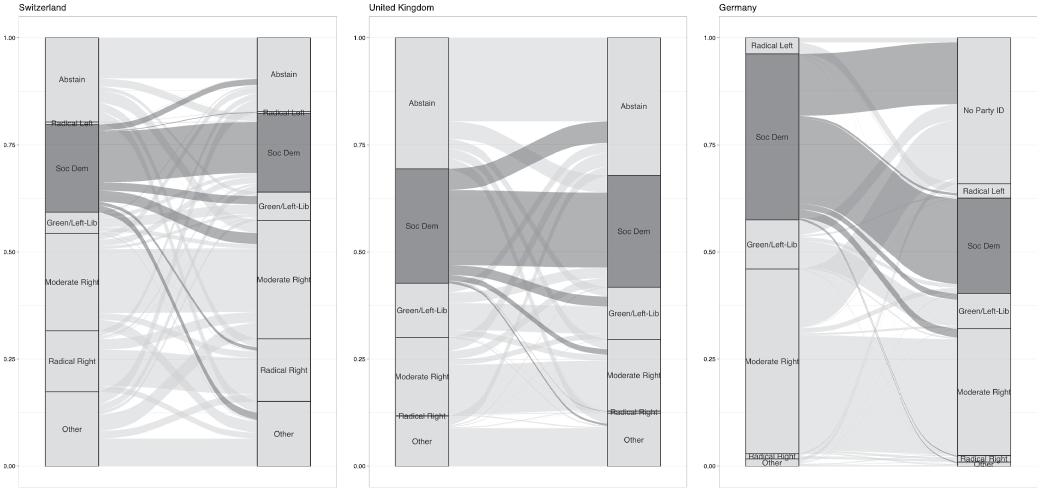
Also in Germany, a sizable number of voters leaves to the Green party. Equally in the UK, social democrats transition to the LibDems, which represent the most important party in the Green/Left-Libertarian camp. Largely due to the electoral system, the Greens have never been a viable option to vote for in the UK under the perspective of strategy voting arguments. Therefore, we read this as a common pattern across all three countries: The most attractive option to defect to are parties that are programmatically progressive on the societal dimension issues. This pattern stands out most in Switzerland where the social democratic core shifts to both the more left-leaning Green party and the socially progressive but economically pro-market Green Liberal party (hence classified into Moderate Right).
Interestingly, both the Swiss SP and the British Labour Party are still successfully keeping and mobilizing considerable amounts of their core voters. Much in contrast, the German SPD struggles to keep its core voters and, perhaps even more importantly, does hardly attract any new voters. This is again different for the British and Swiss Social Democrats, which more successfully mobilize new voters along with attracting voters from all of their competitors. But the transition trajectories for the German SPD are alarming and much in line with its recent electoral decline: The SPD cannot attract new voters and struggles to mobilize its original core.
What becomes evident across all three cases is that the public narrative of original social democrats’ dealignment and realignment into the Radical Right is not supported. Such voters do exist, but they do not exist in large or even decisive numbers. The largest threat from competitors is the progressive option on the societal dimension, in particular green and left-libertarian parties.
How do the Social Democrats handle their complex environments so far? Both Labour and the SP do reasonably well. They manage to mobilize their core, while attracting outsiders. The SP so far stands out as the success story, while the German SPD is lost in transition. It faces severe challenges on both key dimensions of party competition. Thereby it also suffers from its history; the split of the Lafontaine group and the rise of a strong competitor on the first dimension. On the second dimension, the Green party leaves them also with a stronger challenger, which today is on its way to take over the role of the Social Democrats as the second largest party in Germany.
5.5.1 Transitions through Time
The first part of our analyses used a “big brush approach” in which we pooled respondents across time to get a very general understanding of the pattern of voter transitions. The second part takes the temporal dimension more seriously and looks into transitions of all social democrats in our data across each election. For the next set of analyses, we focus on the group of original social democratic voters in the first available wave of each panel data set. We define original core voters as those who have a strong (at least eight out of ten) social democratic party identification in Germany and the UK and those who have voted three times in a row for the Social Democrats in Switzerland (due to missing party ID information). We then plot the voter flows between elections over time. The bars always capture the total number of remaining panel respondents who originally supported the Social Democrats along with their updated party identification or vote intention.
We start the second part of the chapter with the Swiss case (Figure 5.2) because of the particularly large number of effective parties and, hence, potential competitors for the Social Democrats. The Swiss panel started in 1999 with a total of 1,488 respondents who we define as core supporters of the social democratic party. Following this cohort for four years until the next general election, we can see that about a quarter of them abandon the party. The largest share moved to the Green party, which in Switzerland has an almost identical ideological profile but differs somewhat in terms of issue saliency, most notably on environmental issues. A similarly large group of former social democratic voters indicates that they support “other” parties, which in most cases means that they gave their vote to a mixed group of politicians from different parties (“vote for persons, not a party”) rather than submitting the social democratic list to the ballot. Finally, more marginal segments of voters defect in all other directions including a small but nonnegligible group of voters who directly moves to the other end of the ideological spectrum and votes for the radical right Swiss People Party who continued their rapid growth at that time.
Transition away from SP, across elections

Four years later, in 2007, the pattern largely resembles one of the previous election with the Greens capturing a particularly relevant share of former social democratic votes. The year 2011 brought the relevant entry of a new competitor, the Green-Liberals, a more centrist environmental party classified into the Moderate Right camp. This new electoral option has certainly attracted parts of the Social Democratic electorate, but its entry hurt the Green party at least as much as the Social Democrats at that time. The year 2015 represents the consolidation of this pattern with the votes of the social democratic defectors almost evenly split across all the possible competitors. All in all, most former social democrats remained within the left bloc and only about 24% eventually moved on to the right bloc.
Much in contrast to the Swiss SP, both the British Labour Party and the German SPD went through a period of radical programmatic renewal – the Third Way. Both party leaders at the time (late 1990s), Tony Blair and Gerhard Schröder, “modernized” their party mainly on the economic dimension by proposing and adopting liberal market policies. To be fair, at least in the case of Schröder, this period was also marked by a period in government with the Green party and, thus, similar shifts on societal dimension issues – particularly the phase out from nuclear energy. So, these programmatic shifts should potentially also show us a quite different pattern of voting transitions than in the Swiss case. Specifically so, because this period is at the core of the public detour effect narrative.
Yet, what we find first for the UK, shown in Figure 5.3, aligns in most regards with the patterns in the Swiss case. Again, voters get demobilized – but mostly in the first two election cycles (1997 and 2001) we analyze. Interestingly, this is the period during which Tony Blair and his Third Way dominated the party. Thus, it appears that at least to some degree, these policies might have driven voters away from Labour.
Transition away from Labour, across elections
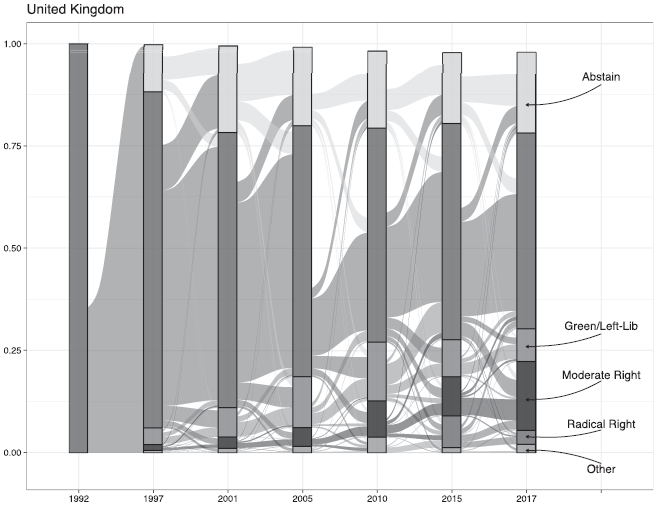
But what is then much alike to the Swiss case is the defection to the “progressive option” – the LibDems, which are the main actor in the Green/Left-Libertarian party family in the UK. Overall, even less voters moved away from the left bloc and joined the Right: All in all about 20% of former Labour voters moved to the Right with only a small fraction eventually voting for UKIP (3–5%).
In our last case, shown in Figure 5.4, we focus on the German case. In the first part of the analyses, we finished with a rather pessimistic view for the German SPD. Yet, the transitions across elections reveal a similar picture. From the beginning of our analysis, the SPD struggles to mobilize its core, and from the beginning their core defects to the Green party. In 1987, the Greens just entered the German parliament one election cycle ago in 1983. They are a young party, often still perceived as a protest party which is incapable to “deliver” policies. But social democratic voters appear to be attracted by this option much from its beginnings but also in considerably smaller numbers than in Switzerland and the UK. This is very interesting as at the time in many ways environmental concerns were perceived as being incompatible with policies for the working class: How to offer environmental policies and at the same time ensure that factories and companies keep running? Yet, in contrast to the former two countries, the SPD’s case seems exemplary for the abstention argument: Supporters leave the party but then also never return to any political party identification. They seem to abstain from politics altogether and in large numbers.
Transition away from the SPD, across elections
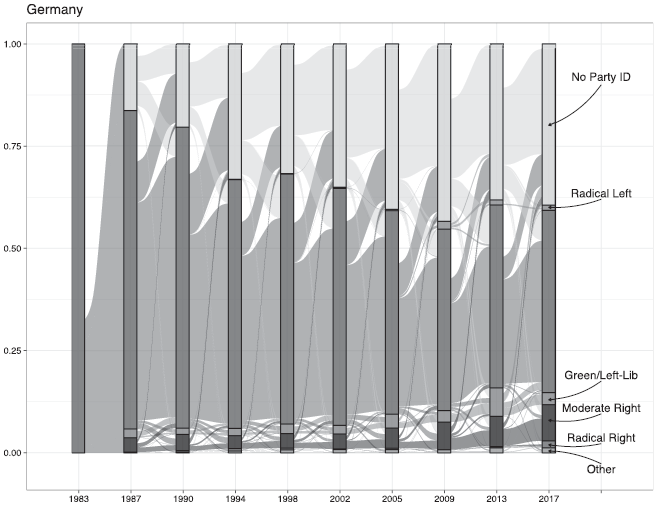
Apart from dealignment and the Green defection, the SPD seems to be spared from competition for its core voters by other parties. Former social democrats do not defect to the Right in large numbers, neither to the Linke. This means that the SPD is incapable in mobilizing its core as well as keeping their core from defecting to the Greens. Yet, there is good news: This means that much like the SP, a more progressive platform on the societal dimension could keep voters from defecting to the Greens while competition on the first dimension – such as welfare chauvinism – might not be relevant to keep voters from defecting to the right and left extremes. But we need to keep in mind that the first analyses showed that the SPD barely has any inflows from other parties. If this pattern persists, it may become difficult to save the SPD from descending into political insignificance.
This becomes drastically clear in Figure 5.5. Here we focus just on the last two German elections and rely on reported voting by respondents instead of party identification. We do this in order to show two things.
The threat of AfD, a new party entry from the right
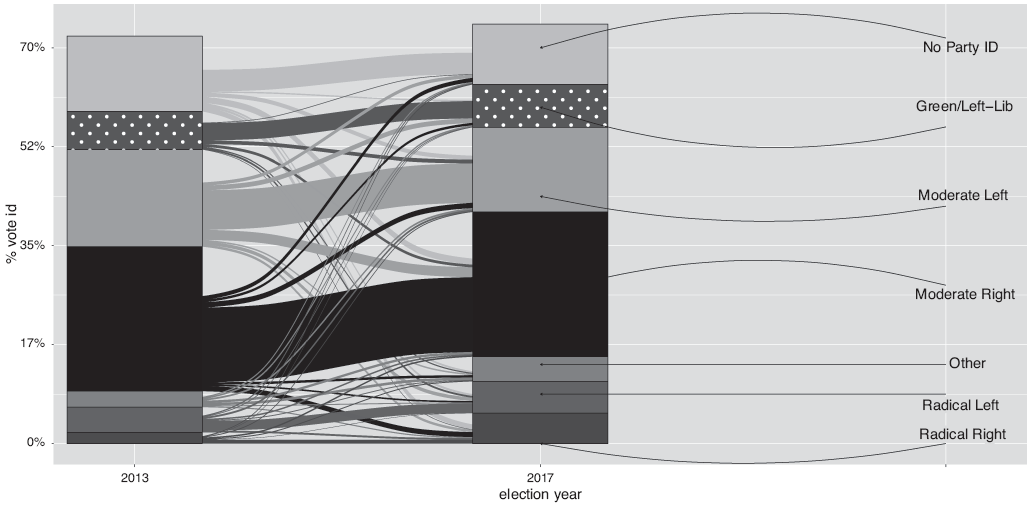
First, that the patterns here align well with the findings discussed earlier based on party identification instead of voting. Second, the radical right party AfD entered the German political arena in 2013 as a mainly Eurosceptic party – but signs of radical right policies became relevant shortly after the 2013 elections. This means that the AfD started to offer the policies that allegedly drove former SPD voters to it in between the two elections. Again, we do not find such a flow to the AfD. The SPD loses more of its 2013 voters to the Christian Democrats, the Greens, the Linke, and abstention. For robustness, we also looked into voter inflows for the AfD to further substantiate that former social democrats did not flock toward the Radical Right in meaningful numbers in Germany. In line with our previous findings, by far the largest inflows are from voters who previously reported not having strong links to any party (figure not shown here for space constraints).Footnote 6
5.5.2 Who Leaves?
In a final step of the analysis, we wish to better understand the abovementioned party transitions by looking into the sociodemographic underpinnings of distinct switching patterns. More specifically, we ask what kind of voters characteristics correlate with the choice of distinct electoral alternatives to the Social Democrats.
The existing work on the social democratic decline suggests various potentially important individual-level factors that may help us understand defection better. We first look at a standard set of socioeconomic and sociodemographic variables which is typically used to explain vote choice: gender, age, education, and income. In addition, we also examine the role of unemployment (e.g., Kurer Reference Kurer2020; Wiertz and Rodon Reference Wiertz and Rodon2021) and union membership (e.g., Karreth et al. Reference Karreth, Polk and Allen2013; Abou-Chadi and Wagner Reference Abou-Chadi and Wagner2019) in supporting social democratic parties.
Given the above-discussed patterns over time and the evident difficulty of social democratic parties to attract new voters, a second important aspect of vote switching may be related to birth cohort. We differentiate between five different birth cohorts ranging from respondents born during WWI to the so-called Generation Y/Z born after.Footnote 7
Finally, perhaps the most frequently investigated factor explaining social democratic support (and the increasing lack thereof) is occupation and class. The well-documented decline of traditional class voting (Kitschelt Reference Kitschelt1994; Oesch and Rennwald Reference Oesch and Rennwald2010; Karreth et al. Reference Karreth, Polk and Allen2013; Rennwald Reference Rennwald2014; Rennwald and Evans Reference Rennwald and Evans2014; Gingrich and Häusermann Reference Gingrich and Häusermann2015) implies that we would expect disproportionate defection among the traditional working-class base. These outflows should be partly compensated by stronger or more enduring support from the new middle class. At the same time, the presence of a strong green or left-libertarian party that also attracts this culturally liberal segment of society is another source of competition (e.g., Rennwald and Evans Reference Rennwald and Evans2014).
In order to examine switching patterns by individual characteristics, we turn to regression models. More specifically we rely on the same sample of respondents discussed earlier – the social democratic core – and then estimate regression models of the following form:
yi,t = β1 currently unemployedi,t + β2 ever unemployedi,t + β3 incomei,t + β4 educationi + β5 union memberi + β6 femalei + β7 agei,t + β8 age cohorti + β9 occupationi,t + αc + εi,t
First, we estimate the correlation of these factors for switchers. We define Yi,t as being ‘1’ whenever a social democrat suggests to have voted for a different party then the Social Democrats. We estimate all regressions using ordinary least squares, cluster our standard errors at the respondent level (i), and use country-level fixed effects (αc) to control away any country-specific differences.
Figure 5.6 reports the findings of the regression model – we rely on a coefficient plot reporting the point estimates of these regressions as markers along with the shaded 90%, 95%, and 99% confidence intervals. All coefficients are standardized such that a direct comparison of the coefficients is possible. It becomes strikingly visible that the fundamental issue of social democratic parties is to attract younger cohorts: Specifically, the generations born after 1981 are flocking away from Social Democracy in larger numbers. By contrast, the “war generations” – being born before the end of World War II – are sticking with Social Democracy. The results discussed later further substantiate that it is the old core that sticks with Social Democracy and the young core leaving Social Democracy behind.
Who switches away from Social Democrats to any other party?
Note: OLS regression models with country fixed effects and standard errors clustered on respondent ID. Variables standardized by dividing by two standard deviations. Cohorts: WWI < 1930; WWII < 1946; boomer < 1965; Gen X < 1981; Gen Y/Z ≥ 1981.
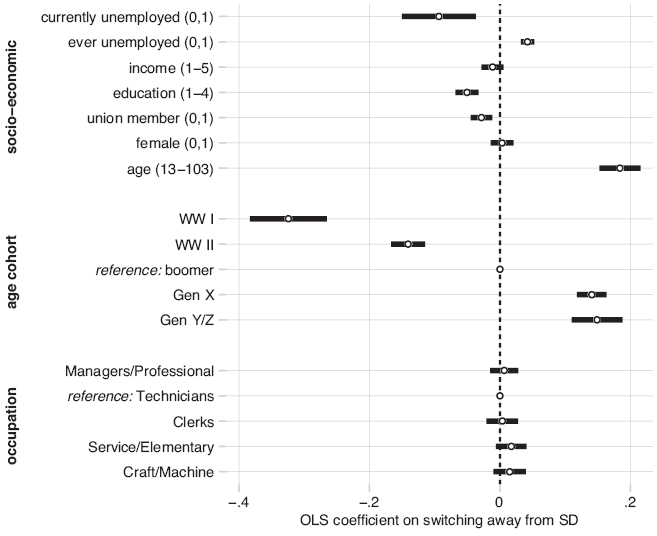
The remaining variables behave as laid out in previous work: Economic hardship tends to drive voters away from Social Democracy, only recent unemployment appears to drive voters toward Social Democrats. But this effect is small and its insecurity is large. By contrast, higher education and union membership keep voters aligned.
But are there differences across party switchers? It is more than likely that the individual factors predict the different vote outcomes differently across parties. To better understand this, we split the voting outcome by party destination in Figure 5.7. Notice that in an effort to ensure readability, the x-axis varies across outcomes, meaning that the size of the coefficients cannot directly be compared across outcomes. One factor remains relevant across all destinations: age cohorts. No matter which new party former social democratic voters choose, the cohort they are born is the major factor correlated with switching away. Thereby, the youngest generations are the ones that are most likely to switch to the fringes. While the generation X seems the one most driven to dealign with party politics altogether.
Who switches to whom?
Note: OLS regression models with country fixed effects and standard errors clustered on respondent ID. Variables standardized by dividing by two standard deviations. Cohorts: WWI < 1930; WWII < 1946; boomer < 1965; Gen X < 1981; Gen Y/Z ≥ 1981.
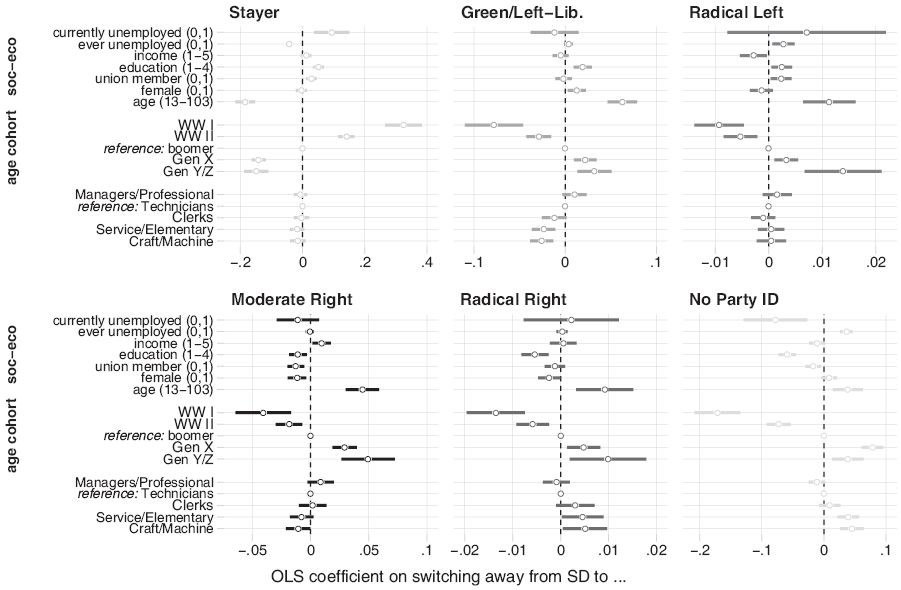
As others have suggested (e.g., Kitschelt Reference Kitschelt1994; Rennwald and Evans Reference Rennwald and Evans2014; Gingrich and Häusermann Reference Gingrich and Häusermann2015), the relevance of occupation varies tremendously across party voting. While manager and professionals stick to the Left, service, elementary and machine workers are disenfranchised and flocking in smaller numbers to the Radical Right. Similarly lower income is a strong factor dealigning social democrats from party politics altogether, and similar effects are visible for having been unemployed in the past.
Altogether, these findings substantiate theoretical arguments elsewhere but also make it clear that in order to understand where Social Democracy is today, we need to understand within individual voting patterns. We do not find stark deviations from this general pattern when looking at the three countries one by one.
5.6 Conclusion
In this chapter, we set out to empirically assess voter outflows of social democratic parties in three countries. We do so by relying on long-term panel data and thereby addressing an important lacuna in research on Social Democracy: Where are all the former social democrats today?
Public narrative has it that the former core moved on to abstention and then later flocked toward the Radical Right. Empirically we do not find support for this narrative. Social democrats only flock in small numbers toward the Radical Right. The most common patterns in our analyses are: (1) former social democrats move on to abstain from politics altogether and (2) they flock to progressive options on the societal dimension (Green and Liberal parties). We also find that the key challenge for social democratic parties today is to attract younger generations. Currently our analyses suggest that social democrats key support base today is largely the boomer and that the following generations find it hard to build up a strong identity toward them. Interesting in light of the diversity in programmatic emphasis of different social democratic parties, these broad patterns are quite comparable across the three cases (Switzerland, Germany, and the UK) we study. This also indicates that potential institutional differences, most prominently the electoral system, do not have a strong impact on the trajectories of social democratic voting. Following classical work on electoral systems, one would assume that the potential to lose votes to the Radical Right are even smaller in majoritarian than in proportional system. This is due to reasons of strategic voting as the Radical Right will have a hard time to attract enough voters to enter any domestic parliament. But we find little to no evidence for such patterns. In many majoritarian systems, the Moderate Right might be much less “moderate” than in proportional systems; having among their members also much more radical politicians, just take the Republicans in the US after the 2016 Presidential elections as an example. This might mean that centripetal tendencies could make the Moderate Right the key competitor instead of any other party family.
6.1 IntroductionFootnote *
In the wake of social and economic structural transformation, the composition of social democratic party electorates in Western Europe has changed profoundly over the past thirty years. Today, most social democratic parties find themselves torn between different social and electoral constituencies they want to address simultaneously, and for whose votes they compete with an increasing number of competitor parties (green and left-libertarian parties, radical left, different moderate right parties, as well as radical right parties) in an increasingly fragmented partisan space. Hence, social democratic party leaders find themselves in highly controversial debates about both the historical and contemporary “mission” of their parties, as well as the electoral challenges and possible strategies to face them. In this context, the question that other parties Social Democrats are in competition with – and over which voter segments – has gained massive academic and political saliency. Patterns of competition can be studied through vote switching data or panel data on voter trajectories (as in Chapter 3 by Abou-Chadi and Wagner, Chapter 5 by Bischof and Kurer, and Chapter 7 by Kitschelt and Rehm in this volume), but they can also be gauged by studying voters’ voting propensities, that is, their self-reported probability to ever vote for particular parties. These voting propensities allow us to identify the electoral potential of parties, as well as inward overlaps with competitors (i.e., voters of other parties who consider voting social democratic) and outward overlaps (i.e., social democratic voters who are inclined to give their vote to a different party).
Knowing about these inward and outward overlaps is key to evaluate the likely implications of different programmatic strategies. Indeed, much of the literature suspects a number of electoral trade-offs social democratic parties may face when deciding on electoral appeals to rival parties’ voters. The assumption is that these trade-offs result from an increasing heterogeneity of the social-democratic electorate: If it is true that social democratic electorates today range from culturally liberal urban professionals to conservative suburban pensioners, and from unionized blue-collar workers to middle-class managers (see the chapter by Jane Gingrich in this volume), then it may well be that these voters also diverge with regard to their consideration sets (e.g., Oscarsson and Rosema Reference Oscarsson and Rosema2019; Steenbergen and Willi Reference Steenbergen and Willi2019), that is, the menu of alternative electoral options they are likely and willing to consider. If inward and outward overlaps are of similar magnitude with competitors from different ideological sides, then social democratic parties’ strategic options would be severely constrained by substitution effects between potential gains and losses on different sides of the ideological spectrum. However, it seems unlikely that the electoral overlaps (inward and outward) are indeed of similar size in all ideological directions. Hence, knowing more about the composition and magnitudes of these inward and outward overlaps can allow us to identify patterns of proximity and overlap that might make some programmatic appeals more promising than others. This is what this chapter is about.
To study these potentials and overlaps empirically, I use data from the European Election Surveys (EES) (four waves between 2004 and 2019, cf. Egmond et al. Reference Egmond, Brug, Hobolt, Franklin and Sapir2017) on individual voting propensities for different parties in ten West European countries. In line with the framework of this volume, I group time periods in decades and countries into regions: Continental and Nordic European countries on the one hand and Southern European countries on the other hand. I exclude the UK as the only Anglo-Saxon majoritarian system from the analyses, because both consideration sets, as well as probabilities for vote switching follow very different – and for our purposes less instructive – logics in majoritarian electoral systems dominated by two main parties.
By studying the voting propensities and comparing them to vote choice, I answer four questions: (a) Is there at all room for social democratic parties to (re-)grow? (b) With which parties do social democratic parties share the largest overlaps? (c) Do social democratic parties compete over middle- or working-class voters? And (d) what seem to be likely payoffs of the four programmatic strategies identified in this volume (see the introductory chapter by Häusermann and Kitschelt)?
The main findings of this chapter are as follows: Voting for social democratic parties has remained a considered option for very many voters: On average about half of all voters can imagine voting for the social democratic party. Jointly with the mainstream right parties, this is the highest potential among all party families. However, the electoral potential has declined over the past two decades, while it has increased massively for green and radical right parties. Also, it is notable that outward overlaps to other parties are substantively higher than inward overlaps from competitor parties, and outward oriented voters of the social democratic parties have on average a higher voting propensity for the competitor than vice versa. Generally, overlaps concentrate with the electorates of green and radical left parties and to a lesser extent with the voters of moderate right parties, but only to a marginal extent with the electorate of radical right parties. Hence, contrary to what is often suggested, I find little empirical indication of an actual electoral trade-offs between green and radical right voters in either direction: Potential voter gains from radical right parties are very low, but the likely cost of appealing to them seems high given the high shares of social democratic voters who can just as well imagine voting green (or radical left). Rather, New Left programmatic appeals toward green and left-libertarian voters appear more promising from the perspective of social democratic parties, since (a) inward overlaps from green/left-libertarian parties are clearly higher than outward overlaps toward radical right and moderate right parties and (b) the voting propensities for social democratic parties are highest among inward overlaps from the greens. Finally, I find that social democratic parties, especially in Nordic and Continental Europe, experience the staunchest competition over middle- and highly educated middle-class voters, rather than over working-class voters. All these findings underline that social democratic parties today mainly compete within the left field over middle-class voters, rather than competing with the right over the working class.
The chapter is structured as follows: Section 6.2 explains why we might expect electoral trade-offs for social democratic parties along both ideological dimensions of the political spectrum. After presenting data and indicators, the empirical part of the chapter proceeds in three steps: I first evaluate the electoral potential and mobilization performance of social democratic parties to evaluate whether there indeed is room to (re-)grow. I then proceed by region to comparatively assess inward and outward overlaps – by country, and by class and education level – before discussing more specifically the four programmatic strategies in terms of their net balance, that is, comparing potential gains and losses and the proximity of rival party electorates.
6.2 Potential Electoral Trade-offs
On average, social democratic parties across Western Europe have lost 10–15 percentage points of their vote shares over the past three decades, dropping from 30–35% to 20–25% of the votes in national general elections (cf. Figures 1.1 and 1.2 in the introductory chapter to this volume). Losses were strongest in Nordic and Continental European countries (even dramatic in some of them, such as France or the Netherlands), but more recently, they were equally strong in Southern European countries. Importantly, this electoral crisis is specific to social democratic parties, rather than being a crisis of the “left field” overall, or of the “social democratic project” (Frega Reference Frega2018). Indeed, the combined vote share of green, radical left, and social democratic parties has remained largely stable.
In the discussion of the reasons for this development, both the long-term trend of electoral decline and the near ubiquity of the social democratic crisis direct the attention to structural developments rather than country-specific, more situational variables. Among the structural changes, electoral realignments in the wake of sociostructural change toward a postindustrial knowledge economy are a key trend. As many contributions building on Kitschelt (Reference Kitschelt1994) have shown, this societal and economic transformation – with its technological, demographic, institutional, and political dimensions – has changed social structure, as well as policy challenges and agendas, thereby leading to a profoundly restructured political preference space in Western Europe along at least two dimensions, one dimension dividing parties with regard to economic-distributive questions and the other dividing them with regard to sociocultural policy questions (e.g., Kriesi et al. Reference Kriesi, Grande, Lachat, Dolezal, Bornschier and Frey2008; Bornschier Reference Bornschier2010; Rydgren Reference Rydgren2013; Beramendi et al. Reference Beramendi, Häusermann, Kitschelt, Kriesi, Beramendi, Häusermann, Kitschelt and Kriesi2015; Ares Reference Ares2017; Manow et al. Reference Manow, Palier and Schwander2018; Oesch and Rennwald Reference Oesch and Rennwald2018; Rovny and Polk Reference Rovny and Polk2019; Benedetto et al. Reference Benedetto, Hix and Mastrorocco2020).
More specifically, occupational upgrading, the educational expansion, as well as the changing role of women in society have expanded the social democratic “project” or “idea” beyond its twentieth century focus on the economic class compromise, toward the inclusion of new social groups and concern in the egalitarian universalistic project that is at the core of Social Democracy. Thereby, the appeal and ambition of the “social democratic project” has extended toward new voter groups and – also – toward new political parties. Demands for progressive sociocultural policies in particular have fueled support for various radical left, as well as green and left-libertarian parties in the expanded new middle classes (e.g., Kitschelt Reference Kitschelt1994; Oesch Reference Oesch2006; Gingrich and Häusermann Reference Gingrich and Häusermann2015; Häusermann and Kriesi Reference Häusermann, Kriesi, Beramendi, Häusermann, Kitschelt and Kriesi2015). Most social democratic parties have over time integrated to various extents these programmatic demands for further – both socioeconomic and sociocultural – inclusion, and thereby diversified their electorate, so that they now gather votes from very different social milieus, which emphasize different aspects of inclusion (Abou-Chadi et al. Reference Abou-Chadi, Häusermann, Mitteregger, Mosimann and Wagner2022). In terms of electoral sociology, a lot of studies have highlighted the changing class composition of the social democratic electorate (Evans Reference Evans1999; Knutsen Reference Knutsen2006; Ares Reference Ares2017; Evans and Tilley Reference Evans and Tilley2017), which has roughly shifted from a working-to-middle class ratio of 2:1 to the reverse (Gingrich and Häusermann Reference Gingrich and Häusermann2015; Häusermann Reference Häusermann, Manow, Palier and Schwander2018). Much of this class shift is due to structural change (i.e., deindustrialization and occupational upgrading), but it also reflects a declining propensity of working-class voters to vote Left. Reversely, on the opposite end of the spectrum, working-class voters today constitute the core constituency of radical right parties in Europe (Kriesi et al. Reference Kriesi, Grande, Lachat, Dolezal, Bornschier and Frey2008; Rydgren Reference Rydgren2013; Oesch and Rennwald Reference Oesch and Rennwald2018).
The upshot of these developments is that social democratic parties today draw their votes from different sociostructural groups/milieus, whose average policy preferences vary in important regards, both in terms of position and saliency. Ample research has evidenced this claim time and time again, especially for sociocultural policy preferences, with attitudes regarding immigration control, minority rights, and environmental protection diverging strongly along the lines of education and class (e.g., Bornschier Reference Bornschier2010; Kitschelt and Rehm Reference Kitschelt and Rehm2014; Rennwald and Evans Reference Rennwald and Evans2014; Häusermann and Kriesi Reference Häusermann, Kriesi, Beramendi, Häusermann, Kitschelt and Kriesi2015; Ares Reference Ares2017; Bornschier et al. Reference Bornschier, Haffert, Häusermann, Steenbergen and Zollinger2024). Hence, it is today largely established that in terms of social classes, working-class voters (in particular production workers), and voters of the new middle class (especially sociocultural professionals) – the old vs. new sociostructural core constituencies of the social democratic parties (Oesch and Rennwald Reference Oesch and Rennwald2018) – hold the most opposite and pronounced attitudes on these issues. From this observation, many observers have concluded that social democratic parties are likely to face an electoral dilemma “on the sociocultural, second dimension” of electoral competition.
On the other hand, many studies have argued that social democracy is less conflicted when it comes to economic-distributive policy questions, as both their middle- and working-class voters should continue to agree on generous welfare state policies and generally extensive market correction by the state (Kitschelt and Rehm Reference Kitschelt and Rehm2014; Häusermann and Kriesi Reference Häusermann, Kriesi, Beramendi, Häusermann, Kitschelt and Kriesi2015; Ares Reference Ares2017; Elsässer Reference Elsässer2018). However, more recent contributions also point to a new and growing potential divide regarding distributive policies, namely regarding the allocation of resources to social policies that either replace income (social consumption) or create and mobilize human capabilities and earnings potential (social investment). These studies show that middle- and working-class voters are indeed divided over these two orientations of postindustrial social policy, with working-class voters preferring consumption over investment and the new middle class being the strongest supporter of social investment (Beramendi et al. Reference Beramendi, Häusermann, Kitschelt, Kriesi, Beramendi, Häusermann, Kitschelt and Kriesi2015; Gingrich and Häusermann Reference Gingrich and Häusermann2015; Garritzmann et al. Reference Garritzmann, Busemeyer and Neimanns2018; Häusermann et al. Reference Häusermann, Pinggera, Ares and Enggist2021, Reference Häusermann, Abou-Chadi, Bürgisser, Enggist, Mitteregger, Mosimann and Zollinger2022; Bremer Reference Bremer, Garritzmann, Häusermann and Palier2022).
The upshot of these voter and preference realignments is that for all the different programmatic profiles social democratic parties could credibly advocate in the knowledge economy, each is likely to come at a price.
However, all these diagnoses regarding potential trade-offs and dilemmas rely on average preference profiles of these sociostructural groups, disregarding their voting propensities and consideration sets. In other words, they imply that social democratic parties (want to) appeal to the “average” production worker or sociocultural professional, not to those subsets of voters in these classes that actually include social democratic parties in their consideration sets. Yet, in increasingly realigned and segmented electoral spaces, the actual, empirical trade-offs parties face will depend on precisely these realigned voting propensities (Bartolini and Mair Reference Bartolini and Mair1990; Abou-Chadi et al. Reference Abou-Chadi, Häusermann, Mitteregger, Mosimann and Wagner2022). Hence, the “price” may vary depending on consideration sets and voting propensities, which is why we need to include those in our estimations.
In the following, I briefly discuss the expected trade-off associated to each of the four programmatic strategies developed in this volume. The first scenario – “Old Left” – would be to turn “back” to traditional left-wing policies of the twentieth century (in particular consumption and market correction) while de-emphasizing sociocultural questions. This is a strategy many critics of the so-called Third Way have proposed, based on the assumption that social democracy has lost voters to the Radical Left as a consequence of economic-centrist policies (e.g., Arndt Reference Arndt2013; Karreth et al. Reference Karreth, Polk and Allen2013). However, not only have radical left alternative options already firmly established in many countries, but it is also unclear how high the cost of such a strategy would be in terms of losing voters to the Moderate Right. The strategy may also entail a cost in terms of neglecting sociocultural issues that are particularly salient in the wider electorate.
Two further programmatic strategies imply a clear and distinctive position also on the sociocultural dimension of programmatic electoral competition. One of them could be called “Left-National,” combining traditional left-wing economic positions (mostly on social consumption and market correction) with more conservative positions when it comes to sociocultural policy issues (e.g., Eatwell and Goodwin Reference Eatwell and Goodwin2018). This strategy has received a lot of attention from political commentators, as it can be seen as a “remedy” to alleged previous mistakes made by social-democratic parties in terms of neglecting working-class concerns. The payoffs of such a strategy, however, depend on the share of radical right voters who can actually realistically imagine voting social democratic, as well as on the losses toward green and left-libertarian parties in particular, which such a move toward more socioculturally conservative positions may entail.
The opposite strategy is, of course, to move toward more culturally liberal positions, that is, a “New Left” agenda, emphasizing socioculturally liberal positions, while highlighting social investment when it comes to social and distributive policies, given that social investment concerns resonate strongly with green voters (Häusermann et al. Reference Häusermann, Pinggera, Ares and Enggist2019). Abou-Chadi and Wagner (Reference Abou-Chadi and Wagner2019) have recently published findings that show such a strategy to be electorally promising. Its payoffs depend, again, on the share of green and left-libertarian voters that are receptive to a social democratic appeal to cultural liberalism, as well as on the share of voters that it may oust to radical right parties, and potentially to parties of the Moderate Right.
Aside from these three scenarios, which all imply the Social Democrats moving toward more extreme programmatic positions, a fourth strategic programmatic option would be to emphasize “Centrist” positions both in terms of economic-distributive and sociocultural issues, thereby appealing to voters of the moderate right parties. This strategy comes closest to the idea of acting as a policy broker on the broader left spectrum of an increasingly fragmented party landscape, enabling and bridging policy coalitions for progressive policies, both economic and cultural. But there is also a risk to this position, of course: Its payoffs depend on the potential vote gains among moderate right parties as compared to potential losses toward either radical left or green parties.
Few studies so far have started to try to evaluate these potential trade-offs and scenarios empirically (e.g., van der Brug et al. Reference Van der Brug, Meindert, de Lange, Baller and Rydgren2012; Abou-Chadi and Wagner Reference Abou-Chadi and Wagner2019; Häusermann et al. Reference Häusermann, Pinggera, Ares and Enggist2019; Abou-Chadi et al. Reference Abou-Chadi, Häusermann, Mitteregger, Mosimann and Wagner2022) at the individual level. Relying on individual-level data on electoral and programmatic preferences is important, because of class heterogeneity: While it is true that sociocultural professionals are on average most culturally liberal, those of them voting social democratic may be less so. And while it has been shown clearly that production workers are on average the most culturally conservative class, it may well be that those workers who include the Social Democrats in their consideration set deviate from their class mean on precisely these issues.
The sketched trade-offs are rooted in sociostructural transformations and in the electoral realignment that has transformed European party politics over the past thirty years. Therefore, they are likely to exist across all countries. However, given the differences in both sociostructural development (i.e., differing sizes of sociostructural occupational potentials, cf. Beramendi et al. Reference Beramendi, Häusermann, Kitschelt, Kriesi, Beramendi, Häusermann, Kitschelt and Kriesi2015) and democratic, as well as welfare institutions in Nordic, Continental European, and Southern European countries, we would suppose the payoffs to vary across these regions to some extent. In particular, given the development of the knowledge economy and the politicization of second dimension politics in the PR systems of Nordic and Continental European countries, we expect the trade-offs social democratic parties face to be strongest in this region: Strong challengers have emerged on all sides of the ideological spectrum, and electoral realignment has progressed furthest, with the dominant position of social democratic parties in the left field having become contested. In Southern European countries, the left field has differentiated in a different way: The emergence of new left parties (think of, e.g., Podemos in Spain or Syriza in Greece) has occurred with an equally strong emphasis on progressive sociocultural issues and strong claims for welfare expansion, as well as with a stronger dimension of protest voting, rather than purely programmatic differentiation. Hence, overlaps may on average be lower than in Nordic and Continental Europe.
The conceptual interpretation of voting propensities is not straightforward. Voting propensity data indicates the self-reported evaluation of how probable it is that the respondent will ever vote for a particular party, on a scale from 0 to 10. Are these propensities really distinct from vote choice? Conversely, are they specific and “narrow” enough to measure meaningful consideration sets? Are they situational or stable? The evidence suggests that distinctive voting propensities are widespread, different from vote choice, relatively stable over time and that they reflect rather consistent ideological commitments rather than short-term programmatic appeals. If voting propensities reflected simply vote choice, we would expect a concentration of responses at the extremes of the answer scale. However, about 50% of respondents answer 0, 5, or 10, while another 50% distribute along the scale. Moreover, between two-third and 80% of voters do indeed have a second preference (i.e., they indicate at least one propensity of 60% or higher to vote for a different party than the one they actually voted for). In other words, most voters do have consideration sets including several parties. At the same time, these consideration sets are specific enough: Only 10–30% of voters in our data have large consideration sets, that is, three or more parties. In other words, voting propensities identify meaningful, specific consideration sets of 2–3 parties for the overwhelming majority of voters. When comparing aggregate electoral potentials based on propensities over time, there is much stability in the relative size of these potentials, which supports the interpretation of propensities as ideologically motivated (rather than situational and strategic). Based on all these empirical patterns, I assume that voting propensities reflect relatively stable, ideologically grounded electoral “consideration sets” which allow us to validly estimate overlaps and payoffs.
These voting propensity data allow me to provide empirical answers to four sets of questions that structure the empirical analysis in this chapter:
(a) How large is the mobilization potential of social democratic parties (relative to other party families)? Is there room to (re-)grow?
(b) How large are the inward overlaps (i.e., voters of rival parties who can also realistically imagine voting for social democratic parties) and where are they to be found? How large are the outward overlaps (i.e., social democratic voters who can also realistically imagine voting for a rival party) and to which parties?
(c) Do these inward and outward overlaps concentrate within the middle or the working classes? In particular, is there a middle- vs. working-class trade-off associated to the four strategies?
(d) What seem to be the likely payoffs of the four programmatic strategies identified in this volume, depending on the relative magnitude of overlaps, as well as the average voting propensities for the other party of inward and outward overlapping voters?
6.3 Data and Indicators
I use data from four waves of the EES 2004–19 (Schmitt et al. Reference Schmitt, Bartolini, van der Brug, van der Eijk, Franklin, Fuchs, Toka, Marsh and Thomassen2009, Reference Schmitt, Hobolt, Popa and Teperoglou2016, 2020; Egmond et al. Reference Egmond, Brug, Hobolt, Franklin and Sapir2017). The EES Voter Studies are fielded regularly right after the general elections to the European Parliament in the EU member states to a population-representative sample via face-to-face interviews. In this chapter, I focus on ten Western European countries for which data was available for all time points: Austria, Germany, Denmark, Spain, Finland, France, Italy, the Netherlands, Portugal, and Sweden.
Voting propensities and vote choice in the most recent national general election are the main variables I use in the analyses. They are available for all major parties per country. In order to conduct the study comparatively, I recoded all national parties into five party families, in line with the party recoding scheme of the overall volume: social democratic parties, radical left parties, green and left-libertarian parties, moderate right parties, and radical right parties.
Voting propensities are measured as follows: “We have a number of political parties in (COUNTRY) each of which would like to get your vote. How probable is it that you will ever vote for the following parties? Please answer on a scale where ‘0’ means ‘not at all probable’ and ‘10’ means ‘very probable.’” Frequencies are highest for 0, 5, and 10, but on average about half of the respondents also choose values in between these three. Potential voters are coded as those indicating a voting propensity of 6 and higher (for at least one party of the party family in case there are several parties in one category). All analyses are replicated for robustness with a cutoff point of 7. While average potential are, of course, lower with the higher cutoff threshold (by about 25% lower on average), all main findings hold with both cutoff points.
Party choice is measured as follows: “Which party did you vote for in these last parliamentary elections?” This variable also allows me to capture abstention as one answer category. I measure party choice with this question referring to the last national election (even though this might be 2–3 years prior to the interview), rather than with the vote choice at the European elections, because I am interested in a comparative assessment of national party systems.
For some of the analyses, respondents are categorized into social classes. EES do not provide ISCO codes for class classification. The available indicators are education and subjective class (as either three class-scale [WC, MC, and UC] or five class-scale [including lower and upper middle class]). For this chapter, I rely on these two indicators of social stratification. “Working class” includes respondents who self-identify as working class or lower middle class; “middle class” encompasses voters who identify as middle class, upper middle class, or upper class. Education is measured in terms of the age at which respondents completed full-time education. I recode it into “low” (<17 years), “medium” (17–19 years), and “high” (>19 years) levels of education. As expected, the distribution concentrates in middle to upper levels of education in Nordic and Continental European countries, with higher shares of medium and low education respondents in Southern European countries. In terms of subjective class, middle-class voters prevail in terms of class size in Nordic and Continental European countries, while the shares of working- and middle-class respondents are more balanced in Southern Europe.
6.4 Empirical Analysis
6.4.1 Room to (Re-)grow? Mobilization Potential of Social Democratic Parties
Figure 6.1 plots the share of respondents in each country who indicate that they can well imagine (≥6) voting at some point for the social democratic party, that is, the mobilization potential. The figure also indicates (darker area) the vote share in the last national general elections. All numbers are averaged per decade. The ratio between the vote share and the potential can be interpreted as the “electoral yield,” that is, the extent to which the party managed to mobilize and realize its potential. For seven out of ten countries, the yield of social democratic parties ranges on average between 60% and 85% of their potential. Only in France, the Netherlands, and Italy are yields markedly lower, which makes sense in terms of the massive electoral losses the social democratic parties had experienced in the national elections.
Social democratic electoral potential (voting propensity ≥ 6) and mobilization (vote) in ten European countries, 2000s and 2010s
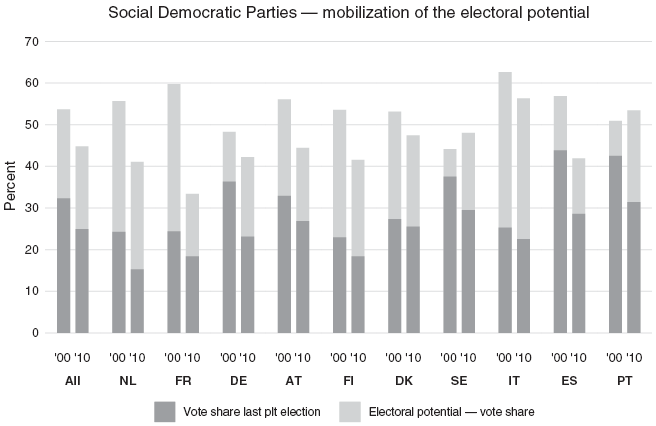
The main insight from Figure 6.1 is that social democratic parties in Western Europe are generally a viable electoral option for many more voters than those who actually gave them their vote. On average, around 50% of all voters can imagine voting for the social democratic party at some point in their life. Importantly, the unrealized potential is not simply a function of the electoral performance but on average remains rather stable over time (with the exception of France). However, Figure 6.1 also shows that in all countries, the electoral potential of social democratic parties has rather declined, in almost half of them by more than 10 percentage points.
Regarding robustness, there are two important observations: First, the findings are robust to a cutoff point of 7 instead of 6. Potentials are on average about 10 percentage points lower with the higher cutoff point, but the comparative pattern of (realized and unrealized) potentials remains robust. The observation of declining potentials between the first and second decades of the 2000s is also robust. I conducted a second robustness test by excluding respondents with large and less specific consideration sets of three or more parties. Thereby, I want to see if I overestimate the potential because some (especially younger) respondents may be open to voting for many different parties. When excluding these respondents with larger choice sets, the “unrealized potentials” decline quite sharply (from 20–40% on average to 10–20%) in those countries with very fragmented left party spectrums – especially the Netherlands, France, Germany, Finland, and to some extent Spain. This indicates that the high electoral potentials for social democratic parties indicate a general predisposition of very many voters to choose a party of the left-wing spectrum. However, it seems less indicative of a specific preference for the social democratic party in particular.
Figure 6.2 pools the countries by regions and compares electoral potentials and electoral yields across party families for the two decades. We notice that the electoral potential of social democratic parties is actually on average among the highest, together with the potentials of moderate right and green/left-libertarian parties in Nordic and Continental European Countries. In Southern European countries, the high potential of social democratic parties stands out even more, clearly outnumbering the electoral potential of green/left-libertarian and radical left parties.
Electoral potential (voting propensity ≥6) and mobilization (vote) for different party families in ten European countries, 2000s and 2010s
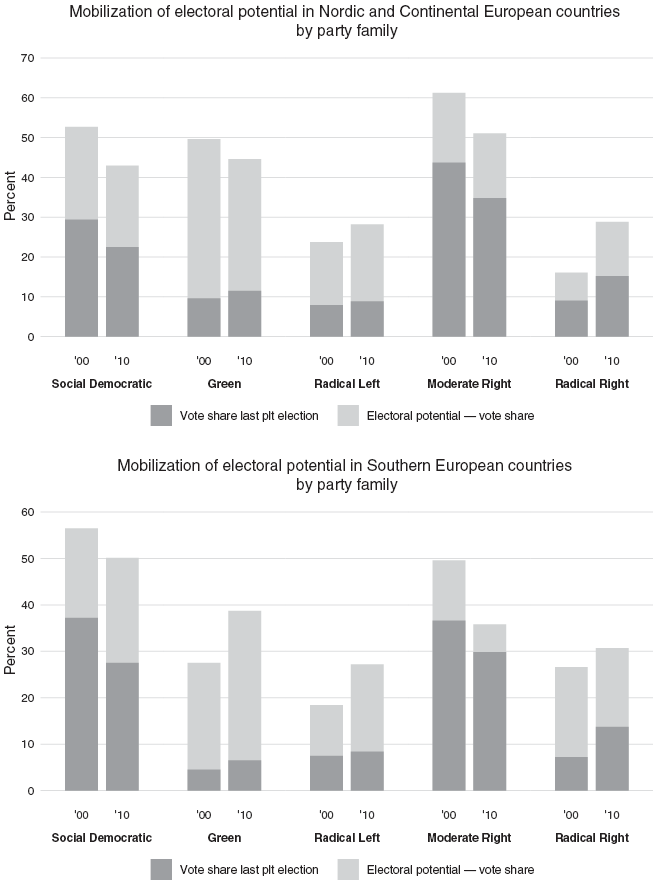
Hence, Figures 6.1 and 6.2 combined show that there indeed seems to be room to (re-)grow for social democratic parties, since actual vote shares do not exhaust their potentials by far. There does not seem to be a sort of a “ceiling” of social democratic voting in particular and left voting in general.
However, the competitive situation of social democratic parties seems challenging, and increasingly so: While the potential of radical left parties seems more narrowly confined, the massive, and massively increasing potentials of green/left-libertarian and radical right parties are striking. In Nordic and Continental European countries, the electoral potential of green and left-libertarian parties equals the one of the Social Democrats, but a much larger share of it is (still) unrealized. At the same time, the electoral potential of radical right parties has almost doubled in this region between the first and the second decades of the current century. In Southern Europe, both green and radical right parties have strongly increased their electoral potential over the same period. Hence, these numbers clearly show that the competitive environment for social democratic parties has markedly intensified both within the left field and at the conservative end of the ideological spectrum.Footnote 1
6.4.2 Inward and Outward Overlaps with Rival Parties: By Region, Class, and Education
Now that we have established that there is in most countries a substantial unrealized electoral potential, where are these voters to be found? In other words, which rival parties have voters who also include the Social Democrats in their consideration set? And which other parties to social democratic parties include in their consideration sets?
I define as inward resp. outward overlaps those voters of rival resp. social democratic parties who at the same time report a voting propensity for the social democratic party resp. a rival party of 6 or higher (with robustness analyses for a threshold of 7). Importantly, there are two ways to estimate the size of these overlaps. On the one hand, one can ask between which parties the overlaps are largest. This information is important, as is reflects which other party electorates are “closest in reach.” However, if such “close” parties are very small, a valid estimation of the magnitude of the overlaps requires a calibration by party size. Consequently, in order to compare inward and outward overlaps across parties, they need to be calibrated by a common denominator.
I take the first perspective in this section – to show the prevalence of overlaps with other party families – and the second perspective in Section 6.4.3 – to compare potential gains and losses of different programmatic strategies across the entire party spectrum.
Table 6.1 presents inward and outward overlaps for the regions of Nordic and Continental Europe. The table above (inward overlaps) indicates the share of respondents who have actually voted for green/left-libertarian, radical left, moderate right, or radical right parties, or who have abstained, but who at the same time indicate that they can just as well imagine voting for social democratic parties. The table below shows outward overlaps, that is, the shares of respondents who have voted for the social democratic parties but report a high voting propensity for a different party family, as well. Region means are weighted averages.
| All countries | Greens | Radical Left | Moderate Right | Radical Right | Abstentionists | ||||||
|---|---|---|---|---|---|---|---|---|---|---|---|
| ‘00 | ‘10 | ‘00 | ‘10 | ‘00 | ‘10 | ‘00 | ‘10 | ‘00 | ‘10 | ||
| 52 | 47 | 59 | 36 | 21 | 21 | 21 | 15 | 32 | 27 | ||
| % of “X”voters who are potential SD voters | Austria | 52 | 46 | – | – | 18 | 21 | 20 | 13 | 25 | 34 |
| Denmark | 52 | 49 | – | – | 25 | 19 | 19 | 24 | 44 | 39 | |
| Finland | 45 | 38 | 55 | 50 | 22 | 18 | 49 | 22 | 35 | 19 | |
| France | 44 | 38 | 57 | 34 | 12 | 14 | 9 | 5 | 33 | 19 | |
| Germany | 53 | 39 | 24 | 23 | 16 | 25 | – | 13 | 24 | 19 | |
| Netherlands | 58 | 49 | 64 | 41 | 27 | 22 | 20 | 17 | 36 | 33 | |
| Sweden | 52 | 54 | – | – | 17 | 22 | 27 | 16 | 20 | 41 | |
| All countries | Greens | Radical Left | Moderate Right | Radical Right | |||||
|---|---|---|---|---|---|---|---|---|---|
| ‘00 | ‘10 | ‘00 | ‘10 | ‘00 | ‘10 | ‘00 | ‘10 | ||
| 49 | 47 | 24 | 32 | 27 | 26 | 7 | 13 | ||
| % of SD voters who are potential “X” voters | Austria | 31 | 39 | – | – | 23 | 22 | 11 | 16 |
| Denmark | 57 | 50 | – | – | 15 | 21 | 7 | 15 | |
| Finland | 39 | 35 | 21 | 34 | 37 | 30 | 15 | 21 | |
| France | 60 | 49 | 17 | 23 | 16 | 27 | 2 | 14 | |
| Germany | 44 | 46 | 15 | 27 | 37 | 30 | – | 6 | |
| Netherlands | 69 | 64 | 43 | 46 | 30 | 39 | 8 | 12 | |
| Sweden | 43 | 55 | – | – | 29 | 25 | 2 | 11 | |
We see that overlaps are highest with green and radical left parties. About half of left-libertarian voters on average can as well see themselves voting social democratic and vice versa. The inward overlaps are similarly high with radical left parties, but with more variation. Hence, both inward and outward overlaps concentrate within the left field.
These high inward overlaps in the left field are followed by the group of abstentionists, among whom about a third could also imagine voting for the social democratic party. They are lower for moderate right and – very clearly – radical right parties. On average less than a fifth of radical right voters would consider ever voting social democratic and even fewer (7–13%) of social democratic voters can imagine ever voting radical right. There is quite some variation in the levels across countries (with Finland in the 2000s being an extreme case), but the rank ordering of overlaps is very consistent.
Table 6.1 already casts doubt on the widespread assumption that social democratic parties mainly compete with radical right parties over the votes of lower social classes. These doubts are further confirmed by the disaggregation of inward and outward overlaps into different education groups in Figure 6.3 (and different subjective classes in the Appendix of this chapter).Footnote 2 In Northwestern Europe, about 70–80% of all respondents on average are in the categories of the medium and highly educated. The overlaps with green and left-libertarian parties, moderate right parties, as well as abstentionists exceed this baseline level by far: With these party families, overlaps clearly concentrate among the middle and highly educated voters. With green/left-libertarian parties, the overlaps even concentrate among the most highly educated category (i.e., respondents who studied on after the age of 20). With the Radical Left and Radical Right, the shares are closer to the distribution in society, but even there, we see that overlapping voter potentials are found mostly among medium- and highly educated voters. This picture is confirmed when looking at subjective social class (see Appendix Figures 6.A1 and 6.A2): Overlaps, especially inward overlaps, exceedingly concentrate among middle-class voters.
Inward and outward overlaps by education, Nordic and Continental Europe (AT, DK, FR, FI, DE, NL, and SE)
Note: “Residual” denotes nonresponses and students.
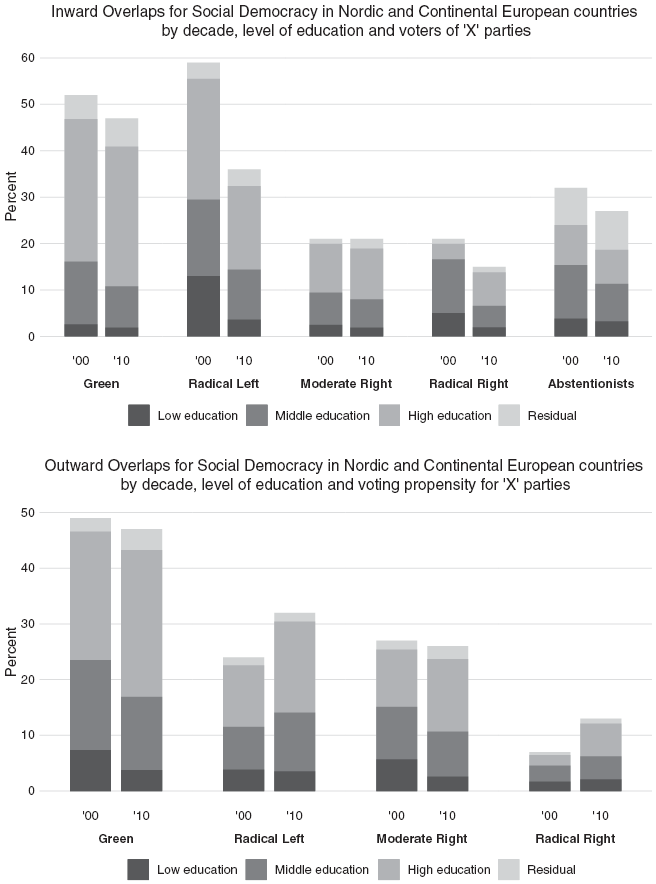
Moreover, it is important to note that the distributions look strikingly similar when it comes to inward and outward overlaps. In other words, it is not the case that social democratic parties “asymmetrically” risk losing working-class voters, while they may win over middle-class votes. Rather, both potential gains and losses concentrate in the middle and upper classes, especially when it comes to those political parties that the overlaps are highest with. This finding is consistent with what Abou-Chadi and Wagner find with regard to vote switching (see their chapter in this volume).
Moreover, Figure 6.3 shows a somewhat gloomy overall picture from the perspective of social democratic parties: Potential gains from other party families have on average declined over time, whereas potential losses tend to have increased. In an increasingly realigned and differentiated party landscape, the social democratic parties, on average, seem to lose the favors of other party voters, even within the left field.
The picture we find for Southern Europe is similar in rank order to Nordic and Continental Europe but at a lower level of overlaps (see Table 6.2). Both inward and outward overlaps are strongest with green/left-libertarian and radical left parties (i.e., within the left field) and on average lower with moderate and radical right parties. Abstentionists rank between the Left and the Right when it comes to inward overlaps. Inward and outward overlaps are on average relatively similar in size, but outward overlaps are overall smaller, especially to the Radical Left (probably indicating that those social democratic voters who wanted to join the new left parties have mostly done so). There is one exception to point out, that is, the strongly increased inward overlaps from radical right parties in the 2010s (stemming mostly from Portugal and Spain), which are not at all matched by symmetrical outward overlaps. It may be too early to tell if these overlaps are sustainable over time.
| All countries | Greens | Radical Left | Moderate Right | Radical Right | Abstentionists | ||||||
|---|---|---|---|---|---|---|---|---|---|---|---|
| ‘00 | ‘10 | ‘00 | ‘10 | ‘00 | ‘10 | ‘00 | ‘10 | ‘00 | ‘10 | ||
| 37 | 28 | 35 | 25 | 11 | 20 | 8 | 11 | 27 | 23 | ||
| % of “X” voters who are potential SD voters | Italy | 0 | 42 | – | – | 7 | 16 | 6 | 7 | 23 | 25 |
| Portugal | 25 | 28 | 35 | 25 | 17 | 46 | 11 | 29 | 30 | 22 | |
| Spain | 44 | 27 | – | – | 9 | 13 | – | 6 | 25 | 23 | |
| All countries | Greens | Radical Left | Moderate Right | Radical Right | |||||
|---|---|---|---|---|---|---|---|---|---|
| ‘00 | ‘10 | ‘00 | ‘10 | ‘00 | ‘10 | ‘00 | ‘10 | ||
| 30 | 36 | 14 | 20 | 12 | 13 | 6 | 9 | ||
| % of SD voters who are potential “X” voters | Italy | 13 | 19 | – | – | 2 | 6 | 4 | 12 |
| Portugal | 26 | 34 | 14 | 20 | 22 | 16 | 7 | 8 | |
| Spain | 35 | 51 | – | – | 10 | 16 | – | 3 | |
Hence, the pattern and rank order of overlaps is similar to Northwestern Europe, but it is important to notice that, as expected, levels of overlaps (especially with green and left-libertarian parties) are smaller, in line with the overall relatively recent reconfiguration of the left field and with the antiestablishment appeal of the new parties on the left in Southern Europe.
The share of lower-class voters in the sample is on average higher in the Southern European than in Nordic and Continental European countries, both in terms of education years and subjective class. Still, overlaps with the green and left-libertarian parties (including new left parties such as Podemos or Sinistra e Libertà) overproportionally concentrate among the middle classes and highly educated voters (see Figure 6.4). Beyond that, however, it is important to note that in Southern Europe, overlaps with the Radical Left, the Radical Right, and abstentionists are more concentrated among the lower- to medium educated and working-class voters.
Inward and outward overlaps by education, Southern Europe (IT, ES, and PT)
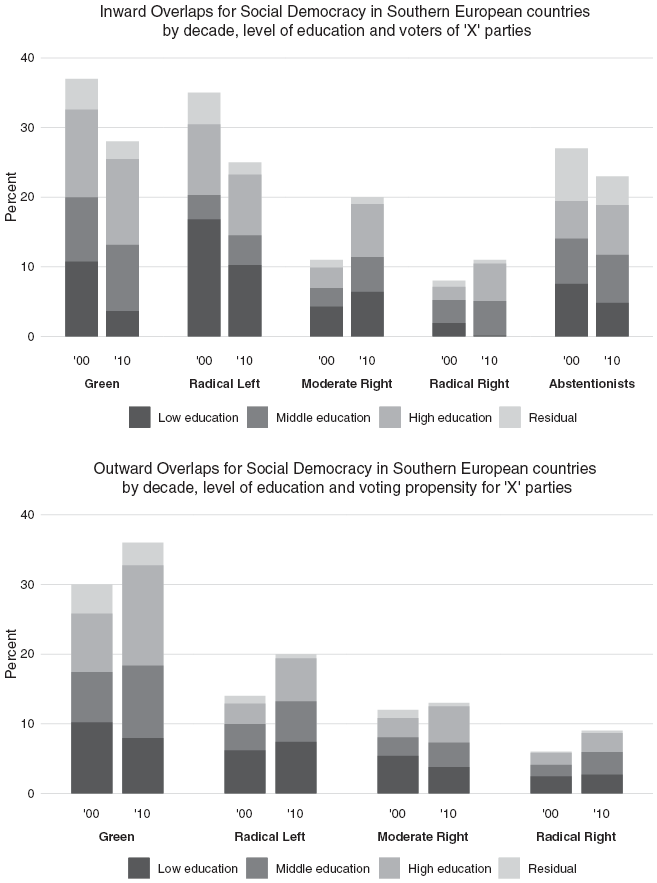
In sum, we see across the regions mainly commonalitiesFootnote 3: Overlaps are highest within the left field, both with regard to inward and outward overlaps. Overlaps with the right, and particularly with the Radical Right are on average much lower. In particular, hardly any social democratic voters indicate they are tempted to vote for the Radical Right. Finally, the Figures 6.3, 6.4, 6.A1, and 6.A2 show that the electoral competition social democratic parties face does not concentrate around voters from lower social classes. Rather, where we observe the highest overlaps, competition revolves around middle-class voters with medium and high education. Finally, a last consistent finding across all countries and regions is that – especially within the left field – inward overlaps tend to decline over time, while outward overlaps tend to increase. This corroborates the increased competitive challenges social democratic parties face.
6.4.3 Programmatic Strategies and Electoral Payoffs
In this section, I integrate the comparison of inward and outward overlaps – in terms of both magnitude and respective voting propensities – to arrive at a very approximative evaluation of likely payoffs of the four possible programmatic strategies. The most important change with regard to the previous analyses is that from now on, I present inward and outward overlaps relative to the same denominator – the entire electorate (i.e., all respondents who indicate having voted for a party in the sample or abstained). This calibration is important, since the relative size of the respective potential gains and losses electorates obviously matters for gauging payoffs: Even if a very high share of, for example, green voters can imagine voting social democratic, this implies very different payoffs depending on whether the green party electorate is small or large.
I will subsequently discuss specific comparisons of party overlaps: When discussing the likely payoffs of a New Left strategy, I will compare inward overlaps from the green and left-libertarian parties to outward overlaps toward radical right parties and to moderate right parties. For the Old Left strategy, I compare inward overlaps from the Radical Left to outward overlaps to the Moderate and Radical Right. A Centrist strategy is supposed to appeal mainly to moderate right voters but may entail potential losses to radical left (and possibly green) parties. Finally, a Left National strategy appeals to inward overlap voters from the Radical Right, at the cost of potential losses to green/left-libertarian and possibly radical left parties. The comparison of these overlaps relies on two parameters: first, the magnitude of the groups, indicated as a share of the overall electorate; second, the average voting propensity among the voters in the overlap. These two indicators provide information on the likely balance of potential gains and losses, as well as on the likeliness that such gains and losses might actually be realized.
Figure 6.5 provides the empirical foundation for the discussion of overlap magnitudes. It displays the percentage of voters of one party who include the relative other party in their consideration set. Inward and outward overlaps are indicated by means of directed arrows and the weight of the lines is proportional to the size of the overlap. I have pooled numbers by region and decade, but the estimates still rely on relatively limited numbers of observations, especially when it comes to overlaps with the Radical Left and the Radical Right. Hence, our focus is on tendencies and regularities, rather than on precise point estimates. The average voting propensities among the overlaps are reported in Figure 6.A3 in the appendix of this chapter.
Inward and outward overlaps as a share of the overall electorate, comparison of magnitudes
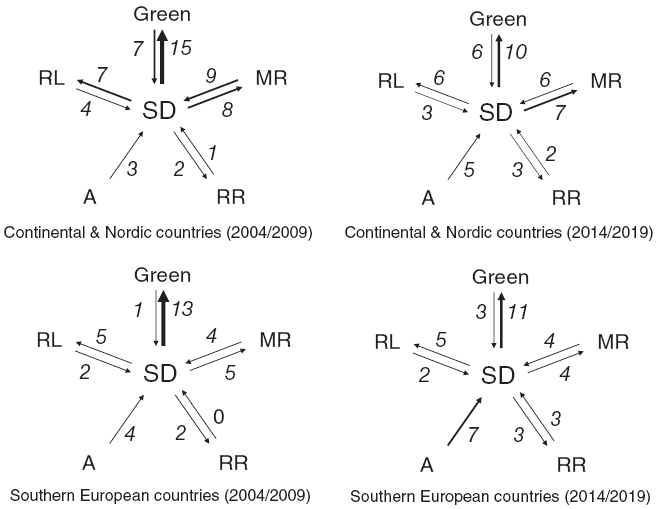
To gauge the implications of a New Left programmatic strategy, we want to know whether inward overlaps from green/left-libertarian parties outweigh outward overlaps to the Radical Right. Figure 6.5 shows the potential gains from green and left-libertarian parties compared to the potential losses to radical right parties as a share of the overall electorate and differentiated by region and decade. We see that on average, potential gains seem to outweigh potential losses in Nordic and Continental European countries (7% vs. 2–3%) but not in Southern European countries. For Nordic and Continental European countries, inward overlaps amount to twice or three times the outward overlaps. The average voting propensity of green overlap voters for the Social Democrats is about the same as the voting propensity of social democratic overlap voters for the Radical Right (i.e., about 6.5–6.7 on the scale 1–10). The question, of course, is, whether such a strategy would also lose voters to the Moderate Right, to which outward overlaps are larger. Given the relatively conservative attitudes of centrist voters especially in the field of immigration (cf. the chapter by Abou-Chadi et al. in this volume), one might expect at least some effect in this direction, which might, however, be partly compensated by additional gains from the Radical Left. Hence, overall, a New Left strategy appears likely to yield positive payoffs for social democratic parties in Continental and Nordic Europe.
The same does not hold for Southern Europe. While estimated outward overlaps to the Radical Right are very low, so are inward overlaps from within the left field. Given that the new alternative parties in the left field have mostly mobilized against the mainstream (establishment) parties, it makes sense that their voters are reluctant to consider the mainstream left as an electoral option. This somewhat lower inward potential within the left field explains why the New Left strategy seems less promising in Southern Europe than in the Continental and Nordic countries.
To evaluate likely payoffs of an Old Left strategy, we compare inward overlaps from the Radical Left to outward overlaps to the Moderate Right.Footnote 4 From Figure 6.5, it appears that an Old Left strategy would on balance seem highly risky, as inward overlaps at the left end of the spectrum amount to only about half of the outward overlaps at the centrist end of the spectrum in both Northwestern countries (3–4% vs. 5–8%) and in Southern European countries (2% vs. 4–5%). A comparison of average voting propensities reinforces this conclusion for Northwestern Europe: Radical left voters who do include the Social Democrats in their consideration set on average rate their propensity to vote for them only at 6.17, that is, it seems that they would be hard to “win over,” whereas the propensity of outward overlapping voters for the Moderate Right is slightly higher (6.36). On this basis, the (small) potential gains from the Radical Left seem indeed hard to realize, in comparison with the more likely losses to the Moderate Right they may entail. In Southern Europe, by contrast, outward overlapping voters on average have a rather low voting propensity for the Moderate Right.
A Centrist strategy is supposed to appeal to moderate right voters by means of more moderate policy positions mainly on the socioeconomic dimension but entails the risk of shying away voters to radical left parties in particular, and – given the very progressive policy preferences of green and left-libertarian voters on both economic and social issues – also to some extent to green and left-libertarian voters. Figure 6.5 indicates that potential gains from the mainstream right parties are indeed on average somewhat lower than potential losses to the Radical Left parties but certainly much lower than potential losses within the left field overall (i.e., green/left-libertarian and radical left parties). Inward overlaps from moderate right parties amount on average to 6–9% in Northwestern Europe and 4% in Southern Europe, which are relatively low numbers given the size of the moderate right party family. In addition, the average voting propensity of these overlapping moderate right voters for the Social Democrats is very low (6.1–6.2). On the other hand, the combined outward overlaps to green/left-libertarian and radical left parties amount to 16–22% in Northwestern Europe and 17–18% in Southern Europe, with much higher average propensities (6.3–6.85). Hence, on balance, there is reason for skepticism whether a Centrist strategy would attract large vote shares to social democratic parties and/or the Left field.
Finally, a Left National strategy would seek to appeal to inward overlapping voters of the Radical Right, at the risk of losing outward overlapping voters within the left field to green/left-libertarian and radical left parties. The assessment of the likely payoffs of such a strategy is quite straightforward: Potential losses are likely to outweigh potential gains by far. While inward overlaps from the Radical Right amount to 0–2% of the electorate in both regions, potential ensuing losses to the green/left-libertarian parties alone go in the numbers of 10–15% relative to the entire electorate. Outward voting propensities for the green/left-libertarian parties are also higher than among inward overlapping voters, at least in Northwestern Europe where outward overlapping voters to the Greens have on average very high propensities. Even if we include orthogonal additional potential gains and losses (from the Moderate Right and toward the Radical Left) into the assessment, the likely balance of a Left National strategy still seems to remain negative. This approximative assessment of payoffs is consistent with analyses of vote switching (see the chapters by Abou-Chadi and Wagner, as well as by Kitschelt and Rehm in this volume), as well as experimental survey evidence on the resonance of programmatic appeals within the potential electorate (see the chapter by Abou-Chadi et al. in this volume).
6.5 Conclusion
In this chapter, I have assessed electoral potentials of social democratic parties, overall, as well as in terms of inward and outward overlaps, in order to gauge the potential for social democratic parties to (re-)grow, the profile of their overlaps with other parties, as well as likely payoffs of some of the strategic programmatic options that are currently on the table for social democratic parties.
The EES voter propensity data from 2004 to 2019 show a number of patterns that are strikingly consistent across countries and time: First, social democratic parties still enjoy a large electoral potential in almost all countries. Social democratic parties have remained a viable electoral alternative for 40–50% of all voters or even more across countries. Hence, there is both demand and room for social democratic politics. However, the competitive environment for social democratic parties has clearly intensified, because the electoral potentials of green, radical left, and also radical right parties have increased over time, while the electoral potential of social democratic parties has declined in most of the countries. Green parties in particular clearly start to close the gap toward social democratic parties when it comes to the electoral potential.
The analysis also supports the idea of a “left field” across countries. Overlaps between either green and left-libertarian and/or radical left parties and Social Democrats are much higher than between social democratic party electorates and the Right. In particular the rank order in the extent of overlaps with other party families is consistent across regions and time: Overlaps are generally strongest with green and left-libertarian parties, followed by overlaps with the Radical Left, inward overlaps from abstentionists, followed by overlaps with moderate right parties and – eventually – radical right parties. Overall, however – and this is also consistent across countries – overlaps within the left field are not symmetrical: Outward overlaps to the alternative parties within the left field largely exceed inward overlaps from these same parties, and this asymmetry increases over time. This indicates that we see a growing differentiation within the left field, with the social democratic parties’ dominant position becoming more and more contested in many countries. In line with these findings, we see that – especially in Northwestern Europe – outward overlapping social democratic voters have a higher voting propensity for the rival parties than the corresponding inward overlaps. In other words, potential losses seem more likely than potential gains. In terms of classes, our findings show that competition over voters revolves around middle-class voters as much as around working-class voters. Especially in the countries of Continental and Northern Europe, overlaps concentrate among the middle class and the more highly educated voters.
Within a largely consistent picture, the analyses also show a number of regional differences: It appears that social democratic parties face the sharpest trade-offs in the countries of Continental and Northern Europe: Inward overlaps from other party families consistently decline while outward overlaps tend to increase. This seems to indicate a particularly fragile situation for social democratic parties, because potential losses in most directions are substantial, while potential gains remain generally smaller. When it comes to the class profile of potential voter flows, Social Democrats seem to mainly compete over middle-class voters with their left-libertarian rivals but over working-class votes with the Radical Left and the Radical Right in Southern Europe. Hence, it seems that if at all, the working vs. middle-class trade-off exists in Southern Europe. In Nordic and Continental Europe, we do not find such a class trade-off, as both inward and outward competition focuses on voters in higher education categories and in the middle classes.
Finally, we have gauged the potential payoffs of different programmatic strategies by comparing inward and outward overlaps across the ideological spectrum. The main finding is that no programmatic strategy in any of the regions is associated with a decidedly positive net payoff. This results from the fact that in most instances, outward overlaps in any direction outweigh inward overlaps, and outward voting propensities are on average higher than inward voting propensities. Two findings stand out quite clearly, however: First, the New Left strategy on average seems to hold the most positive, or at least balanced payoffs, at least in Continental and Northern Europe. In Southern Europe, this strategy is limited by the weak propensity of green and left-libertarian voters to support the Social Democrats. Second, a Left National strategy is impaired by both very small inward overlaps from radical right parties, as well as massive outward overlaps within the left field.


 Open access