

The term biological control is broadly used to identify the suppression of populations of pests, weeds and disease-causing organisms by living organisms (referred to here as biological control agents). Humans have recognized the beneficial effects of biological control agents for thousands of years. For example, a puzzle provided in the ‘Rhind Mathematical Papyrus’, an Egyptian document that dates to 2000 BCE, indicates clearly that cats were appreciated as rodent hunters in ancient Egypt (Chace Reference Chace1979):
In each of seven houses are seven cats, each cat kills seven mice, each mouse would have eaten seven ears of wheat, and each ear will produce seven measures of grain; how much grain is thereby saved?
Cats or other predators may or may not have been intentionally used to suppress pests in early human history, but they certainly would have contributed to the control of pests in even the earliest days of agriculture. Remains of the parasitoid Habrobracon hebetor, which attacks stored-grain-infesting caterpillars, were isolated from Egyptian tombs dating to 2000 BCE as well (Chaddick & Leek Reference Chaddick and Leek1972). By protecting the food supply of humankind from pests, these animals would have been among the first biological control agents.
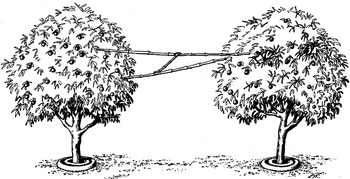
The first credible cases of the intentional use of biological control agents to control pests of humans were deliberate movement and manipulation of predatory ant nests to control orchard and stored-grain pests in China 3,000 years ago (Olkowski & Zhang Reference Olkowski, Zhang, Pickett and Bugg1998; Figure 1.1). These practices continue to this day in various parts of the world (Perfecto & Castiñeras Reference Perfecto, Castiñeras and Barbosa1998; Van Mele et al. Reference Van Mele, Vayssieres, Van Tellingen and Vrolijks2007), and are further discussed in Chapter 9 of this book. Histories of purposeful biological control have been pieced together by Steinhaus (Reference Steinhaus1956), Doutt (Reference Doutt and DeBach1964), Simmonds and colleagues (Reference Simmonds, Franz, Sailer, Huffaker and Messenger1976), DeBach and Rosen (Reference DeBach and Rosen1991) and Legner (Reference Legner and Pimentel2008), among others, and Sawyer (Reference Sawyer1996) provides an account of the colorful beginnings of biological control in California starting in the 1880s. Generally speaking, the history of biological control can be characterized as a gradual increase in the understanding of the biology and ecology of pest–enemy interactions, as well as the development of increasingly sophisticated and creative methods of utilizing biological control agents to control pests. The result is that today, the term biological control can be simultaneously used to refer to a natural phenomenon, a method of pest control, and a scientific discipline.
Illustration of a method used in China to conserve weaver ants on citrus trees and distribute them within groves. Weaver ant nests are collected in mountainous areas and placed on citrus trees outfitted with moats and ladders to keep the ants on the trees (from Olkowski & Zhang Reference Olkowski, Zhang, Pickett and Bugg1998).
In this introductory chapter, we will begin by defining biological control (Section 1.1). The definition of biological control has gone through some historical changes, and recent innovations in biologically based forms of pest management have blurred the divisions between activities that should and should not be classified as biological control. We introduce a new way of defining biological control that relies on ecological relationships among populations and the direct or indirect effects of these relationships on humans. This definition is then used to evaluate various pest control strategies that are at the fringes of traditional definitions of biological control (Section 1.2). We explain the rationale for breaking the discipline of biological control into four categories (‘importation’, ‘augmentation’, ‘conservation’ and ‘natural’) in Section 1.3 and provide a review of growth areas in biological control (Section 1.4). Finally, we briefly introduce the organisms that figure prominently in biological control (Section 1.5).
1.1 What Is Biological Control?
Definitions of biological control have varied in their inclusiveness of ecological processes and biological functions. For example, in an intentionally expansive definition by DeBach and Rosen (Reference DeBach and Rosen1991), any reduction of plant or animal populations by natural enemies (understood to be predators, herbivores, parasitoids or pathogens) occurring in natural or managed systems was called biological control. We favor definitions that are restricted to the control or suppression of organisms that have negative effects on humans (directly or indirectly). Another class of definitions that we find too expansive are those that include a broad range of nonchemical pest control methods. Depending on the authors, these definitions include host plant resistance, insect growth regulators, pheromone disruption, botanical insecticides, transgenic insecticidal crops and even vaccines of human and animal diseases (Pimentel Reference Pimentel, Lundholm and Stackerud1980; US National Academy of Sciences 1988; Rechcigl & Rechcigl Reference Rechcigl and Rechcigl1998). Definitions such as these were vigorously repudiated by Garcia and colleagues (Reference Garcia, Caltagirone and Gutierrez1988), who objected in particular to the inclusion of recombinant genes or gene products in a definition of biological control. We favor restricting biological control to actions precipitated by living organisms or viruses against target organisms that cause harm to humans or their resources (Eilenberg et al. Reference Eilenberg, Hajek and Lomer2001; Hajek Reference Hajek2004; Van Driesche et al. Reference Van Driesche, Hoddle and Center2008).
A definition of biological control from Eilenberg and colleagues (Reference Eilenberg, Hajek and Lomer2001) that is used in Hajek’s (Reference Hajek2004) introductory text reads as follows:
The use of living organisms to suppress the population of a specific pest organism, making it less abundant or less damaging than it would otherwise be.
This definition is useful, but we find it too restrictive for two reasons. First, the phrase ‘The use of …’ emphasizes manipulative biological control, whereas the unmanipulated suppression of organisms that have the potential to attain pest status also constitutes biological control (e.g., Hornby Reference Hornby1983; Settle et al. Reference Settle, Ariawan, Astuti, Cahyana, Hakim, Hindayana, Lestari and Pajarningsih1996; Guretzky & Louda Reference Guretzky and Louda1997; Rosenheim et al. Reference Rosenheim, Wilhoit, Goodell, Grafton-Cardwell and Leigh1997; Maron & Vilà Reference Maron and Vilá2001). Indeed, the global value of biological control as a naturally occurring ‘ecosystem service’ has been estimated at greater than $400 billion per year (Costanza et al. Reference Costanza, d’Arge, de Groot, Farber, Grasso, Hannon, Limburg, O’Neill, Paruelo, Raskin, Naeem, Sutton and Van Den Belt1997). Losey and Vaughan (Reference Losey and Vaughan2006) estimated that natural biological control by native insects in the United States alone provides $4.5 billion of savings per year in increased yield and reduced insecticide inputs in agricultural settings (Table 1.1). Second, the definition cited earlier technically excludes the action of viruses in pest control, since most if not all viruses are considered inanimate (Raoult et al. Reference Raoult, Audic, Robert, Abergel, Renesto, Ogata, La Scola, Suzan and Claverie2004; Villareal Reference Villareal2004). Having said this, viruses have been universally considered bona fide biological control agents – presumably because of their ability to replicate within host cells.
| Parameter | Estimate (US$ in Billions) |
|---|---|
| Crop losses due to native insect pests | $7.32 |
| Proportion of potential native pests reaching damaging levels | 0.35 |
| Hypothetical damage by native pests in the absence of natural control | $7.32/0.35 = $20.91 |
| Value of natural control | $20.91 – $7.32 = $13.59 |
| Proportion of natural control attributable to insects | 0.33 |
| Crop protection attributable to insects | $13.59*0.33 = $4.49 |
We seek a definition of biological control that recognizes the underlying ecological relationships that characterize biological control. These relationships include direct and indirect interactions between populations of target organisms (used in the broadest sense to include animal pests, weeds and disease-causing organisms), biological control agents, humans and their resources (Figure 1.2). Interactions are considered direct when they involve consumption or interference competition, but indirect when they are mediated by a third species and do not involve direct contact as can occur through processes such as resource competition, apparent competition or induced resistance (Wooton Reference Wooton1994). The effects of target organisms on humans are negative and can either be direct through nuisance, disease, injury or death, or be indirect through environmental impacts that reduce the economic, aesthetic or spiritual value of natural or managed resources. In this context, resources are externalities that are of direct benefit to human welfare, whether plant or animal, natural or managed. Direct negative effects of biological control agents on target organisms include herbivory, predation and parasitism, as well as antibiosis, a form of contest competition. Corresponding indirect negative effects include most forms of resource competition and induced resistance, as well as any other interaction in which the presence of the biological control agent results in harm to the target organism or disrupts its performance through the actions of one or more other species. Whether direct or indirect, effects of the biological control agents are of indirect benefit to humans or their resources. Finally, the strength of the various interactions depends not only on the individual species involved, but also on the suitability of the abiotic and biotic environment in which the interactions take place. Thus interactions that appear very promising under controlled conditions in the laboratory or greenhouse have often proved ineffective in the field due to unknown environmental constraints.
Diagram depicting biological control interactions among biological control agents (BCA), target organisms, resources and humans using the notation of Levins (Reference Levins, Cody and Diamond1975). Solid lines indicate direct effects, dashed lines indicate indirect effects, arrowheads indicate positive effects and round heads indicate negative effects. The set of interactions in black shows the ‘biological control triangle’ – the minimum set of interactions that define biological control.
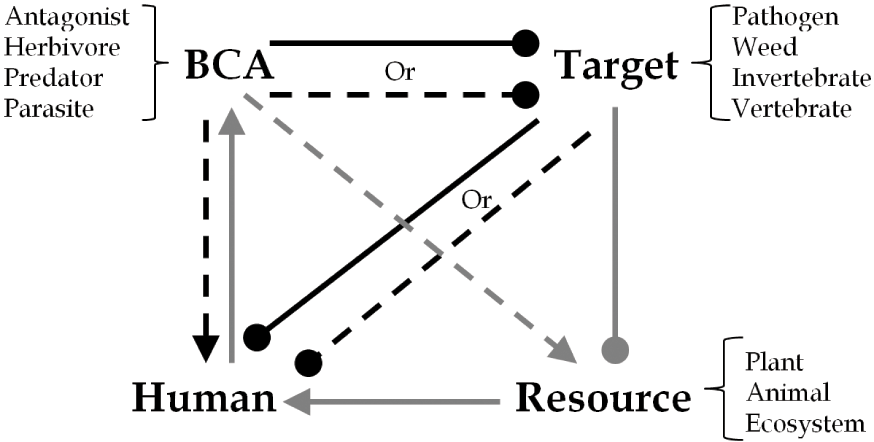
A subset of these interactions constitutes the core definition of biological control, shown in black in Figure 1.2. Biological control is the indirect positive effect of a biological control agent on humans that is mediated by direct or indirect negative effects of that agent on populations of one or more target species. In other words – ‘The enemy of my enemy is my friend.’ We call this set of minimum interactions the ‘biological control triangle’, and consider it the sole necessary criterion in defining biological control.
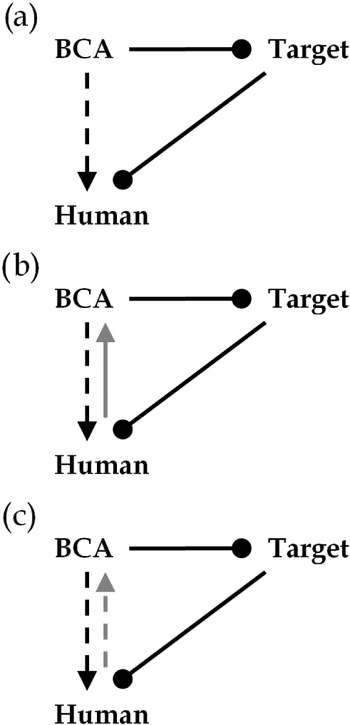
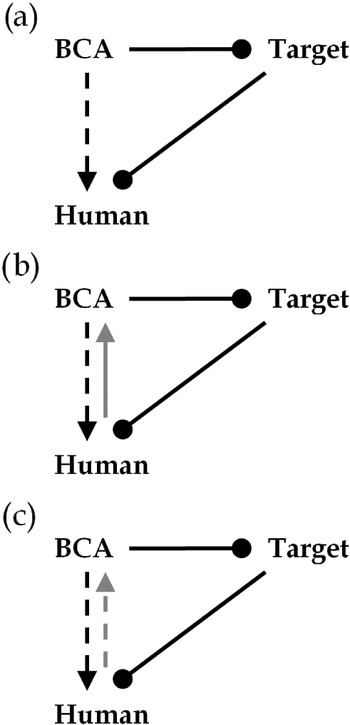
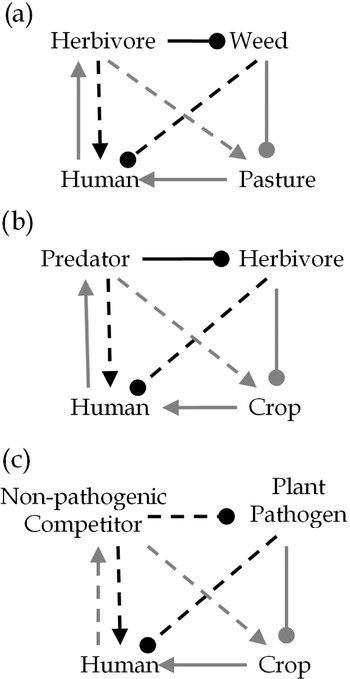
Further, we recognize three basic underlying ecological models of biological control using a simplified set of interactions (Figure 1.3). These models differ in the ways that humans affect the biological control agents of target organisms. In the first model, there is no effect of humans on the biological control agent so that biological control occurs naturally – this is ‘natural biological control’ (Figure 1.3a). The second includes direct human facilitation of the biological control agent (Figure 1.3b), which can be divided into importation and augmentative biological control methodologies, as discussed later in this chapter and in Chapters 2–8. In the final model, facilitation of the biological control agent is indirect (Figure 1.3c). This encompasses conservation biological control, which is discussed later in this chapter and in Chapters 9 and 10. Biological control can be further broken down by the type of interaction and by the kind of target organism and biological control agent. Examples of biological control interactions involving various organisms and mechanisms are shown in Figure 1.4.
Interaction diagrams to characterize (a) naturally occurring biological control, (b) direct facilitation of biological control agents (importation or augmentative biological control) and (c) indirect facilitation of biological control agents (conservation biological control). See legend to Figure 1.2 for explanation of line types.
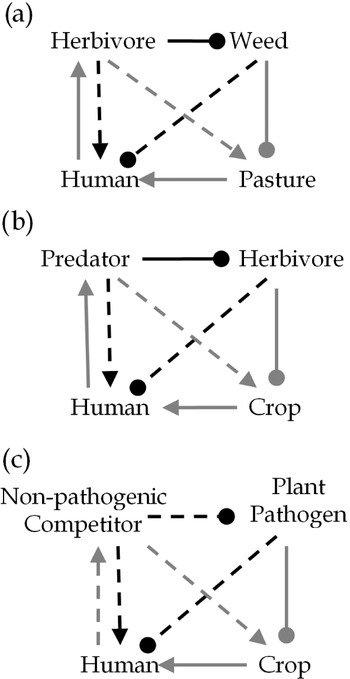
Interaction diagrams depicting three examples of human-facilitated biological control. (a) Importation or augmentative biological control of an agricultural weed by an herbivore or plant pathogen. (b) Importation or augmentative biological control of an arthropod crop pest by an arthropod natural enemy. (c) Conservation biological control of a plant pathogen by a competing microbe that is not itself a pest. See legend to Figure 1.2 for explanation of line types.
These models make clear that biological control interactions require a minimum of three interactors: humans, a target organism that is either directly or indirectly harmful to humans and a biological control agent. All of these protagonists are understood to be living organisms (or viruses). While the target organism and the biological control agent are usually distinct species, this need not necessarily be the case, as we illustrate later in this chapter and in Chapters 8 and 9.
Defining biological control on the basis of ecological interactions has a number of advantages. In addition to encompassing natural biological control, it allows for competitive as well as the more traditional trophic effects of biological control agents. The suppression of bush flies in Australia through the introduction of dung beetles from South Africa provides an interesting example of competition as an effective mechanism in biological control (Moon Reference Moon1980; Tyndale-Biscoe & Vogt Reference Tyndale-Biscoe and Vogt1996). In this case, although bush flies that breed in cattle dung were the target organism, suppression was achieved by the introduction of a biological control agent that competed for the resource of the target organism rather than attacking the target organism itself. Other indirect effects are included as well. An interesting example of another indirect mechanism is that of induced resistance among spider mites in vineyards in California (Karban et al. Reference Karban, English-Loeb and Hougen-Eitzman1997). In this case, the early season presence of Willamette mites, Eotetranychus willametti, induced resistance in the grapevines and resulted in smaller populations of the more damaging Pacific mite, Tetranychus pacificus, later in the season. While competition and induced resistance are unusual in the biological control of arthropod pests or weeds, they are frequent modes of action for the antagonists used in the suppression of plant diseases, as we discuss in Chapter 8 (Wilson Reference Wilson1997; Whipps Reference Whipps2001; Whipps & McQuilken Reference Whipps, McQuilken and Walters2009).
While our definition explicitly involves humans as the beneficiaries, defining biological control in terms of ecological interactions leads to the recognition that the ecological relationships underlying biological control have evolved to benefit nonhuman species as well. Indeed, so-called protection mutualisms, in which protection from enemies is provided in return for food and/or shelter (e.g., Bronstein Reference Bronstein1998; Di Giusto et al. Reference Di Giusto, Anstett, Dounias and McKey2001), share the basic interaction structure with biological control. Ants are involved in some well-studied protection mutualisms. Examples include plants that produce specialized domiciles and food resources for ants that protect them from herbivores (Mayer et al. Reference Mayer, Frederickson, McKey and Blatrix2014), aphids that feed ants with honeydew and gain protection from parasitoids (Stadler & Dixon Reference Stadler and Dixon2005) and antifungal bacteria used by leaf-cutting ants to control pest fungi that infect their gardens (Currie et al. Reference Currie, Scott, Summerbell and Malloch1999). Another class of protection mutualisms involves defensive symbionts in plants and animals, in which endosymbiotic bacteria or fungi protect their hosts from a wide variety of consumers (Clay Reference Clay2014).
1.2 Interactions That Challenge the Definition of Biological Control
We have already alluded to some processes that we do not consider to fall within the category of biological control: host plant resistance, the use of botanical insecticides, insect growth regulators, pheromone disruption and similar environmentally friendly modes of pest control. None of these cases fits the ecological interactions outlined earlier (Figure 1.2). We also argued that the suppression of non-harmful organisms should not be considered biological control. Upon close inspection, however, this latter argument can be problematic. One could maintain that virtually any species could become harmful to humans if it were not regulated by consumers or competitors. And while there may be some truth to this, it may also be difficult to prove that any given innocuous species is being kept from harmful status by a particular biotic interaction or set of interactions. And there is by no means agreement that innocuous species are ‘kept in check’ by top-down forces (the action of natural enemies) (Hunter & Price Reference Hunter and Price1992; Polis & Strong Reference Polis and Strong1996). Losey and Vaughan’s (Reference Losey and Vaughan2006) calculations outlined in Table 1.1, for example, use Hawkins and colleagues’ (Reference Hawkins, Mills, Jervis and Price1999) estimate that one-third of native insect herbivores are controlled by arthropod natural enemies with an unknown percentage controlled by pathogens, and the balance is likely kept at harmless levels by host plant resistance or abiotic factors. This suggests that a sizable fraction, possibly even the majority, of natural control occurs through mechanisms other than predation, herbivory, parasitism, induced defense or competition. We therefore maintain our restriction of biological control to those interactions leading to the suppression of undesired organisms.
Beyond these considerations, however, there are recently developed and as-yet-unrealized approaches to pest control that truly challenge our conception of what is and what is not biological control. These methodologies include transgenic insecticidal crops that use toxin genes isolated from biological control organisms, plant growth promotion as a result of microbial action in the soil, genetic control strategies including sterile male releases and related tactics that replace undesirable with desirable traits in pest populations using genetic drivers and certain forms of immunocontraception. In the following paragraphs, we briefly discuss the overlap between these and other methodologies and explain why or why not we consider them to be biological control interactions.
1.2.1 Transgenic Insecticidal Crops
Various crop plants have been genetically transformed to express toxins derived from the bacterium Bacillus thuringiensis (Bt). A number of formulations of this entomopathogen have been available in spray form for decades, and have provided outstanding biological control of various pest species (e.g., Lacey et al. Reference Lacey, Kaya and Vail2001). Some of these sprays include live Bt spores that have the capability to reproduce in the field, and some contain only the insecticidal toxin. It has been argued that this latter class of sprays should not be considered biological control because the agent does not reproduce in the field (Garcia et al. Reference Garcia, Caltagirone and Gutierrez1988; Hajek Reference Hajek2004), and we are in agreement with this position. What of the case, however, when the toxins are incorporated within crop plants? One could argue that the toxin reproduces or replicates as a component of its host plant and that its use therefore constitutes biological control. However, since the insecticide-encoding gene is now incorporated into the plant, it is no longer part of a third interactor that negatively impacts the pest. It thus does not conform to any of the ecological models of biological control outlined earlier. We therefore suggest that the use of Bt and other toxins within transgenic plants are best viewed as a form of host plant resistance that derives from biological control, and not as a form of biological control.
1.2.2 Plant Growth Promotion
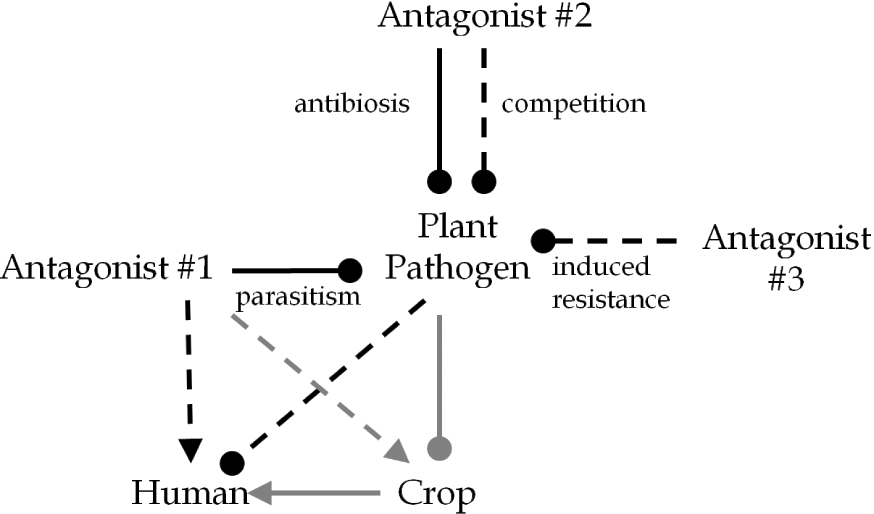
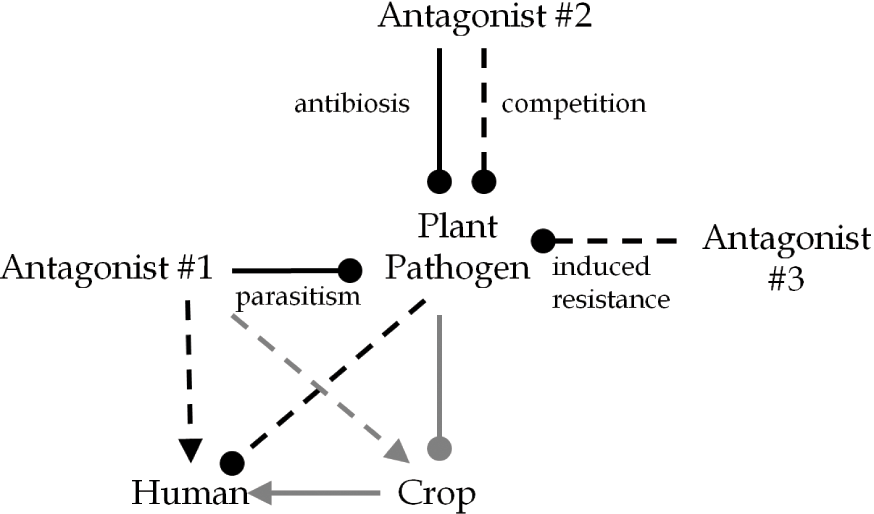
Interactions among host plants, pathogens and biological control agents are complex, and it is well known that antagonists can exhibit multiple modes of action (Santoyo et al. Reference Santoyo, Orozco-Mosqueda and Govindappa2012). While some modes of action such as parasitism, antibiosis, competition and induced resistance are clearly encompassed by biological control (Figure 1.5), others, such as solubilization of micronutrients and release of phytohormones, can promote plant growth in the absence of any pathogens and should not be considered biological control. In response to this dilemma it has been suggested that rhizobacteria be reclassified as either biocontrol plant growth–promoting bacteria (Biocontrol-PGPB) or simply as PGPB to distinguish between these two different mechanisms for increased plant growth (Bashan & Holguin Reference Bashan and Holguin1998). Similarly, while the major mode of action of mycorrhizal fungi is improved plant nutritional status, they also function secondarily as biological control agents through induced resistance and competition for space and nutrients (Whipps Reference Whipps2004). Although factorial experiments can be used to separate the effects of plant growth promotion from those of biological control (Larkin & Fravel Reference Larkin and Fravel1999), the potential for microbial control agents to have multiple modes of action that can vary with plant genotype, microbiota and environmental conditions makes such studies particularly challenging.
Biological control relationships involving three classes of microbial antagonists of plant pathogens that are crop pests. Antagonist #1 class are parasites that consume the pest pathogen, producing a direct negative effect on the plant pathogen. Antagonist #2 class engage in direct competition via antibiosis or indirect competition for space or resources with the pest pathogen and produce a net positive indirect effect on humans because its negative effect on the crop is less than that of the pest pathogen. The antagonist #3 class produces the same net effect via induced resistance. See legend to Figure 1.2 for explanation of line types; not all indirect links are shown in the figure.
1.2.3 Resource Dilution Using Habitat Diversification
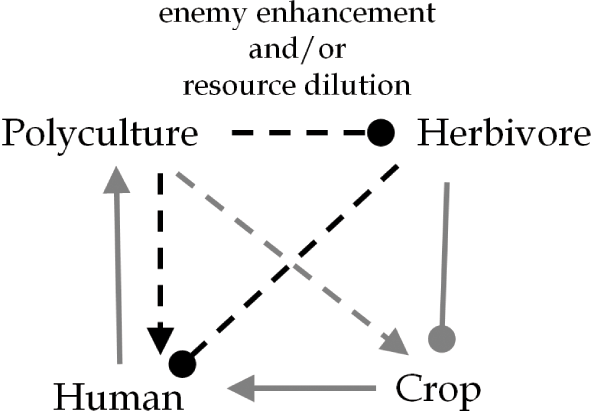
As we explain later and in Chapter 9, habitat diversification is one of the main strategies used in conservation biological control. This strategy is aimed mainly at arthropod pests and diseases of crops, and involves the establishment of polycultures that favor biological control agents. It is well known, however, that these manipulations can lead to pest and disease suppression in the absence of any benefit to biological control agents, and that a reduction in arthropod pest pressure can come from a dilution of the resource (the crop) for pest organisms – often because the pests have trouble actually locating and colonizing the crop within more diversified agroecosystems (Root Reference Root1973; Andow Reference Andow1991). This scenario is not traditionally considered biological control, but the non-crop vegetation itself might be considered a biological control agent of the herbivorous pest by making its favored host plant less accessible or apparent – in essence acting as a foil and resulting in an indirect positive effect on the crop plant (Figure 1.6; see also Parolin et al. Reference Parolin, Bresch, Poncet and Desneux2014). A definition of biological control that stresses ecological relationships suggests that the inclusion of pest and disease reduction through resource dilution should be classified as biological control.
Interactions leading to biological control of herbivores through an increase in vegetational diversity by polyculture establishment within a cropping system. An indirect positive effect on the crop can occur through natural enemy enhancement and/or through decreased apparency of crop plants for herbivores, as can occur through resource concentration. See legend to Figure 1.2 for explanation of line types.
1.2.4 Genetic Control
The best-known form of genetic control is the release of sterile male insects, which is also called the ‘sterile insect technique’ or ‘autocidal control’. In traditional sterile male release programs, mass-reared and sterilized males of a pest species are released to mate with wild females, rendering them infertile. This mode of pest management was first used with great success to eradicate populations of the screwworm, Cochliomyia hominivorax, from the island of Curaçao and large areas of continental North America (Baumhover Reference Baumhover2002). Sterile male releases have also been used with success against various fruit fly species (Krafsur Reference Krafsur1998) and are under consideration for control of the highly invasive and destructive sea lamprey in the North American Great Lakes (Bergstedt et al. Reference Bergstedt, McDonald, Twohey and Heinrich2003; Twohey et al. Reference Twohey, Heinrich, Seelye, Fredricks, Bergstedt, Kaye, Scholefield, McDonald and Christie2003). Cytoplasmic incompatibility (C.I.) induced by bacterial endosymbionts in the genus Wolbachia can also form the basis of a sterile male release method. The incompatibility occurs when Wolbachia-carrying males mate with females that are either Wolbachia-free or harbor a different strain of Wolbachia. Females become effectively sterile as a result of these matings. Local eradication of the mosquito Culex pipiens fatigans was achieved by this method in the 1960s before the role of Wolbachia in causing cytoplasmic incompatibility was understood (Laven Reference Laven1967).
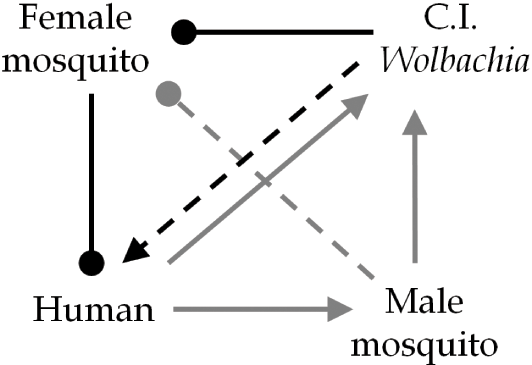
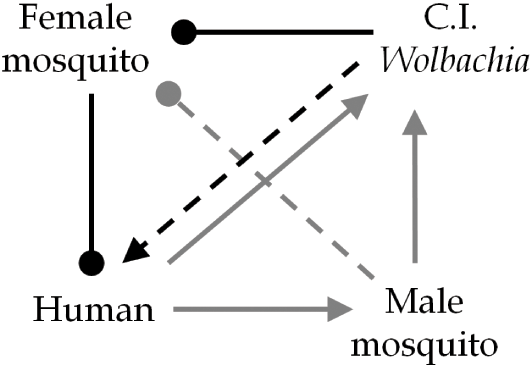
These and other genetic methods of pest control have not been traditionally viewed as biological control tactics, but they do constitute biological control by our definition, because the sterile males have an indirect positive effect on humans by having a negative effect (indirect if Wolbachia are used) on female pests (Figure 1.7). Our ecologically based definition leads to the classification of these interactions as biological control despite the fact that sterile males belong to the same species as the target females, and despite the fact that the traditional mechanisms of biological control – predation, herbivory, parasitism, induced defense and competition – are not involved.
Interactions illustrating genetic biological control using the release of sterile males of a pest mosquito species. In this case sterility is achieved by Wolbachia bacteria that induce cytoplasmic incompatibility (C.I.). The C.I. Wolbachia can be either naturally occurring within particular mosquito strains or they can be purposefully incorporated (as illustrated in this diagram). The text describes extensions of this method that involve strain replacement. See legend to Figure 1.2 for explanation of line types.
In some extensions of these genetic control programs, the goal is to replace the pest species (or strain) with a harmless one (Dobson et al. Reference Dobson, Fox and Jiggins2002; Gould & Schliekelman Reference Gould and Schliekelman2004) and these also constitute biological control by our criteria. Here, the released agents may include females, and they are expected to mate and reproduce successfully with pest species. Control comes about through the introduction of genetic material that compromises the fitness of hybrid individuals and favors the introduced (more benign) genotype at the expense of the harmful one. This method can involve various genetic constructs and it forms the basis for the goal of driving desirable genes into pest populations using transgenesis of the organisms themselves or their symbionts (Gould & Schliekelman Reference Gould and Schliekelman2004; Xi et al. Reference Xi, Khoo and Dobson2005). This general approach was field-tested in northeastern Australia in 2011 using Aedes aegypti mosquitoes that contained a Drosophila melanogaster–derived strain of C.I. Wolbachia that greatly limits the transmission of dengue fever from mosquitoes to human hosts (Hoffmann et al. Reference Hoffmann, Montgomery, Popovici, Iturbe-Ormaetxe, Johnson, Muzzi, Greenfield, Durkan, Leong, Dong, Cook, Axford, Callahan, Kenny, Omodei, McGraw, Ryan, Ritchie, Turelli and O’Neill2011). The frequency of A. aegypti harboring this Wolbachia strain reached near fixation within five months of the beginning of releases, proving that strain replacement using cytoplasmic incompatibility is possible. A regional reduction of cases of dengue fever is likely as a result of these releases (Hoffmann Reference Hoffmann2014). Despite the great promise of genetic control methods, implementation presents a number of challenges. These include identification of useful genes to be driven into pest populations, stability of the transgenes, negative fitness consequences of the genetically modified strains, economic feasibility, the possibility of ecological harm and a potentially negative public perception associated with the field releases of transgenic animals (e.g., Curtis Reference Curtis2000; Dobson Reference Dobson2003; Rasgon et al. Reference Rasgon, Stryer and Scott2003; Gould & Schliekelman Reference Gould and Schliekelman2004; Irvin et al. Reference Irvin, Hoddle, O’Brochta, Carey and Atkinson2004; Turelli Reference Turelli2010; David et al. Reference David, Kaser, Morey, Roth and Andow2013; Alphey Reference Alphey2014).
1.2.5 Immunocontraception
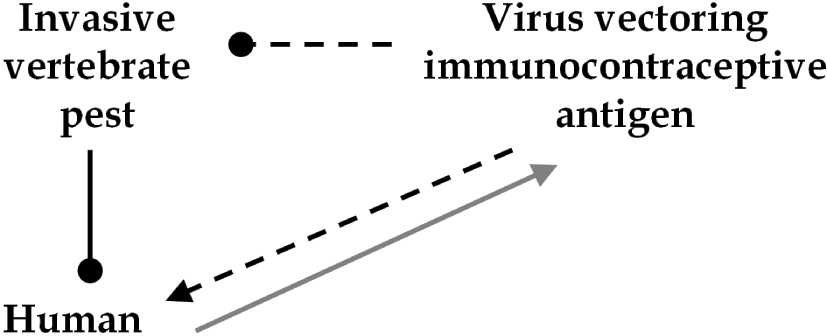
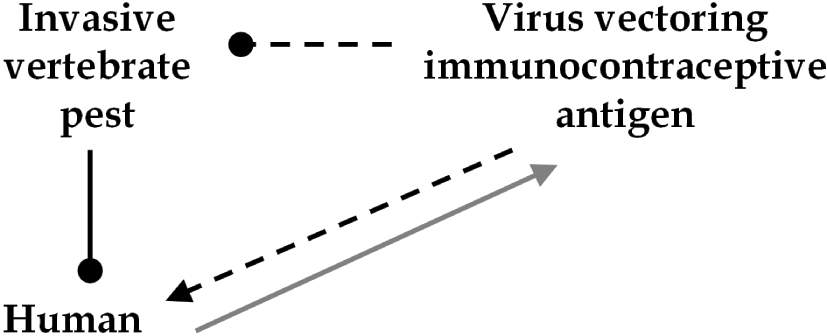
Immunocontraception is being increasingly considered as a method for controlling vertebrate pests. The method consists of deploying one or more proteins from the pest’s reproductive system as an antigen to induce an immune response that disables reproduction. In Australia, immunocontraception has been called the ‘holy grail of vertebrate pest control’ (McCallum Reference McCallum1996). Beyond injecting the pest organisms directly, the antigens can be delivered by one of two methods: baits or self-replicating and spreading vectors such as viruses. We follow Barlow (Reference Barlow2000) in considering only vectored immunocontraception as true biological control (Figure 1.8). More details on these systems are discussed in the following section on disease organisms used in vertebrate pest control.
Interactions involved in the potential release of viruses that are genetically engineered to vector immunocontraceptive antigens against invasive vertebrate pests. See legend to Figure 1.2 for explanation of line types.
1.3 Categories of Biological Control
Manipulative biological control tactics have traditionally been classified as ‘classical’, ‘augmentative’ or ‘conservation’ biological control. These strategies can be used either singly or in combination (Newman 1998; Gurr & Wratten Reference Gurr and Wratten1999). There has been some movement to erect the term ‘systems management approach’ to avoid perpetuating artificial borders between these strategies in weed biological control (Charudattan et al. Reference Charudattan, Chandramohan, Wyss and Wheeler2002). For consistency, however, we retain the three terms and recognize both that multiple strategies can be used, and that these terms do not encompass all facets of biological control. In addition, we stress the importance of natural biological control, in which no human manipulation is involved. All of these forms of biological control will be discussed throughout this book, and we provide a brief introduction and definition of terms here.
1.3.1 Classical (= Importation) Biological Control (Chapters 2–5)
In classical or importation biological control, a biological control agent from the native geographic range of an exotic pest is imported and established to provide long-term control. This form of biological control has been used extensively for the suppression of invasive arthropods and weeds, occasionally for the suppression of invasive vertebrate pests, but not at all for the suppression of plant pathogens or nematodes. The biological control agent is typically collected from the pest species itself, but may also be collected from closely related species. Although the term classical biological control has been used to describe this practice, we prefer the term importation biological control, which has been used as well and is more descriptive and less jargonny – we therefore will mainly use the latter term throughout this book. Lockwood (Reference Lockwood1993) suggested that the term neoclassical biological control be used to describe cases in which exotic biological control agents are imported to suppress native pests. More broadly, new associations (or novel associations) biological control refers to use of biological control agents that do not have an evolutionary history with the pest without regard to whether the pest or biological control agent is native (Hokkanen & Pimentel Reference Hokkanen and Pimentel1989; Wiedenmann & Smith Reference Wiedenmann and Smith1997). This includes importation biological control projects in which the biological control agent was collected from pests other than the target pest for logistic reasons.
1.3.2 Augmentative Biological Control (Chapter 8)
In augmentative biological control, biological control agents are mass-reared and released against pests with the aim of relatively short-term suppression. This is the primary form of biological control against plant pathogens and nematodes, and has been used extensively for the suppression of arthropod pests, but has not been developed for suppression of vertebrate pests. Augmentative control of weeds is achieved through the application of living mycoherbicides, but not yet via application of arthropods. The temporary control of weeds using management of grazing animals such as goats could be considered augmentative biological control (Wardle Reference Wardle1987), and mass-reared, sterilized grass-carp have been released to control aquatic weeds in parts of the United States (Hanlon et al. Reference Hanlon, Hoyer, Cichra and Canfield2000). A critical difference between importation and augmentative biological control is that importation biological control is ideally permanent with no need to re-apply the biological control agent after it has been established. Despite this, augmentative releases of already established biological control agents that had been established through importation biological control are sometimes utilized if the agents fail to provide complete control. For example, importation biological control of the California red scale, Aonidiella aurantii, by the parasitoid Aphytis melinus is considered a success in some parts of California, but augmentation of A. melinus is still widely practiced in these areas (Hare & Morgan Reference Hare and Morgan1997).
Biological control agents used in augmentation are typically commercially mass-produced and the taxa utilized range from microbes and nematodes to arthropods. The common practice of propagation of introduced importation weed biological control agents for redistribution might be considered augmentation, but should more correctly be viewed as facilitation of the natural rate of dispersal of a colonizing biological control agent population. The terms inundative and inoculative biological control are used to differentiate between augmentative biological control releases in which either no reproduction or a few generations of reproduction is expected, respectively. Inoculative biological control programs are often used seasonally and are common in greenhouse settings, where augmentative biological control of arthropod pests has been particularly successful (Heinz et al. Reference Heinz, Van Driesche and Parrella2005).
1.3.3 Conservation Biological Control (Chapters 9, 10)
In conservation biological control, tactics are sought that will improve existing levels of biological control. These tactics include selection of pesticides that do not harm biological control agents, and habitat manipulation aimed at increasing biological control agent activity through increased retention, attraction, survival or reproduction. Conservation practices have played an important role in the biological control of arthropod pests, plant pathogens and nematodes, but have seldom been explored for weed and vertebrate suppression. The deployment of bird nesting boxes to increase the capacity for arthropod or rodent control is a form of conservation biological control (e.g., Mols & Visser Reference Mols and Visser2007; Jedlicka et al. Reference Jedlicka, Greenberg and Letourneau2011; Paz et al. 2013). Many cases of conservation biological control involve the establishment of some kind of polyculture (e.g., intercropping, cover cropping, border vegetation) (Andow Reference Andow1991; Landis et al. Reference Landis, Wratten and Gurr2000). In these cases, reduced pest pressure may be achieved in polycultures by reduced colonization or retention of herbivorous pests (Root’s [Reference Root1973] ‘resource concentration’ hypothesis) and/or through the increased action of biological control agents (Root’s ‘enemies’ hypothesis) (see Figure 1.6). Of these two mechanisms, only the enemies hypothesis has traditionally been considered to constitute conservation biological control as we have discussed previously.
1.3.4 Natural Biological Control
While conservation biological control takes advantage of resident biological control agents, it still involves management to more effectively utilize the services of these enemies. We have already pointed out that naturally occurring biological control plays an important role in pest suppression. One interesting way in which pest managers have taken advantage of natural biological control has been to modify recommendations for pesticide applications based on the naturally occurring densities of biological control agents (e.g., Hoffmann et al. Reference Hoffmann, Wilson, Zalom and Hilton1990; Flint & Dreistadt Reference Flint and Dreistadt1998; Walker et al. Reference Walker, Herman, Kale and Wallace2010; Hallett et al. Reference Hallett, Bahlai, Xue and Schaafsma2014). In some cases, the recommendation is not to spray at all if the density of a particular biological control agent is high enough (regardless of pest density), and in other cases, the threshold pest density at which spraying is recommended is higher when biological control agents are present.
1.4 Some Trends in the Science of Biological Control
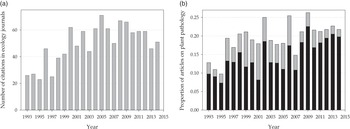
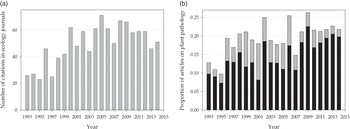
Biological control is in a growth phase as a scientific discipline. Three major international scientific journals currently focus exclusively on biological control, two of which were launched in the early 1990s. The profile of biological control in the ecological sciences has been growing as well, with an increasing number of articles on biological control appearing in ecology-oriented journals (Figure 1.9b). Interest in biological control has also been growing in the field of plant pathology. The fraction of articles in the three major biological control journals (Entomophaga/BioControl, Biological Control and Biocontrol Science and Technology) devoted to biological control of plant pathogens or the use of plant pathogens to control weeds has increased to more than 20% over the past 20 years (Figure 1.9b). Other previously underrepresented areas in which interest is growing include biological control of marine pests (Lafferty & Kuris Reference Lafferty and Kuris1996; Secord Reference Secord2003; Teplitski & Ritchie Reference Teplitski and Ritchie2009) and biological control of mammals using disease organisms (Hoddle Reference Hoddle, Bellows and Fisher1999).
(a) The number of articles in ecology journals for which ‘biological control’ appears as a topic term in the Web of Science between 1993 and 2014. Journals consulted: American Naturalist, Biological Conservation, Conservation Biology, Ecological Applications, Ecological Entomology, Ecological Modelling, Ecology, Functional Ecology, Journal of Animal Ecology, Journal of Applied Ecology, Journal of Chemical Ecology, Journal of Ecology, Molecular Ecology, Oecologia, Oikos, Researches on Population Ecology/Population Ecology and Trends in Ecology and Evolution. (b) The proportion of articles published in biological control journals that focused on either biological control of plant pathogens (black portion of bars) or the biological control of weeds using plant pathogens (gray portion of bars) between 1993 and 2014. Journals consulted: Entomophaga/BioControl, Biological Control and Biocontrol Science and Technology.
How can we explain this general increase in interest in biological control? The continued relevance of pest, disease and weed problems in general, and the increase in invasive pests over recent decades in particular, clearly constitutes one class of reasons. For stemming the invasion of plants and animals into pristine or natural areas, biological control is often seen as the only viable option, and there has therefore been an increase in biological control of invasive species of conservation concern (Van Driesche et al. Reference Van Driesche, Carruthers, Center, Hoddle, Hough-Goldstein, Morin, Smith, Wagner, Blossey, Brancatini, Casagrande, Causton, Coetzee, Cudam, Ding, Fowler, Frankm, Fuester, Goolsby, Grodowitz, Heard, Hill, Hoffmann, Huber, Julien, Kairo, Kenis, Mason, Medalm, Messing, Miller, Moore, Neuenschwander, Newman, Norambuena, Palmer, Pemberton, Perez Panduro, Pratt, Rayamajhi, Salom, Sands, Schooler, Schwarzländer, Sheppard, Shaw, Tipping and van Klinken2010). Also, while some effort has been made to develop chemical pest control methods that pose less risk to humans and the environment (this topic is covered in Chapter 10), highly toxic pesticides have remained the rule rather than the exception, at least into the early 21st century (Johnston Reference Johnston2001). The promise of reducing pesticide use remains one of the main incentives for studying and developing biological control.
The importance of invasive species in affecting not only human health and economies, but also natural ecosystems, has grown over the past decade as well, so that invasion biology is now recognized as a subdiscipline within ecology. Since biological control is one of the main strategies to combat invasive species, it has figured prominently in the field of invasion biology, as we discuss in the next chapter. Biological control introductions also constitute biological invasions themselves, and share some of the risks associated with unintentional biological invasions. And thus, some of the increased attention garnered by biological control is related to negative impacts of biological control introductions, and how to reduce them (Follett & Duan Reference Follett and Duan2000; Wajnberg et al. Reference Wajnberg, Scott and Quimby2001; Bigler et al. Reference Bigler, Babendreier and Kuhlmann2006). This topic is developed more fully in Chapters 4 and 5.
New technologies have also played a role in increasing interest in biological control over the past decade. Advances in molecular genetics have greatly increased our ability to distinguish between strains and cryptic species of biological control agents. This has been a boon particularly for the biological control of plant pathogens, where pest and beneficial organisms may belong to the same species, and where advances in molecular biology have aided elucidation of the mechanisms of systemic acquired resistance (Durrant & Dong Reference Durrant and Dong2004) among other processes. There is also considerable interest in developing transgenic biological control agents (Ashburner et al. Reference Ashburner, Hoy and Peloquin1998; Lacey et al. Reference Lacey, Kaya and Vail2001; Robinson et al. Reference Robinson, Franz and Atkinson2004; Snow et al. Reference Snow, Andow, Gepts, Hallerman, Power, Tiedje and Wolfenbarger2005; St. Leger & Wang Reference Leger and Wang2010), including the genetic control techniques discussed earlier in Section 1.2.4. Transgenic biological control organisms that have been released in the field include predatory mites and entomopathogenic nematodes with marker genes added for experimental purposes only, and baculoviruses engineered to express insect-specific neurotoxins (Harrison & Bonning Reference Harrison, Bonning, Rechcigl and Rechcigl2000; Hoy Reference Hoy, Handler and James2000a). A variant of this approach is to use genetic engineering to transform nonpathogenic organisms into pathogenic ones, as has been done with the movement of Bacillus thuringiensis (Bt) toxin genes into otherwise non-toxic endophytic bacteria that colonize crop plants (e.g. Tomasino et al. Reference Tomasino, Leister, Dimock, Beach and Kelly1995). Other examples of this general strategy are discussed in Chapters 5 and 8. While genetic engineering of biological control agents is an active research area, the widespread use of such agents may in the end be determined as much by issues related to economics, public acceptability and regulatory policy as by scientific discoveries.
The development of transgenic plants, particularly those modified to be resistant to pest insects, has also spurred research in biological control. This may seem paradoxical because these crops are designed to decrease pest problems and could therefore reduce the need for biological control. However, the ecological implications of the transition from traditional pesticide applications to genetically modified crops for biological control need to be understood. Thus, the advent of transgenic insecticidal crops has spurred research on effects of the transgenes on the abundance, diversity and fitness of biological control agents (Andow & Hilbeck Reference Andow and Hilbeck2004; Sisterson & Tabashnik Reference Sisterson and Tabashnik2005; Wolfenbarger et al. Reference Wolfenbarger, Naranjo, Lundgren, Bitzer and Watrud2008; Lovei et al. Reference Lovei, Andow and Arpaia2009; Lundgren et al. Reference Lundgren, Gassmann, Bernal, Duan and Ruberson2009; Duan et al. Reference Duan, Lundgren, Naranjo and Marvier2010), as well as effects that biological control agents will have on the evolution of pest resistance to transgenic crops (Gould Reference Gould1994; Heimpel et al. Reference Heimpel, Neuhauser and Andow2005; Onstad et al. Reference Onstad, Liu, Chen, Roush and Shelton2013; Liu et al. Reference Liu, Chen, Collins, Onstad, Roush, Zhang, Earle and Shelton2014). In addition, decreases in insecticide use that accompany transgenic crops should lead to the opportunity to implement biological control against pests that are not targeted by the insecticidal transgene but that were previously controlled by broad-spectrum insecticides (Sisterson et al. Reference Sisterson, Biggs, Manhardt, Carriere, Dennehy and Tabashnik2007; Lu et al. Reference Lu, Wu, Jiang, Guo and Desneux2012).
Another growth area in both ecology and biological control is the study of indirect interactions (e.g., Wajnberg et al. Reference Wajnberg, Scott and Quimby2001; Persello-Cartieux et al. Reference Persello-Cartieaux, Nussaume and Robaglia2003; Harmon & Andow Reference Harmon and Andow2004; Schmitz et al. Reference Schmitz, Krival and Ovadia2004; Brodeur & Boivin Reference Brodeur and Boivin2006), which is a theme throughout this book, but will receive particular attention in Chapters 2, 3, 4, 5 and 9. The successful biological control of herbivores, in which a biological control agent increases the fitness of the herbivore’s host plant by reducing herbivore pressure, is an example of a trophic cascade. More complicated and interesting interactions are possible, however, and some of these are just now beginning to be studied and documented in field settings (Schmitz et al. Reference Schmitz, Krival and Ovadia2004). Systemic acquired resistance is one of the most striking examples of indirect interactions in biological control. Here, the presence of one plant pathogen or herbivore can induce resistance to other species of plant pathogens or herbivores feeding on the same plant. This can lead to very effective biological control if the inducer is a non-pest and the species subject to the resistance is a pest (Harman et al. Reference Harman, Howell, Viterbo, Chet and Loritto2004). It has become increasingly clear that complex indirect interactions of this and many other kinds are widespread in biological control, a fact that should come as no surprise since many biological control interactions occur within a broad ecological context.
There has also been a tentative increase in the cross-fertilization between biological control and evolutionary biology over the past decade or so. Until relatively recently, the only robust investigation of evolutionary dynamics occurring within the realm of biological control involved interactions between invasive rabbits and myxoma viruses (Fenner & Fantini Reference Fenner and Fantini1999; see Chapter 7). There is, however, great scope for evolutionary inquiries in many other areas of biological control (Ehler et al. Reference Ehler, Sforza and Mateille2004; Hufbauer & Roderick Reference Hufbauer and Roderick2005; Roderick & Navajas Reference Roderick, Navajas and Julien2008; Roderick et al. Reference Roderick, Hufbauer and Navajas2012). For example, biological control agents have often been presumed to be impervious to resistance evolution in the pests that they attack due to their presumed ability to counter resistance through coevolutionary mechanisms. This assumption, however, has begun to be questioned, on both theoretical and empirical grounds (e.g., Holt & Hochberg Reference Holt and Hochberg1997; Hufbauer & Via Reference Hufbauer and Via1999). The evolutionary dynamics of invading species has great relevance for biological control as well (Roderick Reference Roderick, Kauffman and Nechols1992; Roderick & Navajas Reference Roderick and Navajas2003, Reference Roderick, Navajas and Julien2008), both because invasive pests may evolve responses to resistance from native biota, and because biological control agents themselves may undergo evolutionary shifts of various kinds (Ehler et al. Reference Ehler, Sforza and Mateille2004).
And last, the discoveries beginning in the 1990s that many biological control agents and their associated pests are involved in complex interactions with endosymbiotic microorganisms that manipulate sex ratio and reproduction has spurred research into the implications of these dynamics for biological control (e.g., Stouthamer Reference Stouthamer1993, Reference Stouthamer, Ehler, Sforza and Mateille2004; Hsiao Reference Hsiao, Symondson and Liddell1996; Majerus & Hurst Reference Majerus and Hurst1997; Hunter Reference Hunter, Hawkins and Cornell1999; Silva et al. Reference Silva, Van Meer, Roskam, Hoogenboom, Gort and Stouthamer2000; Mochiah et al. Reference Mochiah, Ngi-Song, Overholt and Stouthamer2002; Oliver et al. Reference Oliver, Campos, Moran and Hunter2008). The discovery of defensive symbionts in arthropod pests as well as in crop plants is particularly important as it can help us explain the mechanisms by which resistance to biological control agents can occur and how this form of resistance can evolve (Hsiao Reference Hsiao, Symondson and Liddell1996; Oliver et al. Reference Oliver, Smith and Russell2014; Panaccione et al. Reference Panaccione, Beaulieu and Cook2014).
1.5 Biological Control Agents
Unlike some other authors of books on biological control (DeBach Reference DeBach1974; DeBach & Rosen Reference DeBach and Rosen1991; Van Driesche & Bellows Reference Van Driesche and Bellows1996; Hajek Reference Hajek2004; Van Driesche et al. Reference Van Driesche, Hoddle and Center2008), we do not provide a review of the biology of biological control agents. We feel that this material is well covered in these texts and also in more specialized sources cited later. In the following paragraphs, however, we provide a very brief summary of the organisms that figure prominently in biological control.
1.5.1 Predators
Predators that act as biological control agents include predatory arthropods (Hagen et al. Reference Hagen, Mills, Gordh, McMurtry, Bellows and Fisher1999; Symondson et al. Reference Symondson, Sunderland and Greenstone2002), insectivorous and carnivorous birds (Mols & Visser Reference Mols and Visser2007; Paz et al. 2013), fish that consume mosquito larvae and other aquatic pests (Garcia and Legner Reference Garcia, Legner, Bellows and Fisher1999), vertebrate predators of vertebrate pests (Hickling Reference Hickling, Gurr and Wratten2000) and predatory snails (Port et al. Reference Port, Glen, Symondson, Gurr and Wratten2000; Rondelaud et al. Reference Rondelaud, Vingoles, Dreyfuss and Mage2006). Predatory nematodes may also be important biological control agents of plant-parasitic nematodes and other soil microfauna (Yeates & Wardle Reference Yeates and Wardle1996). The presence of predators can have a strong suppressive effect on pest populations, and most or all of this suppression is presumed to be due to direct consumption. However, predators can also induce antipredator behavior in prey, which can similarly lead to decreased pest activity or abundance (Schmitz et al. Reference Schmitz, Krival and Ovadia2004). For example, predators may induce escape behavior in their prey that reduces their local density and may lead to an increased risk of mortality from other causes (e.g., Nakasuji et al. Reference Nakasuji, Yamanaka and Kiritani1973; Losey & Denno Reference Losey and Denno1998; Nelson et al. Reference Nelson, Matthews and Rosenheim2004; Kaplan & Thaler Reference Kaplan and Thaler2010).
Not only strict predators engage in predation. For example, many arthropod biological control agents are omnivorous, consuming both herbivorous prey and plant material (Lundgren Reference Lundgren2009). Plant consumption by these species can reduce their effectiveness as biological control agents (by reducing the predation rate or causing direct plant damage), or it can increase their effectiveness as biological control agents (by sustaining them during times of low prey availability) (Coll & Guershon Reference Coll and Guershon2002). A second group of biological control agents that engage in predation despite not being strict predators are parasitoids, which are discussed later. Adult females of many parasitoid species prey upon the same host species (or even the same individuals) that they parasitize. This behavior is known as ‘host-feeding’, and it can rival parasitism as a source of herbivore mortality, while supplying parasitoids with nutrients that support additional parasitism (Jervis & Kidd Reference Jervis and Kidd1986; Heimpel & Collier Reference Heimpel and Collier1996).
Predation can also interfere with biological control, as occurs when predators feed on biological control agents (Goeden & Louda Reference Goeden and Louda1976; Rosenheim Reference Rosenheim1998). Many predator species consume pests as well as other predator species, an interaction known as intraguild predation if both predators consume a shared prey (pest) species (Rosenheim et al. Reference Rosenheim, Kaya, Ehler, Marois and Jaffee1995). The net effect of intraguild predators on biological control of herbivorous pests depends on factors such as preference for and encounter rates with the herbivorous versus predatory–prey (Rosenheim & Corbett Reference Rosenheim and Corbett2003) and the presence of additional links in the food web (Janssen et al. Reference Janssen, Montserrat, HilleRisLambers, De Roos, Pallini, Sabelis, Brodeur and Boivin2006; Rosenheim & Harmon Reference Rosenheim, Harmon, Brodeur and Boivin2006).
1.5.2 Herbivores
Herbivorous biological control agents include arthropods for the control of terrestrial weeds, and arthropods and fish for freshwater aquatic weeds. In addition, sea slugs have been contemplated for the biological control of algae in marine environments (Coquillard et al. Reference Coquillard, Thibaut, Hill, Gueugnot, Mazel and Coquillard2000). While victims of predation are almost invariably killed, plants and algae that herbivores feed on often survive the encounter, and in some cases may even benefit from herbivory through compensatory growth or induced resistance (Whitham et al. Reference Whitham, Maschinski, Larson, Paige, Price, Lewinsohn, Fernandes and Benson1991; Karban & Baldwin Reference Karban and Baldwin2000). Myers and colleagues (Reference Myers, Higgins and Kovacs1989) have suggested that compensatory growth and/or reproduction in response to herbivorous biological control agents may be especially common in invasive weeds that are limited by intraspecific competition (see also Ortega et al. Reference Ortega, Pearson, Waller, Sturdevant and Maron2012). On the other hand, herbivory does not necessarily need to kill plants for biological control to be successful. Weeds that are reduced in vigor by herbivory are often weaker competitors and may suffer disproportionately large effects from herbivory when growing in competition with other plants (e.g., McEvoy & Coombs Reference McEvoy and Coombs1999).
1.5.3 Parasitoids
All parasitoids are holometabolous insects, but beyond this they are bound together as a group by a unique suite of life history characteristics rather than by common ancestry. Adult females are free-living, and deposit one or more eggs in, on or near host individuals. The parasitoid larvae then develop on and consume the host organism, almost invariably killing it in the process (Godfray Reference Godfray1994; Quicke Reference Quicke1997). The parasitoid life history combines aspects of biology seen in some predatory, herbivorous and parasitic insects. Like many predators and herbivores, adult female parasitoids seek out resources that will be consumed. Unlike most predators, however, only the immature stages of most parasitoid species consume pest organisms (the exceptions are host-feeding species as noted earlier). Also unlike predators, at most a single host individual is consumed by an individual parasitoid larva, and parasitoid larvae are sessile during the feeding stage. And unlike ectoparasites such as ticks and lice, parasitoids almost invariably kill their host.
Most insect herbivore species are attacked by one or more parasitoid species, but some major arthropod pest groups appear to be entirely free of parasitoid attack. For instance, we know of no parasitoids that attack mosquitoes or other biting flies with aquatic larval stages, and no parasitoids that attack phytophagous mites or adelgids. Many social insects appear to be free of parasitoids as well – we know of no parasitoids of termites, and only a few parasitoid taxa that attack ants. There are some cases of parasitoid attacks on non-arthropods, and one of these is of relevance to biological control. Some parasitoid flies in the family Sciomyzidae attack aquatic pest snails, including species that transmit schistosomiasis to humans (Garcia and Legner Reference Garcia, Legner, Bellows and Fisher1999).
As is the case for predators, not all parasitoid species are beneficial biological control agents. Predators, herbivores and other parasitoids providing biological control can themselves be attacked by parasitoids, potentially compromising the suppression of pest populations (Goeden & Louda Reference Goeden and Louda1976; Rosenheim Reference Rosenheim1998). Hyperparasitoids (also known as ‘secondary’ parasitoids) are parasitoids that attack other, ‘primary’ parasitoid species, and there is some anecdotal (but little experimental) evidence that hyperparasitoids can interfere with biological control programs by attacking otherwise effective parasitoids of pests. Some hyperparasitoids are capable of attacking both the primary parasitoids and the host(s) of these primary parasitoids and thus act in ways functionally identical to intraguild predation. The effect of these facultative hyperparasitoids on biological control is variable, and likely depends on factors such as the attack rate of the facultative hyperparasitoid on the pest versus the primary parasitoid (Rosenheim et al. Reference Rosenheim, Kaya, Ehler, Marois and Jaffee1995; Pedersen & Mills Reference Pedersen and Mills2004). In a subset of hyperparasitoids known as heteronomous hyperparasitoids, female larvae develop on pest hosts, while males develop on other parasitoids including conspecific females (Hunter & Woolley Reference Hunter and Woolley2001). When heteronomous hyperparasitism is confined to conspecific females (autoparasitism), it can provide effective control, but when directed toward other parasitoid species, it is more likely disruptive (Mills & Gutierrez Reference Mills and Gutierrez1996).
1.5.4 Entomopathogens
Most pathogens of insects reproduce within their host by causing breakdown of its tissues and incorporating the breakdown products into additional pathogen biomass. This general form of consumption is common to viruses, bacteria, fungi, protozoans and nematodes. Many entomopathogenic bacteria and fungi used in biological control release toxins into the host to facilitate the breakdown process (Tanada and Kaya Reference Tanada and Kaya1993). In the case of entomopathogenic nematodes in the families Steinernematidae and Heterorhabditidae (the families containing the most important biological control agents), mutualistic bacteria are the agents of host decomposition and the nematodes use the breakdown products and accumulated bacterial biomass for growth and reproduction.
The relatively short span of time separating infection and death that these toxins and mutualistic bacteria achieve has facilitated the use of some entomopathogens as augmentative biological control agents in ways that approximate insecticide use. Along these lines, attempts have been made to incorporate toxin-producing genes into the genome of baculoviruses for the express reason of hastening the time-to-death of their insect hosts (Bonning et al. Reference Bonning, Boughton, Harrison and Upadhyay2002). Sub-lethal levels of host consumption that negatively impact various fitness components are caused by a number of entomopathogenic viruses, fungi, protozoans and nematodes. While these agents cannot be used to achieve a rapid host kill, they can be very effective at decreasing average or equilibrium population densities below pest levels (e.g., Lacey et al. Reference Lacey, Kaya and Vail2001).
1.5.5 Plant Pathogens Used in Weed Control
Plant-parasitic fungi and to a lesser extent bacteria and nematodes are used as biological control agents of weeds. Many of these agents are formulated as sprays (bioherbicides) and used as inundative or inoculative agents, but there are also cases of successful importation biological control of weeds using rust fungi (Charudattan et al. Reference Charudattan, Chandramohan, Wyss and Wheeler2002). As we have noted earlier, infection by pathogens can activate resistance responses within plants – both to the infection itself and to other pathogens and herbivores. Infection by plant pathogens can put weeds at a competitive disadvantage with respect to other plants so that biological control can be particularly effective when weeds are subject to strong interspecific competition (Cousens & Croft Reference Cousens and Croft2000; Abu-Dieyeh & Watson Reference Abu-Dieyeh and Watson2007).
1.5.6 Plant Pathogen Antagonists
Antagonists used in biological control of plant pathogens include bacteria, fungi, yeasts and viruses. While members of all of these groups are active in natural biological control of plant pathogens, their commercial development as products for biological control augmentation has been confined to bacteria and fungi, with one example of a virus product (Whipps & McQuilken Reference Whipps, McQuilken and Walters2009). As already discussed (Figure 1.5), agents can act by any (or a combination) of four mechanisms: (i) direct consumption such as actinomycete parasitism of fungal spores (El-Tarabily et al. Reference El-Tarabily, Hardy, Sivasithamparam, Hussein and Kurtboke1997; Bolwerk et al. Reference Bolwerk, Lagopodi, Wijfjes, Lamers, Chin-A-Woeng, Lugtenberg and Bloemberg2003; Steyaert et al. Reference Steyaert, Ridgway, Elad and Stewart2003), (ii) competition between fungal or bacterial pathogens and nonpathogenic fungi or bacteria for colonization sites and/or nutrients (Janisiewicz et al. Reference Janisiewicz, Tworkoski and Sharer2000; Lindow & Leveau Reference Lindow and Leveau2002; Olivain et al. Reference Olivain, Humbert, Nahalkova, Fatehi, L’Haridon and Alabouvette2006), (iii) antibiosis or the production of antibiotic compounds primarily by bacteria (Raaijmakers et al. Reference Raaijmakers, Vlami and de Souza2002) or (iv) systemic induced or acquired resistance to other plant pathogens that can result from the action of all types of antagonists (Kloepper et al. Reference Kloepper, Tuzun and Kuć1992; Bakker et al. Reference Bakker, Ran, Pieterse and Van Loon2003). The application of molecular tools has contributed to an enhanced understanding of the modes of action of antagonists and the importance of environmental conditions and plant genotype in mediating the action of antagonists. New developments in the use of antagonists have focused on formulation, mixtures of biological control agents and integration with cultural and chemical control methods (Whipps Reference Whipps2001; Whipps & McQuilken Reference Whipps, McQuilken and Walters2009).
1.5.7 Diseases of Vertebrates
Disease organisms used or contemplated as biological control agents of vertebrate animals include viruses, bacteria, protozoans and nematodes (Dobson Reference Dobson1988; Fenner & Fantini Reference Fenner and Fantini1999; Hoddle Reference Hoddle, Bellows and Fisher1999). Viruses have played the most important role and examples include the myxoma virus and rabbit hemorrhagic disease against rabbits and feline parvo virus against cats (Di Giallonardo & Holmes Reference Di Giallonardo and Holmes2015b). The case of the myxoma virus is one of the most important in the annals of biological control (Fenner & Fantini Reference Fenner and Fantini1999). This program has been viewed largely as a success, leading to sizable reductions in rabbit populations in Australia and Chile (Jaksić & Yáñez Reference Jaksić and Yáñez1983; Fenner & Fantini Reference Fenner and Fantini1999; Saunders et al. Reference Saunders, Cooke, McColl, Shine and Peacock2010), despite the evolution of resistance to myxoma in Australia. The interaction between resistance by rabbits and virulence by the virus is a textbook example of the evolution of intermediate-level virulence in disease organisms, as we discuss in Chapter 7.
The most advanced form of biological vertebrate control is virus-vectored immunocontraception (VVIC), in which species-specific viruses are genetically engineered to carry a gene encoding for antigenic proteins associated with either host eggs or sperm. The infection of the target pest with this protein is designed to trigger an autoimmune response against its own gametes, blocking fertilization (Seamark Reference Seamark2001; Courchamp et al. Reference Courchamp, Chapuis and Pascal2003). This technique has been tested for use against rodents and other small mammals, but we are not aware of any releases of VVIC agents (Massei & Cowan Reference Massei and Cowan2014). In Australia, the primary targets are the house mouse, European rabbits and the European red fox, and viruses that have been studied as vectors for these three pests include murine cytomegalovirus, myxoma virus and canine herpes virus, respectively (Seamark Reference Seamark2001). A number of modeling studies have shown that VVIC has great potential in vertebrate pest control when used judiciously (e.g., Barlow Reference Barlow1994; Courchamp & Cornell Reference Courchamp and Cornell2000; Hood et al. Reference Hood, Chesson and Pech2000). Disadvantages that have been identified include irreversibility, development of host resistance, slow response and the need for engineering genetically modified vectors (Barlow Reference Barlow2000; Courchamp & Cornell Reference Courchamp and Cornell2000). One of the arguments put forth in favor of VVIC agents is that they can be designed to result in less animal suffering than alternative control measures such as trapping, shooting, poisoning or the dissemination of pathogens, all of which are aimed at reducing existing populations rather than reducing birth rates. However, as with genetically modified biological control organisms of arthropods discussed previously, the use in the field of these agents, once developed, may rest as much on economics and public acceptance as on scientific advances.
1.6 Conclusions
Biological control encompasses naturally occurring and human-aided decreases in the abundance or damage caused by pest organisms (including weeds) that is attributable to living organisms or viruses. Mechanisms by which biological control can function include but are not limited to predation, herbivory, parasitism, disease, competition, vectoring of disease agents, toxicity and sterility induction. Biological control is not restricted to interspecific interactions so that strategies involving inter-strain antagonism or replacement are included. Important biological control agents can be found within various animal groups as well as within the fungi, bacteria and viruses. Plants can be biological control agents via mechanisms of competition or by serving as a foil for pests of associated desirable plants. We have developed a definition of biological control based on ecological relationships. Biological control requires that an organism or virus have a negative effect on humans in some way (i.e., acts as a pest), and that an enemy (again – a living organism or virus) reduces this negative effect, resulting in an indirect positive effect on humans.
Biological control exists at the confluence of the fundamental natural sciences and applied sciences, and researchers have come to realize that the interactions that make up biological control are similar to ones that structure biological communities and reflect (as well as initiate) evolutionary processes, but also that biological control interactions can differ from natural interactions in important ways (Hawkins et al. Reference Hawkins, Mills, Jervis and Price1999). There is therefore potential for a rich and reciprocal interplay between efforts to improve the efficacy of biological control and efforts to elucidate fundamental principles of ecology and evolution.
It has been remarked in the past that success in biological control is due in part to art and in part to science (Sheppard & Raghu Reference Sheppard and Raghu2005). While it is certainly true that success in collecting and rearing biological control agents can have an elusive quality in which experience and intuition figure prominently, predictability and firm scientific standing has always been the ultimate goal in biological control. In the chapters ahead, we attempt to address the major scientific issues and hypotheses that underlie biological control interactions. We employ an ecological perspective because of the obvious links and overlap between biological control and the ecological sciences.