Book contents
- Frontmatter
- Contents
- List of maps
- Acknowledgments
- List of abbreviations
- Concordance of Caesarius's Letters
- Map 1The diocese of Aries and environs (c. 500)
- Map 2The city and suburbs of Aries (c. 530)
- Introduction
- 1In search of the vita perfecta
- 2Late Roman Aries
- 3The making of a reformer
- 4Visigothic Arles and its bishop
- 5The Ostrogothic peace
- 6Christian rhetoric and ritual action
- 7Christianity as a community religion
- 8The limits of christianization
- 9The coming of the Franks
- 10The legacy of Caesarius
- Select bibliography
- Index
- Cambridge Studies in Medieval Life and Thought Fourth series
9 - The coming of the Franks
Published online by Cambridge University Press: 02 December 2009

Book contents
- Frontmatter
- Contents
- List of maps
- Acknowledgments
- List of abbreviations
- Concordance of Caesarius's Letters
- Map 1The diocese of Aries and environs (c. 500)
- Map 2The city and suburbs of Aries (c. 530)
- Introduction
- 1In search of the vita perfecta
- 2Late Roman Aries
- 3The making of a reformer
- 4Visigothic Arles and its bishop
- 5The Ostrogothic peace
- 6Christian rhetoric and ritual action
- 7Christianity as a community religion
- 8The limits of christianization
- 9The coming of the Franks
- 10The legacy of Caesarius
- Select bibliography
- Index
- Cambridge Studies in Medieval Life and Thought Fourth series
Summary
Caesarius emerged from the Council of Vaison at the height of his political power, the uneven success of his programs of christianization and depaganization notwithstanding. His suffragans had supported his reform program at the Councils of Arles, Carpentras, and Vaison, joined him in censuring Agroecius at the Council of Carpentras, and together with Liberius and other lay aristocrats, endorsed his definition of grace at the Council of Orange. Theoderic had made these councils possible in the first place by incorporating the rest of Caesarius's metropolitan province into the Ostrogothic kingdom, thus allowing Caesarius to confirm in practice the metropolitan authority he claimed in theory. Popes Symmachus and Hormisdas, moreover, had extended valuable privileges to his monastery for women, and Pope Felix had supported his actions against Agroecius. By the late 520s, however, the political environment that Caesarius had found so favorable to his own ambitions was already beginning to deteriorate. Within six years of the Council of Vaison, largely as a result of events outside of his control, he was to lose much of the support he had come to depend upon from the Ostrogothic administration, his suffragan bishops, and the bishops of Rome.
RAVENNA AND ROME: 526–35
When Theoderic died in 526, he was succeeded by his ten-year-old grandson Athalaric, whose mother Amalasuintha was appointed to serve as regent. Without the powers of a king or the capacity to lead the Gothic army, Amalasuintha found it difficult to maintain Theoderic's delicate balance between aspirations to Romanitas and fidelity to Gothic tradition.
Information
- Type
- Chapter
- Information
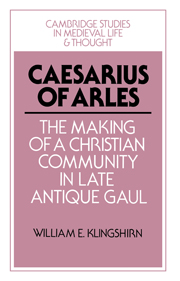
- Caesarius of ArlesThe Making of a Christian Community in Late Antique Gaul, pp. 244 - 272Publisher: Cambridge University PressPrint publication year: 1993
Accessibility standard: Unknown
Why this information is here
This section outlines the accessibility features of this content - including support for screen readers, full keyboard navigation and high-contrast display options. This may not be relevant for you.Accessibility Information
Accessibility compliance for the PDF of this chapter is currently unknown and may be updated in the future.