
Skip to main content Accessibility help
×
  • Cited by 16
    • Volume 2: Constantine to c.600
      Show more authors
    • You may already have access via personal or institutional login
    • Select format
    • Publisher:
      Cambridge University Press
      Publication date:
      28 March 2008
      30 August 2007
      ISBN:
      9781139054133
      9780521812443
      9781107423633
      Dimensions:
      (228 x 152 mm)
      Weight & Pages:
      1.369kg, 784 Pages
      Dimensions:
      (229 x 152 mm)
      Weight & Pages:
      1.12kg, 780 Pages
    You may already have access via personal or institutional login
  • Selected: Digital
    Add to cart View cart Buy from Cambridge.org

    Book description

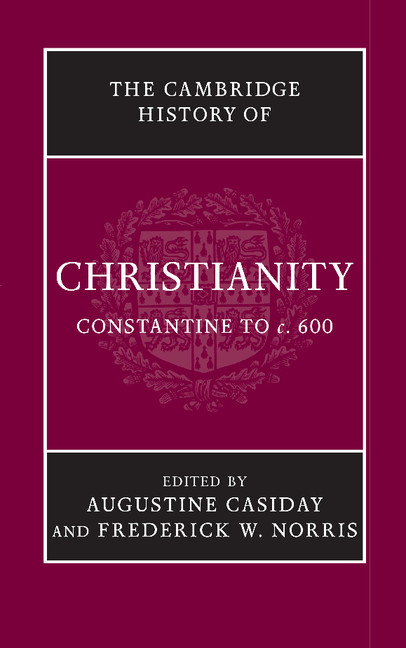
    This volume in the Cambridge History of Christianity presents the 'Golden Age' of patristic Christianity. After episodes of persecution by the Roman government, Christianity emerged as a licit religion enjoying imperial patronage and eventually became the favoured religion of the empire. The articles in this volume discuss the rapid transformation of Christianity during late antiquity, giving specific consideration to artistic, social, literary, philosophical, political, inter-religious and cultural aspects. The volume moves away from simple dichotomies and reductive schematizations (e.g., 'heresy v. orthodoxy') toward an inclusive description of the diverse practices and theories that made up Christianity at this time. Whilst proportional attention is given to the emergence of the Great Church within the Roman Empire, other topics are treated as well - such as the development of Christian communities outside the empire.

    Reviews

    'The twenty-nine essays in total paint a rich canvas of late antique Christianity in its many facets and illustrate the equally lively and varied engagement of current scholarship with this fascinating period … The contributors, editors and the Press must be congratulated for a volume to which the scholarly community will come back for many years as a standard reference tool.'

    Source: Journal of Ecclesiastical History

    '… elegant and learned essay … sweeping and evocative narrative … The volume more than justifies the historiographical assumption of contingent and variable early medieval "Christianities" rather an unchanging and immutable "Christianity" …impressive study of conversion … rewarding …splendid … a good and critical survey … excellent … sophisticated and thought-provoking … at once capture[s] the divinity, artfulness, and physical sensuality of texts … outstanding, expertly and eloquently examining how cults and their saints were capable of "endless reinvention" … All in all, Early Medieval Christianities, c.600-c.1100 is a worthy volume about Christians and their various "Christianities".'

    Source: Church History

    Refine List

    Actions for selected content:

    Select all | Deselect all
    • View selected items
    • Export citations
    • Download PDF (zip)
    • Save to Kindle
    • Save to Dropbox
    • Save to Google Drive

    Save Search

    You can save your searches here and later view and run them again in "My saved searches".

    Please provide a title, maximum of 40 characters.
    ×

    Contents


    Page 2 of 2


    • 25 - The growth of liturgy and the church year
      pp 601-617
    • View abstract

      Summary

      The Constantinian peace afforded the opportunity for new spacious church buildings, and a more public celebration of liturgy with more elaborate forms. The Spanish nun Egeria, after a visit to the Holy Land, reveals a well-established liturgical calendar, and describes the various weekday services in the holy city. This chapter traces the growth of liturgy in the ancient churches of Jerusalem, Antioch, East Syria, Egypt, Rome, and the West. At Rome, 15-23 December seems to have been regarded as the end of the agricultural year, perhaps suggesting the theme of the end of history. Christians assembled on the Lord's Day, which seemingly established itself quickly as the weekly worship day. In addition the Didache mentioned fasting on Wednesdays and Fridays. During the fourth century one can see the development of particular feasts and seasons. Egeria mentions Lent, Easter, Pentecost and Epiphany, and indicates that her community in Spain was well aware of these feasts and seasons.
    • 26 - Interpreting scripture
      pp 618-636
    • View abstract

      Summary

      The Bible provided the narrative framework in which Christians of late antiquity interpreted their world, and was the script by which they carried forward their own performance, or continuation, of the salvation story. A history of early scholarly commentary on scripture simply cannot give a full account, since this interpretive performance played out in diverse contexts in which Christians enacted their faith. Mapping the correspondences between prophetic events or figures (typoi) in the Old Testament and their fulfilments or antitypes under the Christian dispensation had long served to confute Jewish and pagan criticism of the novelty of Christianity, establishing a sacred past and credible identity for the Christian movement. Theôria, contemplation, an embracing spiritual vision of divine revelation, is the principal key to understanding scriptural interpretation in late antiquity. Theôria was the cultivated intuition of the church, at once shaping and shaped by exegesis, developing in constant tandem with the lived performance of the scriptures.
    • 27 - Asceticism and monasticism, I: Eastern
      pp 637-668
    • View abstract

      Summary

      Asceticism had deep roots in ancient society, both in the various religious traditions of the Eastern Mediterranean and in the Greek philosophical tradition. However, the emergence of monasticism constitutes a strikingly rapid and radical change of social, political and religious culture. This chapter discusses asceticism and monasticism in the East during the fourth and fifth centuries. It presents a discussion of some general characteristic features that precedes a typological description of the main varieties and a sketch of the tradition's emergence in the five major areas: Egypt, Palestine, Syria, Asia Minor and Constantinople. In various ways the ascetic groups in the cities, as well as the ascetic households, were transformed into monasteries. In monastic communities, the spiritual direction of the disciple by his master or the answers of the solitary monks to those seeking advice were gathered and transmitted in growing collections of spiritual wisdom.
    • 28 - Asceticism and monasticism, II: Western
      pp 669-690
    • View abstract

      Summary

      As the fifth century wore on, monasticism became an increasingly familiar fixture in Western society, though there were considerable divergences in the types of monastic life to be found within any one area of Western Europe. In Gaul, for instance, not all communities could afford or wished to embrace the aristocratic and learned lifestyle of Lérins. The earliest monastic rules frequently attempted to capture the essence of the spirit inspiring the groups from which they originated. Benedict's Rule is mentioned in two works traditionally attributed to Gregory, but neither text can be taken as evidence of the early diffusion of the Benedictine Rule. For that, one needs to turn to the history of the monasteries founded by Columbanus. Columbanus' forging of links with an aspirant Frankish aristocracy led many families to realise that the foundation of monasteries could be a valuable weapon in their struggle to establish themselves as a permanent elite in the early seventh century.
    • 29 - Art and Propaganda fide: Christian art and architecture, 300–600
      pp 691-725
    • View abstract

      Summary

      Since Jesus declared poverty and humility to be the most important Christian virtues, the question inevitably arises as to why the church accepted architectural ornamentation and the public display of artistic pomp. At first glance, early Christian art appears to be a mere clone, or at best an identical twin, of its Greco-Roman counterpart, and there is indeed no denying the fact that early Christian art is based on the Greco-Roman artisan tradition and mindset. This chapter first discusses a broader context the issue of the acceptance of the pictorial religious image in Christianity. Next, it discusses baptism and baptisteries, and explores the impact the church has on the believer through the medium of art and architecture after acceptance of Christ and baptism. Then, the chapter examines how the church markets salvation to believers through the medium of art. Finally, it discusses subjects of Christian archaeology such as catacombs and mausoleums and their decorative accoutrements.

    Page 2 of 2


    Metrics

    Altmetric attention score

    Full text views

    Total number of HTML views: 0
    Total number of PDF views: 0 *
    Loading metrics...

    Book summary page views

    Total views: 0 *
    Loading metrics...

    * Views captured on Cambridge Core between #date#. This data will be updated every 24 hours.

    Usage data cannot currently be displayed.

    Accessibility standard: Unknown

    Why this information is here

    This section outlines the accessibility features of this content - including support for screen readers, full keyboard navigation and high-contrast display options. This may not be relevant for you.

    Accessibility Information

    Accessibility compliance for the PDF of this book is currently unknown and may be updated in the future.
