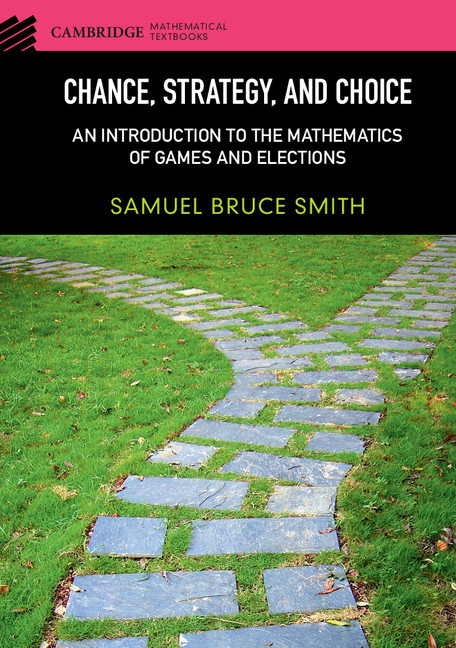
Chance, Strategy, and Choice

-
Select format
-
- Publisher:
- Cambridge University Press
- Publication date:
- 11 May 2018
- 29 June 2015
- ISBN:
- 9781316026786
- 9781107084520
- Dimensions:
- (253 x 177 mm)
- Weight & Pages:
- 1.01kg, 352 Pages
- Dimensions:
- Weight & Pages:
- Subjects:
- Mathematics (general), Economics, Mathematics, Microeconomics, Optimisation
- Series:
- Cambridge Mathematical Textbooks
You may already have access via personal or institutional login- Subjects:
- Mathematics (general), Economics, Mathematics, Microeconomics, Optimisation
- Series:
- Cambridge Mathematical Textbooks
Show more authors 
You may already have access via personal or institutional login
Book description
Games and elections are fundamental activities in society with applications in economics, political science, and sociology. These topics offer familiar, current, and lively subjects for a course in mathematics. This classroom-tested textbook, primarily intended for a general education course in game theory at the freshman or sophomore level, provides an elementary treatment of games and elections. Starting with basics such as gambling, zero-sum and combinatorial games, Nash equilibria, social dilemmas, and fairness and impossibility theorems for elections, the text then goes further into the theory with accessible proofs of advanced topics such as the Sprague–Grundy theorem and Arrow's impossibility theorem.Uses an integrative approach to probability, game, and social choice theoryProvides a gentle introduction to the logic of mathematical proof, thus equipping readers with the necessary tools for further mathematical studiesContains numerous exercises and examples of varying levels of difficultyRequires only a high school mathematical background.
Reviews
'Sam Smith's book offers an intriguing juxtaposition of chance, strategy, and elections. The mathematical analysis is rigorous without being too formal or forbidding. The applications to topics in economics and political science - including auctions, power, and voting - as well as to parlor games like poker will engage both students and professionals.'
Steven Brams - New York University
'I like the logical flow and length of the chapters and I like that the layout is simple (no excessively boxed theorems, etc.). There are numerous chapters, with one key concept explained in each. One could envision that each chapter would roughly be covered in a class period.'
John Cullinan - Bard College, New York
'The author's approach does seem as if it would appeal to a broad range of instructors and students: there are enough chapters that an instructor could choose a collection of topics according to his or her interest. Furthermore, the inclusion of proof-based sections would allow an instructor to use the text for a course targeted at math majors and minors rather than at a general nontechnical audience.'
James Parson - Hood College, Maryland
'The book is well written and interesting. Students should have little difficulty reading and understanding this book … The book covers the topics with clarity and applies game theory to ‘real-world' problems.'
Dan Cunningham - State University of New York, Buffalo
'While some of Smith's material has origins more than 100 years old, the author engages the reader through modern developments, such as the minimax theorem (1928), the work of John Nash and Kenneth Arrow (1950s) and even more recent developments by Steven Brams, William Zwicker and Alan Taylor (1980s–2000s). The author does an effective job of presenting this material to an audience of non-science majors with no prerequisites. A unique feature of the text is the treatment of combinatorial games such as Nim and Hackenbush alongside traditional two person game theory.'
David Vella - Skidmore College, New York
'Chance, Strategy, and Choice fits an important niche for general audience textbooks about games, elections, and other introductory material related to social choice theory … One of my favorite features of the book is that it does an excellent job of integrating the topics of games and elections to illustrate the interconnections between the different areas of social choice theory, often through illustrative examples.'
Adam Graham-Squire Source: MAA Reviews
Contents
Contents
Metrics
Full text views
Full text views helpTotal number of HTML views: 0
Total number of PDF views: 0 *
 Loading metrics...
* Views captured on Cambridge Core between #date#. This data will be updated every 24 hours.
Usage data cannot currently be displayed.
Accessibility standard: Unknown
Why this information is here
This section outlines the accessibility features of this content - including support for screen readers, full keyboard navigation and high-contrast display options. This may not be relevant for you.
Accessibility Information
Accessibility compliance for the PDF of this book is currently unknown and may be updated in the future.