In April 1815, the volcano Mount Tambora blew up with apocalyptic force. Within weeks, the subsequent stratospheric ash cloud had circled the planet, embarking on a slow sabotage of the climate system.1 In 1816, the average global temperature decreased by 0.4°C. Summer temperatures in Europe were the coldest recorded between 1766 and 2000.2 In Britain, William Turner drew vivid, yellow-tinged skyscapes. In Germany, Caspar David Friedrich painted chromatically dense heavens, corresponding to the “optical aerosol depth” of the volcanic eruption.3 During what has since been dubbed the “Year Without a Summer,” Mary Shelley, Percy Bysshe Shelley, Lord Byron, and John William Polidori, prompted by the incessant rainfall near Lake Geneva, initiated a ghost story competition, stimulating Byron’s “Darkness” (1816) and Shelley’s Frankenstein (1818). While Shelley’s novel famously allegorises humanity’s scientific hubris, Byron’s disturbing poem describes an “extinguish’d” sun, wandering darkly in eternal space, “[r]ayless, and pathless.” “[T]he icy earth” swings “blind and blackening in the moonless air.”4 None of them linked the transformed sky over Western Europe to the blast in the Sunda Strait. Neither did Turner, Friedrich, nor the scientists during the three long years of global cooling following the Tambora blast, causing crop failures and famine all over the Western world.5
About seventy years after the Tambora blast, the neighbouring volcano Krakatoa erupted. Two minutes past ten on Monday morning, 27 August 1883, the greatest detonation in recorded human history happened, killing 36,000 people in its immediate wake. Airborne debris quickly hurled into the skies, changing the appearance of the sky, setting barometers and tide-meters flailing thousands of miles away.6 Due to the injection of an obscene amount of sulphur dioxide into the stratosphere, a volcanic winter ensued. Average summer temperatures dropped by 0.5°C in the Northern Hemisphere.7 In contrast to the Tambora eruption, scientists of the period quickly conjectured the causality. The Royal Society provided a full report four years after the event, while contemporary French scientist and astronomer Camille Flammarion described it as “the greatest geological phenomenon in history.”8
From the Tambora to the Krakatoa eruption, advances in telegraphy, the building of undersea cables, and the flourishing of news agencies made it possible for Americans and Europeans to know about the explosion within mere minutes.9 On 30 August 1883, three days after the blast, the local newspaper from West Virginia, the Wheeling Daily Intelligencer, reported the event under the heading “Fires of Inferno: Stirred by the Demons of Death,” vividly relating its different stages, pinnacling when the “volcano began to vomit up enormous streams of white acid and sulphurous mud.”10 A week later, on 8 September 1883, The Illustrated London News depicted the top of Krakatoa, the Islands of the Sunda, and the Straits of Sunda on a front-page triptych.11 The immediate reception in the Western media meant that the word Krakatoa became a synonym for cataclysm, death, and disaster.12
Although the Krakatoa eruption spurred worry that the world was being torn asunder, it also provided empirical proof of a new understanding of climate. Throughout the long nineteenth century, the word climate increasingly came to signify a global and temporal phenomenon. As the first major natural disaster in the new age of the telegraph, its atmospheric disturbance detected all over the world, the Krakatoa eruption enabled climate scientists to recognise the physical interconnections existing in the planetary macrocosm: climate disasters were no longer isolated and regional events. The Krakatoa disaster proved that climate was not localised, but unified, not ahistorical but temporal.13
The natural disaster explains how and why some of the canonical authors of the fin de siècle wrote about climate change before the widespread awareness of global warming. Drawing on the profound and interrelated changes in the global climate, climate science, and climate technology of the nineteenth century, literary authors Jules Verne, H. G. Wells, Edward Bulwer-Lytton, Gabriel Tarde, Mary Bradley Lane, Rokeya Hossain, Joris-Karl Huysmans, and Mark Twain began representing the planetary, social, and aesthetic consequences of global climate control, pioneering an awareness of anthropogenic climate change.
The Short Story of Climate Control
The Krakatoa eruption proved that the climate system could change drastically, but also that humanity should probably try to control it. Initially, climate control signified “the modification of weather patterns, by artificial means.”14 US author Charles Asbury Stephens was the first to use the term in Natural Salvation (1903):
Climate is as much a terrestrial condition to be controlled as a city’s water-supply. A bad climate will be quite unnecessary in the year 2000.… Vaporization and rainfall are the factors to be controlled. An equable distribution of solar heat and a regulated electrical tension are the agencies to be used to this end. The whole problem of climate-control is already outlined in physics, as to its methods.15
While climate control, synonymised as air conditioning, became the unassuming atmospheric background to modern life throughout the twentieth century, at the turn of it, Stephens, echoing Swedish physicist Svante Arrhenius’s fantasy about a global utopia approximately 5–6°C warmer 100–200 years hence, used the term to signify the deliberate engineering of the global atmosphere.
Long before the authors of the fin de siècle integrated the notion of anthropogenic climate change into their fictional universes, the father of modern philosophy and science, French mathematician René Descartes, launched the ideational history of climate control.16 In Discourse on Method (1637), he envisioned thermal comfort as a prerequisite for the philosophical separation between mind and body. Recalling the night of 10 November 1619, when sitting alone in a quiet poêle – the stove-heated room in which he had retreated at the onset of winter – the philosopher revels in the newfound climatological bliss: “I was completely free to converse with myself about my thoughts.”17 Sleeping happily in his chambers, Descartes has three dreams: one in which a strong wind forces him against a church, a second in which he witnesses a room filled with light, and a third where he is sitting at his desk, reading an encyclopaedia. The philosopher interprets his dreams as three omens that he should devote his life to the unification of the sciences. He subsequently attempted to do so through his analytic geometry and rational method, rendering humanity the “masters and possessors of nature.”18 Steeped in dualism, Descartes envisions analytic geometry as a vacuumed space structured by abstract coordinates, not an embodied atmosphere filled with “airborne materials of varying composition, density, temperature, and velocity,” while his philosophical method enacts the alienation of the mind from the body (cogito, ergo sum).19 As Hsuan Hsu points out, the increasingly climate-controlled dreams offer Descartes a vision of philosophical inquiry as pure cognition. Insulated in his private bubble, he erects a philosophy grounded in the proposition that cognition disentangles from the breathing body, otherwise highly sensitive to atmospheric effects such as wind flow, humidity, and temperature, making climate control a prerequisite for modern science and philosophy.
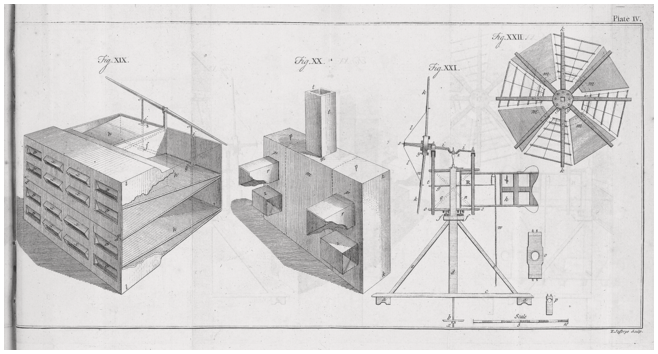
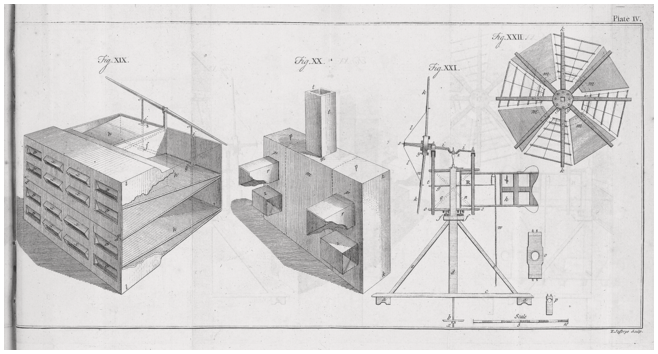
In tune with Descartes’s foundation of modernity as climate-controlled, the doctors, engineers, and scientists of eighteenth-century Britain and France worked hard at conditioning the indoor air. One of the first ventilation technologies was British clergyman and inventor Stephen Hales’s “ventilator trunk,” illustrated in his Description of Ventilators (1744; Figure I.1). Hearing about the recurring outbreaks of typhus on naval ships, Hales fashioned a hand-cranked wood bellow, drawing in fresh sea air, blowing out the foul inner vapours, working as “the Lungs of a Ship.”20 The first use of his ventilation system was on slave ships. Hales’s invention reflected an imperial, Enlightenment approach to nature: the coloniser could improve the naval climate to the benefit of the colonised.21 The early ventilation machines proposed by inventors such as Hales and, later, J. T. S. Desaguliers, were site-specific, intended to benefit social outcasts: convicts, hospital patients, and enslaved people.22
Stephen Hales, A Treatise on Ventilators (London: Richard Manby, 1758), plate IV.
While the early eighteenth-century Enlightenment programme of climate control was predominantly social, the techniques of thermal comfort swiftly became commercial. According to Simon Schaffer, the aerial philosophy of the period, imbuing immaterial air with materiality, played a major role in the commercialisation, establishing “a space in which a new economy of … control might operate.”23 The predominant climate-controlling practice, ventilation, became a symbol of modernity, moving from institutional – ships, hospitals, and prisons – to domestic use. The creation, dissemination, and trade of ventilators, portable stoves, and other devices by entrepreneurs, craftsmen, manufacturers, architects, and clergymen contributed to what Marie Thébaud-Sorger calls a “new oeconomy of nature.”24 The aerial sensibility and material marketplace taking root in the social and urban landscape of eighteenth-century Britain and France commodified indoor air.
One of the premium examples of the new socio-climatological paradigm was the ventilation system made by British engineer Thomas Tidd, servant to the Princess of Wales. Tidd was familiar with the state-of-the-art domestic appliances multiplying in the period, but he was specifically attentive to the atmospheric conditions of the princely interiors. In the 1750s, he constructed a gadget for the benefit of “the nobility and gentry in particular.”25 The Aeolus, named after the Greek god of wind, was a mechanical system fitted in a sash window, automatically stopping when “sensing” a draught from either a window or an open door.26 According to Tidd himself, the innovation could produce “the air to that exact degree of temperature that is most desirable.”27 In Considerations on the Use and Properties of the Æolus; A New Invented Portable Machine for Exchanging and Refreshing the Air of Rooms (1755), the engineer advertised the automatic, noiseless, and maintenance-free domestic appliance at the cost of two guineas for a metal version and three guineas for a gilded one. His list of subscribers mostly counted the genteel men of the period, such as the Prince of Wales, Prince Edward, as well as 110 gentlemen, predominantly physicians and lawyers. The emergent climate technologies were primarily for the privileged upper class.28
In the early nineteenth century, however, business-savvy engineers aimed to deliver climate control to the masses. Inspired by the technologies of heating, cooling, and ventilation integrated into British hothouses, engineer William White argued that his “Air Machine” (1794), cosplaying as a piece of furniture, could cool even the sultriest climate, performing “a luxury of all others the most to be desired.”29 The machine, which allowed the amount of air and degree of temperature to be “increased or diminished at pleasure, and regulated so as to answer a great variety of purposes,” was advertised by White as being usable in both hot and cold climates.30 His machine could even curb the mosquito-laden atmosphere of the intemperate tropes, providing the people of “our East and West Indies, a source of health and comfort.”31 Inspired by emerging hothouse technology, White’s mechanical ventilation system expanded Tidd’s privileged customer base to include the better-off colonial citizen, envisioning global democratisation.
Though expanding, climate control soon becomes about insulation. The British 1841 expedition aimed to sail up the Niger River to spread knowledge of Christianity and Western civilisation through the distribution of Arabic-language Bibles. During the mission, the white sailors remained on the ship while black African converts conducted the groundwork of evangelisation. Inside the ship, an ambitious ventilation system designed by chemist David Boswell Reid protected the white sailors from the outside climate.32 The system ensured that they breathed only a modified, “medicated air,” containing none of the dangerous Indigenous vapours.33 The expedition organisers hoped that the climate-controlled ship would set an example of the British nation and character to the local Aboh and Eggarah people, but instead, the ships became floating hospitals. Three months later, a quarter of the crew had become ill, with fifty dead before returning to London. Despite the signal failure, the official expedition documents stated that Reid’s ventilation system had “undoubtedly contributed to the comfort of the crew,” spinning the device as a success story.34 As Paul Sampson argues, from Hales’s ventilator trunk of the mid eighteenth century to the ruinous Niger expedition of the mid nineteenth century, the danger of climate shifted from the inside to the outside. Instead of airing out the insalubrious interior of the slave ships as an improvement of nature, the goal of climate control becomes one of insulation, protecting the Western bodies from the inhospitable outside.35
Faced with the environmental hazards of the colonies but also domestic industrialisation, interior climate control becomes essential. Throughout the nineteenth century, countless advertisements for “ventilating stoves” or “window ventilators” urged homeowners to invest in devices shielding the inhabitants from the smoky, polluted air of the outside, with popular domestic guides proclaiming that “[n]o consideration of economy should prevent the most constant attention being paid to proper ventilation, so essential is the latter to health and comfort.”36 The difference in health between those working in controlled versus uncontrolled environments became steep. In Notes on the Ventilation and Warming of Houses, Churches, Schools, and Other Buildings (1863), medical practitioner Ernest Jacob remarks that 263 and 218 workers, respectively, died from consumption in the industrial cities of Leeds and Manchester in 1864.37 The greatest mortality rate took place among printers and tailors because they mainly worked nights, necessitating the burning of much gas. In comparison, the miners of Northumberland and Durham, where the pits were freely ventilated, had far fewer cases of consumption.38 In the wake of industrial and urban air pollution, climate control became medical, sheltering human bodies from an accumulating number of atmospheric hazards.
Whereas the architects of the nineteenth century did not devote much time to the hazards of industrialisation, medical men such as Jacob did. Frequent visitors accompanying inspectors of mines and factories, these men held a unique position for observing the environmental disorders the nineteenth century was breeding, noticing the dire conditions that rarely interested the architects.39 Expressing contempt for contemporary architects’ lack of attention, their writings often showcase an intimate practical knowledge of how buildings perform environmentally, but also how they could be improved. Some of them even envisioned the architecture of buildings.40 Describing the Octagon House in Grove Street, Liverpool, Dr John Hayward, who built it, exemplified the trend:
The basement is devoted principally to the collection and warming of the fresh air.… And above, beneath the ridge of the roof, is the foul air chamber, into which all the vitiated air of all the rooms in the house is collected, and from which it is drawn by the kitchen fire, by means of a shaft passing down to the ground floor, and then ascending behind the kitchen fire, and up the kitchen chimneystack round the smoke flue.41
Hayward planned, sectioned, and constructed the house with the ultimate goal of controlling the indoor air. Everything in the structure, including the gas lighting, assisted in realising that ambition: the lobbies, neatly superimposed upon each other, formed a vertical supply duct, delivering clean and warmed air to the rooms.42 The function of the elaborate supply system of fresh, warmed air prevented cold draughts and creating a warm cocoon, an atmospheric ecosystem sheltering the residents from the outside air, constituting a major gain in domestic climate control.
The control of indoor heating was concurrent with ventilation, making the home a sphere of total control. Benjamin Franklin, who also wanted to improve the continental climate by land-clearing (see Chapter 1), introduced the principle of heating a room with warm air in 1742. Anticipating the “warm air furnace of today,” he invented the eponymous “Franklin stove” by placing a chamber surrounded by iron plates inside a stove, with openings in the side and at the top for the escape of air.43 In 1784, James Watt rivalled Franklin’s success, making his office the very first room to be heated by steam, before Matthew Murray installed his “Steam Hall” at the start of the nineteenth century.44 Whereas previous technologies supplied the household with raw fuel – coal gas, for instance – American engineer Birdsill Holly managed to run an underground line from a boiler in his residence to a barn at the rear of his property in 1876. The following winter, he successfully heated a substantial number of residences, stores, and offices.45 Combined with the invention of the radiator, heating by steam and hot water could be found in most buildings, public or private, by the late nineteenth century.46
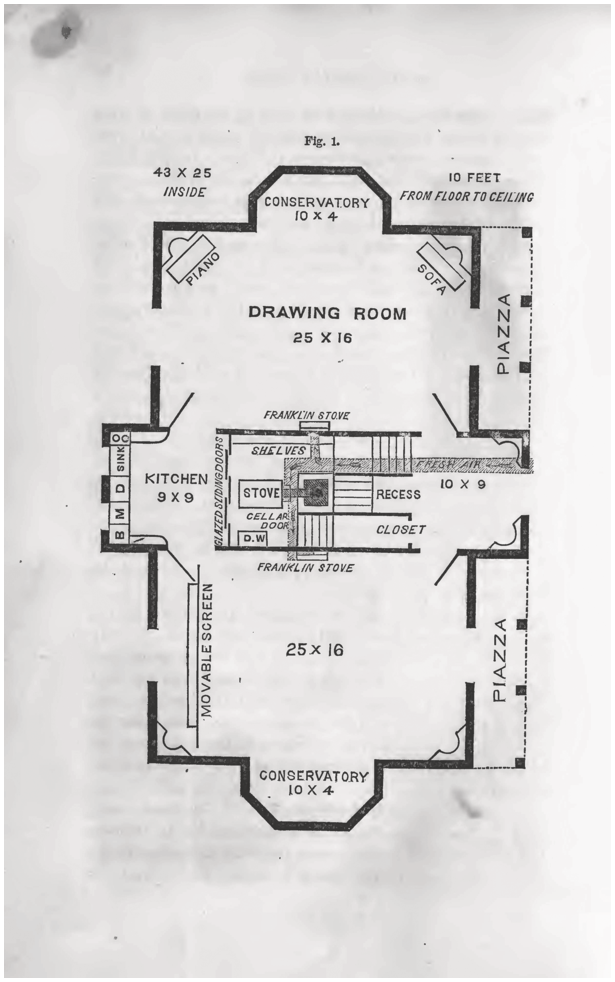
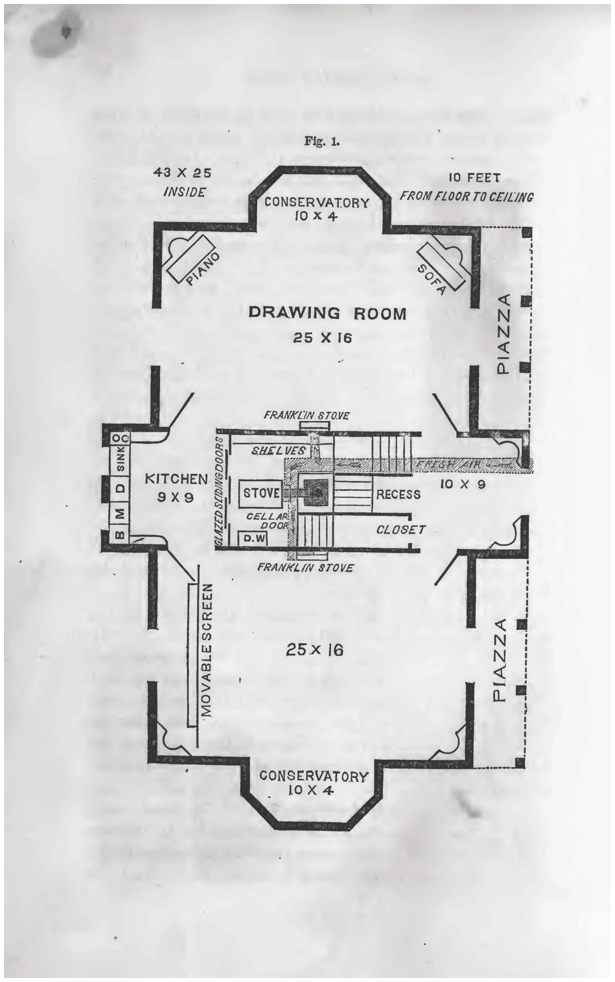
The concurrent advances in indoor heating and ventilation enhanced the control of the domestic environment. American educator and sister of Harriet Beecher Stowe, Catharine Beecher, enhanced the principle, becoming one of the foremothers of the US suburban way of living through her Domestic Economy (1842) and American Woman’s Home (the latter co-written with Harriet, 1869).47 Exposed to the changing facts of life and technology in the newly opened Midwest, Beecher’s American Woman’s Home specifically introduced the idea of a unified core of services, open in layout but functionally differentiated by built-in furniture and equipment, effectively foreshadowing Buckminster Fuller’s futurist Dymaxion House of 1927 (Figure I.2).48 Beecher’s innovative design was so radical and original that historians of architecture have no compunction in drawing a parallel between her American Woman’s Home and the European modern architecture of 1920s: “the house itself – while still nominally ‘Gothic’ in style – is now firmly visualized as a true machine for living.”49 Imagining a complex, highly developed inter-linking of services, she combines a basement hot-air furnace, a variety of Franklin stoves, and a kitchen range into a central heating and ventilation system.50 She kills interior draught by under-floor ducts feeding fresh air into the stoves, delivering warm air to “the points where it is required” while “foul air is extracted from the points where it is not.”51 Beecher’s proposal for the American Woman’s Home was, in its environmental structure and atmospheric technology, essentially the house that most American entrepreneurs were building and most Americans were living in a decade after its publication.52 Although Beecher’s house demonstrates the seamless integration of climate control into the construction of the typified building, it did not deal well with the warm and humid summers prevalent in most of continental United States. Making the home an atmospheric machine, her construction nonetheless stimulated the need for a new technology to properly insulate the domestic indoors from the global outdoors.
“Drawing Room,” in Catharine E. Beecher and Harriet Beecher Stowe, The American Woman’s Home (New York: J. B. Ford, 1869), 26.
The acme of climatological insulation arrived with the invention of air conditioning at the start of the twentieth century. In American Nervousness (1881), neurologist George Beard described the many enervating effects of the country’s environmental intemperance, stating that “[n]o other civilized country, ancient or modern, has ever had such a climate as this.” According to Beard’s theory, the control of climate was a subject of national improvement, because “the inhabitants of the Northern and Eastern portion of the United States are subjected to severer and more sudden and frequent alternations of extreme heat and cold.”53 In tune with Beard, popular magazines like Good Housekeeping and Ladies’ Home Journal warned that variable indoor temperatures could potentially lead to intemperate husbands and children, while an 1896 ad for the Johnson Draft Regulator argued that “an even temperature … means an even temper.”54 The specific American climate, commercialised and politicised as intemperate, supported the technical development of air conditioning, catapulting the nation and its people into temperate, productive modernity.
The Chicago Auditorium and the New York Stock Exchange took the first steps towards large-scale air conditioning. While modern architecture began constructing the façade as a “climate mediator,” integrating “shading devices, brise-soleil, louvers, screens, fins, jalousies” to control the way the sun enters the building and consequently its indoor climate, contemporary newspapers described the modernity of the Chicago Auditorium as just as much a result of its mechanical innovations as its intriguing architectural style: “This is in all respects a modern structure, for every improvement in the building line possessing any merit has been introduced.”55 Unlike the sweltering galleries of the other Chicago theatres, whose lack of climate control made the topmost seats socially unacceptable, the Auditorium integrated advanced cooling technology, making every seat well-ventilated. While the Chicago Auditorium combined comfort and aesthetic pleasure when it opened in 1899, the New York Stock Exchange combined financial productivity with climatological insulation. Deemed “the first great commercial edifice to be built in New York in the twentieth century,” the integrated air-cooling system of the Stock Exchange eased the brokers’ work during the humid summer months. 56 Mechanical engineer Alfred Wolff oversaw the heating, ventilation, and innovative cooling of the building, deemed by one observer “the most important feature of the mechanical installation, as it marks the introduction of a provision of comfort during hot weather that is the leading example of its kind.”57 Operational in the summer of 1903, the cooling and dehumidification system of the New York Stock Exchange combined an even indoor temperature with the even temper necessary to conduct the volatile work of finance. Before the advent of air conditioning, the two public buildings expanded the social terrain of thermal comfort.
The Chicago Auditorium and New York Stock Exchange show that climate control was not only an increasingly elemental feature of the private bubble but also an integral part of the large building, anticipating the twentieth-century paradigm of air conditioning. A few years later, mechanical engineer Willis Haviland Carrier devised the first system to integrate the earlier technologies of steam heating, refrigeration, and ventilation to control the temperature and humidity of a building’s interior climate, specifically a lithography department.58 In 1905, textile engineer Stuart W. Cramer was the first to use the term “air conditioning,” explaining that he “used the term ‘air conditioning’ to include humidifying and air cleaning and heating and ventilation.”59 The design, integration, and coinage of air conditioning in the early twentieth century suggests that it was expanding globally, but also that the work of thermal comfort became increasingly tied up with notions of pleasure, work, and productivity.60 It becomes a prerequisite for the modern middle-class home, small “bubbles,” and, in parallel, a feature of insulated macrospheres: airports, auditoriums, cinemas, offices, shopping malls.61 Making the modern citizen a “thermostatic subject,” desiring stasis and continuity, the spread of indoor climate control (air conditioning) created a stable atmospheric horizon prerequisite for the modern Western world.62
Moving from the interior to the exterior, from the aristocracy to the proletariat, from the domestic to the public, the creation and integration of climate technologies throughout the long nineteenth century installed an atmospheric paradigm of stasis in the Western countries placed at the technoscientific forefront. As climate control was becoming a signifier of social status and a tool for industrial productivity, the global climate was acting increasingly catastrophically – see Krakatoa – stimulating the notion that humanity’s expanding climatological powers could counteract such sudden changes. At the same time that indoor climate control becomes a prerequisite for being modern, climate control becomes a term for large-scale climate engineering, suggesting the scale between the material development of domestic climate technologies and the thematic, motivic, and formal representations of global climate control at the fin de siècle.
Themes, Motifs, and Forms
In The Great Derangement (2016), Amitav Ghosh argues that the inability of the contemporary novel to address climate change is the product of a grid of literary conventions giving shape to the narrative imagination in “that period when the accumulation of carbon in the atmosphere was rewriting the destiny of the earth”: the nineteenth century. He ventures that the modern novel – influenced by the “victory of gradualist views in science” – became an aesthetic machine for churning out fictive scenarios based on steady, probable change.63 Consequently, ecological catastrophe becomes irreconcilable with its rigid narrative confines. Devoted to the description of bourgeois life – rational, orderly, free from exceptional moments – the realist novel, a product of the early Anthropocene, tragically lacks the narrative vocabulary for expressing the environmental crises emerging in the period, signifying the titular derangement.64
Inspired by Ghosh, Allen MacDuffie has recently examined the literary roots of this “culture of denial.” Drawing on Latour’s argument that the nineteenth-century obfuscation of Darwinian ecology lies at the root of our contemporary inability to adequately respond to the environmental crises, MacDuffie argues that what Timothy Morton calls “hyperobjects” – vast material networks only knowable through abstract thinking – occupied the imagination of nineteenth-century writers, such as Alfred Tennyson, George Eliot, and Virginia Woolf.65 He characterises the nineteenth-century novel as “ground zero” for the contemporary practice of soft denial, because it trained its readers “in the art of self-deception, knowing and not knowing what is real at one and the same time.”66 The realist story coached the willing suspension of disbelief, attuning the reader to the practice of disavowal by making it one of the core procedures “by which everyday life is constructed by narrators, fictional characters, and ‘real’ people alike.”67 According to MacDuffie, the soft denial of Darwin is a key to current climate denialism because we “continue to dwell in the conceptual, institutional, and material culture of denial that the Victorians helped create.”68 While that – to some extent – may be true, Ghosh’s and MacDuffie’s critiques may be too sweeping. Notably, Jesse Oak Taylor has demonstrated that realist novels such as Charles Dickens’s Bleak House (1852), George Eliot’s Daniel Deronda (1876), and Joseph Conrad’s The Secret Agent (1907) are well-suited “to the challenges of modeling climate as both a historical and meteorological condition,” due to their “expansive scale and diffusive complexity intersect[ing] with the temporality of reading.”69 Nathan K. Hensley shows how a handful of “exceptionally perceptive writers” used different aesthetic forms to come to terms with an expanding regime of resource capture and wealth accumulation “they correctly understood … to be suicidal.”70 Historicising the “scalar crisis” of the Anthropocene, Aaron Rosenberg has equally revealed how an interconnected group of British authors, writing at the turn of the twentieth century – H. G. Wells, Thomas Hardy, Joseph Conrad, and Virginia Woolf – strategically used alternative genres such as romance, melodrama, horror, and epic to grasp the deep time of ecological change.71 In the same vein, Ursula Heise has ventured that “none of the constraints Ghosh discusses apply to science fiction,” arguing that the genre acts as “a continuation of the epic tradition in the age of the novel.”72 Inspired by recent critiques, this book aims to show that speculative as well as modern forms of the late nineteenth century formulated notions of anthropogenic climate change. Hesitant to privilege one over the other, the book examines how different authors pursuing different narrative modes – speculative, utopian, and modern – represented global climate control in acutely different ways: as a theme, motif, and form.
Across the speculative, utopian, and modern, a range of canonical authors represent climate control as a novum (Latin for “new thing”). According to Darko Suvin, the narrative function of the novum is setting the fictional world radically apart from the reader’s, installing the feeling of “an alternate reality, one that possesses a different historical time corresponding to different human relationships and sociocultural norms actualised by the narration.”73 While the novum formulates a different historical time, the imagination of this time always already draws on the aesthetic, epistemological, social, political, and technological exigencies of the present: “The new is always a historical category,” Suvin contends.74 Although he, inspired by the Russian Formalist notion of ostranenie (defamiliarization) and the Brechtian Verfremdungseffekt, ties the novum to the definition of science fiction as the “literature of cognitive estrangement,” his understanding of the new as historical is pertinent for understanding how the fiction of the fin de siècle aimed at representing anthropogenic climate change.75 The different technologies of global climate control function as thematic, motivic, and formal novums, but the authors tether these functions to the atmospheric, scientific, and technological terrain of their present. While Elizabeth Carolyn Miller accounts for the many “energy novums” in post-1870 speculative fiction, the book shows that a proliferation of “climate novums” – new climate things – emerges in the speculative, utopian, and proto-modernist fiction of late nineteenth-century Britain, France, and the United States.76 The authors use the climate novums as material themes, such as the Baltimore Gun Club’s correction of the global climate in Verne’s The Purchase of the North Pole; as utopian motifs, such as the Ladylander’s caring form of cloud-seeding in Hossain’s “Sultana’s Dream”; or as narrative forms, such as the readerly control of the climate in Twain’s The American Claimant.
In Verne’s and Wells’s speculative fiction, climate control is the central organising unit. Speculative fiction “plays on the tense, shifting, unstable relationship between what was, is, and could be,” depicting “events that have not happened yet,” events that “might happen,” and other permutations of potentiality.77 Through a speculative rhetoric, Verne extrapolates the many land-engineering projects of nineteenth-century France into a perturbed present, where the Baltimore Gun Club’s decision to correct the Earth’s climate structures the story’s intrigue. Compared with Verne, Wells’s speculative theme is equally more manifest and less explicit. Characterising himself as “a certain speculative writer,” Wells created one of the most famous novums of all time: the time machine.78 In The Time Machine, it is, however, the climate novum – a large-scale greenhouse technology – that impinges on the fictional environment, creating an unnaturally hot world as Wells exhibits the terrible socio-biological outcome of the global hothouse. Through dissimilar climate novums – a practice of geoengineering avant la lettre, an extrapolation of the Victorian greenhouse – Verne and Wells speculatively thematise the large-scale planetary and evolutionary consequences of global climate control.
In the utopian fiction of the period, the novum of climate control is not so much a thematic event as a motivic element. At the fin de siècle, the air was “thick with utopian thought,” utopianism an almost “atmospheric effect of the social climate.”79 In contrast to the tradition commenced by Thomas More, however, the fiction of the period placed utopia in time rather than space, historicising the present as part of a larger process. Although the Encyclopédie (1765) first defined “motif” as a musical piece, the utopian representation of climate control is motivic in the architectural sense, functioning as “a distinct element of a design.”80 In Bulwer-Lytton’s The Coming Race, the Vril-ya’s control of the atmospheric agency, vril, enables the erection of an underground utopia upon the columns of climatological, political, and personal stasis. Likewise, in Gabriel Tarde’s underground utopia, anthropogenic climate change is an integral design element of an antinatural, “Good Anthropocene,” in which humanity becomes the benevolent rulers of post-nature. In “Sultana’s Dream,” Rokeya Hossain describes the careful control of the climate as integral to the feminist world of Ladyland, while Lane’s Mizora makes the electrical control of the underground climate a core element of a feminist future world in which everything – from the climate to human biology – is subject to optimisation. The utopian fiction of the fin de siècle made climate control a patent part of the political future, a motif of utopia’s social pitfalls and possibilities.
While speculative and utopian fiction interrogated the planetary, evolutionary, and social consequences of global climate control, proto-modernists such as Joris-Karl Huysmans and Mark Twain portrayed it as a form of art. The trope of the artificial atmosphere is prevalent in decadent fiction (Guy de Maupassant, Hugo von Hofmannsthal, Oscar Wilde, etc.), and Huysmans devotes much of his decadent bible, Against Nature, to the description of how protagonist Jean des Esseintes artfully changes the climate of his boudoir, his house, and, finally, the city of Paris, moving from the domestic to the public sphere. While Huysmans’s work discursively portrays anthropogenic climate change as an art form on the minute scale of his protagonist, Twain formalised climate control. Discarding all mention of weather while urging the reader to provide their own in the appendix, Twain’s humourist, proto-(post-)modern novel, The American Claimant, integrates climate control as a narrative structure of the fictional universe. Formalising anthropogenic climate change, Huysmans’s and Twain’s proto-modernist fiction interrogates the individual and aesthetic possibilities of climate control: while the climate-changing protagonist of À rebours must give up his progressivist ambition to go against nature, exacting a sort of circular progression, Twain’s inclusion of climate control into the reading experiences challenges the diegetic confines of the novel.
These narratives, from the speculative to the proto-modernist, provide uniquely affective glimpses into the planetary, social, and aesthetic consequences of anthropogenic climate change long before the widespread awareness of global warming. Even though literary scholars rarely track the contemporary genre of climate fiction, or cli-fi as coined by Danny Bloom in 2007, further back than to Arthur Herzog’s Heat (1977), the generic roots of cli-fi seem to take hold at the fin de siècle.81 Some scholars claim that cli-fi is distinct for the use of “the scientific paradigm of anthropogenic global warming in their world-making,” but, echoing Axel Goodbody and Adeline Johns-Putra, the genre “may be best thought of as a distinctive body of cultural work that engages with anthropogenic climate change” such as deliberate “human interventions into global climatic conditions which predate global warming.”82 In this perspective, the speculative, utopian, and proto-modernist fiction of the fin de siècle appears as cli-fi avant la lettre, representing the deliberate intervention into the global climate of, say, the deep future, an ensuing utopia, or the literary exegesis itself.83 Excavating how the canonical authors of the period expressed a new understanding of climate through speculative themes, utopian motifs, and modernist forms, the book genealogises cli-fi as a genre formulating the ideational Anthropocene.
Fin de Siècle, Start of the Anthropocene
Framed by the fall of the Second Empire in 1870 and the début of World War I in 1914, the fin de siècle was a volatile period. Consequently, the authors, scientists, and thinkers of the period thought intensively about their place in history. The fact that the concept itself was widely circulated at the time demonstrates the historical self-awareness of the period. It stems from Henry de Fleurigny’s and Francis Jouvenot’s grand-guignol play, Fin de Siècle (1888), from whence it spread like wildfire.84 Four years after the play, fin de siècle had become such a popular term that contemporary French journalist Roger Alexandre caricatured it in his Museum of Conversation (1892): “Open the first paper you come across and you will find the word repeated ten times, twenty times, on every page, in almost every column.”85 Commentators, magazines, and newspapers used the term to describe a new generation of men and women who rejected the moral codes of the past, portending new social as well as aesthetic possibilities.86
To echo Matthew Beaumont, at the fin de siècle, the new became the privileged semiotic of a society steeped in its exceptional historical status.87 In her Humanitarian article, “Is the New Woman a Myth?” (1896), Mrs Morgan-Dockrell summarised the period-specific lust for newness, arguing that the “very word ‘new,’ strikes as it were the dominant note in the trend of present-day thought, present-day effort and aspiration.”88 Quickly immigrated to Britain, by way of Irish writer Oscar Wilde’s The Picture of Dorian Gray (1890), the fin de siècle was associated with a sense of epochal novelty. While the term literally signalled the end of the nineteenth century and, metonymically, a feeling of degeneration, decadence, and decay on a national, social, or individual level (famously apparent in The Picture of Dorian Gray), it also heralded the début of the coming century – the beginning of something new.
A compression of time and space contributed to the sense of epochal novelty. The radical readjustment in the sense of time and space unfolding in the Western countries of Britain, France, and the United States from the start of the nineteenth century was heightened at the end.89 The constellation of new technologies such as the telegraph (oceanic telegraph cables from 1866), telephone (Bell patent in 1876), cinema (first motion picture in 1888), metro (Metropolitan Railway in 1863, Paris Metro in 1900), and the 1884 proposal for the Greenwich median, as well as the imperial expansionism of the period (stimulated by the Berlin Conference of 1884–5), were distinct technological and geopolitical developments that contributed to a shrinking of space and synchronisation of time.90 The globe became smaller, history quicker.
Consequently, the fin de siècle can be understood as a “threshold period.” German literary scholar and reception theorist Hans-Robert Jauss created the term to signify the progressive but unsynchronised change from a late nineteenth-century feeling of imminent apocalypse “to a new aspiration that anticipated a change instead of an end.” The concept describes “the hermeneutic difference between the not yet and the no longer,” spelling out a “progressive change of horizons.”91 Extending Jauss’s notion of “threshold period,” built on the many new avant-garde movements germinating at the beginning of the twentieth century, the book studies the way the fiction of the fin de siècle – in close conversation with the climate, science, and technology of the period – formulated an unsynchronised transition from a Holocene to an Anthropocene awareness.92
Enlarging the sense of newness, the fiction of the fin de siècle represented new visions of the global climate. Karl Jaspers summarises this sense through the concept of “epochal consciousness”: “Man not only exists but knows that he exists. In full awareness he studies his world and changes it to suit his purposes. He has learned to interfere with ‘natural causation.’”93 Jaspers’s concept captures what I, echoing Cara New Daggett, call the ideational Anthropocene.94 As it remains to be seen whether or not the post-1870 Acceleration, the post-1945 Great Acceleration, or some other earlier or later acceleration will stratigraphically indicate the beginning of the Anthropocene, I distinguish between the material and the ideational Anthropocene.95 The former describes the first stratigraphically sound record of the human influence on the geology of the Earth, while the latter signifies a dawning of an Anthropocene awareness, an “epochal consciousness.”96 Although some scientists have argued that the late nineteenth century marks the inception of anthropogenic climate change, I regard the fin de siècle as the unsynchronised transition to the ideational horizon of the Anthropocene.97
Regarding the ideational Anthropocene, I build on and extend the work of Daggett, Benjamin Morgan, and Miller. Daggett has argued that a “dawning consciousness” of the fact that human-industrial impacts “might be planetary and truly catastrophic” characterises the fin de siècle, while Morgan posits that the new ideas of global weather systems and the expansion of fossil fuel–based energy systems make the nineteenth century the “most significant intersection of historical processes in relation to the climate crisis.”98 Taking a historiographical perspective, Miller argues that the “period has a special significance for the literary history of the Anthropocene,” because its self-consciousness eerily resembles the trope of the Anthropocene: understanding their own time as a fin de siècle, authors, artists, and scientists looked at their present in the same way as stratigraphers looks at our present: what Rob Nixon calls a “world that will have been.”99 What Daggett, Morgan, and Miller do not consider, however, is the emergence of literal formulations of the Anthropocene in the period itself. Italian geologist and Catholic priest Antonio Stoppani coined the term “Anthropozoica,” spelling out the arrival of an Anthropocene avant la lettre, while American evolutionist, eugenicist, and geologist Joseph Le Conte created the term “Psychozoic” to signify a coming “age of mind”: a cognitive army modifying the unthinking powers of nature. Counteractive to Daggett’s, Morgan’s, and Miller’s arguments, Stoppani’s Anthropozoica and Le Conte’s Psychozoic stage a geological history of Promethean promise (see Chapters 6 and 7). Studying the ideas and works of the engineers and scientists of the nineteenth century, such as Stoppani and Le Conte, but first and foremost the fiction of the fin de siècle – thematising, motivising, and formalising anthropogenic climate change – the book posits that these formulations of global climate control express a period-specific shift to an Anthropocene awareness.
Thereby, the book provides a new understanding of the historical relation between the Anthropocene and literary fiction. Paul Crutzen and Eugene Stoermer’s original formulation of “The ‘Anthropocene’” (2000) exhibited an acute awareness of the terminological past, but, in contrast to the explicit proponents of the fin de siècle (Stoppani, Le Conte), they did not see the “the central role of mankind in geology and ecology” as a testament to humanity’s techno-utopian future. Rather, they worryingly argued that “develop[ing] a world-wide accepted strategy leading to sustainability of ecosystems against human induced stresses will be one of the great future tasks of mankind.”100 In the wake of Crutzen and Stoermer’s article, the literary scholars of the Anthropocene have focused on the prescient cognisance of the twentieth and twenty-first centuries, while select research via a historical lens has attended to how, for example, literature and culture have engaged with questions of environmental degradation, atmospheric pollution, or resource depletion as a premonition of the Anthropocene.101 These well-researched studies have their merit, but, in this case, the goal is to complicate the grand narrative of gradual ecological “awakening,” to politicise the aesthetic, scientific, and technological past.102 The aim is to examine how Western culture, literature, and science at the fin de siècle formulated an unsynchronised change to an Anthropocene awareness not through concerned, critical, near-prophetic representations of anthropogenic climate change, but via Promethean fantasies of humanity’s global control.
This ambition is a result of the book’s comparative scope. While virtually all studies on the Anthropocene and nineteenth-century literature concentrate on the Victorian period, and thus a British context, the book provides a composite view of how American, British, and French authors, engineers, and scientists thought and wrote about anthropogenic climate change throughout the nineteenth century.103 As I show in this Introduction as well as in Chapter 1, it was in these countries that material evolution of climate technology and scientific development of climate science were the most significant. Although the term fin de siècle historically has been a Franco-British signifier, this is also why I use it.104 While the term hails from France, scholars have recently used it to describe Northern European contexts such as Scandinavia, Eastern European contexts such as Russia, as well as non-European and non-Western contexts such as Latin America, the Middle East, or Japan.105 For the last twenty years, comparatists have even expanded the national confines of the term so that it more generally signifies world culture.106 Thus, the book understands the fin de siècle as an eco-socio-cultural interval from 1871 to 1914 inhabited by numerous aesthetic, political, and scientific conflicts, contradictions, and transitions within the larger story of Western modernity.107 Not only focusing on American, British, and French fiction, but taking them all together under a comparative rubric enables a greater story of how the emergent forms of Western modernism mediated an understanding of anthropogenic climate change under the sign of control. Juxtaposing different texts from different cultural and linguistic contexts enables them to transform each other, unearthing hitherto unnoticed lines of connection between Edward Bulwer-Lytton and Gabriel Tarde, Mary Bradley Lane and Rokeya Hossain, Joris-Karl Huysmans and Mark Twain. In doing so, the texts penetrate and transform each other, enabling a new understanding of the singular texts, authors, but also Western culture at the time. So, while scholars have understood the fin de siècle as transitional within a wide range of areas – culture (high to mass culture), geography (rural to urban), or politics (national to international) – the book contributes to a fresh interpretation of the period by determining that it was not only geographically and socially but also environmentally volatile, comparing an array of authors from different countries.108 Resisting the national compartmentalisation indicated by terms such as the Victorian period, Gilded Age, or Belle Époque, the fin de siècle calls up a vast cultural moment, not a single literary school within a national frame. While recent studies reiterate the issues of gender and geography that characterised its emergence in the 1980s, the book launches a novel appreciation of the fin de siècle as a threshold period in Western modernity but also in the longue durée history of human–nature relations.109
A New History of Climate Change
In the preface to his monumental study La Méditerranée (1949), historian and Annales School leader Fernand Braudel distinguished between three different types of historical time. The first one, the slowest, is the famous longue durée: “a history whose passage is almost imperceptible, that of man in his relationship to the environment, a history in which all change is slow, a history of constant repetition, ever-recurring cycles.” This is the inhuman time incarnated by rain, rocks, and ice – the gradual, glacial labours of the environment. According to Braudel, above this vast ocean of deep time sits the slow but perceptible rhythms of “social history,” narrating changes in social attitudes, institutions, politics, and economics amassed over decades or centuries. At the top, we have the frenetic, eventful, often furious pace of “the news,” counted in hours, days, and months. This is the “history of events.”110 Today, Braudel’s traditional pyramid of history, however, crumbles under the weight of climate change, “put in peril by the latest ‘freak’ weather event.”111 The supposed slow labour of climate behaves with the frothing nervousness of event-time.
The furious pace of climate change demands a re-evaluation of the conceptual grounds on which scholars erected the discipline of history. This is Dipesh Chakrabarty’s neo-canonical argument. His main thesis is that anthropogenic climate change marks the breach of “the wall between human and natural history.”112 With anthropogenic climate change, knowledge of nature becomes inseparable from knowledge of social systems – the relatively fast time of social history streams into the glacial duration of the environment. Crucially for Chakrabarty, the wholesale rethinking of history opens a disjuncture: the species perspective of natural history (humankind as an energy-hungry species amongst a plethora of others) is irreconcilable with the anthropological perspective of cultural history (humankind as endlessly differentiated by class, age, gender, sexuality, nationality, religion, etc.).
Although a range of scholars have responded to Chakrabarty’s challenge through figures of entanglement such as the disjuncture, the interruption, and the vortex, studying the naturecultural phenomenon of climate control requires an eco-historicist approach.113 Following Bruno Latour’s dogma that “there is no greater intellectual crime than to address with the equipment of an older period the challenges of the present one,” eco-historicism reads texts from the past in relation to climatological or ecological conditions: the Little Ice Age, the burning of coal in seventeenth-century Britain, or the 1815 Tambora eruption, to name a few.114 Making the study of past climates and environments “objects of knowledge and desire,” eco-historicism urges “a crossing – a kind of blind, backward leap – into the ecological sciences and toward a working technical literacy in one or more of the disciplines of climatology, geology, geography, and environmental science.”115 While Fredric Jameson’s famous imperative to “Always historicize!” signified the need to understand the literary text as always already conditioned by material socio-culture, in the wake of the Anthropocene and anthropogenic climate change, it is, as Chakrabarty maintains, necessary to expand the imperative so that it includes, for instance, climatological processes.116 In each of the chapters (as well as in this Introduction), the book draws on the ideational and material development of climate control, from utopian socialists such as Charles Fourier (see Chapter 2), evoking the correction of the Earth’s axis, to American engineers such as Robert Dyrenforth (see Chapter 7), aiming to generate artificial rain through artillery bombardment. It also delivers a history of climatology avant et après la lettre to explain how the novel nineteenth-century appreciation of climate enabled visions of control (see Chapter 1). Afforded by what Timothy Clark calls a “retrospective gain in perspective,” the book’s eco-historicist method expands the classical confines of socio-cultural contextualisation by studying texts, cultures, and climates together, anew.117
Contextualisation is a necessary epistemological tool for the eco-historicist aim of the book. Literary scholars such as Wai Chee Dimock and Rita Felski have recently critiqued the practice of so-called synchronic historicism because the preposition in (the placement of the literary work in historical context) “cannot say why this text might still matter in the present.”118 Periods are “coffinlike containers” in which “individual texts are encased and held”; contextualisation is a hollow way of “highlighting the correlations and causalities between text-as-object and context-as-container.”119 Although Dimock’s and Felski’s invitations to think literary history more situationally and trans-temporally are pertinent for a literary history of anthropogenic climate change and the Anthropocene, I wonder – as other scholars have – if what they “are so eager to escape is not in some measure a straw man of their own creation.” The period is a useful construct, always already launched from the present, enabling “literature [to] speak most clearly to us.”120 Contextualisation does not prevent an original perception of the past. It licenses it.
Rather than discarding the period altogether, the way this book produces a literary history about the interdependence of climate and literature, discourse and environment, is dialectically entangled with the present. Etymologically, context signifies the process of “weaving together,” text stemming from the Latin textus, literally meaning “thing woven,” con signifying “together.” In an expanded understanding, context signifies the weaving together of the textual history with the readerly now, re-braiding past and present.121 As every historicist approach “contains within itself an image of the present moment against which this past is posited,” the shadow present from which I re-braid is one of urgency: climate change is exponentially progressing while the still speculative technology of geoengineering is verging on materialisation.122 This is not a place of enlightened, Olympic oversight from which it is possible to portray the past wie es eigentlich gewesen. Following Jesse Oak Taylor, “[a]ny work we read now is situated within the Anthropocene, regardless of where or when it was written.”123 This is not an attempt to make the historical differences of the original context negligible – quite the opposite. The gravitational pull of climate change does not obliterate the atmospheric, material, social, and political exigencies of past literary texts, but it does draw them into the past. Anthropogenic climate change inaugurates an era in which history is stockpiled in the sky: the historical processes of the last centuries have amassed an increasing concentration of greenhouse gases in the atmosphere.124 The project is not about presentism, even strategic presentism (which has been subject to a lot of thought in Victorian studies), but about re-interpreting the ideas, events, technologies, and texts of the nineteenth century to conversely change our sense of how, exactly, it created the present.125 Reading fictional climates literally and comparatively in conversation with a vast range of atmospheric, scientific, and technological sources, the book studies these new associations and meanings to assemble a network across time and space, hoping to write an atmospheric history of our climate-changing present.
To put it briefly, the retrospective literalisation provoked by anthropogenic climate change informs this book’s method. While literary atmosphere historically has been read as “a medium of literary self-reflection,” climate change spells a collapse between literal and literary atmosphere.126 It becomes difficult to read literary atmosphere as an exclusively metaphorical or metonymic expression of, for example, a character’s psyche. While William Rueckert was the first to use the term “ecocriticism” to signal a focus on “the application of ecology and ecological concepts to the study of literature,” the historical relation between twenty-first-century ecocriticism and climate change has made the “founding gesture” of ecocriticism – the literal reading of atmosphere, environment, and landscape – more prevalent than ever before.127 What historically may have seemed like the unimportant elements constituting the “setting” of a novel – the landscape, the weather conditions, the architecture, and so on – becomes the main focus of analysis.
This change in reading modes is stressed not only by the global twenty-first-century popularity of ecocriticism, of course never a unitary field, but also by recent discussions of literary critique, for example, Stephen Best and Sharon Marcus’s influential call for “Surface Reading” (2009). Inspired by Paul Ricoeur’s Freud and Philosophy: An Essay on Interpretation (1970) in which the philosopher dubs Freud’s notorious search for a double meaning a “hermeneutics of suspicion,” Best and Marcus suggest a trusting version of hermeneutics. In contrast to the tradition of in depth-interpretation – the cardinal virtue of the literary critic being their suspicion of language – Best and Marcus read in length, not in depth, searching for “what is evident, perceptible, apprehensible in texts; what is neither hidden nor hiding.”128 To Best and Marcus, “[a] surface is what insists on being looked at rather than what we must train ourselves to see through.”129 Surface reading is a way of trusting the text, understanding it on its own terms without filling its caesuras with meaning gathered from elsewhere (desire, ideology). Best and Marcus’s call for a “superficial,” literalizing way of reading inspires this book’s critical approach, because they suggest looking at literary atmospheres and not through them, making them mere metonymies or metaphors.
However, while surface reading implies an exclusive focus on the text itself, my readings of literary climates are situational in the sense that they entangle comparatively with other types of “non-fictional” texts: philosophical treatises, garden manuals, popular science, architectural drawings, political pamphlets, and so on. Accordingly, my critical method can more adequately be described by what Taylor calls “atmospheric reading,” not to be confused with what Jennifer Mae Hamilton has recently called “meteorological reading”: a focus on the metonymical character of historically mediated weather.130 In contrast to Hamilton’s “meteorological reading,” Taylor does not gloss atmosphere as something else. Reading Emily Brontë’s classic Wuthering Heights (1847), he is careful to underscore the ultimate impossibility “of distinguishing between either climate and atmosphere in their nominally literal (that is, meteorological) and historical senses through the mediating work of literary form.”131 In other words, he argues that it is virtually impossible to extricate climate from atmosphere in the medium of historical literature. He also argues that attending to how works of literature dramatize or depict meteorological phenomena – thunderstorms, heat waves, or, in some of my cases, artificial rain – is not only about interrogating how they narratively stage those phenomena but also about examining how “they impinge on human history.”132 Atmospheric reading is productive because it reads literary depictions of atmospheric phenomena as historically and culturally situated. Working against a hermeneutics of suspicion by reading climates as literal climates, the six main chapters of the book produce six “atmospheric readings,” minutely attending to how works of literature dramatize or depict the control of climate, for example, cloud seeding (Chapter 6), artificial rain (Chapter 4), or the change of axis of the Earth (Chapter 2), but they do this eco-historically informed by the climate, science, and technology of the fin de siècle.
⁂
The book is fundamentally tripartite. It studies three different cultural, material, and linguistic contexts, three different types of narrative, and three different modes of representation through three main parts, divided into six chapters. This order shows that climate control becomes increasingly embedded in the narrative vocabulary of the period, moving from being a central organising unit to become a bearing structure of the fictional diegesis. Thus, the tripartite structure tracks a movement from content to form, from the speculative to the modernist, from the dystopian to the progressivist, expressing a hardening of flimsy, speculative fantasy into perceived reality.
Before those six chapters, comprising the main bulk, Chapter 1 examines the reciprocal development of climate understanding and intervention in the long nineteenth century. It studies the colonial practices of deforestation, cultivation, and drainage that philosophers and politicians such as Benjamin Franklin, Thomas Jefferson, Baron de Montesquieu, Comte de Buffon, and Johann Gottfried Herder hoped would induce a global, Westernised utopia of climatological temperance, creating a paradigm of climate possibilism. The emergence, institutionalisation, and development of the scientific practices, theories, and models of climatology provided empirical documentation of climate as a global system subject to natural as well as anthropogenic change, paving the way for a late nineteenth-century thermodynamic imaginary vision of the atmosphere as a steam engine in need of anthropogenic heat.
Visibly, the new climate of the nineteenth century influenced French author Jules Verne’s The Purchase of the North Pole (1889), explicitly referring to French mathematician and climatologist Joseph Adhémar’s Révolutions de la mer (1860). Chapter 2 studies how the author drew inspiration from the many Saint-Simonian land projects of nineteenth-century France, such as the Suez Canal and the Sahara Sea Project, venturing that his apocalyptic representation of global climate control strongly echoes utopian socialist Charles Fourier’s Theory of the Four Movements (1808), imagining the anthropogenic correction of the Earth’s axis as the foundation for a climate utopia, as well as scientific writer Eugène Huzar’s The End of the World Through Science (1855), secularising the apocalypse as the result of technoscientific intervention. In The Purchase of the North Pole, the techno-optimism of From the Earth to the Moon (1865) and Around the Moon (1869) fades as the author narrates the many catastrophic consequences of the Baltimore Gun Club’s firing of a Columbiad cannon into Kilimanjaro to correct the Earth’s axis and climate.
Following the study of Verne’s apocalyptic event, Chapter 3 examines how British author, social thinker, and scientist H. G. Wells interrogated the long-term evolutionary consequences of climate intervention. In the Victorian period, dubbed the Crystal Age, British engineers such as Nathaniel Bagshaw Ward (the terrarium-like case), John Claudius Loudon (conservatory), and Joseph Paxton (palace) built glass-house structures, increasingly fit for human habitation, hoping to construct the climatological statis of eternal summer on a metropolitan, even regional scale. Engaging with aesthetic, architectural, and ideological development, Wells examined the anthropogenic climate of the Victorian empire, future, and utopia in the short story “The Flowering of the Strange Orchid” (1894), the novella The Time Machine (1895), and the novel A Modern Utopia (1905), speculatively thematising the long-term socio-biological consequences of the greenhouse.
In contrast to Verne’s and Wells’s speculative themes of anthropogenic climate change, British author and politician Edward Bulwer-Lytton’s The Coming Race (1871) and French sociologist and author Gabriel Tarde’s Underground Man (1896) interrogated the utopian possibilities of climate control. Drawing on the changing underground imaginary of the period, afforded by the profound material changes enacted by industrial extraction and subterranean urbanisation, Chapter 4 studies the two authors’ intersection of the underground milieu with climate control. In Bulwer-Lytton’s The Coming Race, it is the evolutionary make-up of the Vril-ya people that allows them to control the subterranean climate through the energy form of vril, suspending climatology agency to a posthuman Other. Inversely, Tarde’s Underground Man is a post-apocalyptic depiction of a society built on art and technology as the future human civilisation ventures underground to upgrade the project of scientific modernity in the wake of solar heat death. The discursive network characterising the underground as an inorganic, climate-controlled place emerging in nineteenth-century Britain and France peaks in Underground Man, where the climate becomes an objet d’art, an engineerable simulacrum, spelling out a progression from dystopian to utopian depictions of climate control.
Stimulated by Bulwer-Lytton’s The Coming Race, American author and schoolteacher Mary Bradley Lane also set her utopia in the underground. In contrast to Bulwer-Lytton, however, her Mizora (1880–1) heralds the arrival of an imperial techno-future where the climate as well as race is something to condition. Extrapolating the techno-social emergence of female aviation in the late nineteenth-century United States, Lane creates a continuum between the social conquest of the sky and the utopian control of the atmosphere. In the same manner, British Indian educator and author Rokeya Hossain structured her feminist short story “Sultana’s Dream” (1905) according to the metaphorical schism between feminism, decoloniality, and Indian ballooning materially enacted by Indian aeronaut Ram Chandra Chatterjee and his daughter. Envisioning a world of Flying Women, escaping the repressive segregation of men and women, Hossain’s formally airy utopia portrays climate control as a social and sentimental practice. Comparing the two different feminist utopias and contexts, both marked by feminist aviation and atmospheric experiments, Chapter 5 showcases the socio-political character of climate control in the period: Hossain’s climate utopia is caring, inclusive, and decolonial, whereas Lane’s is cynical, exclusive, and imperialist.
While the speculative and utopian fiction of the fin de siècle represented climate control as a central theme or motif of the future, Joris-Karl Huysmans’s Against Nature (1884) formulated an understanding of climate as something always already artificial, always already anthropogenic. Before him, French poets such as Théophile Gautier and Stéphane Mallarmé had used an acutely climatological vocabulary in reflexively describing the indistinct character of decadence. Imagining a range of fictional climates – from the distant skies of the South Seas to the rainy colossus of London – the protagonist Jean des Esseintes takes the climatological imagination to the extreme, explicitly fantasising about a decadent Anthropocene in which the planet’s atmosphere becomes a piece of art. Studying how decadent fiction portrayed climate control as an imaginative faculty – anthropogenic climate change as a form of art – Chapter 6 demonstrates that the fiction of the fin de siècle interrogated the aesthetic consequences of climate control on the scale of the individual.
Completing the representational evolution, Chapter 7 studies American author Mark Twain’s The American Claimant (1892). Drawing on the emerging practice of large-scale climate control by business-minded engineers such as Edward Powers and Robert Dyrenforth, backed by the US state, Twain granted the reader of his proto-(post-)modernist novel climatic agency at the same time that influential mapmaker and publisher Levi Walter Yaggy was granting climatic agency to American pupils through his interactive representation of the planet in his Geographical Study (1887) and Portfolio (1893). Ingraining climate control as a fundamental structure to the fictional universe, Twain’s work moves the representation of anthropogenic climate change from the intra-diegetic plot to the extra-diegetic level of authorial narration, from a planetary to a narrative novum, evoking the conclusion that the fiction of climate control becomes integrated into the narrative vocabulary of modernism at the same time that the material practice of indoor climate control became a defining feature of modern life.
Thus, Chapters 2–5 concern the ontology of anthropogenic climate change – the world and society of climate control – while Chapters 6 and 7 interrogate a nascent epistemology of climate change, casting the material effects of the atmosphere as inseparable from human perception. The literary range between planetary catastrophe and domestic comfort suggests that a range of canonical authors pioneered an as-of-yet overlooked understanding of the various consequences of anthropogenic climate change, but also that these authors discretely inscribe the fiction of climate control into ensuing Western modernity and modernism long before the advent of global warming.