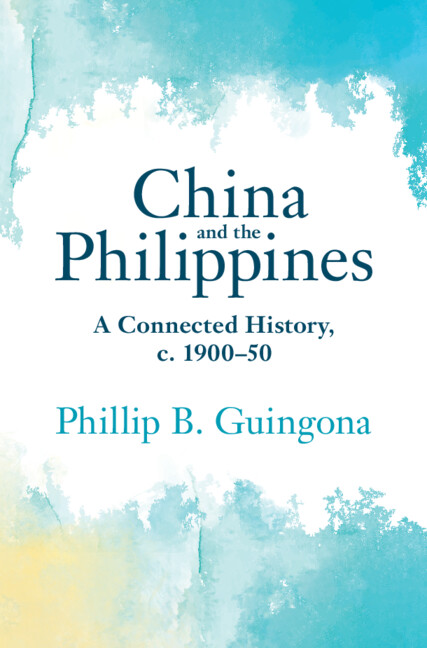
China and the Philippines

-
Select format
-
- Publisher:
- Cambridge University Press
- Publication date:
- 09 November 2023
- 23 November 2023
- ISBN:
- 9781009359207
- 9781009359245
- 9781009359214
- Creative Commons:
-
This content is Open Access and distributed under the terms of the Creative Commons Attribution licence CC-BY-NC 4.0.


https://creativecommons.org/creativelicenses - Dimensions:
- (229 x 152 mm)
- Weight & Pages:
- 0.6kg, 292 Pages
- Dimensions:
- (229 x 152 mm)
- Weight & Pages:
- 0.426kg, 292 Pages
Open AccessYou have digital access to this book
Show more authors 
You have digital access to this book
Book description
Foregrounding the entangled history of China and the Philippines, Guingona brings to life an array of understudied, but influential characters, such as Filipino jazz musicians, magnetic Chinese swimmers, expert Filipino marksmen, leading Chinese educators, Philippine-Chinese bankers, Filipina Carnival Queens, and many others. Through archival research in multiple languages, this innovative study advances a more nuanced reading of world history, reframing our understanding of the first half of the twentieth century by bringing interactions between Asian people to the fore and minimizing the role of those who historically dominated global history narratives. Through methodologically distinct case studies, Guingona presents a critique of Eurocentric approaches to world/global history, shedding light on the interconnected history of China and the Philippines in a transformative period. This title is part of the Flip it Open Programme and may also be available Open Access. Check our website Cambridge Core for details.
Reviews
‘Meticulously researched and imaginatively written, Guingona’s book de-centers the ‘West’ by focusing on the largely unexplored interactions between Filipinos and Chinese during the early twentieth century, and reminds readers that the Philippines and China, as they had in the past, could build a relationship based on friendship and mutual support.’
Richard T. Chu - Five College Professor, History Department, University of Massachusetts-Amherst
‘Beyond being a compelling history of Filipinos in China and Chinese in the Philippines, this book is a meditation on cultural exchange. Guingona shows us the potential of peoples transcending their parochialisms and discovering new ideas through each other.’
Lisandro E. Claudio - University of California, Berkeley
‘With extraordinary skill and erudition, Phillip Guingona commands multiple literatures to restore to understanding a vital Sino-Philippine link obscured in the historical traditions of both countries. Calling attention to the vast yet forgotten exchanges through music, education, and sports, Guingona’s groundbreaking study, delivered in lively prose, is one of the finest examples of inter-Asian, transnational studies through recentering diasporic Chinese as key agents.’
Shelly Chan - Associate Professor of History, University of California, Santa Cruz
‘Guingona established his argument in solid conversation with an abundance of rich, recent scholarship, and he hopes his discussion of the ‘lost’ connection can inspire readers to uncover a world of intimate contact and mutual influence, a world that can serve as a foundation/inspiration for contemporary wisdoms in international relationships. Highly recommended.’
G. Li Source: CHOICE
‘Lively and well-researched.’
Chien-Wen Kung Source: The China Quarterly
‘Guingona’s monograph makes important interventions into the historiographies of these diverse fields by putting previously ignored Chinese and Filipino historical actors at the forefront of the interconnected histories of China and the Philippines. This exploration, as Guingona shows, has previously been most heavily focused on American-Japanese-European perspectives and sources. Guingona intentionally turns his attention away from imperial/colonialist narratives toward highlighting Filipino and Chinese figures. … this book is a novel decolonial interconnected history of China and the Philippines. It would be a good source for those wishing to better understand China’s history of entanglements in Southeast Asia, and vice versa, as well as those interested in the histories of overseas ethnic Chinese communities.’
Patrick Buck Source: H-Net Reviews
Contents
Full book PDFContents
-
China and the Philippines
pp i-i -
-
- You have access
- Open access
- HTML
- Export citation
-
-
Asian Connections - Series page
pp ii-iv -
-
- You have access
- Open access
- HTML
- Export citation
-
-
China and the Philippines - Title page
pp v-v - A Connected History, c. 1900–50
-
-
- You have access
- Open access
- HTML
- Export citation
-
-
Copyright page
pp vi-vi -
-
- You have access
- Open access
- HTML
- Export citation
-
-
Dedication
pp vii-viii -
-
- You have access
- Open access
- HTML
- Export citation
-
-
Contents
pp ix-x -
-
- You have access
- Open access
- HTML
- Export citation
-
-
Figures
pp xi-xi -
-
- You have access
- Open access
- HTML
- Export citation
-
-
Acknowledgments
pp xii-xiii -
-
- You have access
- Open access
- HTML
- Export citation
-
-
A Note on Translation and Rendering of Names
pp xiv-xiv -
-
- You have access
- Open access
- HTML
- Export citation
-
-
A Note on What Is Missing
pp xv-xvi -
-
- You have access
- Open access
- HTML
- Export citation
-
-
Introduction: Before a Vast Ocean
pp 1-20 -
-
- You have access
- Open access
- HTML
- Export citation
-
-
Part I - Mirrored Diasporas
pp 21-68 -
-
- You have access
- Open access
- HTML
- Export citation
-
-
1 - Shanghai’s Filipinos and Manila’s Chinese
pp 29-43 - Filipinos in Shanghai
-
-
- You have access
- Open access
- HTML
- Export citation
-
-
2 - Trumpets and Ledgers
pp 44-68 -
-
- You have access
- Open access
- HTML
- Export citation
-
-
Part II - The Philippine Model
pp 69-118 -
-
- You have access
- Open access
- HTML
- Export citation
-
-
3 - Achieving Modernity by Studying the Philippines
pp 77-91 -
-
- You have access
- Open access
- HTML
- Export citation
-
-
4 - Achieving Modernity by Studying in the Philippines
pp 92-118 -
-
- You have access
- Open access
- HTML
- Export citation
-
-
Part III - Nationalisms of the Founders
pp 119-164 -
-
- You have access
- Open access
- HTML
- Export citation
-
-
5 - Capital Heroes and a Hokkien Nation
pp 125-147 -
-
- You have access
- Open access
- HTML
- Export citation
-
-
6 - Seeking Salvation and a Chinese Nation
pp 148-164 -
-
- You have access
- Open access
- HTML
- Export citation
-
-
Part IV - The Pivot
pp 165-217 -
-
- You have access
- Open access
- HTML
- Export citation
-
-
7 - Coalescence
pp 171-186 - 1921, a Year of Promise
-
-
- You have access
- Open access
- HTML
- Export citation
-
-
8 - Possibilities
pp 187-198 - Meeting at Springfield’s Fields
-
-
- You have access
- Open access
- HTML
- Export citation
-
-
9 - Disintegration
pp 199-213 - The Triangle Offense
-
-
- You have access
- Open access
- HTML
- Export citation
-
-
Conclusions: The Ghosts of the Present
pp 214-217 -
-
- You have access
- Open access
- HTML
- Export citation
-
-
Appendix: Glossary of Names
pp 218-225 -
-
- You have access
- Open access
- HTML
- Export citation
-
-
Bibliography
pp 226-270 -
-
- You have access
- Open access
- HTML
- Export citation
-
-
Index
pp 271-274 -
-
- You have access
- Open access
- HTML
- Export citation
-
Metrics
Altmetric attention score
Full text views
Full text views helpTotal number of HTML views: 0
Total number of PDF views: 0 *
 Loading metrics...
* Views captured on Cambridge Core between #date#. This data will be updated every 24 hours.
Usage data cannot currently be displayed.
Accessibility standard: Unknown
Why this information is here
This section outlines the accessibility features of this content - including support for screen readers, full keyboard navigation and high-contrast display options. This may not be relevant for you.
Accessibility Information
Accessibility compliance for the HTML of this book is currently unknown and may be updated in the future.