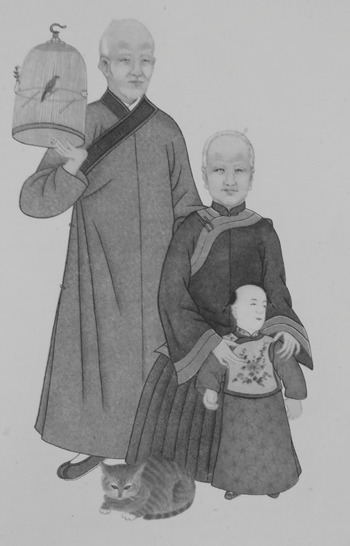


The writer Chiang Yee was in England in the 1930s when he painted in ILLUSTRATION 0.1 of himself with his grandparents. It was painted from memory, by a man who called himself ‘the silent traveller’, isolated and alien. The picture took him back to a place of perfect happiness, with two lovely old people who adored him.
Grandparents with their favourite

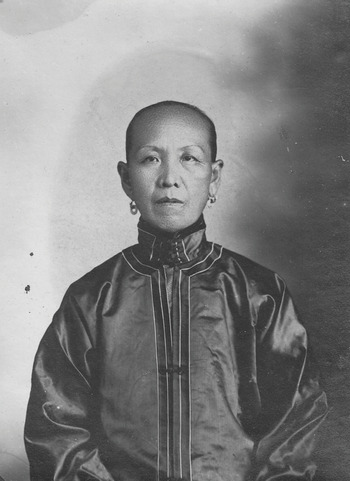
The picture of the grandmother of the celebrated Wong family of Vancouver shows a poised, clear-eyed woman. She is wearing a sombre silk gown. Her hair is pulled back, her face unadorned. She has jade hoops in her ears. She is confident, she has a natural dignity, she is a woman fulfilled. She was born in the late Qing Dynasty. She had three sons and seventeen grandchildren, ten of them born in Vancouver.
In traditional China getting older was not threatening. Old women came into their own, in control of their households, basking in the love of their sons, living with their grandchildren. Their husbands were less important in the family. Old men moved into quiescence, engaging in gentle activities – calligraphy, taiqi, hanging out with other old men. The grandchildren were a joy. Each new grandchild added to the happiness, ‘piling up happiness’:
累積快樂
leiji kuaile
The number, especially of grandsons, mattered: the more there were, the greater proof an old person had of success in life. Pearl Buck, the interpreter of China for generations of Western readers, gave a lyrical description of the happiness of Wang Lung, the main character in The Good Earth: ‘In the space of five years he had four grandsons and three granddaughters and the courts were filled with their laughter and their weeping.’1 The only greater happiness was to see great-grandchildren, to have 四世同堂 sishi tongtang, ‘four generations under one roof’. The ideal image was of a respected patriarch, surrounded by grandchildren, his days passing in quiet pleasure.
Old women were busy and self-confident. They did not fit saccharine Western images of plump, smiling grannies, knitting and sewing in a corner, undemanding and passive. And there are no Chinese versions of dotty old women, as played by Maggie Smith: the working-class, combative Muriel Donnelly in The Best Exotic Marigold Hotel or the crazy Miss Shepherd in The Lady in the Van. Her Dowager Lady Grantham in Downton Abbey is a matriarch who might be recognisable in China, though she had no formal power in her family beyond her autocratic personality.
Comparisons between China and the West that seem unavoidable may also be problematic. They may be facile assumptions about differences and similarities between cultures, assumptions that lead to blind alleys of complacent ignorance. That is one possibility. Another is that there is a history of comparisons; the China–West binary has been used since the nineteenth century (late Qing Dynasty), a pattern of analysis known as the tiyong dichotomy, ‘Chinese knowledge as the essence, Western knowledge for practical use’:
中學為骵 西學為用
zhongxue weiti xixue weiyong
The Wongs’ grandmother

The core of the dichotomy is that there is a Chinese essence that cannot be touched by material and technological change. The essence is made up of values and beliefs, evolved over millennia of history. Originally developed in the government sphere, it came to encompass society, closely associated with Confucian values. In social terms it means that Chinese families are expected to respect and care for their elders, Western families much less so. Tiyong has survived the arrival of a Western ideology, Marxism, and it continues to survive in the age of Socialism with Chinese Characteristics. It is used explicitly to congratulate China on conquering COVID, counterposed to the lack of success in the undisciplined liberal West (the origin of the virus is not mentioned). In looking at the lives of old women ILLUSTRATION, comparisons may help, to point up the advantages and the restrictions of the Chinese way, as seen from the point of view of old women/grandmothers.
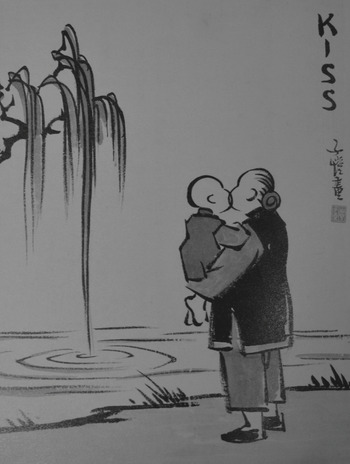
The kiss
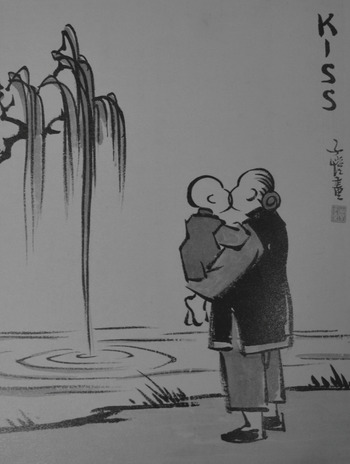
Love and Affection
Grandparents were/are tremendously important to their grandchildren; they were the source of love. The cartoonist Feng Zikai 豐子愷 captured this love. The role of parents was/is to be strict with their children, to prepare them for the harshness of a competitive world. The dearth of overt parental affection created a space for grandparents to give grandchildren warmth and expressions of love.
Chinese adults often remember their grandparents’ giving of love, the gift of the old to the young. The love is reciprocated. The grandchildren think of their grandparents with love and gratitude – and with respect for their fortitude and resilience. Li Jie dedicates her beautiful book about her childhood in Shanghai to her grandparents, who ‘first illuminated for me the human vitality and personal meaning of a baffling and tumultuous century’.2
Generations
There is no such thing as a typical Chinese family, but there has been a common feature: power within the family resided in the senior generation. There was a twist to the tradition of male dominance: as men grew older they withdrew; women became more powerful, as matriarchs. The matriarch was in charge of everything within her household, leaving her husband (later her sons) to manage affairs outside the family. Literate or illiterate, she was supposed to be shrewd, devoted to the welfare of the family. She kept track of income and expenditures – at whatever level of wealth or poverty – she managed relations between family members and she led the observance of rituals and ceremonies.
Her role was as true of peasant (the term 农民 nongmin is now often translated as ‘farmer’) families, the vast majority of the population, as of rich families. In the family economy grandmothers were essential. They were household managers, they looked after the children and they helped out in the fields at the busy times, planting and harvest. This is a prosperous village in Yunnan in the 1940s; the old women were at work at harvest time:3
We often found old women, even those above sixty, busily working in the fields. It will not be too far from the truth to say that the female population of the community turns out en masse during the busy season. They may be at work in the fields or busy in the kitchen preparing food for the workers. On the other hand men could be found at all times in the shops, gambling houses and opium dens enjoying their idle bliss.
Class
I have just mentioned that older women were dominant in families, whether rich or poor. This brings up the issue of class. Defining social class has been an enormous issue in modern China. In the Mao Era (1950 on), often called the Red Era (红色时代 hongse shidai), political upheaval and class struggle demanded class classification (阶级分别 jieji fenbie). The process used many metrics (land ownership, income, family background) which varied by place and time. The process was tumultuous and antagonistic. This system has gone out of usage. I have borrowed a simpler approach, from the pioneer sociologist Chen Da 陳逹 in the 1930s, which fits today’s society better than the Mao Era classification: rich, middle class and lower class.
Child Care
Until very recently paternal grandmothers were accepted as repositories of wisdom in the care of infants and small children. They took over much of the baby care from their inexperienced daughters-in-law, holding the infant in their arms, rocking, soothing, kissing, crooning, singing lullabies to get a baby to sleep, doing everything except feed the baby – that was left to the mother. They dressed babies in elaborate clothes and hats. They were baby-worshippers. Their skills and attention helped to produce the most charming of creatures, a placid, smiling infant.
I have come across very few references to a new mother’s lack of trust in a grandmother’s competence to care for her children, even though the grandmother was her mother-in-law. This has always intrigued me; it is quite contradictory to Western concepts, where baby and child care has gone through cycles of belief and practice that have one thing in common: mothers doubt the knowledge and competence of grandmothers. In China, the expertise of grandmothers seems to go unquestioned. The pattern of trust has shown cracks recently. The state worries about the quality of care of the tens of millions of ‘left-behind children’ (留守儿童 liushou ertong), whose parents, migrant workers, are away for a year or longer at a time. The lack of trust is not the parents’, however, but the state’s.
The role of the grandmother as child carer has increased over time, and has extended from infants and small children to older ones. Grandmothers have come to care for grandchildren for long periods – weeks, months or even years. This extension of care started with the beginnings of industrialisation at the end of the Qing Dynasty and the employment of more and more young women outside the home. After 1949 and the establishment of the Communist government, the Party demanded that young women (i.e. mothers) participate in the revolution. Maternal grandmothers as well as paternal grandmothers were drawn in. Now that millions upon millions of people work away from home, separated from their children, the separations are accepted as part of the new economy.
Contributions to the Family Economy
Grandmothers contributed to the family economy. Their unpaid work within the household was a substitute for money. They preserved vegetables, eggs, meat, fish and fruit; they made noodles, pickles, bean curd. They made household items, bedding, clothing, shoes. And they made handcrafts for sale. Every locality had its tradition of handcraft products, made by women working in convivial groups in the courtyard or at the house gate. Baskets and mats were woven from reeds and osiers; toys were moulded from paste, thread was spun and woven into cloth. Older women taught the local crafts to younger women in their family.
Elders
Old women, as old people, have benefited from the Confucian tradition of respect for age. They are assumed to have accumulated experiences, good and bad, to have absorbed them, and acquired wisdom. The ancient text 韓非子 Han Feizi says, ‘the old horse knows the road’: 老馬識途 laoma shi tu. On a more cynical level is ‘an old reprobate knows all the tricks’: 老奸巨猾 laojian juhua. Wisdom was not gendered, though a rule of thumb was that from men came rather lofty advice, from women practical help and understanding.
The respect for age has held fairly steady in China, with major exceptions. The young radicals in the 1920s and 1930s revolted against the old patriarchal order. Revolt included sympathy for their mothers and grandmothers as victims of patriarchy. In the Mao Era respect for age was turned on its head; youth was in control and old people were repositories of feudal backwardness. The present government has reversed this. Confucian respect for age is mobilised to make up for limited provision of pensions and health care; there are legal and moral provisions that require children to look after their parents and their grandparents. The celebrations to honour the elderly, banned in the Mao Era, have returned. From sixty on the decade birthdays (大壽 dashou) are occasions for major gifts and lavish celebrations.
Grandmothers inculcated traditional culture into their grandchildren, through stories, songs, picture books, proverbs. They taught them religion, praying to household deities, taking them to shrines and temples. They told them stories. Chiang Yee remembered sitting at his grandmother’s knee with his siblings and cousins on hot summer evenings:4
It was her habit to tell us legends and stories about immortals and spirits, or about her life as a girl and a young wife, or about the city and its history. Some of the stories interested me and others did not, but we were all impressed by Grandmother’s knowledge. After a cup or two of kaoliang (a Chinese strong white wine made of barley [actually a spirit made of sorghum]) she was always in good humour and ready to entertain us.
Grandfathers had different responsibilities in cultural transmission. Literate grandfathers were responsible for passing on the higher culture to their grandchildren. The first stage, when the child was very small, was to teach the rudiments of calligraphy, from single strokes to simple characters. They might be written in sand, or with water on a stone floor, or, as the child improved, on paper. The beautiful 2015 film about the great calligrapher Qi Gong 启功, The Calligraphy Master, shows his grandfather teaching him the first stages of calligraphy.
Grandfathers took ancestral succession seriously. They taught their grandchildren about their forebears, and in the telling created continuity between the ancestors and the children. Whether the family had a written genealogy or not, all families had a sense of where they came from, who their relatives were. The genealogies and the oral histories might or might not be factual, but they existed, and the older generation had a duty to pass them on.
Grandparents played a key role in a child’s language development. They spoke to their grandchildren in their native dialect. Standard Chinese (國語 guoyu/普通话 putonghua) was not introduced until the Republic (1912 on) and took a long time to be universally spoken; until recently most people spoke a dialect. Younger people became bilingual, in dialect and standard Chinese, but the grandparents seldom did. They were their grandchildren’s instructors in dialect. This turned out to have long-term value; certain dialects (Beijing, Shanghai, Minnan, Cantonese) have brought their speakers advantage in the economic boom that started in the 1980s.
The Power of Older Women
Older women wielded powerful social control. They were in close touch with their neighbours, with other grandmothers, exchanging the latest local news, gossiping. In the Mao Era the Communist Party called on them to run street committees and watch their neighbours for signs of opposition to the Party. That role has declined, replaced by social media and electronic surveillance.
Old women were/are devotees of the female deities who play an enormous role, in Buddhism, Daoism, popular religion and Christianity. The various deities have their own cults and temples, but their roles are similar. All are loving and caring, protecting mortals in distress. They were immensely popular, which is perhaps why they were attacked so ferociously during the Mao Era, their shrines destroyed and their images smashed. They are now back, stronger than ever, worshipped in countless temples and shrines, some of them of extravagant size and lavishness.
Grandmothers in Literature
China’s most famous grandmother, the Lady Dowager of the Jia Family 賈母, is a central character in the eighteenth-century novel A Dream of Red Mansions, and in cartoons, films, radio and television series, and on playing cards and cigarette cards. The Jia mansion and its garden, the 大觀園 Daguanyuan, have been re-created in Beijing. She feels familiar to all Chinese, a commanding and respected figure (see Chapter 2).
Grandmothers are downplayed in academic and official literature on women in Chinese society; they hardly exist. The focus in feminist history is on girls and young women, on the miseries that women in those age groups have suffered: foot binding, arranged marriage. The push towards raising the status of women since the late Qing has focussed on young women and their contributions to revolution and social change. Older women are absent, unless as domineering mothers-in-law or as carers for the children of their own absent children. I have scoured the literature on Chinese women for discussion of old women, with very slim pickings.5
Other genres of literature value grandmothers, notably biography and autobiography. Traditional biographies were detailed, year-by-year accounts that left out women. In the 1930s a more introspective form of biography emerged. Three autobiographies in English describe childhood in late imperial and early Republican China. Sheng Cheng wrote about his family in Yichang 宜昌 (Hubei), Tan Shihua about his in Sichuan and Ling Shuhua 凌叔華 about hers in Beijing.6 All were from rich families and had foreign connections. Vita Sackville-West, a member of the Bloomsbury Group, wrote the introduction to Ling’s work.
The poor were illiterate, they could not write about themselves, so biographies of the poor are rare. One that does stand out is the oral biography of Ning Lao Taitai told to Ida Pruitt in the 1930s, Daughter of Han.7 Gail Hershatter’s Gender of Memory is a fascinating compilation based on more than seventy interviews that she did in the 1990s with her colleague Gao Xiaoxian, in villages in Shaanxi. They interviewed old women about their lives as young women in the early years of the Mao Era.8
After 1949 biography took on a sinister aspect; people were required to write autobiographies to establish their past in class terms, often with the consequence of a bad ‘label’. In published literature hagiographies of major revolutionary figures were published in great numbers. In the Mao Era demonologies of enemies such as the Four Great Families (四大家族 sida jiazu), the leading families of the Republic, balanced the hagiographies, lurid tales of hideous tyrants and poisonous weeds.
Since the early 1980s there has been an explosion of memoir (回忆录 huiyilu) writing. These may be written by or about a subject. They are often thinly veiled efforts to ‘revise history’, to give people who had previously been vilified back their rightful place in history. Others are efforts at reflected glory, written about famous figures with whom the author has a connection. Memoirs are positive; awkward periods are omitted, as are salacious details of private lives. To offset the probity of memoirs there are ‘outside histories’ (外史 waishi), books packed with lurid and sometimes improbable details of the lives of the famous. Printed books have now given way to online material.
Autobiography disguised as fiction is a major genre for understanding the family and its transformation in modern China. Ba Jin’s 巴金 novels, published in serial form in the early 1930s, gave detailed descriptions of his family in Sichuan. François Cheng’s (Cheng Baoyi 程抱一) novel The River Below, first published in 1998, closely follows Cheng’s childhood in Jiangxi, and his wartime youth in Sichuan.9
Sentiment
Western sophisticates often feel queasy about liberal expression of sentiment. It is dismissed as ‘sentimentality’ or ‘schmaltz’, too sugary, cloying or syrupy to be taken seriously. Overt sentiment seems false, hypocritical, squirm-making, mawkish. It arouses ‘feelings of embarrassment and anxiety’.10 It is class-based: the less educated are more likely to indulge in sentiment than the more educated. And it is overtly commercial – greeting cards, floral tributes. It may go beyond sensible bounds. When my children were small it was common to have a baby’s first boot bronzed; there must be millions of bronze boots around.
There is a countertradition in China. Expressions of overweaning sentiment are quite acceptable, not the least embarrassing. Nowhere does lush sentiment appear more vividly than in portrayals of infants. Babies are shown as laughing, rosy creatures, plump to the point of obesity.
Periodisation and Chronology
Many of the topics I look at in this book recur over time; others mutate, change dramatically or disappear. There is no absolute linear chronology. There are surprises in what comes back, what does not. The best example is Confucian values. They were the foundation of government and society in the Qing, attacked by the Taiping Heavenly Kingdom (太平天國 taiping tianguo) (1850–64), by Republican iconoclasts and by the Communist Party – and are now back again, sponsored by the state. One topic is relatively recent: the growth of population, which stressed the old social system.
In the late Qing Dynasty and the early Republic, social change was slight in most parts of China. The family was the centre of life, traditional values and customs were still dominant, migration was limited to a few regions. Major social changes got under way slowly after the 1911 Revolution. The new political system had limited impact, but industrialisation, new transport systems and constant low-level warfare all combined to accelerate changes in society, concentrated in the cities and coastal regions. In 1937 Japan invaded China. There followed twelve years of warfare, the War of Resistance (1937–1945), then the civil war between the Nationalists and the Communists (1946–1949). The wars brought refugee flights, economic collapse, social upheaval and chaos. The old social order, already compromised, was effectively destroyed.
China’s population is the largest of any state in the world, and has been since time immemorial. For much of that time it was fairly stable, around two hundred million; since the eighteenth century it has more than quadrupled; it passed a billion in the 1980s and is now around 1.4 billion. The population is no longer growing, and concern now is about shrinkage and the imbalance between young and old. I use vague numbers because until the Census of 1981 there was no rigorous census. Historically the bulk of the population was rural; now more than half are permanent or temporary urban residents. In infancy and childhood males have outnumbered females; in old age women outnumber men. Life expectancy has risen dramatically since 1949, from around forty to over seventy, though one generation, born in the early 1960s famine, is significantly smaller. As many as 50 million people of Chinese descent live outside Mainland China; 24 million are in Taiwan, more than 7 million in Hong Kong.Footnote 1
1 For greater detail on historical demographics see Ge Jianxiong 葛剑雄, 中国人口史 Zhongguo renkou shi (A History of China’s Population) (Shanghai: Fudan, 2002); Endymion Wilkinson, Chinese History: A New Manual, 3rd edition (Cambridge, MA: Harvard University Asia Center, 2013), pp. 289–292, 308–311.
During the Mao Era the Communist government made radical efforts to remake China along socialist lines. Old values were trashed as ‘feudal’. The Party took precedence over the family. Mass migrations redistributed people across China. China was isolated from the world and from Overseas communities. Tumultuous political movements caused huge disruption, economic hardship and famine; the greatest turmoil was the Cultural Revolution (1966–1976). The Communist Party survived the excesses of the Mao Era. A new leadership ushered in an era of ‘change and opening up’ (改革开放 gaige kaifang). The last four decades of the Reform Era have seen the rebirth of many traditional norms, grafted onto the wreckage left by the Mao Era. There has been unprecedented economic growth and fundamental social change. Restrictions on family size have changed family dynamics. From rural China hundreds of millions of peasants have moved to work in new industries; they do not move permanently, but remain attached to their villages, where their children live with their grandparents.
Over the past century of political turmoil, economic growth and technological innovation, much of Chinese society has changed beyond recognition. In the lifetime of the old women interviewed by Hershatter and Gao a mind-numbing succession of political movements blurred into each other; they identified clearly two big turning points: ‘Life got better twice, once in the 1950s and again in the 1980s.’11
Beyond political periodisation is personal periodisation, the key dates in a person’s life: birth, marriage, birth of first child. Today’s grandmothers see their lives in personal terms – and they see that through all the societal change the role of grandmothers has changed, but not fundamentally. They have continued to be child-carers, household managers, religious devotees – and above all sources of love, warmth and affection.