Book contents
- Frontmatter
- Contents
- List of contributors
- Preface and acknowledgements
- Introduction: the what, how and why of developmental change: the emergence of a new paradigm
- 1Mind, intelligence and development: a cognitive, differential and developmental theory of intelligence
- 2Types of cognitive change: a dynamical, connectionist account
- 3Developmental patterns in proportional reasoning
- 4Building general knowledge and skill: cognition and microdevelopment in science learning
- 5Cognitive change as strategy change
- 6The emergence of mind in the emotional brain
- 7Practices of quantification from a socio-cultural perspective
- 8Contributions of central conceptual structure theory to education
- 9Accelerating the development of general cognitive processing
- 10Dealing with change: manifestations, measurements and methods
- 11Dynamic modelling of cognitive development: time, situatedness and variability
- 12Modelling individual differences in change through latent variable growth and mixture growth modelling: basic principles and empirical examples
- Index
- References
2 - Types of cognitive change: a dynamical, connectionist account
Published online by Cambridge University Press: 22 September 2009

Book contents
- Frontmatter
- Contents
- List of contributors
- Preface and acknowledgements
- Introduction: the what, how and why of developmental change: the emergence of a new paradigm
- 1Mind, intelligence and development: a cognitive, differential and developmental theory of intelligence
- 2Types of cognitive change: a dynamical, connectionist account
- 3Developmental patterns in proportional reasoning
- 4Building general knowledge and skill: cognition and microdevelopment in science learning
- 5Cognitive change as strategy change
- 6The emergence of mind in the emotional brain
- 7Practices of quantification from a socio-cultural perspective
- 8Contributions of central conceptual structure theory to education
- 9Accelerating the development of general cognitive processing
- 10Dealing with change: manifestations, measurements and methods
- 11Dynamic modelling of cognitive development: time, situatedness and variability
- 12Modelling individual differences in change through latent variable growth and mixture growth modelling: basic principles and empirical examples
- Index
- References
Summary
In this chapter we offer a dynamical account of types of conceptual change both at the cognitive and the mathematical level. Our aim is to show that some classes of neural models can implement the types of change that we have proposed elsewhere. First, we introduce certain types of change that purport to account for the kinds of conceptual change observed in human development. These types are first described at the cognitive level. In the second part of the chapter, we discuss the mathematical/representational level realizations of the cognitive level representations and we claim that the latter can be depicted as points in the system's activational landscape. The concepts of attractors and basins of attraction are introduced and their role is discussed. Our guide in developing our account is the dynamical connectionist theory. In the third part of the chapter we offer a dynamical account of the types of change and we claim that, at this level, conceptual change can be modelled as a process of modification, appearance and disappearance of attractors and/or basins of attraction that shape the system's landscape. Finally, we discuss the kinds of mechanisms at the representational level that could produce the types of change observed at the cognitive level and modelled by means of dynamic connectionism.
Levels in the analysis of the mechanisms of change
Conceptual change can be accounted for at various levels of explanation. We distinguish here the cognitive, the representational and the level of the functional architecture.
Information
- Type
- Chapter
- Information
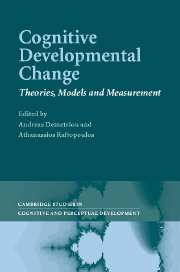
- Cognitive Developmental ChangeTheories, Models and Measurement, pp. 74 - 117Publisher: Cambridge University PressPrint publication year: 2005
References
(1989). A proposal for more powerful learning algorithms. Neural Computation, 1, 201–7CrossRefGoogle Scholar
Carey, S. (1985). Conceptual change in childhood. Cambridge, MA: The MIT Press
Carey, S. (1992). The origin and evolution of everyday concepts. In R. Giere (ed.) Cognitive models of science. Minneapolis: Minnesota University Press
Carey, S. and Spelke, E. (1994). Domain-specific knowledge and conceptual change. In L. A. Hirschfeld and S. A. Gelman (eds.) Mapping the mind: domain specificity in cognition and culture. Cambridge: Cambridge University PressCrossRef
Chi, M. T. H. (1992). Conceptual change within and across ontological categories. In R. Giere (ed.) Cognitive models of science. Minneapolis: Minnesota University Press, 129–86
Chi, M. T. H., Glaser, R. and Rees, E. (1982). Expertise in problem solving. In R. J. Sternberg (ed.) Advances in the psychology of human intelligence (vol. 1). Hillsdale, NJ: Erlbaum
Clark, A. (1993). Associative engines. Cambridge, MA: The MIT Press
(1998). Dynamical embodiments of computation in cognitive processes. Brain and Behavioral Sciences, 21, 635CrossRefGoogle Scholar
Dawson, M. R. W. (1998). Understanding cognitive science. Cornwall: Blackwell
Demetriou, A. (1998). Cognitive development. In A. Demetriou, W. Doise, K. F. M. van Lieshout (eds.) Life-span developmental psychology (pp. 179–269). London: Wiley
Demetriou, A., Efklides, A. and Platsidou, M. (1993). The architecture and dynamics of developing mind: experiential structuralism as a frame for unifying cognitive developmental theories. Monographs of the Society for Research in Child Development, 58 (5–6, Serial No. 234)CrossRef
Demetriou, A. and Kazi, S. (2001). Unity and modularity in the mind and the self: studies on the relationships between self-awareness, personality, and intellectual development from childhood to adolescence. London: Routledge
and (1999). Modelling the developing mind: from structure to change. Developmental Review, 19, 319–68CrossRefGoogle Scholar
Demetriou, A. and Valanides, N. (1998). A three level theory of the developing mind: basic principles and implications for instruction and assessment. In R. J. Sternberg and W. M. Williams (eds.) Intelligence, instruction, and assessment (pp. 149–99). Hillsdale, NJ: Lawrence Erlbaum
, , and (1999). A neural network model of transfer of implicit knowledge. Cognitive Science, 23(1), 53–82CrossRefGoogle Scholar
Edelman, G. M. (1987). Neural Darwinism. New York: Basic Books
Edelman, G. M. (1992). Bright air, brilliant fire. On the matter of mind. New York: Basic Books
Elman, J. L. (1995). Language as a dynamic system. In R. F. Port and T. Van Gelder (eds.) Mind as motion: exploration in the dynamics of cognition. Cambridge, MA: The MIT Press
Elman, J. L., Bates, E. A., Johnson, M. H., Karmiloff-Smith, A., Parisi, D. and Plunkett, K. (1996). Rethinking innateness: a connectionist perspective on development. Cambridge, MA: The MIT Press
Fauconnier, G. (1997). Mappings in thought and language. Cambridge: Cambridge University Press
Fodor, J. (1981). Representations: philosophical essays on the foundations of cognitive science. Cambridge, MA: The MIT Press
Hinton, G. E., and Sejnowski, T. J. (1986). Learning and relearning in Boltzmann machines. In D. E. Rumelhart, J. L. McLelland, and the PDP Research Group (eds.) Parallel distributed processing: explorations in the microstructure of cognition, vol. 1: Foundations. Cambridge, MA: MIT Pres
and (1997). Distributed representations of structure: a theory of analogical access and mapping. Psychological Review, 104(3), 427–66CrossRefGoogle Scholar
Horgan, T. and Tienson, J. (1996). Connectionism and the philosophy of psychology. Cambridge, MA: The MIT Press
Johnson, M. (1981). The body in the mind: the bodily basis of meaning, imagination, and reason. Chicago, IL: University of Chicago Press
Juarrero, A. (1999). Dynamics in action. Cambridge, MA: The MIT University Press
Kelso, S. (1995). Dynamic patterns: the self organization of brain and behavior. Cambridge, MA: The MIT Press
., and (2000). Development of meaning making: a dynamic systems approach. New Ideas in Psychology, 18, 57–82CrossRefGoogle Scholar
Lakoff, G. (1987). Women, fire, and dangerous things: what categories reveal about the mind. Chicago, IL: University of Chicago Press
McClelland, J. L. (1995). A connectionist perspective on knowledge and development. In T. J. Simon and G. S. Halford (eds.) Developing cognitive competence: new approaches to process modeling (pp. 157–204). Hillsdale, NJ: Lawrence Erlbaum
, , and (1998). Modelling the influence of thematic fit (and other constraints) in on-line sentence comprehension. Journal of Memory and Language, 38, 283–312CrossRefGoogle Scholar
Marr, D. (1982). Vision: a computational investigation into human representation and processing of visual information. San Francisco, CA: Freeman
Newell, A. and Simon, H. A. (1972). Human problem solving. Englewood Cliffs, NJ: Prentice Hall
Piaget, J. (1975). The development of thought: equilibration of cognitive structures. Oxford: Basil Blackwell
(1999). A connectionist approach to word reading and acquired dyslexia: extension to sequential processing. Cognitive Science, 23(4), 543–69CrossRefGoogle Scholar
and (1993). Deep dyslexia: a case study of connectionist neuropsychology. Cognitive Neuropsychology, 10, 377–500CrossRefGoogle Scholar
, , and (1996). Understanding normal and impaired word reading: computational principles in quasi-regular domains. Psychological Review, 103(1), 56–115CrossRefGoogle ScholarPubMed
and (1992). Connectionism and developmental theory. British Journal of Developmental Psychology, 10, 209–54CrossRefGoogle Scholar
Pollack, J. B. (1990). Recursive distributed representations. In G. Hinton (ed.) Connectionist symbol processing. Cambridge, MA: The MIT Un. PressCrossRef
Pollack, J. B. (1995). The induction of dynamic recognizers. In R. F. Port and T. Van Gelder (eds.) Mind as motion: exploration in the dynamics of cognition. Cambridge, MA: The MIT Press
Pylyshyn, Z. (1984). Computation and cognition: toward a foundation for cognitive science. Cambridge, MA: The MIT Press
(1997). Cognitive and perceptual limitations and learning: an excursion to connectionism. Human Development, 40(5), 293–319CrossRefGoogle Scholar
and (1997). The neural basis of cognitive development: a constructivist manifesto. Behavioral and Brain Sciences, 20, 537–56CrossRefGoogle ScholarPubMed
(1997). Is the learning paradox resolved? Behavioral and Brain Sciences, 20, 537–96CrossRefGoogle Scholar
, and (1996a). Numerical bifurcation analysis of distance-dependent on-center off-surround shunting neural networks. Biological Cybernetics, 75, 495–507CrossRefGoogle Scholar
, and (1996b). On the validity of simulating stagewise development by means of PDP networks: application of catastrophe analysis and an experimental test of rule-like network performance. Cognitive Science, 20, 101–36CrossRefGoogle Scholar
Rumelhart, D. E., McClelland, J. L. and the PDP Research Group (1986). Parallel Distributed Processing: explorations in the microstructure of cognition, vol. 1: Foundations. Cambridge, MA: MIT Press
Sejnowski, T. and Rosenberg, C. (1986). NETtalk: a parallel network that learns to read aloud. The Johns Hopkins University, Technical Report JHU/EEC-86/01
and (1993). From simple associations to systematic reasoning: a connectionist representation of rules, variables, and dynamic binding using temporal synchrony. Behavioral and Brain Sciences, 16, 417–94CrossRefGoogle Scholar
Shultz, T. R. (2003). Computational developmental psychology. Cambridge, MA: The MIT Press
Shultz, T. R. and Schmidt, W. C. (1991). A cascade-correlation mode of balance scale phenomena. In Proceedings of the Thirteenth Annual Conference of the Cognitive Science Society. Hillsdale, NJ: Lawrence Erlbaum, 635–40
Shultz, T. R, Schmidt, W. C., Buckingham, D. and Mareschal, D. (1995). Modelling cognitive development with a generative connectionist algorithm. In T. J. Simon and G. S. Halford (eds.) Developing cognitive competence: new approaches to process modelling. Hillsdale, NJ: Lawrence Erlbaum
Siegler, R. S. (1981). Developmental sequences within and between concepts. Monographs of the Society for Research in Child Development, 46 (2, Serial No. 189)CrossRef
Siegler, R. S. (1996). Emerging minds. Oxford: Oxford University Press
, and (2000). Artificial grammar learning by infants: an auto-associator perspective. Developmental Science, 3(4), 442–56CrossRefGoogle Scholar
, and (1985). On differentiation: a case study of the development of concepts of size, weight, and density. Cognition, 21, 177–237CrossRefGoogle ScholarPubMed
Smolensky. P. (1990). Tensor product variable binding and the representation of symbolic structures in connectionist systems. In G. E. Hinton (ed.) Connectionist symbol processing. Cambridge, MA: The MIT PressCrossRef
, and (1999). Dynamical models of sentence processing. Cognitive Science, 23(4), 491–517CrossRefGoogle Scholar
Thagard, P. (1992). Conceptual revolutions. Princeton, NJ: Princeton University Press
Thelen, E., and Smith, L. (1994). A dynamic system approach to the development of cognition and action. Cambridge, MA: The MIT Press
Thom, R. (1983). Mathematical models of morphogenesis. Ellis Horwood
, , and (1999). Addressing student difficulties in applying a wave model to the interference and diffraction of light. Physics Education Research Supplement, American Journal of Physics 67(7) S5–S15Google Scholar
Zeeman, C. (1965). Topology of the brain. Mathematics and computer science in biology and medicine. Medical Research Council
Accessibility standard: Unknown
Why this information is here
This section outlines the accessibility features of this content - including support for screen readers, full keyboard navigation and high-contrast display options. This may not be relevant for you.Accessibility Information
Accessibility compliance for the PDF of this chapter is currently unknown and may be updated in the future.