

Background and Setting
The Wider Contextual Setting
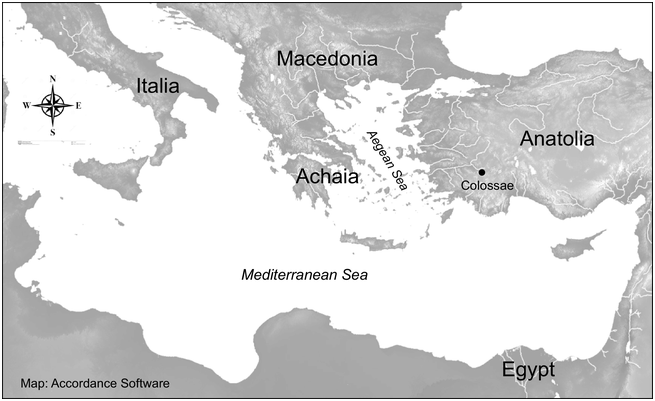
The city of Colossae (Kolossai) belonged to the region of ancient Phrygia and could be found in the Lycus Valley. Located in western Anatolia (modern Türkiye/Turkey), Phrygia was an old and distinct territory with its own culture, language, and religion centuries before the arrival of Rome. Phrygia’s home was originally along the Sakara (Saggarios; Latin Saggarius) River in northwest Anatolia, and its civilization peaked in the eighth century BCE, extending far south beyond Colossae. Major empires conquered it, from the Persians to Alexander the Great to even the Celtic tribal warlords who had migrated from the north.Footnote 1 Each conqueror desired to control the trade routes running east to west. Centuries before Paul, the Persian Xerxes the Great camped near Colossae on his way to Greece, as did the Persian Cyrus. Herodotus says that Xerxes arrived at Colossae and described it as a “considerable city of Phrygia” (Herodotus 7:30).Footnote 2 Both saw the Lycus Valley as a strategic gateway to the west (see Map 1).
Map of the Mediterranean.
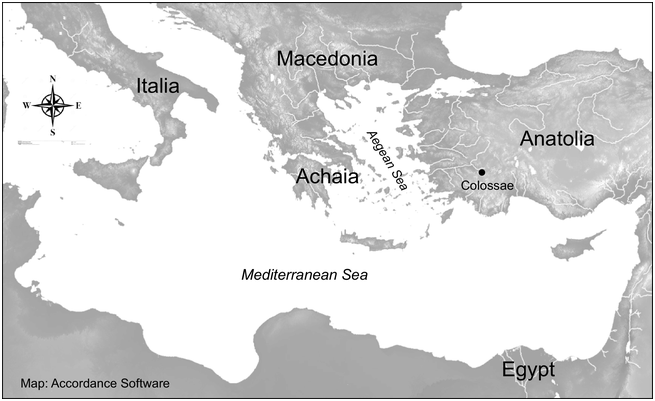
Map 1. Long description
A grey-scale map showing Macedonia, Achaia, Italia, Egypt, and above all, Anatolia. The Aegean and Mediterranean seas are clearly marked. The location of Colossae is marked, showing its larger geographical context.
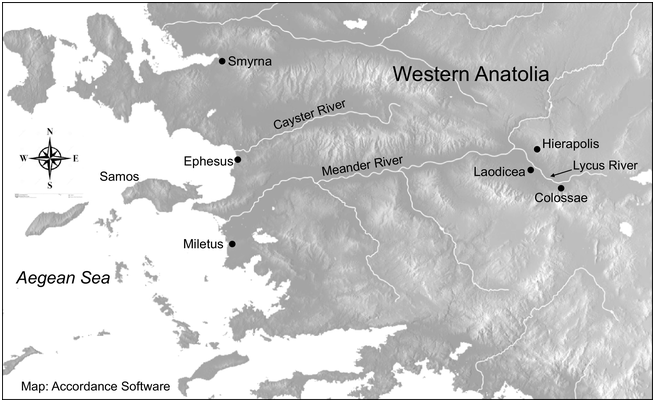
Eventually the prosperity of Laodicea and Hierapolis dominated the valley, and soon the city of Colossae began to decline. Ptolemy, Alexander’s successor in the fourth century BCE, refers to many cities in the region but fails to mention Colossae.Footnote 3 The region fell to Rome in the second century BCE, and by 25 BCE Rome had devised a plan to subdivide the area into provinces, with Phrygia split among the imperial provinces of Asia, Bithynia, and Galatia. A generation before Paul, Strabo could write that Colossae was a “small town (polisma).”Footnote 4 While Ptolemy also lists many towns of importance, he fails to even mention Colossae (see Map 2).
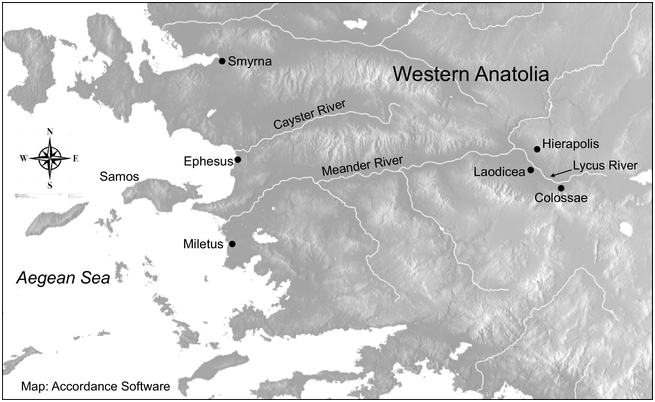
Map 2. Long description
A grey-scale map showing the Roman cities of western Anatolia, focusing on the Meander River from Ephesus to the Lycus Valley. The three cities of the Lycus Valley are clearly marked.
Nevertheless, Phrygian culture persisted in the Roman period and is represented today in over seventy tombstones showing “Old Phrygian” in their writing (something a Roman or Greek tombstone would rarely do).Footnote 5 In the widely shared culture of Greco-Roman Hellenism, Phrygia was like Wales or Scotland in the United Kingdom: sharing in the whole but distinctly apart in its deeper interests; preserving its own language as well as it could while resisting absorption by the larger empire.
Thus, Colossae was in Roman provincial “Asia” but had a background of Phrygian regional culture. It was located about 120 miles east of the great coastal city of Ephesus, and its “mound” was identified in 1835. Today it can be found in the verdant Lycus Valley, whose Lycus River flows into the larger Meander River running west to Miletus.Footnote 6 Three cities, about twelve miles apart, were located in this valley – Hierapolis, Laodicea, and Colossae – but they were a part of a larger network of cities that were important centers of Roman trade and government (Apamea, Pisidian Antioch, Tralles, etc.). We should imagine abundant trade passing through the Lycus Valley, interacting with its citizens, and following a route west (joining the Meander Valley) and northwest to Ephesus.Footnote 7 Roman efficiency had built an impressive network of roads across this region that moved troops and goods safely and rapidly. By the early first century CE, Colossae was a small though significant Roman city still overshadowed by its neighbors, as referred to in Col 4:13. Laodicea was the financial and administrative center in the region, and Hierapolis’ mineral springs attracted many visitors from afar in search of medicinal cures.Footnote 8
The region was tremendously fertile and known for its wool and dyed cloth.Footnote 9 The geographer Strabo remarks about the region: “The country round Laodicea produces sheep that are excellent, not only for the softness of their wool, in which they surpass even the Milesian wool, but also for its raven-black color, so that the Laodiceans derive splendid revenue from it, as do also the neighboring Colosseni from the color which bears the same name.”Footnote 10 To the south of the valley, the high Cadmos Mountains were the source of the Lycus River and gave the region a never-ending supply of water. In antiquity and even today, people have viewed the water from the Cadmos as healing and therapeutic.
The success of Colossae came to an end sometime in the mid-first century (late in Paul’s life) when an earthquake damaged it severely (along with Hierapolis and Laodicea). Tacitus says that the earthquake was so terrific that twelve cities in Asia were ruined in one night (he gives their names).Footnote 11 Rome immediately rushed to their aid, offering money, tax relief, and construction help. Unfortunately, the city of Colossae was not rebuilt, nor has it been excavated even to this day.Footnote 12 All that remains are surface debris and a partially visible, unexcavated theater that could host about 5,000.Footnote 13 Estimates are that the city held a population of about 25,000, making it far smaller than its two neighbors in the valley that today display extensive remains of temples, baths, theaters, aqueducts, gymnasia, and monumental ruins.
Rome
The Roman imperial presence in remote regions such as western Anatolia has now become clearer. Today epigraphic and ancient architectural remains – including many still passable Roman roads – attest to the widespread presence of Roman culture. But it is important to recall the inner workings of Roman politics to see how turmoil in Rome was putting pressure on cities like Colossae and its Christian community.
The late first century BCE was a time of turbulence in Rome. Julius Caesar’s assassination in 44 BCE was followed by his successors falling into war – which ended at the Battle of Actium in 31 BCE, leaving Octavian (or Augustus) as emperor. Despair and concern gripped many Roman elites, who felt that the republic had been lost. To a degree, their fears were not unfounded: The Roman republic, for which they felt enormous pride, had been lost, only to be replaced by an empire (Imperial Rome) with strictly centralized governance under the charismatic Augustus and his successors.
Augustus brought a revival to Rome that was nothing short of eschatological. Turmoil could be replaced by tranquility and insecurity by peace if only Rome and its provinces entered into a new social contract. Augustus built a renewed professional military that secured “the roads” and the barbarian borders, cleared the Mediterranean of pirates, and began a massive revitalization of infrastructure that inspired Romans to believe in the power of Rome again. Commitment to this vision could be seen in the new temples built rapidly in every province. The elite did as they had always done: sponsoring civic projects on a grand scale, whose remains are with us to this day.
It was this “Augustan” program of cultural renewal – revival, really – complete with a mythology blending nationalism with religious piety that no province could avoid. Roman imagery was everywhere, and we can imagine that even in remote valleys like the Lycus one could not escape the pressures to conform to the new imperial world of Roman religion and life. Paul Zanker’s fascinating The Power of Images in the Age of Augustus provides abundant pictures of how everything from family altars to coins bore homage to Augustus and the new Roman vision.Footnote 14 Coins depicted Augustus’ defeat of the Parthians and his distribution of olive branches to compliant subjects. Jewelry depicted kneeling Parthians and Augustus as victor. Mirrors, lamps, hairpins, tables, and wall art employed the same images. In some cases, statues of Augustus imitated ancient Greek images of Hercules. That this was going on in the Lycus Valley can be seen with a brief trip to the modern archaeological museum at Ephesus.
But this was not simply propaganda; this was mythology – an eschatology – that swept up the imagination of the empire. Moral and cultural renewal led to new festivals, buildings, games, temples, and arts, all heralding a new age. A golden age was dawning. Images of fertility and victory decorated buildings as the sculptor’s chisel reflected the sentiment on the street. Rome was back. Power had returned. Augustus would march into Anatolia like Alexander the Great and reestablish Roman hegemony.
Perhaps the best representation of this is the statue of Augustus found at the Villa of Livia at Prima Porta, north of Rome.Footnote 15 Originally cast in bronze, it was copied frequently in marble and presented Augustus as warrior-savior, relaxed and with a jaunty stance, his right arm uplifted and pointing to the future, spear held firmly. Defeated Parthians pay homage on his breastplate (or cuirass). He is the image of a Greek athlete, young and virile, echoing the golden age of Greece – which the Romans admired.Footnote 16 But this type of image became the standard. Even after Augustus’ death (14 CE) the renewal continued, and depictions of Tiberius and Caligula used the same imperial style.
This mythology also integrated religion directly. Augustus proclaimed divine authority for the “Julian family” (descending from Julius Caesar), and this began with the posthumous deification (or apotheosis) of Caesar himself. In 17 CE the first coin of a deified Caesar appeared, and soon after Augustus was labeled divi filius or “divine son” on currency. Images portrayed Caesar ascending to heaven in a chariot, and his heavenly rising star appeared on coins. Augustus intended for his two grandsons, Gaius and Lucius, to succeed him, and quickly this divine identity was attached to them. Their untimely deaths made Augustus reluctantly choose a military commander named Tiberius to follow him (who was the adopted son of his third wife, Livia). This kept the Julian flame alive.Footnote 17
Imperial propaganda represented the two options set before every region: One could be defeated like the Parthians – which was the warning – or one could enjoy the pax (or peace) of Rome and flourish. Overall, this so-called Pax Romana was contagious, causing some provinces to join the new order with zeal, but others (such as Judea) continued to look at it warily. This was a world order demanding compliance in exchange for peace. And this unmasked its reality: This pax was also a fiction. Some regions would not comply, and this led to war. As Tacitus later remarked, “Peace there was, without question, but a bloody one” (Annals, 1.9.5; 10.4).Footnote 18
This detour has been necessary because it draws us into the world that every Colossian knew intimately. This was the air they breathed. It was impossible to live in Colossae and not be profoundly aware of imperial expectations and imperial promises. Temple participation was akin to political loyalty; pietas (piety) for the gods was the norm; home decor announced one’s embrace of imperial symbols and mythologies. This may be analogous to the British royal cypher “ER” (Elizabeth Regina) and its stylized crown that appear on British passports and mailboxes (pillar boxes) in the UK. I also think of the portraits of Queen Elizabeth (the “queen mum”) often found on kitchen walls throughout the UK in the late twentieth century.
A church planted in such a setting would have to deal with these realities and ask what costs its members would incur if they rejected this mythology and instead embraced a different narrative of salvation. What if they followed a different divine son? Paul will discuss this in Colossians, but he will have to navigate this intense environment of religious–political conformity with care, and any criticism of it will have to be coded carefully.
We also have to remember that most of the Colossians would not have been able to read this letter (illiteracy was widespread), and so when Paul sent it, the letter came with a courier who would read it and interpret its meaning. This public reading served as an announcement – a “forthright social, economic and political announcement that King Jesus rules the cosmos.”Footnote 19 Colossians offers, then, a worldview, a reframing of salvation and an implied upending of Rome. Jesus was the supplier of true salvation and the telos toward which history had been moving.
Roman Imperial Religion
It is impossible to imagine life in antiquity without religion. The “irreligious” or secular life is a modern invention that the ancient world did not know. Human destiny involved an interplay with “the gods,” whose secrets were ferried to humanity through priests, oracles, and mysteries of innumerable varieties. The gods’ anger or generosity shaped common life. Blessing or placating them was a human duty. In this sense, Colossae, like every Roman city, was steeped in religion, with many forms of syncretism where ancient faiths merged with new Roman beliefs. Jews lived alongside these cults – and soon, Christians joined them. But in each case, it was inevitable that common Roman religious instincts would infiltrate these monotheistic faiths. The same is true today. Most churches in the world have to some degree absorbed the civil religions or political eschatologies that forever present themselves as more exciting or convincing than the gospel itself.Footnote 20 The Colossians were no different.
The Hellenistic world was a time of cultural syncretism. There were few beliefs about one universal god (except among philosophers, and then only in the later Roman era), but instead religious practice was usually local and linked to one’s region or culture. Often these gods merged, and what was once Greek took on a Roman name (Zeus was eventually identified with Jupiter, Artemis with Diana, Poseidon with Neptune). If you were Roman, it was expected that you observed Roman forms of devotion. If a city was a Roman colony, one could expect to see multiple temples devoted to Roman deities and, after the fall of the republic, to the emperor. Someday archaeologists will likely find the remains of a Roman temple at Colossae just as we have at Ephesus, Laodicea, and Hierapolis.
In the Roman period, one of the first features of religious piety was a commitment to the pax deorum (peace with the gods). This was a harmonious relationship with the gods that could prevent war, public disasters, plague, and famine, and could lead to both national and personal prosperity. In times of crisis, placating these gods was critical: Temple sacrifice, prayer, and elaborate liturgies each aimed to rectify the situation. But also, watchfulness for impiety was critical. In the Roman imperial period, divine blessing for the emperor became a common public duty.
The Romans had their own pantheon, headed by Jupiter Optimus Maximus (Jupiter, the Best and Greatest), and he was a part of dii consentes (the twelve united gods) that oversaw Rome’s fate. Temples to these were abundant. But many more divinities also existed. These were often nameless, and they were viewed as divine actors who could hamper life or bless it. Many of these were continuations of old regional gods that were vastly popular among ordinary people.Footnote 21 To orchestrate the pax deorum there were numerous orders of priests, each tasked with bringing this peace. Public divination was vital to their work when they needed to diagnose the source of calamities. Among them were augures, priests who interpreted the meaning in the movement of birds (who lived close to the heavens). Haruspices were priests who interpreted the entrails of sacrificed animals.
Under imperial Rome, devoted residents of Colossae would have participated in each of these practices. In the first century, most religious activity would have focused on the emperor, thanksgiving for his life, and prayers for his prosperity (and thus the prosperity of Rome), and, in this sense, religion joined with patriotism, demonstrating one’s fidelity to the empire. A family might also have a small altar in their home, paying homage to deceased relatives or to the gods whose will directed their lives.
Mystery Religions
But imperial religious devotion was not the only religious option in Colossae. In addition to all of these formal activities, there were also mystery religions, whose popularity was sweeping the Hellenistic world by the first century BCE. The Greek term mystēs meant “initiate,” and a mystērion was a ritual of initiation. Marvin Meyer summarizes their purposes:
The mysteries advocated salvation for individual followers who chose to seek initiation into the mysteries and thus to draw close to the divine and to each other. … They celebrated the death and new life that may be experienced not only in nature but also in the world of humankind.Footnote 22
Followers of the mysteries believed that their rituals and liturgies as well as their experiences were so sacred that they devoted themselves to secrecy, and even today we know little about them. Most of their practices were private and did not include the public display of faith found in temples. But we do know that they had sacred symbols, purification rituals, meals, and initiation rites. They employed the imagery of death and life liberally as a metaphor for the initiation–transformation. In a fragment attributed to Plutarch, we read about a cult initiation as a death:
At first there is wandering, and wearisome roaming, and fearful traveling through darkness with no end to be found. Then, just before the consummation, there is every sort of terror, shuddering and trembling and sweating and being alarmed. But after this a marvelous light appears, and open places and meadows await, with voices and dances and the solemnities of sacred utterances and holy visions. In that place one walks about at will, now perfect and initiated and free, and wearing a crown, one celebrates religious rituals and joins with pure and pious people.Footnote 23
Some sources describe public parades that invited onlookers to join. The Metamorphoses of Apuleius describes a colorful cult parade carrying an image of the Egyptian goddess Isis who was preceded by singers, dancers, music, and criers. Many people dressed as Egyptian gods and followed the parade. The key is that in these cults members believed they would find sōtēria (salvation) both in this life and the next through their rituals.
It is likely that when some Romans encountered a Christian gathering in a city like Colossae, they may have considered it a mystery religion since it employed the religious vocabulary familiar to mystery cults. For some scholars, the opponents Paul meets in Colossae may well have promoted features known in some of the mysteries. This is the thesis of the important work of Clinton Arnold, The Colossian Syncretism: The Interface between Christianity and Folk Belief in Colossae.Footnote 24 Rather than finding the source of the philosophy (2:8) of the opponents in Colossians in Jewish mysticism, he points to the mystery religions and their ascetic practices as mixing with Jewish belief in a highly pluralistic setting. The scholars who disagree with Arnold do not point to a more purely Hellenistic set of beliefs as the origin of the problem but instead lean more heavily into Judaism and see a fluid relationship between Jewish and Christian communities.Footnote 25 For some, the clearest evidence of these opponents is in 2:8–23, and it can be explained entirely within first-century Jewish views.
Judaism
For the most part, Judaism was outside this mainstream’s wildly diverse religious setting. As a monotheistic faith, showing obedience to the God of Israel and devotion to the temple in Jerusalem made achieving harmony with the Roman cults difficult though not impossible. While small migrations of Jews may have come to the area as early as the sixth century BCE, Josephus says that Antiochus III moved about 2,000 Jewish families from Babylon to Phrygia to increase his hold on the region. As military settlers, they were given homes and were exempt from paying taxes for ten years.Footnote 26 They continued to live in the region undisturbed. In 62 BCE, Lucius Valarius Flaccus (governor of Asia) impounded the annual half-shekel tax that all Jewish men were sending to the Jerusalem temple. This number can give us an estimate of the Jewish male population (over twenty years of age). At Apamea they took 45,000 half-shekels; at Laodicea they took 9,000. As Bruce suggests, these probably represent the Jewish population of the region surrounding these cities, not the cities themselves.Footnote 27
Rome’s awareness of these Jewish communities surfaces again in the reign of Augustus, who declared in 14 BCE that the half-shekel tribute to Jerusalem would be protected for the Jews of Asia.Footnote 28 Ramsay believed that Jews in this region of the diaspora also showed reciprocal favor to Rome. An inscription of a Jew named Julia Severa honors her leadership at the synagogue (as archisynagōgos), but she also appears on coins honoring her work (along with her husband, Servenius Capito) in municipal office – a role one could hardly play without some participation in the imperial cult.Footnote 29 But Jewish stories also merged into popular local Roman life. In the Phrygian city of Apamea a local flood legend combined with the Noah story. Coins from the third century CE show an inscription with Noah’s name along with a raven and a dove holding an olive branch. The later Sibylline Oracles (1:261–265) even placed Mount Ararat in Phrygia.
Josephus cites a letter written in about 45 BCE from the officials of the leaders of Laodicea to an unnamed Roman official saying that he should not impede the local Jewish residents and the practice of their religious duties.Footnote 30 In 3 CE Augustus made a formal declaration of Jewish rights, and this undoubtedly affected the region.Footnote 31 And later, after the First Jewish War (66–70 CE), more epigraphic evidence on tombs illustrates further signs of a Jewish community that lived throughout Phrygia.Footnote 32 There is no question of a thriving Jewish community in Phrygia. Even in Acts 2, in the list of nations found at Jerusalem’s Pentecost gathering, we read about Jews who had come from Anatolia: “Cappadocia, Pontus, Asia, Phrygia and Pamphylia” (2:9–10).
The Narrow Contextual Setting
On his first tour, Paul left Perga in southern Anatolia and traveled north, where he entered Antioch of Pisidia, which was viewed as in the easternmost reaches of Phrygia. On his second tour, Luke writes, “They went through the region of Phrygia and Galatia” (Acts 16:6). Of course, we cannot know if they entered the Lycus Valley. However, on his third tour, we have a provocative hint. Luke says, “While Apollos was in Corinth, Paul passed through the interior regions and came to Ephesus, where he found some disciples” (Acts 19:1). This phrase the interior regions (anōterikos) means anyplace away from the shore – “the uplands” or “the interior.” Luke may mean that as Paul traveled west toward Ephesus, he took the Lycus Valley route and entered Ephesus from the upper plateau east of the valley. We also know that Paul remained at Ephesus for over two years, so that Luke can summarize, “All the residents of Asia heard the word of the Lord, both Jews and Greeks.”
If Paul was located at Ephesus and traveled to nearby locations, he most certainly knew the cities of the Lycus. But, apparently, he did not go to Colossae nearby. Col 2:1 tells us that the Colossians and the nearby Laodiceans had not “seen his face” and thus did not know him personally. A colleague of Paul’s named Epaphras was the first to bring the gospel to the Lycus Valley (Col 1:7), and Paul heaps praise on him to support his work and to gain the endorsement of their friendship. To Paul, Epaphras was a “beloved fellow servant” and a “faithful minister of Christ” (1:7). Apparently when Paul is later imprisoned in Rome, Epaphras was with him (“my fellow prisoner”; Phlm 23). This is expansive praise and shows that Epaphras, who founded the Colossian church, was one of Paul’s most valued personal colleagues.
The letter to the Colossians was carried by the courier Tychicus, who was accompanied by Onesimus (4:7–9), the former slave and resident of Colossae. We can imagine that Christian communities had been established in all three of the Lycus Valley cities thanks to the work of Epaphras. The Christians in these small churches likely knew each other by name. Paul knows, for instance, that a woman named Nympha hosts the Laodicean church (4:15).Footnote 33 Thus Paul can tell them to have this letter read in Laodicea and likewise to have the Laodicean letter read in Colossae (4:16). What was this other letter? Many have supposed that this is Ephesians, a circular essay also carried by Tychicus (Eph 6:21; cf. 2Tim 4:12). This means that, as a courier, Tychicus was carrying three letters: Colossians, Philemon, and Ephesians. Tychicus would tell everyone about Paul’s circumstances and circulate the more general Ephesian letter.
A final reference to the Lycus Valley appears in Rev 3:14–22, where we find an exhortation for the church of Laodicea near Colossae. The letter to Laodicea is filled with cultural allusions that give us insights into life in the valley during this time. The prosperity and commercial successes of Laodicea was likely shared by all three cities in the valley.Footnote 34
Authorship
I have been presupposing thus far that Paul is the author of Colossians and that descriptions of his travels through Phrygia might bear some relevance to this letter. The letter itself makes this claim (1:1, 23), but today the subject of its authorship has seen wide disagreement.
The letter presents itself as highly personal, often using the first person (“I am now rejoicing in my sufferings for your sake …” 1:24). It also ends with a highly personal conclusion (“I, Paul, write this greeting with my own hand. Remember my chains. Grace be with you.” 4:18). This is similar to Gal 6:11, a generally accepted letter. These may be the hallmarks of authenticity.Footnote 35
The letter also includes personal links to an itinerary and personalities that all fit the Pauline setting (4:7–17). For instance, the author says that he is in prison (4:3, 18; possibly 1:24), and we know of this from Paul’s own history. Acts implies that he may have been imprisoned in Ephesus near Colossae. But the letter’s affinity with Philemon and the more likely setting of a runaway slave finding refuge and hiding in Rome suggest Rome may be the best locale for the letter’s origin and Paul’s imprisonment.
Overall, Paul refers to seven persons with surprising personal details. Timothy is “his brother,” and Archippus is sufficiently well known that Paul can give him an assignment (4:17). Aristarchus and Justus are apparently with Paul in prison (4:10), and he alerts the Colossians that “Mark the cousin of Barnabas” may come to see them. These, Paul says, are the only persons from “the circumcision,” likely referring to Jewish-Christians, but here using a phrase repeated in Galatians. These details are important because they offer more about Paul’s visibility to us and his circumstances than we might expect. John Barclay concludes, “If Colossians is by a later Paulinist, it is unparalleled in its sophisticated adaptation of incidental details to camouflage its inauthenticity.”Footnote 36
However, this question of authorship is vexing not only for Colossians but also for a number of Paul’s letters.Footnote 37 Scholars wonder if an imitator of Paul (or a well-intended disciple) could have included so many personal features and even imitated the apostle’s style in some cases. The debate centers on easily identifiable problems.
Vocabulary and Style
One of the primary arguments against Pauline authorship has been the number of words in the letter that occur only once or do not appear in the other so-called accepted Pauline letters.Footnote 38 There are thirty-four hapax legomena (once-used words) in the letter.Footnote 39 These are terms that appear nowhere else in the NT. Based on comparisons with the “accepted” seven Pauline letters, Colossians has eighty-seven non-Pauline words. Scholars also point to favorite Pauline terms such as the word group for “righteousness” (dikaios). It is absent in Colossians but occurs sixty times in the authentic Pauline letters (forty-one times in Romans alone). However, 1 Corinthians only uses it once (1:30), and it is absent from 1 Thessalonians, and this does not disqualify these letters. 2 Corinthians does not use “law” (nomos), and it uses “believe” (pisteuein) only once in 4:13 – both common Pauline terms. Philippians has seventy-nine words that do not appear in the other six accepted letters of Paul, and this poses the same challenge.Footnote 40 The problem with arguments from statistics is methodology. Variation is common, and only the degree of variation may disqualify a letter.
The truth is, vocabulary in any letter can shift due to the letter’s subject, its context, its possible use by a scribe, and even the year when it was penned. An author’s style may change with time. Thus, it is impossible to use this criterion confidently, and it is fair to suggest that Colossians falls within the range of how Paul might write.
While scholars are increasingly reluctant to launch an argument on vocabulary, many find stylistic arguments more compelling. Here we find variations from the critical Pauline canon that deviate significantly. It is well known that Colossians employs genitives frequently (e.g., “the word of the truth of the gospel,” 1:5). It is also argued that Colossians uses a liturgical or lyric style and departs from Paul’s usual rhetorical or debating tone. But this too is not entirely persuasive. After reviewing data for vocabulary and style, Lohse can conclude that while Colossians exhibits several peculiarities, it also shares so many features with Paul, such that, after 100 years, an argument against Paul’s hand cannot be sustained.Footnote 41
Scribes in Antiquity
In every case where there are vocabulary or stylistic issues, we cannot forget how common it was in the ancient world for writers to employ the services of a scribe (called an amanuensis). For example, Paul uses Tertius (Rom 16:22) as a scribe. In Colossians, did Paul similarly use Timothy (1:1b)? Paul’s addition of a “signature” in 4:16 certainly suggests that a scribe is working alongside the author. Cicero (To Atticus, Letter 333[13.25]) describes two types of dictation for a scribe: “Tiro, takes down whole sections together,” but “Spintharus” writes down “syllable by syllable.”Footnote 42 Here Cicero is describing a variety of roles for a scribe: One might strictly hold to the exact language of the author, another might have freedom to improve the language, grammar, or logic of longer sections. Cicero assures Atticus that he is using Spintharus because of his precision in the details. This underscores something we now know well: Trusted scribes had a broad range of involvement in these efforts. And in Paul’s case, he often used trusted colleagues. Anyone who has published a book knows precisely this range of editorial involvement Cicero is describing.
McKnight offers a lengthy argument based on this use of scribes. He is critical of the entire enterprise of locating differences in Pauline letters and the presumption of knowing what the authentic or pure Paul sounded like.Footnote 43 He is actually flipping the entire debate on its head. His complaint centers on the assumption that we can possess a “known Paul” in, say, Galatians or Romans, and then we move toward an “unknown” document like Colossians that then does not match the known Paul.
The problem is not with Colossians (or other presumed non-Pauline letters); the problem is with the supposed “canon” of Paul against which everything is measured. We assume we know more than we do, and this distorts our judgments. We move from the known to the unknown when our methods using the known-Paul are infected by historically precarious presuppositions. McKnight writes, “The historical error at work here is repeated over and over …. That solely the man, the apostle, the Jew Paul is responsible for Galatians and that therefore in Galatians or Romans or 1 and 2 Corinthians we have a pure sample of Paul, the authentic voice of Paul.”Footnote 44
Part of the difficulty is because we know so much more about how authorship was viewed in antiquity. Paul himself says that he is not skilled at writing (Gal 6:11), which means he used scribes generously in his letters (Rom 16:22). And if this is the case, if these scribes contributed substantially to the form and content of the letters, then we cannot even say that Galatians represents “the pure Paul.” Nor does Romans. If these conclusions are correct, then arguments based on vocabulary and style collapse. This is not to deny that there is variation in style and vocabulary in Colossians when compared with the so-called authentic letters of Paul, but that these differences do not bear the importance we once thought they did.
In sum, it is defensible today to open the door to the Pauline authorship for this letter. And scholars are increasingly willing to reexamine assumptions we have held in the academy since the nineteenth century. This is not inspired by canonical or confessional commitments. But it reflects a generous reconstruction of history that other historians of classical antiquity generally give to their documents. The confidence with which we dismiss certain documents as non-Pauline surprises many of them.
The Letter of Colossians Is Sent
If Colossians is linked to the circumstances of Paul’s own life, particularly in the prison letters, we can assume that this letter too came from an imprisonment. From Acts we know of three imprisonments for Paul (16:23–40; 21:32–23:30; 28:30): Philippi, Caesarea, and Rome. Most scholars point to Rome (Philippians seems to provide direct evidence, 1:13; 4:22), where Paul was imprisoned for two years (Acts 28:30).Footnote 45 In his final greeting in Col 4:18 he urges the Colossians to “remember my chains” (or imprisonment, desmos). In 4:3 he repeats this reminder. The close associations with Ephesians (see later), Philemon, and Philippians all point to the same setting (Eph 6:20; Phlm 1, 23; Phil 1:19, 2:3).
We know that Paul had free custody in Rome, which means that he could be surrounded by many friends and coworkers and be able to send correspondence as well as receive visitors. Paul lived in a world without public postal services, and, like anyone else, he relied on couriers to deliver his letters to their recipients. In some cases, letter writers might hire travelers headed in the direction of their recipients. Others enlisted friends. But letter writing as we have it here in the NT was common. Today we have recovered many such letters from places like Egypt, where we have found approximately 6,761 papyrus letters. Today we have 800 letters belonging to Cicero, 124 from Seneca, and 247 from Pliny the Younger.Footnote 46
The early Christians used trusted followers who could not only deliver the letter reliably but also interpret Paul’s meanings. On occasion we have the names of Paul’s couriers. For Colossians and Ephesians, Paul employed Tychicus (Col 4:7; Eph 6:21). Philemon is also a prison letter, and since the opening verses of Philemon and Colossians mirror each other we think that they were written together. This brings the letters into the same basic orbit. Philemon, however, is a personal letter addressed to the former owner of the slave Onesimus (Phlm 10). We can imagine then that Tychicus left Rome accompanied by Onesimus carrying at least three of these four prison letters. Philippians refers to Paul’s plan to send Epaphroditus back to Philippi (2:25), and if this is the same mission, Epaphroditus may have traveled with Tychicus.
It is hard for us to imagine the dedication that was required for couriers such as these. Tychicus and Onesimus could have either taken a ship from the port of Rome (Ostia) or traveled south on the Appian Way (125 miles) to the great shipping harbor of Puteoli, a port once used by Paul (Acts 28:13).Footnote 47 They would have joined an eastbound ship and then transferred to another vessel in southern Achaia (Greece) at either of the Greek islands of Crete or Delos, eventually making their way to the Aegean ports of Anatolia.
Or they could have traveled overland, following the Appian Way from Rome south to Brundisium, where a ship across the Adriatic Sea would bring them to the Egnatian Way, a major highway that crossed northern Macedonia (from the Macedonian coast to Byzantium).Footnote 48 But once they came to eastern Macedonia, they could set sail from Thessalonica or Neapolis (near Philippi) to cross over to Anatolia at either Smyrna, Ephesus, or Miletus. From there it was a relatively short trek to the Lycus Valley. We suspect that these Christian couriers met with Christian communities as they traveled (much as Paul did). Hospitality such as this was a mainstay of Mediterranean culture. For example, when Paul came into Puteoli on his imprisonment journey he met a church there, remained for seven days, and many accompanied him north to Rome. Tychicus could have followed Paul’s itinerary in reverse.
Relationship to Ephesians
Colossians and Ephesians share many common features. In some cases, entire sections are the same. For example, the greetings at the end of each letter are the same (Eph 6:21–22; Col 4:7–8). Turns of phrase appearing in one seem to be duplicated in the other (Eph 1:4 and Col 1:22; Eph 1:7 and Col 1:14; Eph 2:5 and Col 2:13; Eph 4:2 and Col 3:12, 14). Both letters offer what is called a “household code” giving directions on the duties of household members from slaves to children (Eph 5:21–6:9 and Col 3:18–4:6). Both letters bear a high Christology showing Christ as resplendent in his glory and status.
The chief solution to these parallels is literary dependence. And the majority of scholars see Ephesians as dependent on Colossians due to the way that Ephesians further amplifies themes in Colossians. This observation impacts considerably views on the authorship of Ephesians and has led many to believe that Ephesians was penned by a disciple of Paul after the apostle’s death, imitating themes from Colossians.Footnote 49
Literary borrowing was not unknown in antiquity. The synoptic gospels provide one example, as does the literary relationship between 2 Peter and Jude. In this case, some scholars infer that one of these letters must be pseudepigraphical, while others suggest that the letters’ similarities stem from them originating at the same time. Theoretically at least Paul could have written Colossians and Ephesians together and sent both out to different destinations. He could have used Colossians as the template around which he wrote the more expansive essay (known to us as Ephesians) that would have a wider circulation.
Use of the Old Testament
One of the striking features of Colossians is the absence of formal quotations from the Old Testament.Footnote 50 However this does not mean there are no allusions – there are many. But some commentators see these echoes or allusions as sufficiently subtle that arguments for them seem unpersuasive. Therefore, this discussion centers on probability, and this is always difficult. Is it possible that Paul’s deeply rooted understanding of the OT led to him assuming a shared understanding with his audience?
A good example of this dilemma is found in Paul’s opening words in 1:6, 10, where Paul describes the gospel bearing fruit in all the world. Is this an echo of Gen 1:28, where God speaks to humanity’s role in creation (“… be fruitful and multiply and fill the earth and subdue it and have dominion”)? Parallels to the LXX are absent, but interpreters believe that Paul may be looking at the MT (which is not Paul’s usual pattern). Nevertheless, the foundational ideas of Gen 1:28 – the call for humanity to bear God’s image as his vice-regents to all the world – are exactly what Paul has in mind in Colossians, as he understands that the gospel is our reclaiming of the call to inaugurate a new era fulfilling this mandate. Being “fruitful and multiplying” now refers to the growth of the kingdom, not to the populations descending from the first human pair. Paul then is employing a vital idea embedded in the redemptive story of Israel: the reclamation of all the Earth for God. He takes the structure of an OT argument and then reapplies it to a new setting: Fruitfulness no longer refers to progeny, but to new converts throughout the world.
Similar echoes are at Col 1:9, 12–14, 15, 19, 26–27; 2:2–3; 3:1, 9–10; 4:5. We will look at these in turn within the commentary, but the same methodological issues will rise: When do we know that Paul is leaning into assumed concepts understood by his readers? The absence of a citation hardly means that Paul is unaware of the great theological backdrop that has shaped him and his Jewish world. We who write as Christians to a well-informed Christian audience do this very thing regularly.
Paul and the Difficulties at Colossae
It goes without saying that Colossians is a theologically rich letter with important emphases on Christology, the church, and the Christian life. However, many of these themes are linked to difficulties that are also mentioned in the letter. No doubt 2:8–23 is the key passage in the letter that gives us some insight into these problems being stirred up by teachers in the church.
This raises one persistent problem with outlining a Pauline theology. Paul’s writing is frequently engaged in a polemical debate with opponents. In many of his letters (see Gal 1:8; 4:17; 5:12; 6:12–13; 2Cor 11:4–5, 13–15, 20–23; 12:11; Phil 3:2, 18–19; 1Tim 1:3–7; 4:1–3; 6:3–5) Paul refers to false teachers and criticizes them directly. But Colossians is not quite like this. In Colossians, “false teachers” may even be the wrong label altogether because the nature of Paul’s debate is vague. Paul does not point out particular teachers as he does in 2 Corinthians but instead speaks generally about someone (2:4) who might teach incorrectly. Generally, we think that these teachers are inside the church, but even that is not absolutely clear. Needless to say, what has emerged is a view of the letter that points to the “Colossian heresy” or “the Colossian error,” which represents some mix of Jewish or proto-Gnostic influences. Today there is a bewildering number of suggestions for who these opponents might be.Footnote 51
But the problem becomes worse when we try to reconstruct what these teachers were saying. We speculate about them only using Paul’s rebuttals, particularly in Colossians 1 and 2. The danger here (called “mirror reading”) comes when we read strong rejoinders by Paul and then conclude that Paul’s words are mirroring the problem of false teaching. It is like overhearing a telephone conversation and thinking you know what is being said on the other end. Of course, what are missing are the voices of these teachers. And without them, our reconstructions must remain speculative.
Some have wondered if there ever was a Colossian heresy. Or perhaps, with Dunn, we can first ask how we can use such a term, since “heresy” implies an established orthodoxy that someone at Colossae has violated.Footnote 52 Dunn is not denying that there was a system of belief that found a degree of consensus in the early church. He is simply warning that such a volatile term as “heresy” distorts how we see what is going on. But were there teachers in Colossae who were contradicting this early system of faith and who were gaining a following in the Colossian church? Some say that even this goes too far. Morna Hooker was the first to ask whether the idea of “opponents” has been overplayed. Only one verse (2:19) refers to a system of thought (“philosophy,” see commentary) that Paul opposes.Footnote 53 Perhaps instead Paul is fully aware of the religious environment in its setting and is writing to immunize the Christian readers “against the possibility of being misled.”Footnote 54 In this view, Paul is sounding a warning, not engaging in a polemic.
Many scholars, however, come away from Colossians 2:8–23 convinced that something more concrete is on Paul’s mind. When Paul warns against “someone who will deceive you” (2:4), or someone who “will take you captive” (2:8), or someone who may “judge you” (2:16, 18), he likely has specific identifiable opponents in mind. Paul describes these views as a “philosophy” (2:8) and its practitioners as putting pressure on members of the church (2:16, 18). That specific regulations are being imposed (2:20–22) suggests a movement within the church that wants to promote spiritual rigor and presents itself as elitist: Their teaching stems from visions that promise to elevate the average believer. In 2:23 Paul provides a brief list of the benefits that have been promised: self-abasement, devotion, and, above all, severity to the body. This is an austere form of faith that Paul knows is a departure from anything Epaphras taught this church, and he is writing to correct it.
The first explanation of this “philosophy” Paul opposes has always been Hellenism. In this view, either Gnosticism or an early form of it (proto-Gnosticism) is to blame. The number of scholars intrigued by this option is enormous (G. Bornkamm, H. Conzelmann, etc.). The origin of this view may come from F. C. Baur in the nineteenth century, who suggested that the Colossian error points to an early gnostic philosophy that concentrated on mediating religious figures (“elements of the universe,” 2:8, 20) who could supply wisdom (sophia, 1:9, 28; 2:3, 23; 3:16; 4:5), insight (synesis, 1:9; 2:2), and knowledge (epignōsis, 1:6, 9–10; 2:2–3; 3:10). It is only by placating these cosmic powers (2:10, 15) that one can enter into the fullness (2:9) of life.Footnote 55 Further, 2:18 refers to “initiatory visions,” which suggests a cult initiation (embateuō, to initiate). Christ, therefore, must be fitted into this schema, and, of course, Paul will object to this idea strenuously.
On the other hand, a growing number of scholars believe that the principal features of these teachings stem from some form of Judaism. This view began in 1879 with J. B. Lightfoot, who saw this as a form of Judaism that had been shaped by Hellenistic influences.Footnote 56 The references to sabbath and circumcision (2:11, 16) suggest this, but other references to fullness (2:9), angel worship, and visions (2:18) imply a second background. As Lightfoot wrote, “We discern an element of theosophic speculation which is alien to the spirit of Judaism proper.”Footnote 57 He referred to it as a “Judeo-Gnostic heresy.”
Some have tried to narrow the Jewish context further. Some have pointed to Qumran and suggested distinct parallels.Footnote 58 Others have suggested a Jewish mysticism that was tainted by Hellenistic popular religion.Footnote 59 This latter idea today has considerable support and has led to deeper explorations into how popular religion in the Roman Empire likely influenced Jews living there.
We can at least affirm the following things about these teachers in Colossae:Footnote 60 First, it is clear that the fundamental ideas associated with this teaching stemmed from Jewish faith and practice as well as the OT. This is clear from 2:16 and 2:21–23. Therefore, this means that we are not dealing here with a syncretistic Hellenistic philosophy with only a few marginal Jewish beliefs. Even talk of “Gnostic Judaism” should be dismissed.Footnote 61 Jewish belief is central. Dunn writes:
In other words, the number of distinctively and definitively Jewish features are such that it is scarcely possible to envisage the Colossian “philosophy” as a non-Jewish core that has attracted Jewish elements; at most we have to speak of an apocalyptic or mystical Judaism transposed into the diaspora that has been able to make itself attractive to those sympathetic to Judaism by playing on familiar fears and making more impressive claims.Footnote 62
Dividing the world into “circumcised” and “uncircumcised” (2:11–13) and rules regarding the sabbath (2:16) are characteristically Jewish. This is also true of language about the religious calendar, food law, and purity. But more, Paul is able to presuppose the wide structures of Jewish faith as he presents a counter to their teaching: Exodus, inheritance, wisdom and Torah. Why is Paul intent on defending the Colossian identity with reference to these traits? One possibility is that these teachings are pouring into the church from Jews living nearby and/or these ideas have made inroads among the Jewish-Christians within the church.Footnote 63
Second, we should not imagine a uniform Judaism in the diaspora any more than we imagine such uniformity in first-century Judea. There were a variety of practices, and in the Hellenistic world some of these no doubt were shaped by their context. Jewish cultural identity could be held intact while embracing, for example, a dualism foreign to historic Jewish belief (compare Qumran). One key may be to reconstruct the opponents’ beliefs based on what they fear: the powers of darkness (1:13), a notion that was widely prevalent in the ancient world. In some manner, religious practice involved the management of these powers and the possibility of escaping their threat. This could have led to promoting ascetic practices that were required to maintain safety and prosperity. Therefore, we can imagine people in the Colossian community claiming to have superior access to power (“fullness,” 1:19; 2:9) through spiritually rigorous practices and visions. And from Judaism they have embraced commitments to dietary rules and sacred calendars. Above all they were anxious about angels and spiritual beings that could sorely impact their well-being.
We know not to draw a bright line between Judaism and Hellenism as if the two communities did not mix and share their identities and beliefs. If the Book of Acts provides a pattern, we need to imagine small communities of Christians in which both Jews and Gentiles lived together and in that shared life also shared many of the common religious sentiments of their familial communities. If the problematic teaching in Colossae emerged from the synagogue, it also arrived bearing Hellenistic influences.
A growing number of scholars have defined the Colossian problem as coming from the world of Jewish mysticism and asceticism. Some have pointed to “Merkabah” mysticism (Smith), Halakik mysticism (McKnight), or Jewish folk religion (Arnold). While many still contend that these teachers may simply be rival Jews from a nearby synagogue who reject the teaching of this new church (Dunn, Garland, Wright), nevertheless these teachers have appropriated some views about salvation and enlightenment that they gathered from their religious surroundings – which makes Arnold’s thesis so compelling. These antagonistic voices originated from nearby Jewish spaces but also were intimately known to those inside the church. And their views not only contradicted the growing theological agreements about Jesus in the Pauline churches, but also they added elements from Hellenistic folk religion that were aimed at undermining Christian belief. They sought out enlightenment through abstinence from eating and drinking and through these hoped-for visionary experiences that provided “heavenly ascents” to arenas where angels lived. This was then attached to much Jewish religious tradition (laws, calendars, dietary rules) as a reflection of the new spirituality they had attained. This sort of mash-up of traditional theology and folk religion should not surprise us. Christians today regularly do the same thing: They challenge and disqualify fellow Christians on peculiar issues (Christian Zionism, prosperity gospel, views of the Holy Spirit, political positions) that they believe are central to the faith but which are not – and in many cases are utterly misguided.
The number of views resolving the “philosophy” of these opponents is utterly endless, but we will argue for some synthesis of Judaism and Hellenism, with one providing the organizing center. For our efforts we will simplify their profile to some basic certainties: These are teachers who come from the synagogues and who are making claims against Gentile converts, arguing that their position is not secure. This explains – as we will see – many of the echoes to other Pauline polemical writing such as Galatians, where Paul’s opponents are similar. But here in Colossae this presents itself with slight differences. The ascetism found here may well be Jewish, but it has been living in Hellenistic settings for a very long time. We should expect to hear echoes of the OT alongside echoes of Hellenistic mysticism and folk belief.
One example may suffice. Asia Minor exhibited remarkable interest in angels as intermediate heavenly beings. Along with this, mystics promoted the notion of the accessibility of these heavenly regions to those who knew their secrets. And, remarkably, this was a Jewish practice as well as Hellenistic.Footnote 64 The Merkabah (Hebrew, “chariot”) mysticism promoted entry to these regions, and its practice is attested widely in Jewish writings from the period.Footnote 65 Even Paul, for example, in 2Cor 12:1–10 describes his own interest in and experience with such visions and revelations. In this letter, Paul must explain that Christian faith concerns itself not with our ascent into the heavens but with Christ’s descent. Our focus remains on him and his activities, not the refinement of our religious or mystical skills. This shows Paul’s chief theological interest in the letter. The centrality of Christology will return again and again, and practices that strive to supplement our identity in Christ will incur sharp criticism as both inadequate and unnecessary.
Paul’s Theological Interests
It is hard for us to imagine the world of these Colossian believers. The celestial and the terrestrial existed in tension, and any sense of control over one’s life in this world was hard-won. Divine entities (or spiritual powers) guided the fate of the average person, and the one question held by everyone was how to achieve the means to control their fate. For the most part, life seemed incomprehensible and uncertain, which inspired numerous religious systems that brought assurance and security. Some offered access to this spiritual world, which was gained by associating with intermediary powers, joining mystery cults, or pursuing visions. Personal disciplines were enforced as a way to keep from disqualifying oneself for divine benefits. Everyone (Jews included) would have been affected by this worldview.
Christology
This context helps us understand why Christology is the central focus of Colossians. Any reading of 1:15–20 or the similar texts found in 2:2–3, 2:9–10, or 2:13–15 makes this clear. To be sure, Paul has taken the Christological categories we read in his other letters and advanced them to new levels.Footnote 66 But the framework here is different. Paul portrays Christ as supreme not simply over all human life or as the fulfillment of Israel’s Messianic hopes, but in connection to the cosmos itself.Footnote 67 It is Christ’s supremacy that rings through every chapter of this letter. Christ is not an intermediary who may be relied on to simply aid us in all things; Christ is the Lord who rules all things. Christ’s relationship with God is unlike any other (the “fullness” of God resides in him, 1:19). Therefore, Christ’s power can make ultimate claims on everything, both in heaven and on Earth. There is no realm of creation that is not subject to his authority (1:15–17) because the “whole fullness of deity dwells in him bodily” (2:9). Therefore, those who are affiliated with Christ – who belong to Christ – belong to a person who has mastery over the powers that they once feared. If Christ enjoys the fullness (plērōma) of God, so, too, believers are “filled” in him (plēroō) in 2:10.
This set of affirmations works in two directions. On the one hand, the authority of Christ is absolute. He is supreme in the cosmos and is not a peer among the powers that influence the world. In fact, they are subject to him (1:16), as the creation is subject to its creator. Throughout Colossians the relationship between Jesus Christ and the Father is reinforced again and again. God is Christ’s father (1:3), but also Christ is his son (1:13). Christ is now seated at God’s right hand (3:1). Christ bears the visible image of the invisible God and is the “first-born” of all creation (1:15, a verse we will examine closely). The cumulative effect of these ideas is singular: Jesus Christ shares ontologically in the very personhood of God. Or, in different language, Jesus Christ is divine. Colossians could be seen as the capstone of an idea that sweeps through the gospels and ends here: Christ did not enter history to represent God; Christ entered history to present God. While today we may take this idea for granted, it is remarkable by any standard. In Christ, God himself has descended, and this does not compromise a commitment to monotheism. The gospel has rearranged the nature of creation and humanity’s place in it. The gospel claims that God himself has taken charge of the presumed chaos of the world; he has penetrated this world and come himself to make a renewed claim on his creation. There is no hint here in Colossians or anywhere in Paul that this high Christology in any manner compromises monotheism. This thinking will lay the groundwork that will shape the fourth-century councils and creeds.
Christian Life
The second outworking of this idea concerns those who live in this world and who have feared the principalities and powers that rule it. If Christ is supreme, Christ is also sufficient. There is no need to ascend into the divine world to discover security or solace in life because God himself has descended. There is no need to pursue spiritual practices that will guarantee some sense of control over outcomes in life: We have been raised in Christ (3:1) and have taken on his protections and life. There is no need to fear the powers of the cosmos; believers are dead to these things (2:20). Thus everything to be had in every religious pursuit can be found in Jesus Christ, who is “the head” (2:19) of the entire body, giving it life. In a word, we are sheltered in Christ – in God – and therefore all fears should recede.Footnote 68
Anyone who offers wisdom or secrets, rituals or mysteries does not realize that in Christ we are recipients of all wisdom (2:3), and as new persons re-created in Christ we orient not toward religious machinations in this world but to realities “above,” where Christ is seated (3:1). We thus belong to another reality. “[Christ] has rescued us from the power of darkness and transferred us into the kingdom of his beloved Son” (1:13). This transfer means we belong someplace – to someone – and are not adrift in a chaotic world with various religious claimants.
I do not imagine that Paul saw this attachment to Jesus and his kingdom as simply an intellectual exercise of belief or an association with a new community (the church). For Paul, this is a Spirit-empowered rebirth, a connection with true Power that employed the categories common in the Colossian (or Hellenistic) context. In a world of deviant and threatening powers, Christians now are attached to the one true Power that makes the others powerless. If the mark of Christ’s circumcision is on us (2:11), if we have been buried with him and raised with him (2:11), we have entered a reality that is both familiar to the religious vocabulary of antiquity but also fundamentally different. Christ-in-power now has come to reign, and we are subsumed into his rule.
While Paul will argue against those who wish to impose rules on personal conduct as a means to achieving deeper religious success (2:20–23), he does not abandon the importance of Christian conduct. The “commandments” still matter (1Cor 7:19). He can argue against “the law” in Galatians but still argue for “the law of Christ” (Gal 6:2). There is for Paul indeed saving faith, but there is also “the obedience of faith” (Rom 1:5). In Colossians we find Paul doing the same. In chapters 3 and 4 Paul outlines guidelines for conduct that will attend the lives of those who belong to the kingdom of Christ. Their basis will not be in religious traditions found in the surrounding culture. They must be rooted in this new reality found in Christ. As Moo says, “Rules must never take the place of Christ as the source of spiritual nourishment and growth; and any rules that we propose to follow must be clearly rooted in and lead back to Christ.”Footnote 69 Paul’s ethics in Colossians are anchored to transformation (3:7). We have put on a new nature (3:10) in which the peace of Christ reigns (3:15) and Christ’s word dwells (3:16).
Salvation and the Church
It goes without saying that in Colossians we find then not simply a theological rearrangement that will set right the thinking of the Christians in this city. Paul’s intent is not simply to locate Jesus Christ rightly in the Colossian imagination (Christology). Paul wants to make clear the choices that are before every member of the church. This is not simply a casual affiliation, as if membership here would be an alliance against other rival communities.
The work of Christ is cosmic, just as his Christological identity is cosmic. Christ has been at work bringing about the reconciliation and redemption of creation to its creator. He has provided an opening for forgiveness and the defeat of malevolent powers through his work on the cross (1:20). Joining with this work is the decisive question that is now set before every reader of this letter. It is not just a matter of consent to good ideas; it is a transformational experience that includes the power of God. It is not an association of good people with shared interests doing good things; it is an enclave of people who possess a vision and a life – both fueled by the Spirit – to renew this world.
If the identity and work of God is cosmic, then it follows that those who join with this work are also located in a community where the reconciliation and redemption of creation are the first order of business. If we have died and been raised with Christ (2:12) and been given new life (2:13), then the church participates in the ongoing life-giving, reconciling work of Christ. In Ephesians Paul describes an ecclesiology that lives at the juncture of the reconciliation of Jew and Gentile (Eph 2:11–22). This idea alone Paul finds to be astonishing, and it should lead to the church understanding race and culture in new ways. In Colossians the reconciling work of the church discovers a larger, cosmic platform, and the inclusion of Gentiles is but one example of this larger work. The church joins the reconciling work of Christ only when it sees itself as a part of this creational restoration and re-creation in all of its forms: Wherever creation is disordered – socially in human conflict and division, economically in disparities of wealth leading to poverty and suffering, racially where one claims privilege and excludes another, spiritually where malevolent powers oppress, or creationally where the world itself has been damaged through sin – in these and myriad ways the church becomes the church when it joins Christ in asserting God’s rule over creation and setting things right.
Colossians and Empire
If this cosmic Christology and cosmic ecclesiology are as they seem, then it is a short step to wonder how these views would have settled in a Roman Empire that also made cosmic claims. How would these divine claims for Jesus Christ live alongside the divine claims of Caesar and his divinely endorsed rule? Colossians has become a source of fascination, and many scholars have wondered if Paul’s Christology is probing imperial claims and challenging them.
What I am describing, of course, is the currently popular interest in imperial studies in Paul, which today has enthusiastic supporters and strong dissenters. Henry Maier has charted much of this territoryFootnote 70 and points to Paul’s description of the gospel affecting the “whole world” (1:6) and Christ’s victory (2:15) as a Roman triumph as the most obvious signals of Paul’s awareness of an imperial gospel opposed to his own.Footnote 71 But there is more. Hints abound that allude to imperial propaganda (universal reconciliation and “making peace,” 1:20), setting Christ against a political gospel. Maier concludes:
A first-century Christian audience hearing the letter read aloud would immediately have recognized imperial-sounding themes, greeted as it was daily by ubiquitous imperial images – in market squares, theatres, baths, law courts, temples, households, on coins, on triumphal arches and public buildings, not to mention the many sacred precincts dedicated to the worship of the emperor and his family – celebrating the Roman order as a divinely ordained order representing a pacification of erstwhile hostile and ethnically dispersed peoples, brought by military might into a global pax by a divinely appointed emperor heading a moral, natural and spiritual renewal.Footnote 72
Maier and others have pointed out that the principle focus of Colossian study has examined Christology alone, and this now should be viewed as too limiting, even parochial. Colossians is (for him) an “imperially charged text” bearing “potent resonances” that happily mimic and twist the language of Rome. However, the great paradox – the destabilizing idea – that Paul offers is that this victory of Christ has been achieved by defeat. “It is from the cross – a symbol of Roman pacification of enemies – in the body of Jesus’ death, that a new Imperium issues forth (1.20; 2.15).”Footnote 73 The peace has been achieved not by the suppression of Rome’s enemies; peace comes from the death not of the ruled but of the ruler, and opponents are converted and invited to join a kingdom grounded in love and care for one another, a kingdom ruled by Christ himself. As Maier says, “This is an imperial pax by other means.”Footnote 74
Critics have pointed out that this subversive view of Rome’s ideology could have easily emerged from Paul’s own identity as a Jew. And this is correct. In the Roman period Israel engaged in a tricky dance with this empire that rarely tolerated dissidents. And yet Jews enjoyed remarkable freedom, all while rejecting the many gods of Rome, refusing its idols, and promoting the one true God who was the God of Abraham. This implied, of course, that Rome’s gods (and the emperor?) were false claimants to divine authority. And this likely contributed to a theoretical framework for Israel’s catastrophic war with Rome in the first century. But before this, at least in Paul’s time, Judaism had discovered a delicate détente in relations with its imperial occupier.
Literary Structure
Commentators debate how to organize Colossians, but at least we can see some widely agreed-upon divisions. The letter begins with common features of greetings, a prayer, and encouragement for the readers. But the chief divider comes in 2:6, where Paul provides an array of problems concerning false teaching in the church. This “core” of the letter moves from 2:6 to 4:6. The letter closes with lists of introductions and greetings to people living in the Lycus Valley. This type of closing was also common in ancient letters. Curiously, note how Paul writes the final line in his own hand. This tells us two things: First, Paul is likely using a scribe who was professionally skilled to serve him; and second, Paul wants to add a personal mark to the letter using his imperfect writing. We see something similar in Gal 6:11, 1Cor 16:21, and particularly 2Thess 3:17, where he writes, “I, Paul, write this greeting with my own hand. This is the mark in every letter of mine; it is the way I write.” This practice was common in the ancient world and is similar to our pattern of signing letters that have been formally printed. The signature signals the letter’s authenticity.