Book contents
- Communism in an Enchanted World
- Cambridge Studies in the History of the People’s Republic of China
- Communism in an Enchanted World
- Copyright page
- Contents
- Acknowledgements
- Author’s Note
- Maps
- Introduction
- 1Ancestor Worship: Household and Lineage
- 2Temple Religion
- 3Worshipping the Gods
- 4Folk Religion and the Three Teachings
- 5Ghosts and Demons
- 6Marriage, Fertility, and Folk Religion
- 7Death and Funerary Ritual
- 8Searching for Sacred Medicine
- 9Health and Spirit Healing
- 10Spirit Mediums and Witchcraft
- 11Geomancers and Yin-Yang Masters
- 12Divination and Fortune-Telling
- Conclusion
- Appendix on Sources
- Bibliography
- Index
Summary
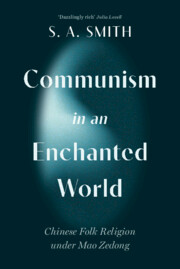
When I began research on the topic of the CCP and folk religion, I did so expecting that it would be a story of conflict between ordinary people and the regime, especially in the countryside. It was, certainly, largely a story of repression in which the new Communist government suppressed religious institutions, such as temples, monasteries, and spirit halls, and ritual specialists, such as monks, nuns, household Daoists, diviners, geomancers, and many others. But that turned out not be the whole story. There were instances in which ordinary folk defended temples and stood up to local officials who tried to suppress temple fairs; and, occasionally, as with the redemptive religious societies or, in a different way, with blind fortune-tellers, acts of collective resistance in defence of folk religion did take place, albeit never on a mass scale. The relatively low level of resistance was partly due to the fact that ordinary people had a clear-sighted understanding of the historically unprecedented power of the party-state at the local level and were reluctant to test it. But there were other factors involved, including features intrinsic to folk religion that skewed it in a conservative direction, not least because of the strong imprint of Confucianism upon it, which valorizing social harmony, loyalty to the powers-that-be, and to the ancestors. In addition, supernatural politics, discussed in the companion volume, fostered ambivalence in the populace, who resented the arbitrariness of officials, but who saw in the figure of Chairman Mao – understood as the possessor of the Mandate of Heaven or as a bodhisattva – proof that the regime had the interests of the people at heart. But ultimately folk religion survived because it provided meaning and guidance on matters beyond the purview of the party-state. The Communist regime represented a more intense form of domination over the masses than had existed historically, and its ideological apparatuses were remarkable successful in setting the terms of what was thinkable. Yet those who maintained their faith found ways of accommodating to it and, crucially, of offering support to the regime yet reserving the right also to withhold it. Mao’s China was a world in which millions saw nothing contradictory in being supportive of the Revolution yet faithful to the gods.
Information
- Type
- Chapter
- Information
- Communism in an Enchanted WorldChinese Folk Religion under Mao Zedong, pp. 310 - 327Publisher: Cambridge University PressPrint publication year: 2026
Accessibility standard: WCAG 2.2 AAA
Why this information is here
This section outlines the accessibility features of this content - including support for screen readers, full keyboard navigation and high-contrast display options. This may not be relevant for you.Accessibility Information
The HTML of this chapter complies with version 2.2 of the
Web Content Accessibility Guidelines
(WCAG), offering more comprehensive accessibility measures for a broad range
of users and attains the highest
(AAA)
level of WCAG compliance, optimising the user experience by meeting the most extensive
accessibility guidelines.
Content Navigation
Table of contents navigation
Allows you to navigate directly to chapters, sections, or non‐text items through a linked table of contents, reducing the need for extensive scrolling.
Allows you to navigate directly to chapters, sections, or non‐text items through a linked table of contents, reducing the need for extensive scrolling.
Index navigation
Provides an interactive index, letting you go straight to where a term or subject appears in the text without manual searching.
Provides an interactive index, letting you go straight to where a term or subject appears in the text without manual searching.
Reading Order & Textual Equivalents
Single logical reading order
You will encounter all content (including footnotes, captions, etc.) in a clear, sequential flow, making it easier to follow with assistive tools like screen readers.
You will encounter all content (including footnotes, captions, etc.) in a clear, sequential flow, making it easier to follow with assistive tools like screen readers.
Short alternative textual descriptions
You get concise descriptions (for images, charts, or media clips), ensuring you do not miss crucial information when visual or audio elements are not accessible.
You get concise descriptions (for images, charts, or media clips), ensuring you do not miss crucial information when visual or audio elements are not accessible.
Visualised data also available as non-graphical data
You can access graphs or charts in a text or tabular format, so you are not excluded if you cannot process visual displays.
You can access graphs or charts in a text or tabular format, so you are not excluded if you cannot process visual displays.
Visual Accessibility
Use of colour is not sole means of conveying information
You will still understand key ideas or prompts without relying solely on colour, which is especially helpful if you have colour vision deficiencies.
You will still understand key ideas or prompts without relying solely on colour, which is especially helpful if you have colour vision deficiencies.
Use of high contrast between text and background colour
You benefit from high‐contrast text, which improves legibility if you have low vision or if you are reading in less‐than‐ideal lighting conditions.
You benefit from high‐contrast text, which improves legibility if you have low vision or if you are reading in less‐than‐ideal lighting conditions.