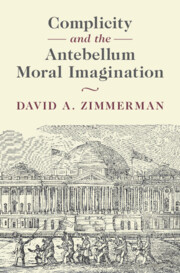
Book contents
- Complicity and the Antebellum Moral Imagination
- Cambridge Studies in American Literature and Culture
- Complicity and the Antebellum Moral Imagination
- Copyright page
- Contents
- Figures
- Acknowledgments
- Introduction
- Chapter 1Conspiracy, Contagion, and Catholic Sex Talk
- Chapter 2Structure, Network, Apocalypse
- Chapter 3Systems
- Chapter 4Tolerance Complicity and Uncle Tom’s Cabin
- Chapter 5Cotton Complicity
- Chapter 6The Complicity Windfall
- Chapter 7The Coffle and the Capitol
- Chapter 8Purity Rights and the Congressional Slave Trade
- Epilogue
- Notes
- Bibliography
- Index
- Series page
Chapter 6 - The Complicity Windfall
The Black Market and African Cotton
Published online by Cambridge University Press: 20 February 2026

Book contents
- Complicity and the Antebellum Moral Imagination
- Cambridge Studies in American Literature and Culture
- Complicity and the Antebellum Moral Imagination
- Copyright page
- Contents
- Figures
- Acknowledgments
- Introduction
- Chapter 1Conspiracy, Contagion, and Catholic Sex Talk
- Chapter 2Structure, Network, Apocalypse
- Chapter 3Systems
- Chapter 4Tolerance Complicity and Uncle Tom’s Cabin
- Chapter 5Cotton Complicity
- Chapter 6The Complicity Windfall
- Chapter 7The Coffle and the Capitol
- Chapter 8Purity Rights and the Congressional Slave Trade
- Epilogue
- Notes
- Bibliography
- Index
- Series page
Summary
Between 1858 and 1862, the African Civilization Society, led by Henry Highland Garnet and Martin Delany, sought to reorient the Atlantic cotton economy and undermine American slavery by planting a Black emigrant cotton-producing colony in the Niger Delta. They insisted that trade with cotton-hungry Great Britain would release Britain from its shameful complicity as the globe’s dominant consumer of slave cotton and help Britain pay down its debt to Africa and people of African descent. To these Afro-pragmatists, this new Black market, harnessing the very market mechanisms that constrained Black life under US slavery, would fund the development of a commercially sovereign Black nation, launching Black commercial modernity and, with it, Black cultural ascendence and geopolitical respect. This chapter traces the interwoven economic, moral, religious, racial, and imperial matrices of this Black market. While this book’s other chapters focus on complicity as a moral problem, this chapter examines complicity as a racial, political economic, and rhetorical resource.
Keywords
Information
- Type
- Chapter
- Information
- Complicity and the Antebellum Moral Imagination , pp. 154 - 182Publisher: Cambridge University PressPrint publication year: 2026
Accessibility standard: Unknown
Why this information is here
This section outlines the accessibility features of this content - including support for screen readers, full keyboard navigation and high-contrast display options. This may not be relevant for you.Accessibility Information
Accessibility compliance for the HTML of this chapter is currently unknown and may be updated in the future.