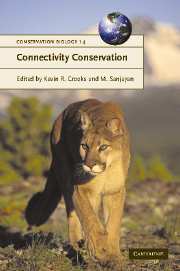
1 - Connectivity conservation: maintaining connections for nature
Published online by Cambridge University Press: 24 May 2010

Summary
For the first time in Earth's long history, one species – Homo sapiens – completely dominates the globe. Over 6 billion people now inhabit the planet, and that number is growing at an alarming rate. In sharp contrast to previous eras, we drive, fly, telephone, and e-communicate from even the most remote regions of Earth. With the aid of technology, no significant segment of our population is truly isolated. Today, it is possible to make a cell phone call from the Serengeti, or live “off the grid” from in-holdings within the midst of national forests or wilderness areas in North America. With the notable exception of weedy species that thrive amidst the disturbances we create, predictably, the more “connected” we become, non-human life with which we share this planet becomes increasingly disconnected.
The vast reach of humans and the resulting parcelization of natural landscapes are of major concern to conservation scientists. Indeed, horror stories about habitat fragmentation appear in every book about conservation biology, make appearances in high-school textbooks, and are featured regularly in our leading newspapers and magazines. And conservation biologists are not alone in their concern about massive habitat destruction and fragmentation. Members of the public also have been inspired to promote special efforts for connecting landscapes in our increasingly dissected world.
While the vision of connected landscapes may be compelling, the practice of preventing fragmentation and conserving connectivity is not a simple matter.
Information
- Type
- Chapter
- Information
- Connectivity Conservation , pp. 1 - 20Publisher: Cambridge University PressPrint publication year: 2006
References
, and . 1998. Do habitat corridors provide connectivity?Conservation Biology 12:1241–1252CrossRefGoogle Scholar
1999. Linkages in the Landscape: The Role of Corridors and Connectivity in Wildlife Conservation. Gland, Switzerland/Cambridge, UK: IUCN.Google Scholar
1998. Reversal of the burden of proof in fisheries management. Science 279:821.CrossRefGoogle Scholar
Dobson, A., K. Ralls, M. Foster, et al. 1999. Corridors: reconnecting fragmented landscapes. Pp. 129–170 in and (eds.) Continental Conservation: Scientific Foundations of Regional Reserve Networks. Washington, DC: Island Press.Google Scholar
Gilpin, M. E., and M. E. Soulé. 1996. Minimum viable populations: processes of species extinction. Pp. 19–34 in , (ed.) Conservation Biology: The Science of Scarcity and Diversity. Sunderland, MA: Sinauer Associates.Google Scholar
, , and . 2001. Conservation of mammals in Eastern North American wildlife reserves: how small is too small?Conservation Biology 15:1355–1363CrossRefGoogle Scholar
2000. Corridor length and patch colonization by a butterfly, Junonia coenia. Conservation Biology 14:738–745CrossRefGoogle Scholar
, , , et al. 2001. Impact of landscape management on the genetic structure of red squirrel populations. Science 293:2246–2248CrossRefGoogle ScholarPubMed
1992. The role of corridors in conservation: solution or bandwagon?Trends in Ecology and Evolution 7:389–392CrossRefGoogle ScholarPubMed
Merriam, G. 1984. Connectivity: a fundamental ecological characteristic of landscape pattern. Pp. 5–15 in and (eds.) Proceedings of the 1st International Seminar on Methodology in Landscape Ecological Research and Planning. Roskilde, Denmark: Roskilde University.Google Scholar
, and . 2001. On the use of connectivity measures in spatial ecology. Oikos 95:147–151CrossRefGoogle Scholar
1987. Mammalian extinctions in western North American parks: a landbridge perspective. Nature 325:430–432CrossRefGoogle Scholar
1995. Extinction of mammal populations in western North American national parks. Conservation Biology 9:512–526CrossRefGoogle Scholar
1987. Corridors in real landscapes: a reply to Simberloff and Cox. Conservation Biology 1:159–164CrossRefGoogle Scholar
, and . 1998. Rewilding and biodiversity: complementary goals for continental conservation. Wild Earth 8:18–28Google Scholar
, , , , and . 1996. Conservation biology and carnivore conservation in the Rocky Mountains. Conservation Biology 10:949–963CrossRefGoogle Scholar
2001. The matrix matters: effective isolation in fragmented landscapes. American Naturalist 158:87–99CrossRefGoogle ScholarPubMed
, , and . 1997. Biological corridors: form, function, and efficacy. BioScience 47:677–687Google Scholar
, and . 1991. Nature Conservation: The Role of Corridors. Chipping Norton, NSW, Australia: Surrey Beatty and Sons.Google Scholar
1995. Corridors, islands and stepping stones: the role of dispersal behavior in designing reserves for a rare Oregon Butterfly. Bulletin of the Ecological Society of America 76:240–261Google Scholar
, and . 1987. Consequences and costs of corridors. Conservation Biology 1:63–71CrossRefGoogle Scholar
, , , and . 1992. Movement corridors: conservation bargains or poor investments?Conservation Biology 6:493–504CrossRefGoogle Scholar
Soulé, M. E. 1991. Conservation corridors: countering habitat fragmentation: theory and strategy. Pp. 91–104 in (ed.) Landscape Linkages and BiodiversityWashington, DC: Island Press.Google Scholar
, and . 1986. What do genetics and ecology tell us about the design of nature reserves?Biological Conservation 35:19–40CrossRefGoogle Scholar
, and . 1999. Continental Conservation: Scientific Foundations of Regional Reserve Networks. Washington, DC: Island Press.Google Scholar
, , , and . 1993. Connectivity is a vital element of landscape structure. Oikos 68:571–573CrossRefGoogle Scholar
, and . 2000. On the usage and measurement of landscape connectivity. Oikos 90:7–19CrossRefGoogle Scholar
, and . 2001. On the use of connectivity measures in spatial ecology: a reply. Oikos 95:152–155CrossRefGoogle Scholar
1989. Landscape ecology: the effect of pattern on process. Annual Review of Ecology and Systematics. 20:171–197CrossRefGoogle Scholar
, , and . 2001. Landscape Ecology in Theory and Practice: Pattern and Process. New York: Springer-Verlag.Google Scholar
1989. The Ecology of Bird Communities, vol 2, Processes and Variations. New York: Cambridge University Press.Google Scholar
, , , , and . 1998. Quantifying threats to imperiled species in the United States. BioScience 48:607–615CrossRefGoogle Scholar
Winker, K., D. W. Warner, and A. R. Weisbrod. 1992. The northern waterthrush and Swainson's thrush as transients at a temperate inland stopover site. Pp. 384–402 in , and , (eds.) Ecology and Conservation of Neotropical Migrant Landbirds. Washington, DC: Smithsonian Institution Press.Google Scholar
, , and . 1997. Landscape connectivity and population distributions in heterogeneous environments. Oikos 78:151–169CrossRefGoogle Scholar
Accessibility standard: Unknown
Why this information is here
This section outlines the accessibility features of this content - including support for screen readers, full keyboard navigation and high-contrast display options. This may not be relevant for you.Accessibility Information
Accessibility compliance for the PDF of this chapter is currently unknown and may be updated in the future.
- 81
- Cited by