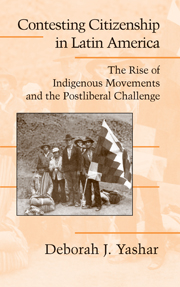
 Contesting Citizenship in Latin America
The Rise of Indigenous Movements and the Postliberal Challenge
3 - THE ARGUMENT: INDIGENOUS MOBILIZATION IN LATIN AMERICA
Published online by Cambridge University Press: 05 September 2012

Summary
The Latin American anomaly has yet to be explained. Why were ethnic cleavages weak in Latin America? Why did they reverse course at century's end, as indigenous mobilization proliferated throughout the region? And why have significant regional and national movements emerged in all cases except Peru? This chapter addresses the contemporary and yet uneven emergence of indigenous movements in Latin America by analyzing the five cases outlined in Chapter 1: Ecuador, Bolivia, Guatemala, Mexico, and Peru. I compare these cases cross-temporally and cross-nationally.
This chapter highlights the role of citizenship regimes vis-à-vis existing social cleavages and uneven state penetration – as conceptualized and discussed in Chapter 2. I argue here that different types of citizenship regimes first diffused and then activated ethnic cleavages. Earlier citizenship regimes unintentionally enabled indigenous communities to carve out spaces of local autonomy, with limited interference from the state in matters of local governance. Subsequent citizenship regimes, however, threatened the autonomy that had been secured and, consequently, politicized ethnic cleavages. Hence we must trace the comparative historical arc of citizenship regimes and the associated patterns of state formation to understand the politicization of these ethnic cleavages and the motive for organizing. Where autonomy was possible, ethnic cleavages were weak. Where autonomy was subsequently challenged, ethnic cleavages became more salient.
This comparative historical discussion of citizenship regimes explains why ethnic cleavages have become more politicized in the contemporary period but were comparatively weak in earlier periods.
Information
- Type
- Chapter
- Information
- Contesting Citizenship in Latin AmericaThe Rise of Indigenous Movements and the Postliberal Challenge, pp. 54 - 82Publisher: Cambridge University PressPrint publication year: 2005
Accessibility standard: Unknown
Why this information is here
This section outlines the accessibility features of this content - including support for screen readers, full keyboard navigation and high-contrast display options. This may not be relevant for you.Accessibility Information
Accessibility compliance for the PDF of this chapter is currently unknown and may be updated in the future.