Book contents
- Frontmatter
- Contents
- Preface and acknowledgements
- 1 Political equality, wealth and democracy
- 2 Freedom to speak and freedom to spend
- 3 Strategies and reforms
- 4 Access, influence and lobbying
- 5 Beyond equal votes: election campaigns and political parties
- 6 Public spaces, property and participation
- 7 The mass media: democratic dreams and private propagandists
- 8 Participation in the digital era: a new distribution?
- 9 Conclusion
- Index
- References
3 - Strategies and reforms
Published online by Cambridge University Press: 05 June 2012

Book contents
- Frontmatter
- Contents
- Preface and acknowledgements
- 1 Political equality, wealth and democracy
- 2 Freedom to speak and freedom to spend
- 3 Strategies and reforms
- 4 Access, influence and lobbying
- 5 Beyond equal votes: election campaigns and political parties
- 6 Public spaces, property and participation
- 7 The mass media: democratic dreams and private propagandists
- 8 Participation in the digital era: a new distribution?
- 9 Conclusion
- Index
- References
Summary
Various strategies can be devised to address the tensions between inequalities in wealth and political equality. Such strategies include the prohibition of certain types of exchanges or payments, the disclosure of political expenditures, limits on political spending, subsidies to facilitate participation, rights of access to public spaces and certain types of media regulation. None of these measures fully secure political equality and even with such measures in place, inequalities in wealth will remain influential in relation to the various unregulated activities. However, these strategies still have value in taking a step towards a more egalitarian system and in recognising the ideal of political equality. Many such measures are already in place in the UK, having arisen in a piecemeal fashion for a variety of different reasons. The argument here is that such measures can be connected as playing a role in promoting political equality. While the workings of each strategy will be considered in later chapters, the aim here is to provide an introductory overview and look at some of the main problems associated with each method.
The risks of state intervention
Before looking at the different strategies, it is useful to consider whether the risks associated with state interventions are so great that the impact of inequalities of wealth should be tolerated. In the previous chapter, one recurring concern was that, even if political equality is a desirable goal, there is a danger in empowering someone to decide what controls should be imposed on the use of wealth in politics.
Information
- Type
- Chapter
- Information
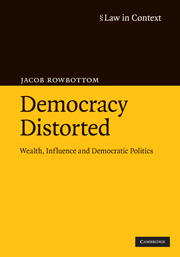
- Democracy DistortedWealth, Influence and Democratic Politics, pp. 62 - 77Publisher: Cambridge University PressPrint publication year: 2010
References
and , ‘Secondary Associations and Democratic Governance’ (1992) 20 Politics & Society393 at 397–406CrossRefGoogle Scholar
, ‘Property, Speech, and the Politics of Distrust’ (1992) 59 The University of Chicago Law Review41 at 56–7CrossRefGoogle Scholar
, ‘Clipping Coupons for Democracy: An Egalitarian/Public Choice Defense of Campaign Finance Vouchers’ (1996) 84 California Law Review1 at 16CrossRefGoogle Scholar
, Liberalism Divided: Freedom of Speech and the many uses of State Power (New York: Westview Press, 1996) pp. 39 and 148Google Scholar
, Electoral Reform in England and Wales (New Haven: Yale University Press, 1915) p. 436Google Scholar
, ‘Equal-Dollars-Per-Voter: A Constitutional Principle of Campaign Finance’ (1994) 94 Columbia Law Review1204CrossRefGoogle Scholar
Accessibility standard: Unknown
Why this information is here
This section outlines the accessibility features of this content - including support for screen readers, full keyboard navigation and high-contrast display options. This may not be relevant for you.Accessibility Information
Accessibility compliance for the PDF of this chapter is currently unknown
and may be updated in the future.