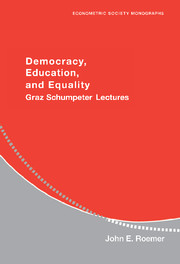
Book contents
- Frontmatter
- 1A Brief Overview
- 2Models of Party Competition
- 3Democratic Competition over Educational Investment
- 4The Dynamics of Human Capital with Exogenous Growth
- 5The Dynamics of Human Capital with Endogenous Growth
- 6Estimation of Technological Parameters
- 7Conclusion
- References
- Appendix: Proof of Theorems
- Index
2 - Models of Party Competition
Published online by Cambridge University Press: 05 January 2013

Book contents
- Frontmatter
- 1A Brief Overview
- 2Models of Party Competition
- 3Democratic Competition over Educational Investment
- 4The Dynamics of Human Capital with Exogenous Growth
- 5The Dynamics of Human Capital with Endogenous Growth
- 6Estimation of Technological Parameters
- 7Conclusion
- References
- Appendix: Proof of Theorems
- Index
Summary
POLITICAL PARTIES
For millenia, different interest groups in society - primarily, according to one prominent view, different economic classes - have fought each other for control of the economic surplus. Democracy is one institution that organizes that struggle, and it has, according to Adam Przeworski [1999], one principal virtue: it minimizes bloodshed, for an aspect of democracy is the peaceful transition from one regime to its elected successor; as well with universal suffrage, it gives every citizen a voice in the action. Of course, both of these virtues are imperfectly implemented in actual democracies, but, to a first-order approximation, democracy dominates other forms of rule with respect to these two criteria.
In the modern period, since 1789, the democratic struggle has been organized primarily through political parties. There are exceptions: some Swiss cantons practiced direct democracy until quite recently, in which decisions are made by committees of the whole polity. The party form has, however, been almost ubiquitous. Parties historically have represented different interest groups in the polity. Sometimes parties are identified by the name of their interest group, such as the Labor Party or the Farmers' Party. Often, however, they are identified by an ideology, such as the Socialist or Christian Democratic Party.
Information
- Type
- Chapter
- Information
- Democracy, Education, and EqualityGraz-Schumpeter Lectures, pp. 11 - 34Publisher: Cambridge University PressPrint publication year: 2006
Accessibility standard: Unknown
Why this information is here
This section outlines the accessibility features of this content - including support for screen readers, full keyboard navigation and high-contrast display options. This may not be relevant for you.Accessibility Information
Accessibility compliance for the PDF of this chapter is currently unknown and may be updated in the future.