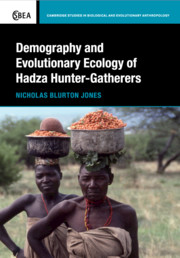
Book contents
- Frontmatter
- Contents
- Preface and acknowledgments
- Part IDemography
- 1Introduction
- 2Geography and ecology in the Eyasi basin
- 3History of the Hadza and the Eyasi basin
- 4Research strategy, methods, and estimating ages
- 5Migration and intermarriage: are the eastern Hadza a population?
- 6Hadza regions: do they contain sub-populations?
- 7Fertility
- 8Mortality
- 9Testing the estimates of fertility and mortality
- 10Hadza demography: a normal human demography sustained by hunting and gathering in sub-Saharan savanna
- 11The Hadza and hunter-gatherer population dynamics
- Part IIApplying the demographic data to interpreting Hadza behavior and biology
- References
- Index
1 - Introduction
from Part I - Demography
Published online by Cambridge University Press: 05 January 2016

Book contents
- Frontmatter
- Contents
- Preface and acknowledgments
- Part IDemography
- 1Introduction
- 2Geography and ecology in the Eyasi basin
- 3History of the Hadza and the Eyasi basin
- 4Research strategy, methods, and estimating ages
- 5Migration and intermarriage: are the eastern Hadza a population?
- 6Hadza regions: do they contain sub-populations?
- 7Fertility
- 8Mortality
- 9Testing the estimates of fertility and mortality
- 10Hadza demography: a normal human demography sustained by hunting and gathering in sub-Saharan savanna
- 11The Hadza and hunter-gatherer population dynamics
- Part IIApplying the demographic data to interpreting Hadza behavior and biology
- References
- Index
Summary
There are about a thousand people whose first language is Hadzane. At the time of my research between 1985 and 2000, most of them lived, hunted, and gathered plant foods in rocky hills in the eastern rift valley near Lake Eyasi in northern Tanzania. They call themselves Hadza, or Hadzabe (plural), or to a Kiswahili speaker, Wahadzabe, adding the Kiswahili plural animate noun prefix. They can be roughly divided into eastern and western sub-populations.
Hadza live in spectacular country. Many eastern Hadza camps are within sight of the outer wall of Ngorongoro crater, a UNESCO World Heritage Site, and many others are just across the rift valley from the equally well-known Serengeti National Park, Olduvai gorge, and Laetoli of fossil footprint fame (Photograph 1.1). Western Hadza lived adjacent to high-priced safari country around Maswa, south of Serengeti. James Woodburn, the first serious anthropologist to write about the Hadza in English (based initially on his intensive fieldwork in 1959–1961) (Woodburn, 1964) has reported on many aspects of Hadza life, and since 1988, our research group has added publications on behavioral ecology and life history. Now Frank Marlowe (2010) has collected his and other's recent research to give an excellent description of Hadza life. My aim here is more specialized. First, I want to set a detailed study of Hadza demography alongside the classic works on hunter-gatherer demography by Howell (1979) and Hill and Hurtado (1996) and other recent accounts such as those of Early and Headland (1998). Second, I want to use individual variation within the whole population to pursue some of our long-standing questions about how individuals, hunting and gathering in a sub-Saharan savanna environment, promote their reproductive success (RS). This should be useful to anyone interested in the evolution of our species.
From some hillside Hadza camps, one would be able to see, with a strongly wind-stabilized telescope, the tourist buses climbing the outer flank of Ngorongoro crater. Yet the majority of Hadza live by an economy as far removed from that of the tourists, and of most other Tanzanian citizens, as it is possible to get. Despite brief experiences with other lifestyles, most Hadza acquired the bulk of their food by hunting wild animals and gathering wild plants.
Information
- Type
- Chapter
- Information
- Publisher: Cambridge University PressPrint publication year: 2016
Accessibility standard: Unknown
Why this information is here
This section outlines the accessibility features of this content - including support for screen readers, full keyboard navigation and high-contrast display options. This may not be relevant for you.Accessibility Information
Accessibility compliance for the PDF of this chapter is currently unknown and may be updated in the future.