Book contents
- Frontmatter
- Contents
- Contributors
- Foreword
- Acknowledgments
- 1Middle Childhood: Contexts of Development
- 2The Significance of Middle Childhood Peer Competence for Work and Relationships in Early Adulthood
- 3Aggression and Insecurity in Late Adolescent Romantic Relationships: Antecedents and Developmental Pathways
- 4Middle Childhood Family-Contextual and Personal Factors as Predictors of Adult Outcomes
- 5Genetic and Environmental Influences on Continuity and Change in Reading Achievement in the Colorado Adoption Project
- 6Reciprocal Effects of Mothers' Depression and Children's Problem Behaviors from Middle Childhood to Early Adolescence
- 7Middle Childhood Life Course Trajectories: Links Between Family Dysfunction and Children's Behavioral Development
- 8The Contribution of Middle Childhood Contexts to Adolescent Achievement and Behavior
- 9Educational Tracking Within and Between Schools: From First Grade Through Middle School and Beyond
- 10School Environments and the Diverging Pathways of Students Living in Poverty
- 11The Relations of Classroom Contexts in the Early Elementary Years to Children's Classroom and Social Behavior
- 12Out-of-School Time Use During Middle Childhood in a Low-Income Sample: Do Combinations of Activities Affect Achievement and Behavior?
- 13Low-Income Children's Activity Participation as a Predictor of Psychosocial and Academic Outcomes in Middle Childhood and Adolescence
- 14Healthy Mind, Healthy Habits: The Influence of Activity Involvement in Middle Childhood
- 15Media Effects in Middle Childhood
- 16Continuity and Discontinuity in Middle Childhood: Implications for Adult Outcomes in the UK 1970 Birth Cohort
- 17Mandatory Welfare-to-Work Programs and Preschool-Age Children: Do Impacts Persist into Middle Childhood?
- 18Effects of Welfare and Employment Policies on Middle-Childhood School Performance: Do They Vary by Race/Ethnicity and, If So, Why?
- 19Effects of a Family Poverty Intervention Program Last from Middle Childhood to Adolescence
- 20Experiences in Middle Childhood and Children's Development: A Summary and Integration of Research
- Author Index
- Subject Index
- References
3 - Aggression and Insecurity in Late Adolescent Romantic Relationships: Antecedents and Developmental Pathways
Published online by Cambridge University Press: 16 September 2009

Book contents
- Frontmatter
- Contents
- Contributors
- Foreword
- Acknowledgments
- 1Middle Childhood: Contexts of Development
- 2The Significance of Middle Childhood Peer Competence for Work and Relationships in Early Adulthood
- 3Aggression and Insecurity in Late Adolescent Romantic Relationships: Antecedents and Developmental Pathways
- 4Middle Childhood Family-Contextual and Personal Factors as Predictors of Adult Outcomes
- 5Genetic and Environmental Influences on Continuity and Change in Reading Achievement in the Colorado Adoption Project
- 6Reciprocal Effects of Mothers' Depression and Children's Problem Behaviors from Middle Childhood to Early Adolescence
- 7Middle Childhood Life Course Trajectories: Links Between Family Dysfunction and Children's Behavioral Development
- 8The Contribution of Middle Childhood Contexts to Adolescent Achievement and Behavior
- 9Educational Tracking Within and Between Schools: From First Grade Through Middle School and Beyond
- 10School Environments and the Diverging Pathways of Students Living in Poverty
- 11The Relations of Classroom Contexts in the Early Elementary Years to Children's Classroom and Social Behavior
- 12Out-of-School Time Use During Middle Childhood in a Low-Income Sample: Do Combinations of Activities Affect Achievement and Behavior?
- 13Low-Income Children's Activity Participation as a Predictor of Psychosocial and Academic Outcomes in Middle Childhood and Adolescence
- 14Healthy Mind, Healthy Habits: The Influence of Activity Involvement in Middle Childhood
- 15Media Effects in Middle Childhood
- 16Continuity and Discontinuity in Middle Childhood: Implications for Adult Outcomes in the UK 1970 Birth Cohort
- 17Mandatory Welfare-to-Work Programs and Preschool-Age Children: Do Impacts Persist into Middle Childhood?
- 18Effects of Welfare and Employment Policies on Middle-Childhood School Performance: Do They Vary by Race/Ethnicity and, If So, Why?
- 19Effects of a Family Poverty Intervention Program Last from Middle Childhood to Adolescence
- 20Experiences in Middle Childhood and Children's Development: A Summary and Integration of Research
- Author Index
- Subject Index
- References
Summary
Experiences in the family and peer group play important roles in the development of interpersonal competencies across the childhood and adolescent years. Toward the end of adolescence, stable and supportive romantic relationships increasingly serve adaptive functions in promoting individual well-being and in fostering a sense of connection and security to others (Collins, Hennighausen, Schmit, & Sroufe, 1997; Conger, Cui, Bryant, & Elder, 2000; Furman, 1999). Romantic relationships marked by conflict and violence pose risks for current and longer-term adjustment and can compromise the health and well-being of the partner to whom the violence is directed (Capaldi & Owen, 2001). Romantic relationships in which one or both partners are wary, jealous, and insecure can stifle growth and fuel disagreements and disharmony (Holtzworth-Munroe, Meehan, Herron, Rehman, & Stuart, 2000).
Relationship insecurity and relationship violence covary to some degree (Holtzworth-Munroe & Stewart, 1994), suggesting that they may be linked in the development of romantic relationship dysfunction. Within the marital violence literature, insecurity has been proposed as a key pathway through which relationship violence develops. Consistent with this perspective, Holtzworth-Munroe et al. (2000), in their examination of types of male batterers, found that one type of batterer could be characterized by insecurity and a tendency to confine violence to an intimate relationship. Holtzworth-Munroe et al. (2000) speculate that insecurity plays an etiological role in the development of partner violence. If this were the case, then insecurity might serve as a mediating link between social experience (e.g., of rejection and intimidation) and subsequent violence.
Information
- Type
- Chapter
- Information
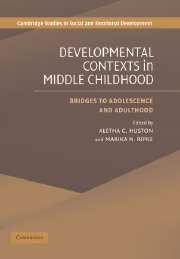
- Developmental Contexts in Middle ChildhoodBridges to Adolescence and Adulthood, pp. 41 - 61Publisher: Cambridge University PressPrint publication year: 2006
References
, & (1991). Multiple regression: Testing and interpreting interactions. Newbury Park, CA: Sage.Google Scholar
, , , & (2000). Adolescent and family predictors of physical aggression, communication, and satisfaction in young adult couples: A prospective analysis. Journal of Consulting and Clinical Psychology, 68, 195–208.CrossRefGoogle ScholarPubMed
(1996). Parental psychological control: Revisiting a neglected construct. Child Development, 67, 3296–3319.CrossRefGoogle ScholarPubMed
(Ed.). (2002). Intrusive parenting: How psychological control affects children and adolescents. Washington, DC: American Psychological Association.CrossRefGoogle Scholar
, & (1991). Attachment styles among young adults: A test of a four-category model. Journal of Personality and Social Psychology, 61, 226–244.CrossRefGoogle ScholarPubMed
, , , & (2001). Child-rearing antecedents of intergenerational relations in young adulthood: A prospective study. Developmental Psychology, 37, 801–813.CrossRefGoogle ScholarPubMed
, , , (1993). Parenting practices and peer group affiliation in adolescence. Child Development, 64, 467–482.CrossRefGoogle ScholarPubMed
, , & (1994). Measuring friendship quality during pre- and early adolescence: The development and psychometric properties of the friendship qualities scale. Journal of Social and Personal Relationships, 11, 471–484.CrossRefGoogle Scholar
, & (2001). Physical aggression in a community sample of at-risk couples: Gender comparisons for high frequency, injury, and fear. Journal of Family Psychology, 15, 425–440.CrossRefGoogle Scholar
, , , & (2001). Aggression toward female partners by at-risk young men: The contribution of male adolescent friendships. Developmental Psychology, 37, 61–73.CrossRefGoogle ScholarPubMed
, & (1997). Interpretative guide to the Millon Clinical Multiaxial Inventory (2nd ed.). Washington, DC: American Psychological Association.Google Scholar
Coie, J. D., & Dodge, K. A. (1998). Aggression and antisocial behavior. In (Ed.) & (Vol. Ed.), Handbook of child psychology: Vol. 3. Social, emotional, and personality development (5th ed., pp. 779–862). New York: Wiley.Google Scholar
Collins, W. A., Hennighausen, K. C., Schmit, D. T., & Sroufe, L. A. (1997). Developmental precursors of romantic relationships: A longitudinal analysis. In & (Eds.), Romantic relationships in adolescence: Developmental perspectives: New directions for child development research (pp. 69–84). San Francisco: Jossey-Bass.Google Scholar
Collins, W. A., & Sroufe, L. A. (1999). Capacity for intimate relationships: A developmental construction. In . (Eds.), The development of romantic relationships in adolescence. Cambridge studies in social and emotional development (pp. 125–147). New York: Cambridge University Press.CrossRefGoogle Scholar
, , , & (2000). Competence in early adult romantic relationships: A developmental perspective on family influences. Journal of Personality and Social Psychology, 79, 224–237.CrossRefGoogle ScholarPubMed
, , , , & (2002). Family adversity, positive peer relationships, and children's externalizing behavior: A longitudinal perspective on risk and resilience. Child Development, 73, 1220–1237.CrossRefGoogle Scholar
, , , & (1998). Multiple risk factors in the development of externalizing behavior problems: Group and individual differences. Development and Psychopathology, 10, 469–493.CrossRefGoogle ScholarPubMed
, , , & (1991). Family, school, and behavioral antecedents to early adolescent involvement with antisocial peers. Developmental Psychology, 27, 172–180.CrossRefGoogle Scholar
, , & (1990). Mechanisms in the cycle of violence. Science, 250, 1678–1683.CrossRefGoogle ScholarPubMed
, , , , , , & (2003). Peer rejection and social information processing factors in the development of aggressive behavior problems in children. Child Development, 74, 374–393.CrossRefGoogle ScholarPubMed
Furman, W. (1999). Friends and lovers: The role of peer relationships in adolescent romantic relationships. In & (Eds.), Relationships as developmental contexts. The Minnesota symposia on child psychology: Vol. 30 (pp. 133–154). Mahwah, NJ: Erlbaum.Google Scholar
, & (2003). Anxious solitude and peer exclusion: A diathesis-stress model of internalizing trajectories in childhood. Child Development, 74, 257–278.CrossRefGoogle ScholarPubMed
Hollingshead, W. (1975). The Hollingshead four factor index of socioeconomic status. Unpublished manuscript, Yale University, New Haven, CT.
, , , , & (2000). Testing the Holtzworth-Munroe and Stuart (1994) Batterer Typology. Journal of Consulting and Clinical Psychology, 68, 1000–1019.CrossRefGoogle ScholarPubMed
, & (1994). Typologies of male batterers: Three subtypes and the differences among them. Psychological Bulletin, 116, 476–497.CrossRefGoogle Scholar
, & (1998). Parenting behaviors and parent-child relationships: Correlates of peer victimization in kindergarten?Developmental Psychology, 34, 1450–1458.CrossRefGoogle Scholar
, , , , , & (2002). History of family dysfunction and perpetration of dating violence by adolescent boys: A longitudinal study. Journal of Adolescent Health, 30, 375–383.CrossRefGoogle ScholarPubMed
, , , , & (2003). Friendship quality, peer group affiliation, and peer antisocial behavior as moderators of the link between negative parenting and adolescent externalizing behavior. Journal of Research on Adolescence, 13, 161–184.CrossRefGoogle ScholarPubMed
, & (2003, April). Mutual antipathies, reciprocated friendships, and school adjustment in middle childhood: Concurrent and longitudinal relations. Poster presented at the Society for Research in Child Development, Tampa, FL.Google Scholar
, , , & (1998). Developmental antecedents of partner abuse: A prospective-longitudinal study. Journal of Abnormal Psychology, 107, 375–389.CrossRefGoogle ScholarPubMed
, & (1981). Jealousy, romantic love, and liking: Theoretical considerations and preliminary scale development. Psychological Reports, 49, 23–31.CrossRefGoogle Scholar
Melby, J. N., & Conger, R. D. (2001). The Iowa Family Interaction Rating Scales: Instrument summary. In & (Eds.), Family observation coding systems: Resources for systemic research (pp. 33–58). Mahway, NJ: Erlbaurm.Google Scholar
, , & (1997). Supportive parenting, ecological context, and children's adjustment: A seven-year longitudinal study. Child Development, 68, 908–923.Google Scholar
, , , & (1999). The impact of after-school peer contact on early adolescent externalizing problems is moderated by parental monitoring, perceived neighborhood safety, and prior adjustment. Child Development, 70, 768–778.CrossRefGoogle ScholarPubMed
, , , , & (2001). Antecedents and behavior-problem outcomes of parental monitoring and psychological control in early adolescence. Child Development, 72, 583–598.CrossRefGoogle ScholarPubMed
, , & (1996). Violence and injury in marital arguments: Risk patterns and gender differences. American Journal of Public Health, 86, 35–40.CrossRefGoogle ScholarPubMed
Sroufe, L. A., & Fleeson, J. (1986). Attachment and the construction of relationships. In & (Eds.), Relationships and development (pp. 27–47). Hillsdale, NJ: Erlbaum.Google Scholar
, , , & (1996). The Revised Conflict Tactics Scales (CTS2): Development and preliminary psychometric data. Journal of Family Issues, 17, 283–316.CrossRefGoogle Scholar
, , , & (2000). Harsh physical discipline in childhood and violence in later romantic involvements: The mediating role of problem behaviors. Journal of Marriage and the Family, 62, 508–519.CrossRefGoogle Scholar
Thornberry, T. P., & Krohn, M. D. (2001). The development of delinquency: An interactional perspective. In (Ed.), Handbook of youth and justice (pp. 289–305). New York: Plenum.CrossRefGoogle Scholar
Accessibility standard: Unknown
Why this information is here
This section outlines the accessibility features of this content - including support for screen readers, full keyboard navigation and high-contrast display options. This may not be relevant for you.Accessibility Information
Accessibility compliance for the PDF of this chapter is currently unknown and may be updated in the future.