Book contents
- Frontmatter
- Contents
- Contributors
- Foreword
- Acknowledgments
- 1Middle Childhood: Contexts of Development
- 2The Significance of Middle Childhood Peer Competence for Work and Relationships in Early Adulthood
- 3Aggression and Insecurity in Late Adolescent Romantic Relationships: Antecedents and Developmental Pathways
- 4Middle Childhood Family-Contextual and Personal Factors as Predictors of Adult Outcomes
- 5Genetic and Environmental Influences on Continuity and Change in Reading Achievement in the Colorado Adoption Project
- 6Reciprocal Effects of Mothers' Depression and Children's Problem Behaviors from Middle Childhood to Early Adolescence
- 7Middle Childhood Life Course Trajectories: Links Between Family Dysfunction and Children's Behavioral Development
- 8The Contribution of Middle Childhood Contexts to Adolescent Achievement and Behavior
- 9Educational Tracking Within and Between Schools: From First Grade Through Middle School and Beyond
- 10School Environments and the Diverging Pathways of Students Living in Poverty
- 11The Relations of Classroom Contexts in the Early Elementary Years to Children's Classroom and Social Behavior
- 12Out-of-School Time Use During Middle Childhood in a Low-Income Sample: Do Combinations of Activities Affect Achievement and Behavior?
- 13Low-Income Children's Activity Participation as a Predictor of Psychosocial and Academic Outcomes in Middle Childhood and Adolescence
- 14Healthy Mind, Healthy Habits: The Influence of Activity Involvement in Middle Childhood
- 15Media Effects in Middle Childhood
- 16Continuity and Discontinuity in Middle Childhood: Implications for Adult Outcomes in the UK 1970 Birth Cohort
- 17Mandatory Welfare-to-Work Programs and Preschool-Age Children: Do Impacts Persist into Middle Childhood?
- 18Effects of Welfare and Employment Policies on Middle-Childhood School Performance: Do They Vary by Race/Ethnicity and, If So, Why?
- 19Effects of a Family Poverty Intervention Program Last from Middle Childhood to Adolescence
- 20Experiences in Middle Childhood and Children's Development: A Summary and Integration of Research
- Author Index
- Subject Index
- References
20 - Experiences in Middle Childhood and Children's Development: A Summary and Integration of Research
Published online by Cambridge University Press: 16 September 2009

Book contents
- Frontmatter
- Contents
- Contributors
- Foreword
- Acknowledgments
- 1Middle Childhood: Contexts of Development
- 2The Significance of Middle Childhood Peer Competence for Work and Relationships in Early Adulthood
- 3Aggression and Insecurity in Late Adolescent Romantic Relationships: Antecedents and Developmental Pathways
- 4Middle Childhood Family-Contextual and Personal Factors as Predictors of Adult Outcomes
- 5Genetic and Environmental Influences on Continuity and Change in Reading Achievement in the Colorado Adoption Project
- 6Reciprocal Effects of Mothers' Depression and Children's Problem Behaviors from Middle Childhood to Early Adolescence
- 7Middle Childhood Life Course Trajectories: Links Between Family Dysfunction and Children's Behavioral Development
- 8The Contribution of Middle Childhood Contexts to Adolescent Achievement and Behavior
- 9Educational Tracking Within and Between Schools: From First Grade Through Middle School and Beyond
- 10School Environments and the Diverging Pathways of Students Living in Poverty
- 11The Relations of Classroom Contexts in the Early Elementary Years to Children's Classroom and Social Behavior
- 12Out-of-School Time Use During Middle Childhood in a Low-Income Sample: Do Combinations of Activities Affect Achievement and Behavior?
- 13Low-Income Children's Activity Participation as a Predictor of Psychosocial and Academic Outcomes in Middle Childhood and Adolescence
- 14Healthy Mind, Healthy Habits: The Influence of Activity Involvement in Middle Childhood
- 15Media Effects in Middle Childhood
- 16Continuity and Discontinuity in Middle Childhood: Implications for Adult Outcomes in the UK 1970 Birth Cohort
- 17Mandatory Welfare-to-Work Programs and Preschool-Age Children: Do Impacts Persist into Middle Childhood?
- 18Effects of Welfare and Employment Policies on Middle-Childhood School Performance: Do They Vary by Race/Ethnicity and, If So, Why?
- 19Effects of a Family Poverty Intervention Program Last from Middle Childhood to Adolescence
- 20Experiences in Middle Childhood and Children's Development: A Summary and Integration of Research
- Author Index
- Subject Index
- References
Summary
Over two decades ago, when a major review of development in middle childhood was published (Collins, 1984), the authors concluded that middle childhood characteristics predict adolescent and adult development better than preschool indicators do. Although many people would not find this conclusion surprising, it contradicted two widespread notions: that a child's future is shaped in early childhood and that little of interest happens in middle childhood compared with “coming of age” in adolescence. The authors called for new research investigating the processes by which the phenomena of middle childhood account for later development, and more inquiry into the effects of middle childhood experiences and environments, particularly economic and cultural backgrounds, using more sophisticated methods to investigate complex developmental questions.
More than 20 years later, we are positioned to address middle childhood processes and environments with several context-rich longitudinal studies, many of which specifically examine economic and cultural variations. Advances in research methods and data analytic techniques allow a variety of new approaches to our central questions.
We address two related questions:
How do developmental patterns in middle childhood – both continuous and discontinuous – relate to directions taken in adolescence and adulthood?
What do experiences in the family, peer group, school, out-of-school time, and the larger economic and cultural milieus of middle childhood contribute to long-term developmental patterns?
Information
- Type
- Chapter
- Information
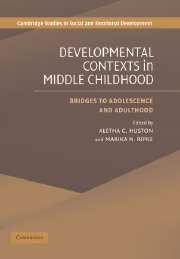
- Developmental Contexts in Middle ChildhoodBridges to Adolescence and Adulthood, pp. 409 - 434Publisher: Cambridge University PressPrint publication year: 2006
References
, , , , & (2001). Early childhood television viewing and adolescent behavior. Monographs of the Society for Research in Child Development, 66.Google ScholarPubMed
, & (2002). Socioeconomic status and child development. Annual Review of Psychology, 53, 371–399.CrossRefGoogle ScholarPubMed
(1984). Development during middle childhood: The years from six to twelve. Washington, DC: National Academies Press.Google Scholar
, , , , & (2000). Contemporary research on parenting: The case for nature and nurture. American Psychologist, 55, 218–232.CrossRefGoogle ScholarPubMed
(1957). The two disciplines of psychology. American Psychologist, 12, 671–684.CrossRefGoogle Scholar
(1984). Years of poverty, years of plenty. Ann Arbor, MI: Survey Research Center, University of Michigan.Google Scholar
Eccles, J. S., Wigfield, A., & Schiefele, U. (1998). Motivation to succeed. In (Series Ed.) & (Vol. Ed.), Handbook of child psychology: Vol. 3. Social, emotional, and personality development (5th ed., pp. 1017–1096). New York: Wiley.Google Scholar
, & (1999). Student council, volunteering, basketball, or marching band: What kind of extracurricular participation matters?Journal of Adolescent Research, 14(1), 10–43.CrossRefGoogle Scholar
, & (1999). Student council, volunteering, basketball, or marching band: What kind of extracurricular participation matters?Journal of Adolescent Research, 14(1), 10–43.CrossRefGoogle Scholar
, , , , & (1999). Managing to make it: Urban families and adolescent success. Chicago: University of Chicago Press.Google Scholar
(1998). The nurture assumption: Why children turn out the way they do. New York: Free Press.Google Scholar
, , & (1948). The stability of mental test performances between two and eighteen years. Journal of Experimental Education, 17, 309–324.CrossRefGoogle Scholar
Huston, A. C., & Wright, J. C. (1998). Mass media and children's development. In (Series Ed.), & (Vol. Eds.), Handbook of child psychology: Vol. 4. Child psychology in practice (5th ed., pp. 999–1058). New York: Wiley.Google Scholar
Ladd, G. W., Buhs, E. S., & Troop, W. (2002). Children's interpersonal skills and relationships in school settings: Adaptive significance and implications for school-based prevention and intervention programs. In & , (Eds.), Blackwell handbook of childhood social development (pp. 394–415) Malden, MA: Blackwell.Google Scholar
, , & (2005). Organized activities as contexts of development: Extracurricular activities, after-school and community programs. Mahwah, NJ: Lawrence Erlbaum.Google Scholar
, , , & (2001). Sex differences in antisocial behavior: Conduct disorder, delinquency, and violence in the Dunedin Longitudinal Study. Cambridge, UK: Cambridge University Press.CrossRefGoogle Scholar
, , , , & (2001). How welfare and work policies affect children: A synthesis of research. New York: Manpower Demonstration Research Corporation.Google Scholar
Rubin, K. H., Bukowski, W., & Parker, J. G. (1998). Peer interactions, relationships, and groups. In (Series Ed.) & (Vol. Ed.), Handbook of child psychology: Vol. 3. Social, emotional, and personality development (5th ed., pp. 619–700). New York: Wiley.Google Scholar
, , & (1958). Mental growth and personality: A longitudinal study. Monographs of the Society for Research in Child Development, 23 (Serial No. 68).CrossRefGoogle Scholar
(2000). Parents, peers, and other socializing influences. Developmental Psychology, 36, 699–710.CrossRefGoogle Scholar
Accessibility standard: Unknown
Why this information is here
This section outlines the accessibility features of this content - including support for screen readers, full keyboard navigation and high-contrast display options. This may not be relevant for you.Accessibility Information
Accessibility compliance for the PDF of this chapter is currently unknown and may be updated in the future.