

Scour the grounds … the sprawling ruins of the tower … tear away the veil of this terrible mystery.
The Scottish Setting
In early nineteenth-century Italy, Scotland was often depicted in opera as a distant sea-swept land filled with mystery and ancient tales, a picturesque setting for popular works such as Johann Simon Mayr’s Ginevra di Scozia (1801) and Rossini’s La donna del Lago (1819). Scotland was also a well-used location by Cammarano, the librettist of Lucia, especially when problems with the Neapolitan theatrical censors arose. For example, in an effort to defuse the political elements within the French play Le proscrit [‘The Outcast’] (1839) when turning it into the Italian opera Il proscritto (1842, with music by Saverio Mercadente), Cammarano changed the action from France (around the time of Napoleon’s defeat) to Scotland in the 1650s and the time of Lord Oliver Cromwell (1599–1658). As John Black speculates, ‘perhaps this was considered so far-flung and outlandish a country that any degree of treason could be perpetuated without threatening the security of the Bourbon occupancy of the throne or the moral welfare of the people’.2 Fortunately, for Lucia, which is set in Scotland, no geographical changes were requested by the Neapolitan censors. The only alteration required of the original text was the change of Raimondo’s profession from a Presbyterian minister to a ‘tutor and confidant’, presumably because the censors did not wish to see a member of the Church of Scotland depicted on an Italian stage.3
The historical setting of the opera was a different matter. Part of a collection of historical novels that highlight Scottish rural life in the late 1600s and early 1700s, The Bride of Lammermoor is set during the time of the Treaty of Union (1707), when Scotland and England became one state, the United Kingdom of Great Britain. Although Walter Scott’s historical setting has little to do with the actual action within the novel, the book is framed by the setting nonetheless, so much so that at the start of the book, the Ravenswood clan is stripped of its lordship and lands after supporting the deposed King James VII (1688), the last Catholic monarch of England, Scotland and Ireland. The Scottish throne thus went to the Protestant William of Orange (William III) and Mary II, Queen Regent, who were supported by the Ashton clan. As the Ravenswood estate came up for sale, Sir Ashton purchased the land and took control of the castle and all its contents. He even tried to prevent Edgar Ravenswood, the last surviving member of the Ravenswood clan, from burying his father in the family crypt. Hence, the bitter conflict that ensues when Edgar (Edgardo) and Lucy Ashton (Lucia) become lovers.
Cammarano’s libretto is set at the end of the sixteenth century, a whole century before the action of Scott’s novel.4 If we are to take Cammarano’s historical backdrop at face value, then the opera takes place during the time of Mary, Queen of Scots, or Mary Stuart (1542–87) the daughter of James V of Scotland. When James died, Mary inherited the throne before her first birthday. Ruled by regents until she was old enough to claim the Scottish throne, Mary was sent to France, her mother’s birthplace, where she was raised a Catholic and married Francis II, King of France. When Francis II died in 1560, Mary returned to Scotland a year later to claim the throne. Scotland had become decidedly Protestant in her absence, breaking with the Roman Catholic Church. Mary was eventually forced to abdicate the throne in 1567 and sought refuge with her cousin Queen Elizabeth I. Suspecting her of treason, Elizabeth had Mary beheaded in 1587.
Following her death, Mary Stuart was a popular subject among European Catholics, with books and plays appearing soon after her death.5 She was viewed by many as a martyr of the faith – the legitimate ruler of England and Scotland owing to Henry VIII’s break with the Catholic Church to marry Anne Boleyn, the mother of Elizabeth I. Mary Stuart was also the subject of a number of operas throughout the nineteenth century, especially in Italy, where Donizetti even set a version of the tale that premiered at La Scala on 30 December 1835 as Maria Stuarda, just a few months after the premiere of Lucia.6 Although it did not achieve great success in the nineteenth century, Donizetti’s opera on the Scottish queen is a familiar work among opera fans today, who often refer to it as one of the three ‘Tudor Queens’ of Donizetti, which also includes Anna Bolena (1830), second wife of Henry VIII, and Roberto Devereux (1837), lover of Queen Elizabeth I.
Serving neither as a mistaken translation nor a mere coincidence, I believe the historical backdrop to Lucia was intentionally set by Cammarano to the time of Mary Stuart. There are two examples in the libretto that support this conclusion, namely in Act I, scene 5, as Edgardo mentions to Lucia that he has a political mission in France to secure Scotland’s future, and in Act II, scene 2, as Enrico voices his frustrations to Lucia that if Mary ascends the throne, it would be disastrous for the Ashton family.7 The implication here is that the Ravenswood family is Catholic (in compliance with the Scott original) and a supporter of Mary’s reign, while the Ashton family is Protestant and a supporter of a Scotland independent of continental influences. (Note that Raimondo, Peter Bide-the-Bent in Scott’s novel, is a Presbyterian minister who serves the Ashton clan.) In addition, situating Edgardo as the only supporter of Mary in the opera helps to endear him to Catholic audiences. His departure from Lucia at the end of Act I to take up his mission in France is thus better understood and perhaps excused owing to its importance to Scotland’s future and the Catholic cause. And coupled with the fact that he remains the last surviving Ravenswood – living in a broken-down tower on his former family estate – Edgardo’s departure highlights a sympathetic connection to Mary Stuart and her fight for legitimacy.
The Gothic
The gothic, as a literary genre or style of writing, was richly defined in the late eighteenth and early nineteenth centuries, representing a varied response to the irrational, unseen and superstitious elements within nature and the human soul.8 Matthew Gregory Lewis’s gothic novel The Monk (1796), for example, presents an understanding of human moral truth that is attained through supernatural horror and extreme sexual desire, all set within the context of the Spanish Inquisition in the fifteenth century.9 Ann Radcliffe, the famous author of many gothic novels in her day (e.g., The Mysteries of Udolpho, 1794 or The Italian, 1796) often sought to rationalize the terror-filled elements in her works by revealing the cruelty of Catholic institutions or of wanton men.10 Although first arising in the British Isles and then spreading throughout Europe, the gothic came slowly to Italy owing much to the fact that ‘in the absence of a unified nation and in a context of linguistic de-territorialisation, literate élites [e.g., Alessandro Manzoni] conceptualise[d] Italianness as the un-mediated legacy of Classical tradition in the name of “reason”’.11 One of the consequences of such a position, as the Italian literary scholar Fabio Camilletti argues (quoting Manzoni), ‘is the unappealable refusal … of the “irrational” and “superstitious” drives of the “Northern” cultures … [which] Italian literature should irrevocably reject [and] find an “Italian way” to literary modernity based, instead, on rationalism, aesthetic measure and avoidance of excess’.12 However, despite the lack of a true gothic tradition in Italy, the country still remained the setting of many gothic novels, owing to its strong connection to the Classicism of the past and the Catholic Church, which was viewed by gothic writers in Northern Europe as an institution filled with cruel and ancient mysteries. In fact, gothic writers strengthened the stereotype of Italy as a violent and backward environment by ‘creating and exploiting what would soon become the typical gothic paraphernalia, made of ruined castles, ghosts, dark forest, sentimental heroines, wicked villains and the dramatic landscapes of the Alps and Apennines’.13 Thus, although the gothic was not prevalent in Italian writing in the first half of the nineteenth century, the gothic was still known to many Italians owing to the proximity between the fictional Italy of the past and the real Italy of the present in the work of gothic writers. Indeed, the very notion of the gothic is one that appears to focus on the liminal space between the irrational and the rational, the performative and the real, making Italy a ripe space in the early nineteenth century for the reception of the gothic in opera.14
Although it was never performed during the composer’s lifetime, Donizetti’s first attempt at the horror-filled conventions of the gothic was the opera Gabriella di Vergy (1826), from a libretto written by Andrea Leone Tottola and based on a late eighteenth-century French play of the same name.15 The opera is set in France during the time of the Crusades, where false love, imprisonment, murder, madness and a blood-soaked heart ripped from a lover’s chest all make an appearance. The use of violent medieval settings and various horrific plot elements was somewhat new to Italian opera librettos in the 1820s (e.g., Rossini’s Matilde di Shabran, 1821) and thus created the opportunity for composers like Donizetti to experiment with the loosening of conventional forms and musical gestures in their works for the stage.16 This was certainly the case with Lucia, where one finds several gothic elements that serve to haunt Lucia and thus become a powerful resource in relaying the dramatic potential of Donizetti’s music (see Chapter 3 for a discussion of the score in relation to the sound of the gothic).
In keeping with the gothic elements in The Bride of Lammermoor, Scott indicates in the introduction to the novel that the story of Lucy Ashton was based on a tale he heard as a child about Janet Dalrymple (d. 1669), the daughter of James, First Viscount of Stair and Dame Margaret Ross, who apparently practiced witchcraft.17 In spite of her secret engagement to a Lord Rutherford, ‘who was not acceptable to them either on account of his political principles or his want of fortune’ (ix), Janet Dalrymple was forced by her mother to marry a David Dunbar of Baldoon (in Southeast Scotland). On the night of Janet’s wedding to David, she stabbed him and was quickly taken away and deemed insane. David survived but Janet died some weeks later.18
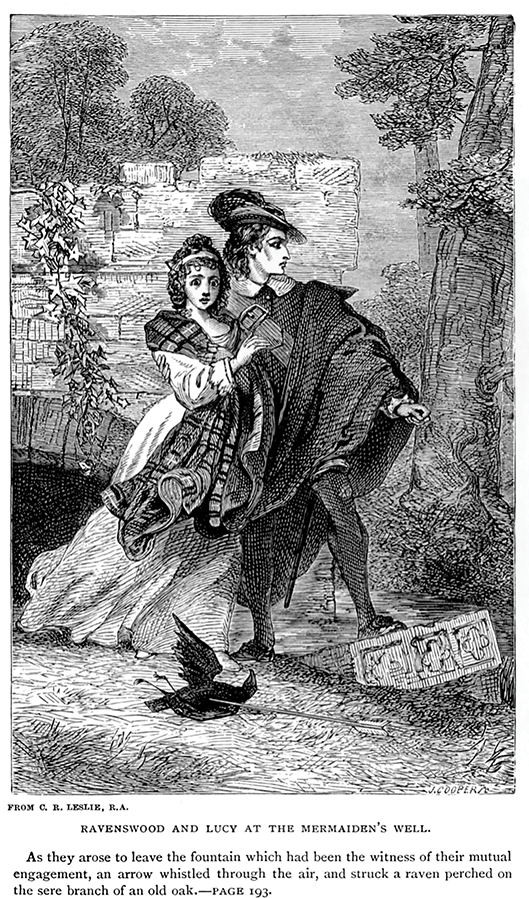
Scott expanded the story of Janet Dalrymple and filled it with much of the gothic machinery that appeared in British novels since the late-eighteenth century, including a persecuted heroine, a brooding lover, an ancient castle, prophesies of death and foreboding, three witches, a ghost and a fountain that bears a legend of a murdered watery nymph (see Figure 1.1).19 Many of these same plot elements appear in Cammarano’s libretto, where they all coalesce around a so-called Siren Fountain, which makes its first appearance in Act I, scene 4; the stage setting is as follows:
A park. At the back of the stage, a side of a castle with a passable small door. At the front of the stage is the so-called ‘Siren Fountain’, which was once covered by a beautiful structure, decorated with architectural ornaments of a Gothic character, but it is now surrounded by the remnants of that construction. The top has fallen in, the sides are all ruined and the spring that gushes out from under the ground has opened a gap between the stones and the rubble, creating a small stream. It is dusk. The moon rises.20
Charles Robert Leslie, ‘Ravenswood and Lucy at the Mermaiden’s Well’, illus., in Walter Scott, The Bride of Lammermoor.
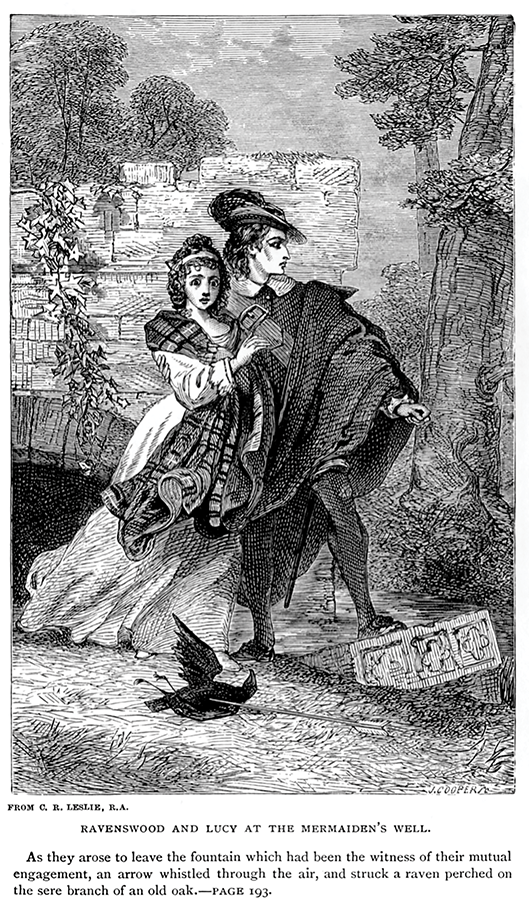
Figure 1.1 Long description
The engraving shows the young man in dark clothes and a fashionable hat standing close to the young woman in a loose white dress and a plaid shawl, with trees and stonework in the background and a dead raven at their feet. At the bottom of the illustration, there is a text that reads, Ravenswood and Lucy at the Mermaiden’s Well. As they arose to leave the fountain which had been the witness of their mutual engagement, an arrow whistled through the air and struck a raven perched on the sere branch of an old oak. Page 193.
The fountain has an auspicious history within the novel (chapter 5) for it is the location where a member of the Ravenswood clan (Raymond Ravenswood) fell in love with a young watery nymph, a naiad, who would appear every Friday to greet him. After spending the day together, the woman would depart at the sound of a bell from a nearby hermitage that would toll at the start of vespers. In his attempt to retain the mysterious woman and to determine her true intentions, Raymond conspired to have the bell toll a half hour later. When the next Friday came, she appeared and greeted Raymond as before. Later, as she began to perceive shadows growing on the ground and the sun nearly set, the naiad shrieked and ripped herself from Raymond’s arms and dove down into the fountain. As Raymond looked to find her, a pool of blood appeared in the water, evidence to Raymond that she had died a gruesome death.
In an effort to memorialize her, Raymond adorned the fountain with symbols of sirens and built a protection around the fountain to secure it from harm. Filled with grief and remorse, Raymond later sought death in battle. From this point on in the telling of the tale, Scott writes, ‘the house of Ravenswood was supposed to have dated its decay’.21 However, as Scott further explains, which is a true sign of the gothic, where the perception of truth and fiction are deliberately confused in the telling and retelling of the tale, the supernatural origins of the fountain were eventually explained away by some who believed Raymond fell into a jealous rage and killed his lover who he suspected of betrayal. And yet, according to Scott:
All agreed that the spot was fatal to the Ravenswood family; and that to drink of the waters of the well, or even approach its brink, was as ominous to a descendant of that house as for a Grahame to wear green, a Bruce to kill a spider, or a St. Clair to cross the Ord on a Monday.22
In the novel, when Edgar rescues Lucy from the wild bull near his ancient home, he brings her to the fountain so she may gather her wits and catch her breath. And it is here, of course, that he and Lucy fall in love and later declare themselves husband and wife. The fountain, therefore, similar to its appearance in the opera, has a clear ominous connection to the past, bringing forth an ancient legend in order to make it relevant to the present-day lives of the characters in our story, a sure sign of the gothic.
Returning to the opera and picking up from where Scott’s legend ends, the scene at the fountain has Lucia and Alisa looking for Edgardo. While scanning the area, Lucia sees the fountain and tells Alisa that at this very spot she saw the ghost of a dead woman, murdered by a jealous lover, a member of the Ravenswood clan:
Lucia is the only one who has seen the ghost and thus is the first and only individual to speak of its existence. Alisa, the only other character in the opera who knows of Lucia’s vision, believes that Lucia’s ghost is a sign, a supernatural omen or a warning that her relationship with Edgardo is doomed. Nonetheless, Lucia’s vision of a woman murdered by the hand of a jealous lover (and a Ravenswood lover at that) makes Lucia even more desperate to place her hope in Edgardo, who, she believes, will save her from a similar fate.
In contrast to the opera, the ghost in the novel is that of ‘Old Alice’, a blind former servant of the Ravenswood clan who has the ability to see the future.24 Earlier in the book, Alice warns both Lucy (Lucia) and Edgar (Edgardo) that their relationship will fail (chapter 19). When Alice later dies (presumably from old age), her ghost appears to Edgar at the same fountain where he and Lucy were engaged (chapter 23). And, similar to the ghost story in Lucia, when the ghost appears, she motions with a raised hand, a possible warning, but does not speak before disappearing. Not knowing if what he saw was real, Edgar rushes off to see if Alice is still alive. When he arrives at her cottage, he sees Alice’s dead body attended by three witches. This is the last we read of the ghost in the novel. The same can be said for the opera, for the ghost never truly ‘appears’ on stage, only within the mind of Lucia (in both Acts I and III). Whether the ghost is real or not is never questioned by Lucia or Alisa but understood and accepted as a possible reality within their gothic environment. And yet, although the ghost does not have any lines in the original libretto, nor is it discussed in reviews of the opera from the first half of the nineteenth century, in modern productions of Lucia it is customary to have the ghost mimed on stage to remind the audience of what Lucia is seeing. For example, the opera director Mary Zimmerman’s 2007 popular production of Lucia at The Metropolitan Opera has the ghost appear twice on stage as a blue-lit, pale-faced visitor who motions to Lucia.25
Cammarano’s libretto also retains Scott’s original curse of divine retribution when a solemn vow is broken. In chapter 20 of Scott’s novel, Edgar and Lucy exchange two halves of a broken coin, a symbol of their union. In Act I of the opera, Cammarano has the couple exchange rings, which he explains in the published libretto with the following note:
During the period in which this story is set, it was a general belief in Scotland that whoever broke a ceremoniously sworn vow was liable to divine punishment, which would be carried out almost at the same time as the breaking of the vow. For this reason, lovers’ oaths were not things to be taken lightly at the time; they had at least the significance of a wedding. The most common of these ceremonies was that the lovers broke a coin in two and each kept one half. That has, however, been substituted here for an exchange of rings as it is more suitable for the scene.26
The fact that Cammarano felt the need to include this note is indicative of his desire to stay true to Scott’s original text but also, and more importantly, to have the audience register the significance of the curse to the plot.
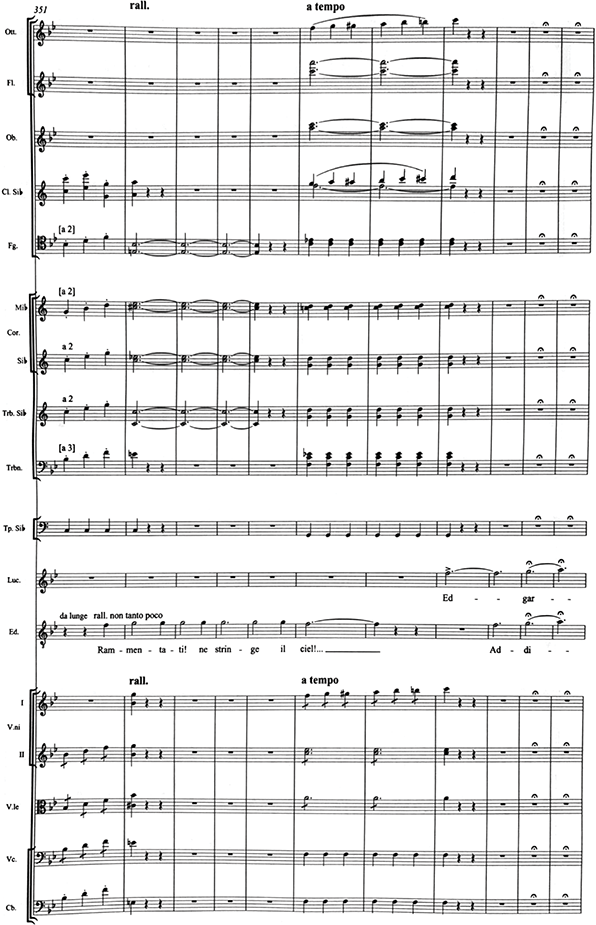
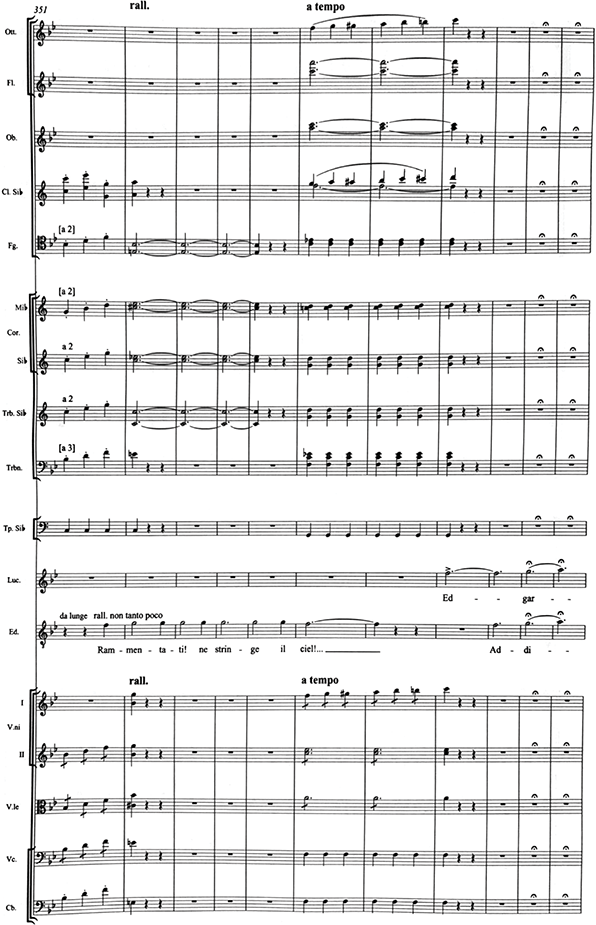
Twice in the libretto we are reminded of the curse. The first time is at the end of Act I, when the lovers say their goodbyes, which prompts Edgardo to remind Lucia that ‘we are now bound by Heaven’ (see Example 1.1). We see in the orchestral score that the majority of the orchestra is silenced as the brass and woodwinds (trumpets, horns and bassoons) alone accompany Edgardo’s fateful reminder, which when combined with a syllabic vocal line set to a high G4, gives the curse a strong foreboding sonic presence. The implication is that if they break their vows, they will invite God’s wrath.
Gaetano Donizetti, Lucia di Lammermoor [Orchestral Score], Act I, scene 5, No. 3: Scena e Duetto Finale, bb. 351–61.
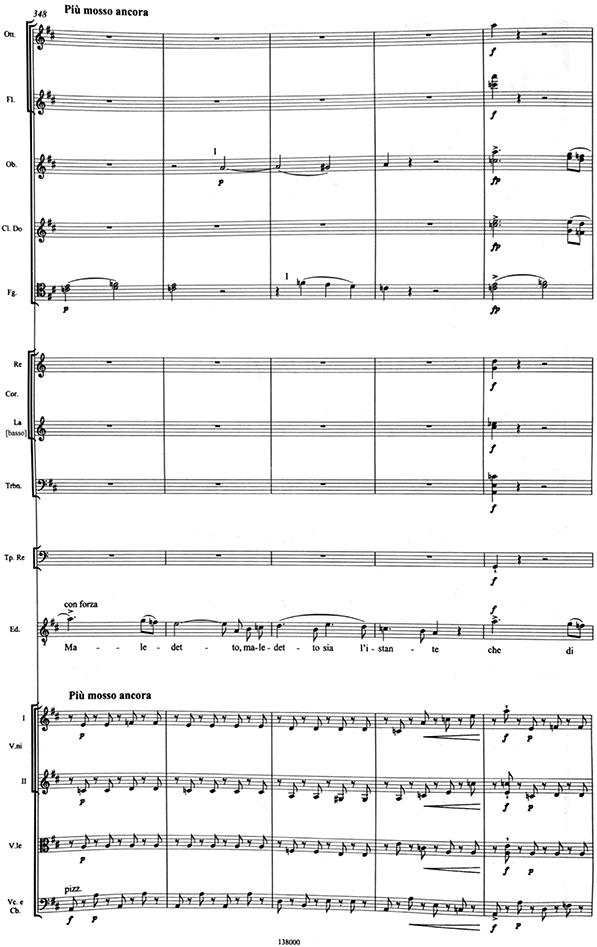
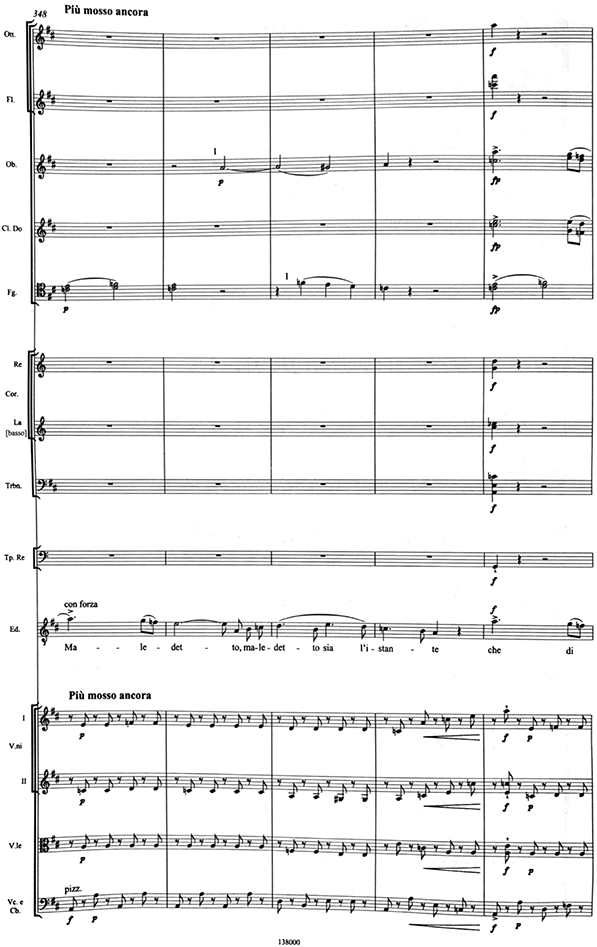
The second time the curse appears is in Act II, when Lucia tells Raimondo that she cannot marry Lord Bucklaw because of her vow to Edgardo. Raimondo rebuffs this claim by reminding Lucia that ‘neither Heaven nor the world recognizes wedding vows that God’s minister does not bless’.27 In the next scene, when Lucia does sign the nuptial agreement to marry Lord Bucklaw, she proclaims, ‘I have signed my death warrant’, an acknowledgement perhaps of the curse itself. This fear is quickly realized by the arrival of Edgardo, who, after verifying Lucia’s signature on the marriage contract, pronounces the curse: ‘Heaven and love you have now betrayed … may the angry hand of God destroy you.’28 Musically, Edgardo’s words are set in the high register of the voice; the climax of the phrase (A4) is on the words ‘cursed’ [maledetto] (see Example 1.2). Accompanied once again by brass and woodwinds, the curse takes on a truly gothic presence here. In fact, in Donizetti’s letter to Ricordi, he was surprised by the audience’s immediate reaction to it (sung by Gilbert Duprez) in the midst of an ensemble number, which is further evidence of the dramatic importance of the curse to the libretto and its appreciation in the score.29
Gaetano Donizetti, Lucia di Lammermoor [Orchestral Score], Act II, scene 6, No. 6: Finale Alto Secondo, bb. 348–52.
Filled with religious superstition, ancient tales of watery nymphs, forbidden love and murder, Scott’s novel is one that Cammarano exploits to provide a gothic setting to the libretto. His use of the legend of the fountain, the marriage vow, the promise of God’s wrath if it be broken and the lone appearance of the ghost of a woman, who (legend has it) a Ravenswood killed, all create a dark mystery within the opera and one that presents a competing narrative to the family rivalry between the Ashtons and the Ravenswoods. This mystery is never truly answered in the opera but is left open for interpretation by both the characters in the opera and the audience. We never truly know if the ghost is real, nor if Lucia dies due to the curse or whether the fountain is filled with such potent energy that any vow made near it is in direct response to the wrongs of the past. And so the libretto to Lucia remains a true reflection of the gothic genre, a mixture of both the real and unreal, the past and present, the internal and external, which, although centered on the fountain, are all conveniently located within and around Lucia, making her perception of reality the main psychological focus for the work.
The Persistence of Death
It was not uncommon in Italian bel canto to be reminded of the persistence of death in everyday life. Death finds its way in many Italian works of the time, including (to name a few) Bellini’s I Capuleti e I Montecchi (1830), Norma (1830) and Donizetti’s own Anna Bolena (1830), Lucrezia Borgia (1833), Rosmonda d’Inghilterra (1834) and the forementioned Maria Stuarda (1835). In Music in the Present Tense: Rossini’s Italian Operas in their Time (2019), Emanuele Senici argues that the Napoleonic wars ‘constituted for a number of Italians a profoundly traumatic experience … a spiritual and moral death’, whereby the theatricality of opera and its glorification of a ‘good death’ was a necessary cathartic resource to comprehend the present.30 By the 1830s, death appeared to be a constant reality for many Italians, either through the suppression of Italian revolutionary sentiment (e.g., the carbonari) by the Austrian army, which resulted in several deadly skirmishes across the peninsula, or the raging cholera epidemic that swept across Europe, the latter of which by 1837 claimed 19,470 lives in Naples alone (18 per cent of the total population).31 And so, it is not surprising that when Donizetti’s opera begins, we are told in the opening scene that Lucia is in mourning, grieving her mother’s death, whose grave she often visits.32
In Act I, scene 2, Raimondo chides Enrico for trying to marry Lucia off before she is ready: ‘Can a mourning virgin, who weeps over a dear mother’s recent passing bend her thoughts to the marriage bed? Ah! Let us respect a grieving heart … when oppressed with such sorrow one cannot feel love.’33 But then, in Act II, after telling Lucia that he has received no word from Edgardo, Raimondo advises Lucia to marry the man whom her brother has arranged for her, and he does so by using the memory of her dead mother: ‘Surrender, or more misfortunes will come to you … be moved by my tender care, the death of a parent and the impending peril of your brother … or your mother will turn over in her grave.’34 To such words, Lucia responds: ‘You win … life will be a long and cruel torment for me’.35
The link between Lucia and death continues in the next scene at the wedding ceremony. At the start of scene 4, Arturo is concerned about Lucia’s well-being. Enrico assures him that she is fine but advises him not to ‘be surprised by her appearance; she still mourns her mother’s death’.36 After Lucia enters the hall and signs the marriage contract, she complains of feeling ill. When Edgardo suddenly appears, Lucia faints and falls into the arms of Raimondo and Alisa. As she slowly recovers, falling in and out of consciousness, Lucia remarks ‘with fear I had hoped that my life had ended but death is no help for me; I still live on in torment … No peace is found in Heaven nor on Earth; both have betrayed me! I would like to cry but I cannot; Ah! even tears are denied me’.37 No more talk of mourning is heard at this point in the opera, for everyone now sees that the true reality of Lucia’s grief is not her mother’s death but her own, hastened by the loss of Edgardo, which prompts everyone on stage to proclaim: ‘she is like a withered rose, standing between life and death’.38
In the penultimate scene of the opera, Lucia appears as a ghost, a ‘mostly-dead’ woman walking among the living.39 The libretto states:
Lucia is in a simple white dress: her disheveled hair and the look of death on her face give her more the appearance of a ghost than of a living creature. Her fixed gaze, her convulsive movements and her malevolent smile disclose not only a frightening insanity but also the signs of a life that is drawing to a close.40
Her deathly appearance (as seen in similar performances of Ophelia in Shakespeare’s Hamlet at the time; see Chapter 6) is evident to the wedding party, who collectively respond: ‘she looks as if she has risen from the grave’!41 Lucia then sings of her love for Edgardo, but all along, she remains fearful that the ghost from the fountain, a symbol of a lover’s betrayal, will separate them. Lucia’s final words are, ‘I am near the tomb … Already, I feel death’s cold breath, but my heart languishes … one heartbeat remains; it is a heartbeat of love! Shed bitter tears on my grave [Edgardo], while up in Heaven, I will pray for you … Only with your arrival will Heaven be a place of beauty for me.’42
Death is also a constant companion to Edgardo, the other main victim of this tragic tale. Edgardo first appears in Act I, scene 5, soon after Lucia mentions the ghost to Alisa. He tells Lucia he has to leave Scotland, but before he leaves, he wants to make peace with Enrico and forgive him for killing his father. When Lucia hears Edgardo’s anger towards Enrico grow, she tries to calm him, but Edgardo insists on telling her why he is so upset:
Donizetti sets Edgardo’s lines in a slow, dance-like rhythm within a mixed minor–major mode, which serves as a foil to Lucia’s cavatina (‘Regnava nel silenzio’ [‘At dead of night’]) presented in the previous scene (Lucia’s cavatina is discussed in Chapter 4). By setting Edgardo’s most intimate thoughts in this way, we come to hear the dueling forces on Edgardo’s conscience: his love for Lucia and his father’s death. Following his opening aria, Edgardo and Lucia agree to exchange wedding rings, promising the other that ‘only the icy hand of death shall end our love’.44 This promise, of course, unites the two lovers both in life and in death and reflects the connection that the opera shares with Shakespeare’s Romeo and Juliet, namely that their love can only exist in death as familial forces and acts of revenge conspire to keep them apart.
The full circle of Edgardo’s death vow comes at the end of the opera as he stands among the tombstones of his dead relatives to take his own life:
It is strange that an opera about a female bride ends with the male lover’s death in a kind of reversal of Shakespeare’s play, where instead of Juliet killing herself after seeing Romeo’s dead body, Edgardo, after hearing of Lucia’s death, kills himself with the hope of seeing her again. A possible reason, however, for not having Lucia’s death end the opera might simply be in keeping with Scott’s original text. In the final chapter of The Bride of Lammermoor, after the death and funeral of Lucy, Edgar rides off on horseback to fight Colonel Douglas Ashton (Lucy’s older brother).46 While crossing the beach, an area known as Kelpie’s Flow, Edgar is swallowed up in quicksand and dies, which fulfils the prophecy and warning spoken earlier in the book by Edgar’s servant.47 Anyone familiar with Scott’s novel would certainly expect the opera to have an ending where Edgardo dies while fulfilling his vow to fight for Lucia. All of which seems to suggest Donizetti and Cammarano, in their effort to be faithful to the source text, cast aside the conventions of Italian opera and ended Lucia with Edgardo’s death and not the death of the prima donna, which was common practice at the time (see Chapter 2 for a discussion of the conventions of Italian bel canto).
As we examine the life of Lucia and Edgardo, two lovers at war with themselves and the world, we see that they both greet death with hope. According to Vijay Mishra, the ‘gothic sublime’ is a type of enlightenment or emotional release from internal forces that enslave one, which are often materialized outside the individual in the form of a ghost or death itself. Only by conquering the ‘thing’ that has haunted them will one be free of what has held them back, their conscience clear of regret, guilt and fear.48 If we apply this theory to the opera, we see that Lucia’s grief over the death of her mother and Edgardo’s grief over the death of his father persist throughout the opera, pulling the lovers apart from their destiny to be together. By conquering death, they are able to transcend the burdens of their past and free themselves to love. However, the price is severe. Lucia kills the man she is forced to marry and dies from the strain, while Edgardo takes his own life. Similar to other lovers in operas before them (e.g., Romeo/Juliet and Norma/Pollione), death is the doorway to a new and happier life, one they both embrace.
Female Madness and Murder
In Scott’s novel, it is Lady Ashton, Lucy’s mother, who has a tight grip on her daughter’s emotions and actions, an abusive relationship that does not allow Lucy to have any independence of action or thought, hence all the misunderstandings, violence and death that occur at the end of the novel. It would seem that the only way out for Lucy is madness, allowing her to break with the reality around her and to escape into her own mind, where she is finally able to take control of her life, albeit a life that swiftly leads to her death. The novel’s signature plot element of female madness has a long history within literature, especially gothic literature. It also features strongly in opera, and it is precisely what Cammarano uses to define Lucia’s retreat from a world where, in her words, as spoken at the nuptial agreement in Act II: ‘I am betrayed by both Heaven and Earth’.49
When she first appears on stage, Lucia tells us she had a vision. Although such a vision reflects elements of the gothic (as mentioned earlier), from a medical point of view, Lucia hallucinated. Coupled with the fact that her vision of the ghost does not materialize for the audience nor for any of the principal characters on stage, evidence is clear that Lucia is having severe delusions. Indeed, throughout the opera, Alisa, Enrico, Raimondo, Arturo and Edgardo all voice their concerns over Lucia’s mental state and so when she appears at the end of the opera – pale, disheveled, splattered with her victim’s blood, convulsing, uttering scattered thoughts – it is no surprise; they all saw it coming.
In the nineteenth century, madness in women was seen more often than not as a symptom of hysteria, understood at the time to be a particular female ailment with a long history of documentation in society.50 Hysteria was a disease that had both physical and emotional symptoms. If untreated, the individual suffering from the disease would experience muscle contractions, shortness of breath, fever, hallucinations and vocal fits of anger; in short, madness.
One of the more important studies on hysteria in the first half of the nineteenth century was written by the French physician and medical historian Frédéric Dubois d’Amiens (1799–1873), who published Histoire philosophique de l’hypochondrie et de l’hystérie [A Philosophical History of Hypochondria and Hysteria] in 1833.51 In this 551-page, award-winning medical treatise, Dubois d’Amiens states that hysteria results from an anemic condition within menstruating women, whereby sudden emotional swings, such as joy, grief, fright or surprise further induce the symptoms of the disease.52 With this description in mind, one notes that throughout the opera, Lucia is continually referred to as being quite pale and physically frail, which were possible signs to many in the nineteenth century that Lucia, a young woman, ready to bear a child, was menstruating and thus more susceptible to hysteria. For example, in Act II, scene 2, Lucia enters her brother’s chambers, lingers by the door and is described in the libretto with a quasi-medical description: ‘the paleness of her face, a bewildered expression, everything about her highlights an internal suffering and the first symptoms of mental derangement’.53 During the ensuing dialogue, she suffers a succession of shocks and is seized by tremors after reading the supposed letter from Edgardo. The libretto describes her appearance: ‘surprise and the most excited breathlessness are expressed on her face, followed by a tremor that shakes her from head to toe’.54 But it is during the finale of Act II, just after having signed the nuptial agreement, that she complains of faintness, which indeed occurs right as Edgardo appears. After the finale, Lucia loses the strength once again to stand and faints as the curtain falls to end the act. The fact that the libretto continues to define her physical condition, symptoms once again to be diagnosed by the audience and those on stage, highlights the failing health of Lucia.
Decisively, in the last act, in the ‘mad scene’, Lucia, after murdering her husband, lurches from one hallucination to another: first, she believes she sees Edgardo; then the ghost, who separates her from Edgardo; and then, she senses the presence of enemies who want to destroy her happiness with Edgardo. Next, believing herself safe with Edgardo, Lucia begins to tremble with joy as she hallucinates that she is with him in paradise. This idyll is then shattered by her brother’s sudden arrival on stage, triggering a new set of hallucinations in which Lucia relives the moment when Edgardo stomps on the ring and curses her.
The hallucinations that Lucia experiences are what d’Amiens refers to as hallucinations singulières [a focused or particular hallucination], an affliction often diagnosed in hysterics.55 ‘The sweet sound’ [‘il dolce suono’] of Edgardo’s voice heard in Lucia’s head and sung throughout the ‘mad scene’ becomes an obsession, a singular focus that helps to rationalize the condition she is facing. When Lucia’s ‘mad scene’ ends, she is taken off to her bedroom, where she quickly succumbs to the final stages of the disease by falling into a state of muteness, where only moans and inarticulate mumblings of Edgardo’s name can be heard. According to d’Amiens, mâchoire de verrouillage [lock jaw] would have set in and her muscles contracted, leading one to believe that her heart will soon stop.56
In this state, Lucia remains at the end of the opera past any hope of medical treatment and dies. In fact, the common cure for female hysterics in the nineteenth century was marriage or rather the so-called ‘marriage bed’, whereby coitus was generally understood by the medical community as a way to alleviate the symptoms of the disease.57 Marriage, of course, is the lynchpin to the dramatic action within Lucia. It is in marriage that Lucia is defined by her brother and by Raimondo, who both argue in Act II that Lucia must give up her own desires so that others can live. When Lucia kills Arturo, however, she ceases to have value for the men around her. She thus becomes an uncured female hysteric, destined to remain unwed (now widowed), a murderer, a ghost among the living.
In defining her appearance and actions as a madwoman in both the novel and the opera, Scott and Cammarano created a woman who was not simply a diversion from everyday life nor a mere tragic figure, but someone who could be found on the stages of many Italian theatres at the time (e.g., Bellini’s Il Pirata, La Sonnambula and I Puritani) or within a nearby asylum, such as the Maddalena Lunatic Asylum in Aversa, just north of Naples.58 Cammarano knew this to be true as evidenced in a stage manual he wrote for an outside theatre: ‘Let the chorus be sure to show themselves full of pity and terror over Lucia’s ordeal, and Alisa to keep herself always near at hand, following her with her eyes, as we usually do with unfortunate people who have gone out of their minds.’59 Mad women were thus pure voyeuristic entertainment or, at best, observed education for those who desired a deeper understanding of what defines health and well-being within society.
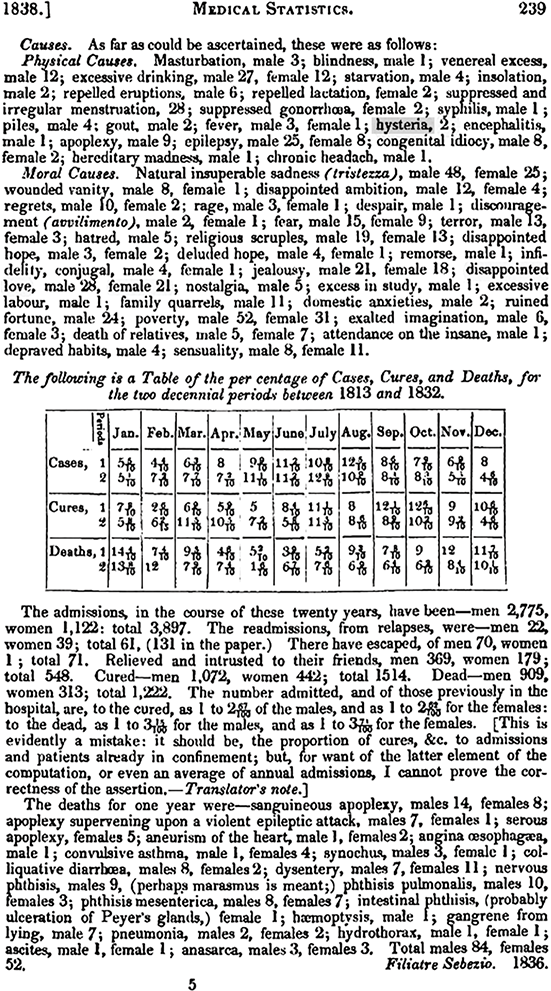
Those who visited asylums in the nineteenth century (often on Sundays) included family and friends of the patient, clergy, tourists, actors, philanthropists, subscription holders and government inspectors, who would report on the gender, age and general cause of the patient’s malady.60 A particular example is an 1838 report published from the Maddalena Asylum (see Figure 1.2), written at a time and location consistent with the premiere of Lucia at the Teatro di San Carlo. One notes from the Maddalena report that there were two hysteria patients in residence (highlighted). Also, the report labels hysteria as a ‘physical cause’ of madness rather than a ‘moral cause’, such as ‘disappointed love’ or ‘jealousy’. What this report thus shows is that madness was a symptom of a very real disease and one that was common not only to operas and gothic novels but also to public asylums.
Felippo Volpicella, ‘Statistics of the Lunatic Asylum at Aversa (Naples)’, British and Foreign Medical Review, or, A Quarterly Journal of Practical Medicine 6 (1838): 239.
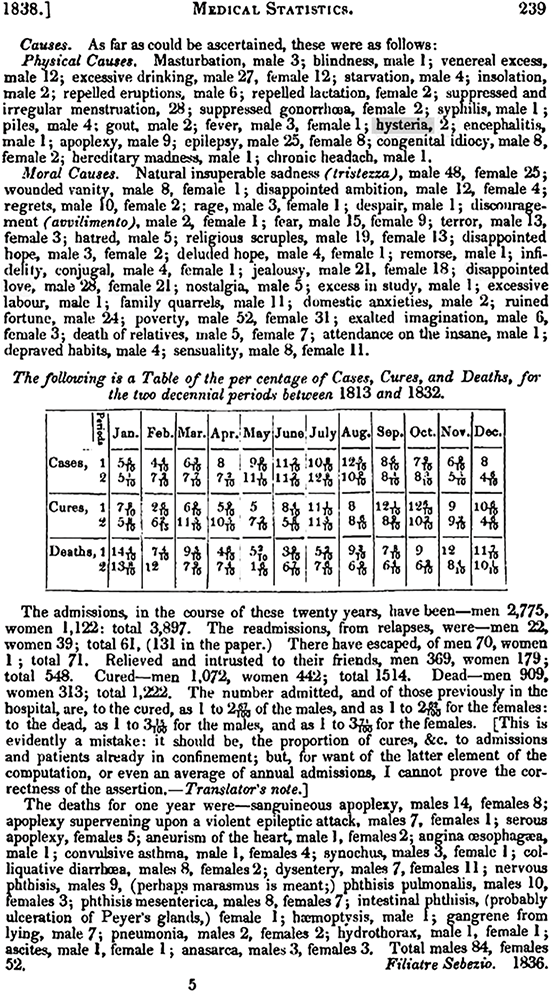
Figure 1.2 Long description
1838. Title: Medical Statistics. 239. It reads as follows: Causes. As far as could be ascertained, these were as follows: Physical Causes. Masturbation, male 3; blindness, male 1; venereal excess, male 12, excessive drinking, male 27, female 12, starvation, male 4, insolation, male 2; repelled eruptions, male 6; repelled lactation, female 2, suppressed and irregular menstruation, 28; suppressed gonorrhoea, female 2; syphilis, male 1; piles, male 4: gout, male 2; fever, male 3, female 1; hysteria, 2; encephalitis, male 1; apoplexy, male 9; epilepsy, male 25, female 8; congenital idiocy, male 8, female 2; hereditary madness, male 1; chronic headach, male 1. Moral Causes. Natural insuperable sadness (tristezza), male 48, female 25; wounded vanity, male 8, female 1; disappointed ambition, male 12, female 4; regrets, male 10, female 2: rage, male 3, female 1, despair, male 1; discourage ment (avvilimento), male 2, female 1, fear, male 15, female 9, terror, male 13, female 3; hatred, male 5; religious scruples, male 19, female 13; disappointed hope, male 3, female 2; deluded hope, male 4, female 1; remorse, male 1; infidelity, conjugal, male 4, female 1; jealousy, male 21, male 18, disappointed love, male 28, female 21, nostalgia, male 5; excess in study, male 1, excessive labour, male 1, family quarrels, male 11, domestic anxieties, male 2, ruined fortune, male 24; poverty, male 52, female 31; exalted imagination, male 6, female 3; death of relatives, male 5, female 7; attendance on the insane, male 1; depraved habits, male 4; sensuality, male 8, female 11.
The following is a Table of the per centage of Cases, Cures, and Deaths, for the two decennial periods between 1813 and 1832. It consists of twelve columns: January, February, March, April, May, June, July, August, September, October, November, December. It reads as follows: Row 1. Cases, Periods 1: 5 6 over 10, 4 4 over 10, 6 3 over 10, 8, 9 9 over 10, 11 2 over 10, 10 8 over 10, 12 5 over 10, 8 6 over 10, 7 9 over 10, 6 9 over 10, 8. Row 2. Cases, Periods 2: 5 1 over 10, 7 2 over 10, 7 7 over 10, 7 2 over 10, 11 1 over 10, 12 8 over 10, 10 8 over 10, 8 1 over 10, 8 3 over 10, 5 1 over 10, 4 6 over 10. Row 3. Cures, Periods 1. 7 8 over 10, 2 5 over 10, 6 9 over 10, 5 9 over 10, 5, 8 4 over 10, 11 1 over 10, 8, 12 1 over 10, 12 5 over 10, 9, 10 6 over 10. Row 4. Cures, Periods 2. 5 8 over 10, 6 2 over 13, 11 3 over 10, 10 3 over 10, 7 2 over 10, 5 8 over 10, 11 3 over 10, 8 6 over 10, 8 9 over 10, 10 2 over 10, 9 2 over 10, 4 6 over 10. Row 5. Deaths, Periods 1. 11 1 over 10, 7 4 over 10, 9 3 over 10, 4 6 over 10, 5 2 over 10, 3 9 over 10, 5 2 over 10, 9 3 over 10, 7 8 over 10, 9, 12, 11 7 over 10. Row 6. Deaths, Periods 2. 13 8 over 10, 12, 7 9 over 10, 7 4 over 10, 1 6 over 10, 6 7 over 10, 7 6 over 10, 6 9 over 10, 6 1 over 10, 6 2 over 1, 8 4 over 10, 10 1 over 10. The text below the table reads as follows: The admissions, in the course of these twenty years, have been-men 2,775, women 1,122: total 3,897. The readmissions, from relapses, were-men 22, women 39; total 61, (131 in the paper.) There have escaped, of men 70, women 1, total 71. Relieved and intrusted to their friends, men 369, women 179; total 548. Cured-men 1,072, women 442; total 1514. Dead-men 909, women 313; total 1,222. The number admitted, and of those previously in the hospital, are, to the cured, as 1 to 2 67 over 100 of the males, and as 1 to 2 62 over 100 for the females: to the dead, as I to 3 15 over 100 for the males, and as 1 to 3 71 over 100 for the females. [This is evidently a mistake: it should be, the proportion of cures, &c, to admissions and patients already in confinement, but, for want of the latter element of the computation, or even an average of annual admissions, I cannot prove the correctness of the assertion. Translator’s note.]
The deaths for one year were-sanguineous apoplexy, males 14, females 8; apoplexy supervening upon a violent epileptic attack, males 7, females 1, serous apoplexy, females 5, aneurism of the heart, male 1, females 2; angina oesophagaea, male 1, convulsive asthma, male 1, females 4, synochus, males 3, female 1; colliquative diarrhoea, males 8, females 2, dysentery, males 7, females 11, nervous phthisis, males 9, (perhaps marasmus is meant;) phthisis pulmonalis, males 10, females 3, phthisis mesenterica, males 8, females 7, intestinal phthisis, (probably ulceration of Peyer’s glands,) female 1; haemoptysis, male 1, gangrene from lying, male 7; pneumonia, males 2, females 2, hydrothorax, male 1, female 1 ascites; male 1, female 1; anasarca, males 3, females 3. Total males 84, females 52. Filiatre Sabezio. 1836.
In the end, such accounts of the lives of the mentally ill allowed the reader or viewer to sympathize with those individuals whose humanity was on full display for all to see and hear. In fact, in 1838, a few years after the premiere of Lucia, several European courts rewrote the laws that defined the treatment and care of the mentally ill. These so-called ‘Lunacy Acts’ were passed in England, Ireland and France and were soon imitated by regional legislators in Italy.61 The new laws were designed for the protection of people with mental illness from abuse and mistreatment. They mandated that every asylum provide a framework for the assistance, care and protection of people with mental illness and eliminate the possibility of detention.62
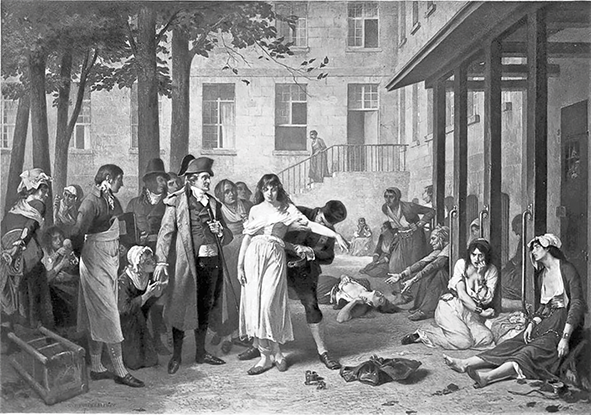
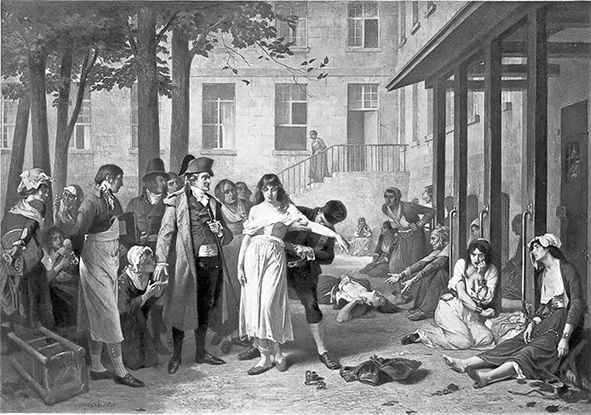
‘Lunacy Acts’ were a part of a larger asylum reform movement that began during the late 1780s and continued well into the nineteenth century. The French physician Philippe Pinel (1745–1826) is credited as the first to develop such humane treatment, which began soon after the French Revolution by freeing the mentally ill from chained imprisonment, famously depicted in Tony Robert-Fleury’s oil painting of 1876 (see Figure 1.3). The painting portrays several stock figures in asylums at the time: a woman (on the ground) tearing at her clothing, two huddled melancholics, a tense maniac, and a woman (at the right) with a vacant stare chained to the wall.63 In the center is a limp and passive woman being freed from her chains as Dr. Pinel looks on with approval.
Tony Robert-Fleury, ‘Pinel, médecine en chef de la Salpêtrière, délivrant les aliénés de leurs chaînes’, 1876, Photoengraving on paper based on original oil on canvas, Goupil & Co.
The success of Pinel’s treatment with the mentally ill was well documented and increasingly became the standard for treating patients within insane asylums.64 Pinel’s work was cited throughout d’Amiens’s study on hysteria. In particular, in the section ‘Thérapeutique’, d’Amiens references Pinel’s method of treatment, which argues for the patient to be first brought into dialogue with the physician and then, with the power of suggestion, the hysteric would come to recognize their own malady and begin the process of healing.65
Comparing the treatment that Lucia receives in Act III in the opera to that prescribed by Pinel, one notes that the wedding party does not tackle her, restrain her or even arrest her for the murder of her husband. The individuals on stage simply observe her, albeit in horror, allowing Lucia to wander the stage despite her obvious mental derangement. Even when her brother Enrico rushes in to grab her after she appears in front of the entire wedding party in a night dress stained with Arturo’s blood, Raimondo pulls him back and argues, ‘Stop! Don’t you see her [mental] state?’.66
This is in contrast to the Scott original, which has Lucy overpowered by those around her with physical force:
Female assistance was now hastily summoned; the unhappy bride was overpowered, not without the use of some force. As they carried her over the threshold, she looked down, and uttered the only articulate words that she had yet spoken, saying, with a sort of grinning exultation, ‘So, you have ta’en up your bonny bridegroom?’ She was, by the shuddering assistants, conveyed to another and more retired apartment, where she was secured as her situation required, and closely watched.67
Published in 1819 and set in the late seventeenth century, the Scott original text has Lucy endure the same brutal handling that was prevalent among the mentally ill in Europe before the nineteenth century, that is to say, treating them as criminals.68 Although Lucy did attack her husband with a knife, she does not kill him, only injure him. Nonetheless, the difference in treatment between Lucy and Lucia is stark, a further indication that the 1835 operatic version of the story conformed to the moral treatment generally understood by the medical community at the time, which was further supported by Cammarano’s instructions to a stage manager mentioned earlier.
On the issue of murder in the opera, it is important to note that of all the leading female characters in Italian opera who succumb to madness, including Imogene in Vincenzo Bellini’s Il Pirata of 1827, Anna Bolena in Donizetti’s own Anna Bolena of 1830, Amina in Bellini’s La Sonnambula of 1831 and Elvira in Bellini’s I Puritani of 1835, Lucia is the only one who kills.69 The fact that Lucy/Lucia commits violence against her husband was and remains the most shocking aspect of the story/opera. The original legend on which Scott based his novel was known primarily due to this violent act, which was presumed to have been aided by supernatural forces or witchcraft.70 Depending on class and station, in France in particular and Europe in general, a woman in the early nineteenth century who murdered her husband was considered a traitor to the state.71 As the husband was viewed as the king of the household and the household was viewed as a reflection of the state, such murderous acts were a threat to social order and in need of immediate suppression. In the operatic world, for example, when a woman kills, her own death soon occurs, such as with Lady Macbeth in Verdi’s Macbeth (1847), Marguerite in Gounod’s Faust (1859) and Puccini’s Tosca (1900).72 When a woman is ‘mad’, however, society appears to be kind to the killer (e.g., Massenet’s Navarraise, 1894), a kind of ‘insanity defense’ soon develops among her would-be accusers, as witnessed in the ‘mad scene’ in Lucia, when Raimondo and the chorus stop Enrico from punishing Lucia owing to her obvious display of madness. Because of this madness, Lucia’s murderous act is dismissed, leaving others to be blamed for her actions. The pious-minded Raimondo quickly blames Enrico (‘Tremble, cruel man, you are responsible for her life’) and Normanno (‘Wretch, you spilled blood! You are the cause!’), forcing everyone in the opera to look upon Lucia with pity.73 One notes in the final scene of the opera, the chorus of men who are leaving the castle do not speak of Arturo or his murder but voice concerns for Lucia, referring to her simply as ‘Oh, poor one’ [Oh meschina!].
By casting blame on others, Lucia remains a vulnerable creature in the opera and not a reflection of the glorious heroine we have often seen in opera productions since the mid twentieth century (e.g., Maria Callas, Berlin State Opera, 1955 or Nadine Sierra, The Metropolitan Opera, 2022). The reception of the ‘mad scene’, both in the nineteenth century and today, will be discussed in Chapter 7, but for now, suffice it to say, Lucia’s madness did not resonate well with audiences in the first half of the nineteenth century, who saw in the character of Lucia a mad woman to be sure but one that was dismissed in favor of her lover, whose act of suicide was far more laudable and desired.
This chapter set out to define how the Scottish setting, the gothic, the persistence of death and female madness play a part in crafting an early nineteenth-century libretto that bears witness to the creative mind of Cammarano and his socio-cultural environment. The gothic genre and female madness in particular are source texts that are often seized upon by opera directors today, who project contemporary notions of horror and mental illness onto the work that make these areas of the opera loom larger than others (e.g., opera directors Mary Zimmerman, The Metropolitan Opera, 2007 and Katie Mitchell, The Royal Opera House, 2016). It would be desirable, however, to see in future opera productions more of an emphasis on the Scottish setting, especially the religious and political strife that exists between the two families, a conflict that resonates all too well in our ever-increasingly polarized world. Such an emphasis would give greater power to the main forces that keep the two lovers apart and further underline the Romeo and Juliet tropes that are found throughout the work, including warring families, doomed love, a misplaced/false letter, a religious man who attempts to counsel both sides and the final murder-suicide.74