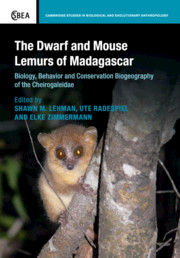
 The Dwarf and Mouse Lemurs of Madagascar
Biology, Behavior and Conservation Biogeography of the Cheirogaleidae
Book contents
- Frontmatter
- Contents
- List of contributors
- Foreword
- Part ICheirogaleidae: evolution, taxonomy, and genetics
- Part IIMethods for studying captive and wild cheirogaleids
- 6How to anesthetize mouse lemurs
- 7Microcebus murinus – a unique primate for modeling human brain disorders, including Alzheimer's disease and bovine spongiform encephalopathy
- 8Life history variation in mouse lemurs (Microcebus murinus, M. lehilahytsara): the effect of environmental and phylogenetic determinants
- 9The effects of the lunar cycle, temperature, and rainfall on the trapping success of wild brown mouse lemurs (Microcebus rufus) in Ranomafana National Park, southeastern Madagascar
- 10Tiny samples from tiny lemurs: methodological considerations for endoparasite analyses in mouse lemurs
- 11A review of ectoparasites in the Cheirogaleidae
- Part IIICheirogaleidae: behavior and ecology
- Part IVCheirogaleidae: sensory ecology, communication, and cognition
- Part VCheirogaleidae: conservation biogeography
- Index
- Plate section
- References
6 - How to anesthetize mouse lemurs
from Part II - Methods for studying captive and wild cheirogaleids
Published online by Cambridge University Press: 05 March 2016

Book contents
- Frontmatter
- Contents
- List of contributors
- Foreword
- Part ICheirogaleidae: evolution, taxonomy, and genetics
- Part IIMethods for studying captive and wild cheirogaleids
- 6How to anesthetize mouse lemurs
- 7Microcebus murinus – a unique primate for modeling human brain disorders, including Alzheimer's disease and bovine spongiform encephalopathy
- 8Life history variation in mouse lemurs (Microcebus murinus, M. lehilahytsara): the effect of environmental and phylogenetic determinants
- 9The effects of the lunar cycle, temperature, and rainfall on the trapping success of wild brown mouse lemurs (Microcebus rufus) in Ranomafana National Park, southeastern Madagascar
- 10Tiny samples from tiny lemurs: methodological considerations for endoparasite analyses in mouse lemurs
- 11A review of ectoparasites in the Cheirogaleidae
- Part IIICheirogaleidae: behavior and ecology
- Part IVCheirogaleidae: sensory ecology, communication, and cognition
- Part VCheirogaleidae: conservation biogeography
- Index
- Plate section
- References
Summary
Introduction
Mouse and dwarf lemurs are the smallest primate species. They may be used in a variety of scientific projects under field or laboratory conditions. Despite trap capture and the small size of mouse and dwarf lemurs, for successful performance of some procedures animals need to be anesthetized (Glander, 2013). In particular, the very small size of mouse lemurs with a body mass of 20–100 g and a body length of 5–13 cm (Louis et al., 2008) requires special considerations for anesthesia and might limit the use of standard veterinary anesthesia equipment and techniques in the field.
To choose the best anesthetic method for a project, different factors such as drugs and available equipment, type, invasiveness and duration of procedure, possible interaction of drugs with measured parameters, and the experience of the scientist should be considered. In the face of modern imaging methods and the use of mouse lemurs as a research model of human disease, more prolonged anesthetics and sensitive monitoring of vital parameters, ventilation, and oxygenation becomes necessary to maintain physiological conditions.
Therefore, the purpose of the current article was to discuss general considerations for anesthesia in an animal of the size of mouse lemurs relating to equipment, and the properties and effects of anesthetic drugs. In addition, a review of published drug doses and drug combinations used for various procedures in mouse lemurs is included.
Material and methods
Publications concerning anesthesia techniques in mouse and dwarf lemurs were found by searching “Pubmed” of the United States National Library of Medicine, “Veterinary Science” of CAB International and Web of Science. These databases were searched for the following words or terms: “mouse lemur,” “dwarf lemur,” “Microcebus,” “Cheirogaleus”, alone or in combination with the word “an*esthesia.”
The search covered the period from 1959 to January 2014. Articles were scrutinized for description of immobilization or anesthesia techniques. Relevant articles were selected manually. Abstracts of conference proceedings were included only when material and methods and results were clearly stated.
Results
Vital parameters
Regardless of which anesthetic technique is used, knowledge of basic physiological variables of the species of interest, such as heart rate, respiratory rate, and body temperature, is useful to successfully monitor the animals' response (respiratory and cardiovascular depression) to anesthesia. Based on the influence of drugs, handling or capture stress and activity state, these values can vary considerably.
Information
- Type
- Chapter
- Information
- The Dwarf and Mouse Lemurs of MadagascarBiology, Behavior and Conservation Biogeography of the Cheirogaleidae, pp. 135 - 160Publisher: Cambridge University PressPrint publication year: 2016
References
, , , et al. 1988. Clinical pharmacology of Dormicum (midazolam) and Anexate (flumazenil). Resuscitation 16:5–27.Google Scholar
, , . 2014. Apparatus for administration of anesthetics. In , , (eds.), Veterinary Anaesthesia, 11th edition (pp 209–243). Saunders Elsevier, Edinburgh.
, , , et al. 2006. The ventilatory stimulant doxapram inhibits TASK tandem pore (K2P) potassium channel function but does not affect minimum alveolar anesthetic concentration. Anesthesia and Analgesia 102:779–785.Google Scholar
, , . 2010. Resveratrol suppresses body mass gain in a seasonal non-human primate model of obesity. BioMedCentral Physiology 10:11.Google Scholar
. 1983. Hematology of the lesser mouse lemur (Microcebus murinus). A preliminary study. Folia Primatology (Basel) 41:129–136.Google Scholar
, , , et al. 1997. T2-weighted MRI studies of mouse lemurs: a primate model of brain aging. Neurobiology of Aging 18:517–521.Google Scholar
. 2010. Inhaled anesthetics: uptake and distribution. In , , , , (eds.), Miller's Anesthesia. Churchill Livingstone, Elsevier, Philadelphia.
, , , et al. 2010. Pungent general anesthetics activate transient receptor potential-A1 to produce hyperalgesia and neurogenic bronchoconstriction. Anesthesiology 112:1452–1463.Google Scholar
, , . 2010. Inhaled anesthetics: pulmonary pharmacology. In , , , , (eds.), Miller's Anesthesia (pp. 561–594). Churchill Livingstone, Elsevier, Philadelphia.
, . 2009. Non-invasive blood pressure measurement in mice. Methods in Molecular Biology 573:45–55.Google Scholar
. 2009. Laboratory Animal AnaesthesiaAcademic Press, San Diego.
, , (eds.) 2010. Miller's Anesthesia (pp. 539–559). Churchill Livingstone, Elsevier, Philadelphia.
. 2008. General anaesthesia: from molecular targets to neuronal pathways of sleep and arousal. Nature Reviews Neuroscience 9:370–386.Google Scholar
, . 2003. Daily hypothermy in captive grey mouse lemurs (Microcebus murinus): effects of photoperiod and food restriction. Journal of Comparative Physiology B 136:71–81.Google Scholar
, , , et al. 2008. Chronic food shortage and seasonal modulations of daily torpor and locomotor activity in the grey mouse lemur (Microcebus murinus). American Journal of Physiology – Regulatory, Integrative and Comparative Physiology 294:R1958–1967.Google Scholar
. 2013. Darting, anesthesia, and handling. In , , (eds.), A Handbook of Techniques in Primate Ecology and Conservation (pp. 27–39). Oxford University Press, Oxford.
. 1998. L'anesthesie d'un lemurien: Le microcebe murin (Microcebus murinus). Ecole Nationale Veterinaire D'Alfort. 177 pp.
, , , et al. 2014. Evaluating capture stress in wild gray mouse lemurs via repeated fecal sampling: method validation and the influence of prior experience and handling protocols on stress responses. General and Comparative Endocrinology 195:68–79.Google Scholar
, , , et al. 1993. On the relationship between sweet taste and seasonal body weight changes in a primate (Microcebus murinus). Chemical Senses 18:27–33.Google Scholar
. 2007. Intravenous anaesthetics. In , (eds.), BSAVA Manual of Canine and Feline Anaesthesia and Analgesia, 2nd edition (pp. 133–149). British Small Animal Association, Quedgeley.
, , , et al. 2013. The relationship of sleep with temperature and metabolic rate in a hibernating primate. PLoS ONE 8:e69914.Google Scholar
. 2007. Feeding ecology and seed dispersal of sympatric cheirogaleid lemurs (Microcebus murinus, Cheirogaleus medius, Cheirogaleus major) in the littoral rainforest of south-east Madagascar. Journal of Zoology 271:88–98.Google Scholar
, , . 2013. Light pollution modifies the expression of daily rhythms and behavior patterns in a nocturnal primate. PLoS ONE 8:e79250.Google Scholar
. 2008. Rodent anaesthesia. In (ed.), Anaesthesia of Exotic Pets (pp. 59–84). Saunders Elsevier, Edinburgh.
Jr, , , et al. 2008. Revision of the mouse lemurs, Microcebus (Primates, Lemuriformes), of northern and northwestern Madagascar with descriptions of two new species at Montagne d'Ambre National Park and Antafondro Classified Forest. Primate Conservation 23:19–38.Google Scholar
, , , et al. 2012. Characterization of blood biochemical markers during aging in the grey mouse lemur (Microcebus murinus): impact of gender and season. BioMedCentral Veterinary Research 8:211.Google Scholar
, , , et al. 1978. Atropine and glycopyrronium premedication. A comparison of the effects on cardiac rate and rhythm during induction of anaesthesia. Anaesthesia 33:906–912.Google Scholar
, , , et al. 1996. Body temperature and torpor in a Malagasy small primate, the mouse lemur. In , , (eds.), The Tenth International Hibernation Symposium (pp. 55–61). University of New England Press, Lebanon, NH.
, , , . 2010. Inhaled anesthetics: cardiovascular pharmacology. In , , , , (eds.), Miller's Anesthesia (pp. 595–632). Churchill Livingstone, Elsevier, Philadelphia.
, . 2001. Daily hypothermia and torpor in a tropical primate: synchronization by 24-h light-dark cycle. American Journal of Physiology – Regulatory, Integrative and Comparative Physiology 281:R1925–1933.Google Scholar
, , , et al. 2003. Olfactory bulbectomy modifies photic entrainment and circadian rhythms of body temperature and locomotor activity in a nocturnal primate. Journal of Biological Rhythms 18:392–401.Google Scholar
, , , et al. 2012. Age-related cerebral atrophy in nonhuman primates predicts cognitive impairments. Neurobiology of Aging 33:1096–1109.Google Scholar
, , , et al. 2013. Effects of resveratrol on daily rhythms of locomotor activity and body temperature in young and aged grey mouse lemurs. Oxidative Medicine and Cell Longevity 2013:187–301.Google Scholar
, , , et al. 2011. Resveratrol dietary supplementation shortens the free-running circadian period and decreases body temperature in a prosimian primate. Journal of Biological Rhythms 26:271–275.Google Scholar
, , , et al. 2012. Effects of dietary resveratrol on the sleep–wake cycle in the non-human primate gray mouse lemur (Microcebus murinus). Chronobiology International 29:261–270.Google Scholar
, , , et al. 2013. Sleep deprivation impairs spatial retrieval but not spatial learning in the non-human primate grey mouse lemur. PLoS ONE 8:e64493.Google Scholar
, , , et al. 2012. Primate communication in the pure ultrasound. Biology Letters 8:508–511.Google Scholar
, . 1993. Removal of the olfactory bulbs modifies the gonadal responses to photoperiod in the lesser mouse lemur (Microcebus murinus). Biology and Reproduction 49:58–65.Google Scholar
, . 2000. Daily energy expenditure of the grey mouse lemur (Microcebus murinus): a small primate that uses torpor. Journal of Comparative Physiology B 170:633–641.Google Scholar
, . 2009. Torpor and energetic consequences in free-ranging grey mouse lemurs (Microcebus murinus): a comparison of dry and wet forests. Naturwissenschaften 96:609–620.Google Scholar
, , , et al. 2014. Hearing and age-related changes in the gray mouse lemur. Journal of the Association for Research in Otolaryngology 15:993–1005.Google Scholar
, , , et al. 2013. Cardiorespiratory and anaesthetic characteristics of sevoflurane anaesthesia in young and geriatric grey mouse lemurs (Microcebus murinus). Association of Veterinary Anaesthetists Spring Meeting, London: Veterinary Anaesthesia and Analgesia. http://onlinelibrary.wiley.com/doi/10.1111/vaa.12053/pdf. p 17.
, , , et al. 2008. Effects of age on thermoregulatory responses during cold exposure in a nonhuman primate, Microcebus murinus. American Journal of Physiology – Regulatory, Integrative and Comparative Physiology 295:R696–703.Google Scholar
Accessibility standard: Unknown
Why this information is here
This section outlines the accessibility features of this content - including support for screen readers, full keyboard navigation and high-contrast display options. This may not be relevant for you.Accessibility Information
Accessibility compliance for the PDF of this chapter is currently unknown and may be updated in the future.