


21.1 Introduction
Around the end of the eighteenth century, with the design of the steam engine by James Watt, the geological age of the Anthropocene started (Crutzen Reference Crutzen, Ehlers and Krafft2006). This has led to unprecedented changes in the natural environment, the most serious of which is climate change. We have tried to change our paths since then though. In fact, more than 50 years have now passed since the 1972 Stockholm Conference (Rockström et al. Reference Rockström, Gupta and Qin2021) – the United Nations Conference on the Human Environment. This was when global leaders for the first time made the environment and the triple planetary crisis of climate, nature, and pollution a focus issue. At that time, in 1972, they warned – and this still holds true today – that ‘Through ignorance or indifference we can do massive and irreversible harm to the earthly environment on which our life and well-being depend’ (United Nations 1973).
Since then, state leaders have created the United Nations Environment Programme (UNEP) entered into force both a climate and biodiversity agreement (United Nations Framework Convention on Climate Change (UNFCCC) and the Convention on Biological Diversity (CBD)) with many iterations; signed the UN 17 Sustainable Development Goals (SDGs) in 2015 with corresponding targets, as part of the realization of Agenda 2030; and in 2022 and 2023, state leaders also signed the Kunming-Montreal Global Biodiversity Framework (GBF) and the Agreement under the United Nations Convention on the Law of the Sea on the conservation and sustainable use of marine biological diversity in areas beyond national jurisdiction (BBNJ). Still, we have continued to saturate Earth’s capacity to support future generations (Intergovernmental Panel on Climate Change 2018). The planet is more polluted than earlier, there are fewer fish in the ocean, the temperature is increasing, methane levels are at their highest in 800,000 years, polar regions are melting, plastics are ubiquitous, and the ocean is more acidic than ever (Barnes & Kaiser Reference Barnes, Kaiser and Safran2009; Hönisch et al. Reference Hönisch, Ridgwell and Schmidt2012; Worm & Branch Reference Worm and Branch2012; MacLeod et al. Reference MacLeod, Arp, Tekman and Jahnke2021; Intergovernmental Panel on Climate Change 2022).
In fact, six of nine planetary boundaries that are needed for humans to be able to develop and thrive for generations to come have been breached already (Richardson et al. Reference Richardson, Steffen and Lucht2023). Then, in 2025, the ocean acidification boundary was crossed (Findlay et al. Reference Findlay, Feely, Jiang, Pelletier and Bednaršek2025). This is a boundary that is also specifically mentioned in the SDGs, with target 3 of SDG14 Life below water specifying the need to ‘Minimize and address the impacts of ocean acidification, including through enhanced scientific cooperation at all levels’. It was in fact the only by-product of climate change and greenhouse gas emission that was singled out to be included under this goal (United Nations Department of Economic and Social Affairs 2022). Still, there is a lack of concrete knowledge of how breaching this boundary will impact either non-human populations or the corresponding human population that depends on these (Buckley et al. Reference Buckley, Pinnegar and Painting2017).
In light of this, the current chapter considers ocean acidification within the planetary boundaries framework and assesses the lack of responses that led to, and may further exacerbate, the breaching of this boundary. We argue that this in part can be explained by the human-centric perspective of global environmental governance, where effective governance is linked to risk perception within a human context. In terms of ocean acidification, we argue that humans still have a low personal risk perception, coupled with a lack of knowledge (or interest) about it, which directly hinders its agenda setting and implementation of effective governance. We conclude with considering whether the increased saliency of biodiversity challenges, as brought to the surface with the signing of the GBF in 2022, can bring more attention to the role of stressors such as ocean acidification on sustainability and the consequences the breach of this planetary boundary can have on not only humans but also non-human populations.
21.2 Ocean Acidification and Planetary Boundaries
Planetary boundaries are related to critical Earth-system processes that jointly define the operating space within which what some call the Anthropocene can be maintained (or the Holocene as it is officially known as). However, findings demonstrate that the current level of resource use must be dramatically reduced if all people are to lead a good life for not only the current, but also for future generations. Still, since the start of multilateral negotiations towards managing humans’ exploitation of nature in Stockholm in 1972, and even within the planetary boundaries framework itself, there is a marked human well-being and growth perspective which effectively hinders its saliency. The SDGs, for example, demonstrate a distinctly human, and not planetary focus, with 12 of its 17 goals being social objectives, and only 4 having an environmental focus and the final one on the process of implementation. They therefore have a focus on pursuit of human development, a good, reserved for humans. However, this may in fact undermine Earth-system processes that frame the planetary boundaries themselves, by causing disturbances to Earth system components to a degree that risks changing global environmental conditions markedly (O’Neill et al. Reference O’Neill, Fanning, Lamb and Steinberger2018). Ocean acidification is driven by climate change and its corresponding pressure indicator of CO2 emissions, which has already breached said boundaries. This in turn is further driven by the land system change boundary, which, if properly managed, could bring global forest covers to high enough levels so that they better complement the ocean as substantial sinks of atmospheric CO2 and bring it back to safe operating space in terms of planetary boundaries.
The interlinkages between land system change, climate change, and ocean acidification demonstrate the interconnectedness of human interventions and resultant impacts on nature. These connections and the corresponding breach of ocean acidification and corresponding gravity and impact on nature and humans alike, however, lack recognition in society. Ocean acidification and its effects have been well documented the last decade, though, within the scientific community especially, with studies ranging from effects on plankton and larvae and economic activities, to the microbial food web and bacterial processes to name some (Burrell et al. Reference Burrell, Maas, Teesdale-Spittle and Law2016; Leo et al. Reference Leo, Kunz and Schmidt2017; Narita & Rehdanz Reference Narita and Rehdanz2017; Alvarez-Fernandez et al. Reference Alvarez-Fernandez, Bach and Taucher2018; Tiller et al. Reference Tiller, Arenas and Galdies2019; Galdies et al. Reference Galdies, Bellerby and Canu2020a, Reference Galdies, Tiller, Martinez Romera, Leal Filho, Azul, Brandli, Lange Salvia and Wall2020b). There has also been ample scientific knowledge reported, proving that the ocean pH is declining at an unprecedented rate compared to the last 300 million years of the Earth’s history (Pearson & Palmer Reference Pearson and Palmer2000; Hönisch et al. Reference Hönisch, Ridgwell and Schmidt2012; Intergovernmental Panel on Climate Change 2022; Richardson et al. Reference Richardson, Steffen and Lucht2023). We also know that this corresponds with the post-industrial revolution increase in anthropogenic CO2 emissions (Gattuso & Hansson Reference Gattuso and Hansson2011; Zeebe & Ridgwell Reference Zeebe, Ridgwell, Gattuso and Hansson2011).
This is because ocean acidification is caused by the uptake of about 30–40 per cent of all carbon dioxide from the atmosphere into the ocean (Doney et al. Reference Doney, Fabry, Feely and Kleypas2009), which, I concur, on its face sounds like a positive. In fact, about one million tonnes of CO2 will enter the ocean per hour today removing it from the atmosphere (Sabine et al. Reference Sabine, Feely and Gruber2004). However, with a continuous increase of CO2 in the atmosphere, this also means an increased amount of it in the ocean, altering ocean chemistry and causing potential disruptions to oceanic biodiversity through making the waters more acidic, 30 per cent more acidic in fact since the Industrial Revolution, and the rate of changes is faster than any time on record with no sign of slowing down (Gattuso & Hansson Reference Gattuso and Hansson2011; Zeebe & Ridgwell Reference Zeebe, Ridgwell, Gattuso and Hansson2011), after having remained constant for millions of years (Pearson & Palmer Reference Pearson and Palmer2000).
The impact of this on biological, biogeochemical, and ecological processes of the oceans, and the consequences of these impacts on not only nature itself, but also human needs, are only partially known, and poorly quantified. Though some organisms are more sensitive to lower pH, others are better able to adapt to it. Some again, even similar species, may compensate the effect of acidification through some internal mechanisms (Tiller et al. Reference Tiller, Arenas and Galdies2019; Galdies et al. Reference Galdies, Tiller, Martinez Romera, Leal Filho, Azul, Brandli, Lange Salvia and Wall2020b). The IPCC, in part B.4.2, also stated with high confidence that ‘The level of ocean acidification due to increasing CO2 concentrations associated with global warming of 1.5°C is projected to amplify the adverse effects of warming, and even further at 2°C, impacting the growth, development, calcification, survival, and thus abundance of a broad range of species, for example, from algae to fish’. In fact, the term ‘Ocean Acidification’ was mentioned 103 times in this report, demonstrating that it is a known and important effect of climate change, with several negative impacts on both nature and humans. And to be able to stop it, we need to see significant reductions in the atmospheric CO2 concentration within a very short time frame, as specified by among others the Monaco Declaration and the latest IPCC report (Monaco Declaration 2009; Intergovernmental Panel on Climate Change 2018).
21.3 Risk Perception
Despite the availability of this knowledge, more than 50 years after Stockholm, we are still to a large extent choosing to continue within the vein of business as usual, and ocean acidification still does not reach the consciousness of policymakers to the extent that other multilateral agreements do; those that may be more tangible in their implementation and goals like the Montreal protocol to tackle the hole in the ozone layer, or the forthcoming plastic treaty (Green Reference Green2009; Raubenheimer & McIlgorm Reference Raubenheimer and McIlgorm2017; Tiller et al. Reference Tiller, Arenas and Galdies2019, Reference Tiller, Booth and Cowan2022; Simon et al. Reference Simon, Raubenheimer and Urho2021). We, therefore, look to the risk perception literature to assess how the science–policy interface can be exploited to convey the importance of ocean acidification to the public, which in turn may ensure its rise to the agenda setting stage of public policy.
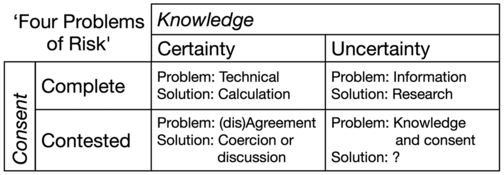
Our assessment starts with the premise that the concept of personal risk in given situations not only refers to the perceptions of a probability for an event happening, such as ocean acidification, affecting marine biodiversity negatively. It also concerns our perceptions of what the consequences of this will have on a personal level, including both objective and perceived risk. The former is based on knowledge about the issue, while the latter refers to the individual’s perception thereof; and there is an unbridged gap between these two groups. When there is a substantial amount of divergent scientific literature on an environmental topic and its effect on human health, this can lead to no consensus about whether or what mitigation measures need to be taken, such as in the case of ocean acidification being ‘just’ an impact of climate change. The latter could result in cultural constructions of risk events that can differ greatly within society and between sectors that depend or not on ocean resources (Adams Reference Adams1995). For the purposes of ocean acidification, we will assess it within the framework of the knowledge-consent vs. certainty-uncertainty figure (Figure 21.1).
Four Problems of Risk. Risk perception, problems, and solutions as products of knowledge and consent adapted from Wildavsky and Dake (Reference Wildavsky and Dake1990) ‘Four Problems of Risk’. The term ‘consent’ is used by the original authors. We understand it as having the meaning of ‘consensus’ or ‘agreement’. However, generally, we understand that ‘consent’ implies a lack of objection, whereas consensus’ is an active agreement to something.

The top-left box is when individuals in question have both complete certainty around the knowledge about a given topic, such as ocean acidification, and complete consent within the group that this is the complete amount of knowledge about the issue area. All the alternatives around the topic are known already, and the objectives as well. In a case like this, for a given environmental problem, the solution is centred on calculating the outcome that is most efficient to solve it. An example is the hole in the ozone layer resulting in the Montreal protocol. The ‘hole’ in the atmospheric ozone layer, from ozone depletion because of the use ozone-depleting substances such as chlorofluorocarbons (CFCs) (Molina & Rowland Reference Molina and Rowland1974), led to global public outrage. The reason for this was perception of personal risk, and a fear of millions of new skin cancer patients and other human health effects (for example, infectious diseases, suppression of the immune system and eye disorders). This risk led to the issue being taken seriously in public and political arenas (Morrisette Reference Morrisette1989). In this case, the challenge was technical, with a need for innovation in product development, and the solution was calculating how to solve it. The alternatives were known, and the objectives were agreed upon, and as such, finding a solution was a matter of calculating the most efficient outcome that would ensure that the problem was solved.
In the bottom-left box, there is also certainty about the environmental challenge and its importance in terms of scientific knowledge around it like in the case of the ozone hole. However, there is disagreement with regard to consent. There is also some contestation around the value of existing knowledge with respect to the cost-benefit of the consequences of it. The example here could be the COVID-19 pandemic, and the solution was differentiated responses in different countries, based, among others, on risk relative to number of cases. Individuals knew during this time period that there was a global pandemic and that it resulted in people losing their lives. However, there was disagreement regarding the extent of the problem in various regions or countries. Also, some people questioned whether economic security was more important in terms of how best to respond, for example if lockdowns should happen or not. Some countries therefore implemented economically strict and coerced shutdowns (for example Korea). Other countries, such as Sweden, on the other hand, implemented limited or partial shutdowns that led to higher rates of mortality in the shorter-term (Hale et al. Reference Hale, Angrist and Kira2020).
In turn, the top-right category is when there is complete consent in the public that there is an environmental challenge that needs to be solved. However, the knowledge about the risks of this environmental challenge is limited, and there is insufficient information for some to assess the risks. A solution in such a case is to default to more research being needed to address knowledge gaps. This is likely where the case of ocean acidification is currently located and why there is not yet an encompassing treaty for either and that the solution is further research to assess to what degree they represent a risk for human populations. The certainty around knowledge pertaining to risk is still not strong enough to drive the public to demand immediate action, as was the case of the Montreal Protocol.
Finally, the bottom-right category is one when there is neither enough knowledge in place nor consent on the cost-benefit of consequences. Different social relations groups fall into different groups in this table when it comes to perceptions of personal risk around environmental issues. An example of this is arguably the UNFCCC and solutions to climate change. Though there is no clear-cut solution to a challenge where there is insufficient consent or knowledge, one of the actions that the global community put in place was that of establishing the Intergovernmental Panel on Climate Change (IPCC). This was to prepare comprehensive scientific, technical, and socio-economic knowledge about climate change and its impacts that were accessible to the public as well. In Tiller et al. (Reference Tiller, Arenas and Galdies2019), the authors quote cast member of Weekend Update of Saturday Night Live TV show Michael Che saying, in response to the IPCC report on climate change that had just been released:
I keep asking myself ‘why don’t I care about this?’ Don’t get me wrong, I 100 percent believe in climate change, yet I’m willing to do absolutely nothing about it. I think it’s because they keep telling us we’re gonna lose everything, and nobody cares about everything. People only care about some things.
Though said in a comedy setting, the statement still rings true when it comes to public perceptions of climate change policy and global action in general, and risk perception of individuals.
Considering this, and though we have established that the human dimension of ocean acidification, through socio-economic impacts, could be substantial (Turley & Boot 2011), the risk perception is low for the issue area. This is despite the fact that, for fisheries and aquaculture, for example, the phyto- and zoo-plankton communities and resultant transfers to the whole trophic web could affect the potential for sustainable future fisheries (Blaustein Reference Blaustein2010; Doubleday et al. Reference Doubleday, Nagelkerken, Coutts, Goldenberg and Connell2019). Modification of the sea bottom because of ocean acidification, disappearance of corals, and reduction of rocky substrata for coastline protection against natural hazards could also be affected. It could affect climate regulation negatively as well, by altering the fluxes of sequestration of carbon into the deep ocean through the biological pump (Sarmiento & Gruber Reference Sarmiento and Gruber2002). And it could even affect human health, though this is a complex study linked to decline in high seas opportunities for exploiting biodiversity and genetic resources that could be used for new medicinal, pharmaceutical, industrial, and agricultural applications (Blaustein Reference Blaustein2010; Doubleday et al. Reference Doubleday, Nagelkerken, Coutts, Goldenberg and Connell2019). Combined though, these are dramatic risks – not just for nature but also for human activities and livelihoods. Yet, the feeling of risk on individuals is still arguably low, leaving ocean acidification to not have enough saliency for policymakers to put it on the agenda. This has been reflected in an EU study on the impacts of climate change, where results precisely reflected this, with respondents being least aware of ocean acidification (Buckley et al. Reference Buckley, Pinnegar and Painting2017).
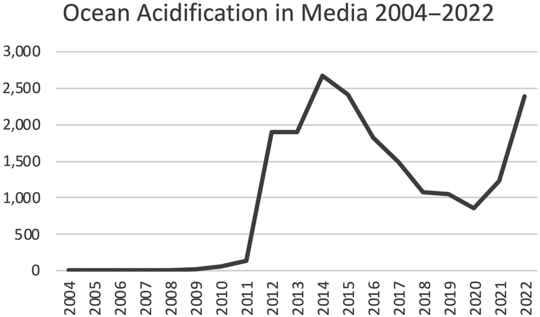
We can see this clearly when we do a media search on Retriever looking at the term ‘Ocean Acidification’ over time in all international media channels as well (Figure 21.2). We can see that after the SDGs in 2015, there was a sharp increase in media discussions about the issue area, perhaps because of it being explicitly mentioned in target 14.3 as mentioned. This is then followed by a sharp decline until 2020 when it begins to increase in saliency again. McCombs and Shaw (Reference McCombs and Shaw1972) discussed early how news media is able to influence the salience of topics on the public agenda, and thereby help set the agenda for policymaking. Also, increased media attention is believed to result in increased concern for a particular issue (Brown & Deegan Reference Brown and Deegan1998).
Ocean acidification in Media.
21.4 Responsibility
Who is responsible to stop ocean acidification, though, if humans don’t feel any personal risk with regard to it and governance actions have a limited human centric approach? And how should this be reflected in governance? Granted, we have tried to curb ocean acidification, directly and indirectly, at national, regional, and global levels (Tiller et al. Reference Tiller, Arenas and Galdies2019; Galdies et al. Reference Galdies, Bellerby and Canu2020a, Reference Galdies, Tiller, Martinez Romera, Leal Filho, Azul, Brandli, Lange Salvia and Wall2020b). However, we have only created agreements within the framework of planetary boundaries that protect humans from anthropogenically induced change that is affecting nature (and us in turn) – and not ensured that we protect nature itself from human use. To manage the expected negative impacts on humans, for example, would focus on biodiversity conservation and habitat restorations, as well as adaptation to changes to the Ocean (Falkenberg et al. Reference Falkenberg, Bellerby and Connell2020). Verma (Reference Verma2019) highlights five guiding principles that identify an anthropocentric world view, namely: (1) humans are at the centre, with the highest status; (2) humans are most capable of managing earth; (3) humans are the most important species on earth, in charge of the rest of nature on the planet; (4) unlimited resources on earth are for humans only, and healthy nature can only be accomplished through a healthy economy; and (5) if we humans are to succeed as a species on earth, we have to be managers of resource extraction and benefits deriving thereof.
In a similar fashion, Verma contradicts this world view with that of ecocentrism, where humans are part of nature and need to live sustainably as part of it on the same terms as other species. Prioritizing ecocentrism is also highlighted by Kotze and French (Reference Kotzé and French2018), for example, who emphasized that ‘a more ecocentric orientation … is urgently required to enable a more ecocentric rule of law to better mediate the human-environment interface in the Anthropocene’. In fact, risk as we have discussed it in this chapter has primarily referred to risk to humans – not nature itself – though that is where most negative effects will materialize first. This, in, turn will lead to, down the chain, humans also being affected, but we are not the primary and immediate recipients of the risks associated with ocean acidification. This is also likely the reason for the lack of focus at the global governance stage, despite its damaging threats. And we know, it’s not from a lack of knowledge, nor has it been since the creation of the Intergovernmental Panel on Climate Change (IPCC) in 1988 and the adoption of the UNFCCC in 1992 at least. However, with the signing of the Kunming-Montreal Global Biodiversity Framework, the global community took a sharp turn in that direction by including both sustainable use (human centric) and protection in and of itself. Target 8 specifically emphasizes that it will
[m]inimize the impact of climate change and ocean acidification on biodiversity and increase its resilience through mitigation, adaptation, and disaster risk reduction actions, including through nature-based solution and/or ecosystem-based approaches, while minimizing negative and fostering positive impacts of climate action on biodiversity.
This agreement is scheduled to reach its targets by 2030 and will work in tandem with the BBNJ agreement for areas that are outside national jurisdiction. By 2030, perhaps risk perception will have reached the consciousness of humans about this planetary boundary as well, and we can see reversals of the environmental damages, as we have done with the boundary for atmospheric aerosol loading after the implementation of the Montreal protocol. If we collectively decide that the future high is worth the temporary pain of making the required changes, that is.Footnote 1

 Open access