Exponential Random Graph Models for Social Networks

-
Select format
-
- Publisher:
- Cambridge University Press
- Publication date:
- 05 April 2013
- 19 November 2012
- ISBN:
- 9780511894701
- 9780521193566
- 9780521141383
- Dimensions:
- (228 x 152 mm)
- Weight & Pages:
- 0.6kg, 352 Pages
- Dimensions:
- (228 x 152 mm)
- Weight & Pages:
- 0.48kg, 360 Pages
- Subjects:
- Social Theory, Research Methods in Sociology and Criminology, Research Methods In Sociology and Criminology, Sociology
- Series:
- Structural Analysis in the Social Sciences (35)
You may already have access via personal or institutional login- Subjects:
- Social Theory, Research Methods in Sociology and Criminology, Research Methods In Sociology and Criminology, Sociology
- Series:
- Structural Analysis in the Social Sciences (35)
Show more authors 
You may already have access via personal or institutional login
Book description
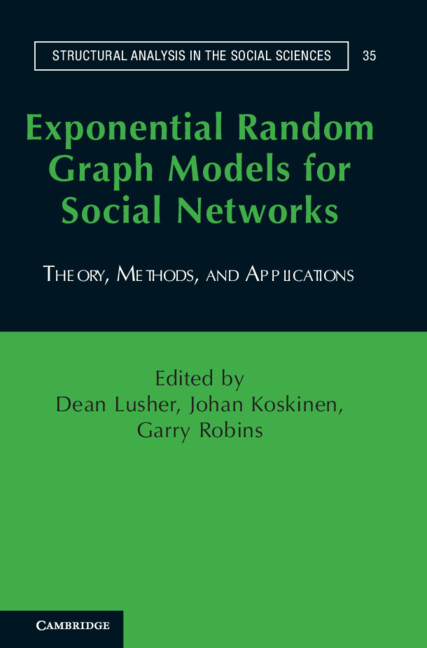
Exponential random graph models (ERGMs) are increasingly applied to observed network data and are central to understanding social structure and network processes. The chapters in this edited volume provide a self-contained, exhaustive account of the theoretical and methodological underpinnings of ERGMs, including models for univariate, multivariate, bipartite, longitudinal and social-influence type ERGMs. Each method is applied in individual case studies illustrating how social science theories may be examined empirically using ERGMs. The authors supply the reader with sufficient detail to specify ERGMs, fit them to data with any of the available software packages and interpret the results.
Reviews
‘I’ve been waiting impatiently for this book and I was definitely not disappointed. Finally we have a sourcebook on ERGMs that is both comprehensive and comprehensible. Most of the chapters are written for quantitative researchers who are not statisticians. Many illustrative empirical applications are worked through. Software packages are discussed. For the researcher who is intrigued by the possibility of analyzing network data with an ERGM, or who is already trying to do so, this is an indispensable resource.’
Peter Carrington - University of Waterloo
‘This collection offers readers an intuitive understanding of ERGMs, followed by a formal explanation of their statistical underpinnings as well as a methodological cookbook based on current software. Next, network scholars at the forefront of advancing theoretical and methodological contributions present eight compelling empirical studies. These studies illustrate how ERGMs offer exciting opportunities to advance theoretical understandings of network phenomena at the intra-organizational, inter-organizational, and societal levels.’
Noshir Contractor - Jane S. and William J. White Professor of Behavioral Sciences, Northwestern University
‘p*, the exponential family of random graph distributions introduced by Frank and Strauss in 1986, has indeed become the best statistical model in network science. This edited volume is a must-have - Lusher, Koskinen, and Robins have put together a thorough compilation for both the p* novice and enthusiast. It is the handbook to own - and use!’
Stanley Wasserman - Indiana University
Contents
Contents
Metrics
Altmetric attention score
Full text views
Full text views helpTotal number of HTML views: 0
Total number of PDF views: 0 *
 Loading metrics...
* Views captured on Cambridge Core between #date#. This data will be updated every 24 hours.
Usage data cannot currently be displayed.
Accessibility standard: Unknown
Why this information is here
This section outlines the accessibility features of this content - including support for screen readers, full keyboard navigation and high-contrast display options. This may not be relevant for you.
Accessibility Information
Accessibility compliance for the PDF of this book is currently unknown and may be updated in the future.