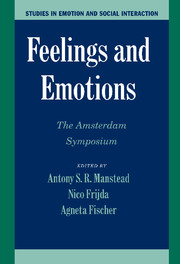
Book contents
- Frontmatter
- Contents
- List of Contributors
- 1Introduction
- PART ITHE NATURE OF FEELINGS AND EMOTIONS
- PART IIBASIC PSYCHOLOGICAL PROCESSES IN FEELINGS AND EMOTIONS
- PART IIIFEELINGS AND EMOTIONS: THE PLACE OF PLEASURE
- PART IVFEELINGS AND EMOTIONS IN THEIR SOCIOCULTURAL CONTEXT
- 18The Development of Individual Differences in Understanding Emotion and Mind
- 19Emotional Intelligence
- 20Culture and Emotion
- 21Emotion Norms, Emotion Work, and Social Order
- PART VFEELINGS, EMOTIONS, AND MORALITY
- Subject Index
- Author Index
- Plate section
- References
21 - Emotion Norms, Emotion Work, and Social Order
Published online by Cambridge University Press: 05 June 2012

Book contents
- Frontmatter
- Contents
- List of Contributors
- 1Introduction
- PART ITHE NATURE OF FEELINGS AND EMOTIONS
- PART IIBASIC PSYCHOLOGICAL PROCESSES IN FEELINGS AND EMOTIONS
- PART IIIFEELINGS AND EMOTIONS: THE PLACE OF PLEASURE
- PART IVFEELINGS AND EMOTIONS IN THEIR SOCIOCULTURAL CONTEXT
- 18The Development of Individual Differences in Understanding Emotion and Mind
- 19Emotional Intelligence
- 20Culture and Emotion
- 21Emotion Norms, Emotion Work, and Social Order
- PART VFEELINGS, EMOTIONS, AND MORALITY
- Subject Index
- Author Index
- Plate section
- References

HTML view is not available for this content. However, as you have access to this content, a full PDF is available via the 'Save PDF' action button.
Summary
ABSTRACT
The social origins and functions of emotion norms are examined. Emotion norms both reflect and sustain the social structures in which they develop. Individuals undergo emotional socialization and are subject to pressures to conform, especially adults in service and professional jobs, who actively manage reactions that violate social expectations. Efforts at emotional conformity help to sustain the social order, maintain hierarchy, and build solidarity. Emotional deviants are usually stigmatized and subjected to social control, but under some conditions they can become agents of social change.
An experiment by Dutton and Aron (1974) is often used in psychology textbooks to illustrate the role of cognition in emotional experience. The study was intended to demonstrate that physiological arousal can be misattributed to the wrong cause. Men who were approached by an attractive experimenter after crossing a suspension bridge over a deep gorge were more likely to indicate romantic or sexual interest in the experimenter, in contrast to men who had crossed a low wooden bridge over a stream. Dutton and Aron concluded, consistent with Schachter's two-factor theory of emotion (Schachter & Singer, 1962), that emotions are in part determined by available cognitive cues, not by physiological reactions alone.
Information
- Type
- Chapter
- Information
- Feelings and EmotionsThe Amsterdam Symposium, pp. 359 - 378Publisher: Cambridge University PressPrint publication year: 2004
References
American Psychiatric Association. (1994). Diagnostic and statistical manual of mental disorders: DSM-IV. Washington, DC: American Psychiatric Association
(1999). Emotional capital and professional socialization: The case of mortuary science students (and me). Social Psychology Quarterly, 62, 101–116CrossRefGoogle Scholar
, & (1994). Managing emotions in public: The case of wheelchair users. Social Psychology Quarterly, 57, 300–312CrossRefGoogle Scholar
Cancian, F. M. (1987). Love in America: Gender and self-development. New York: Cambridge University Press
, & (1989). Changing emotion norms in marriage: Love and anger in U.S. women's magazines since 1900. Gender and Society, 2, 308–342CrossRefGoogle Scholar
Clark, C. (1990). Emotions and micropolitics in everyday life: Some patterns and paradoxes of “place.” In T. D. Kemper (Ed.), Research agendas in the sociology of emotions (pp. 305–333). Albany: State University of New York Press
Clark, C. (1997). Misery and company: Sympathy in everyday life. Chicago: University of Chicago Press
, & (1983). Counteracting the deviance of depression: Peer support groups for victims. Journal of Social Issues, 39, 169–194CrossRefGoogle Scholar
(1998). When emotion work is doomed to fail: Ideological and structural constraints on emotion management. Symbolic Interaction, 21, 299–328CrossRefGoogle Scholar
Denzin, N. K. (1990). On understanding emotion: The interpretive-cultural agenda. In T. D. Kemper (Ed.), Research agendas in the sociology of emotions (pp. 85–116). Albany: State University of New York Press
, & (1974). Some evidence for heightened sexual attraction under conditions of high anxiety. Journal of Personality and Social Psychology, 30, 510–517CrossRefGoogle ScholarPubMed
, & (1990). Empathy: Conceptualization, measurement, and relation to prosocial behavior. Motivation and Emotion, 14, 131–149CrossRefGoogle Scholar
Ekman, P.; Friesen, W. V.; & Ellsworth P. (1982). What are the similarities and differences in facial behavior across cultures? In P. Ekman (Ed.), Emotion in the human face (2d ed., pp. 128–143). Cambridge: Cambridge University Press
(1997). Ideology and interpersonal emotion management: Redefining identity in two support groups. Social Psychology Quarterly, 60, 153–171CrossRefGoogle Scholar
; ; & (1999). A laughing matter? The uses of humor in medical interactions. Motivation and Emotion, 23, 155–174CrossRefGoogle Scholar
Frude, N., & Goss, A. (1981). Maternal anger and the young child. In N. Frude (Ed.), Psychological approaches to child abuse (pp. 52–63). Totawa, NJ: Rowman & Littlefield
(1996). Pamela's place: Power and negotiation in the hair salon. Gender and Society, 10, 505–526CrossRefGoogle Scholar
Gordon, S. (1989). The socialization of children's emotions: Emotional culture, exposure, and competence. In C. Saarni and P. Harris (Eds.), Children's understanding of emotions (pp. 319–349). New York: Cambridge University Press
Graham, H. (1981). Mothers' accounts of anger and aggression towards their babies. In N. Frude (Ed.), Psychological approaches to child abuse (pp. 39–63). Totowa, NJ: Rowman & Littlefield
(1977). Learning real feelings: A study of high steel ironworkers' reactions to fear and danger. Work and Occupations, 4, 147–170CrossRefGoogle Scholar
(1988). Cadaver stories and the emotional socialization of medical students. Journal of Health and Social Behavior, 29, 344–356CrossRefGoogle ScholarPubMed
(1979). Emotion work, feeling rules, and social structure. American Journal of Sociology, 85, 551–575CrossRefGoogle Scholar
Hochschild, A. R. (1983). The managed heart: Commercialization of human feeling. Berkeley: University of California Press
Illouz, E. (1997). Consuming the romantic utopia: Love and the cultural contradictions of capitalism. Berkeley: University of California Press
(1981). Social constructionist and positivist approaches to the sociology of emotions. American Journal of Sociology, 87, 2, 336–362CrossRefGoogle Scholar
(1987). How many emotions are there? Wedding the social and the autonomic components. American Journal of Sociology, 93, 2, 263–289CrossRefGoogle Scholar
Kleinman, A., & Kleinman, J. (1985). Somatization: The interconnections in Chinese society among culture, depressive experiences, and the meanings of pain. In A. Kleinman and B. Good (Eds.), Culture and depression: Studies in the anthropology and cross-cultural psychiatry of affect and disorder (pp. 429–490). Berkeley: University of California Press
, & (1989). Emotional socialization in the postmodern era: Children in day care. Social Psychology Quarterly, 52, 35–43CrossRefGoogle Scholar
Leidner, R. (1993). Fast food, fast talk: Service work and the routinization of everyday life. Berkeley: University of California Press
Levy, R. I. (1984). Emotion, knowing, and culture. In R. A. Shweder and R. A. Levine (Eds.), Culture theory: Essays on mind, self, and emotion (pp. 214–237). Cambridge: Cambridge University Press
; ; ; ; & (1999). Public conceptions of mental illness: Labels, causes, dangerousness, and social distance. American Journal of Public Health, 89, 1328–1333CrossRefGoogle ScholarPubMed
(2000). Reciprocal emotion management: Working together to maintain stratification in private law firms. Work and Occupations, 27, 32–63CrossRefGoogle Scholar
(2001). Occupational claims to professionalism: The case of paralegals. Symbolic Interaction, 24, 343–365CrossRefGoogle Scholar
(1985). The social shaping of emotion: The case of grief. Symbolic Interaction, 8, 171–190CrossRefGoogle Scholar
Maslach, C. (1982). Burnout: The cost of caring. Englewood Cliffs, NJ: Prentice-Hall
McCall, G. J., & Simmons, J. L. (1978). Identities and interactions. New York: Free Press
, & (1996). The dimensions, antecedents, and consequences of emotional labor. Academy of Management Review, 21, 986–1010CrossRefGoogle Scholar
Pierce, J. L. (1995). Gender trials: Emotional lives in contemporary law firms. Berkeley: University of California Press
Pogrebin, M. R., & Poole, E. D. (1995). Emotion management: A study of police response to tragic events. In M. G. Flaherty and C. Ellis (Eds.), Social perspectives on emotion (Vol. 3, pp. 149–168). Stamford, CT: JAI Press
, & (1989). Processes in emotional socialization. Social Psychology Quarterly, 52, 22–34CrossRefGoogle Scholar
Power, M. B., & Krause-Eheart, B. (1995). Adoption, myth, and emotion work: Paths to disillusionment. In J. G. Flaherty and C. Ellis (Eds.), Social perspectives on emotion (vol. 3, pp. 97–120). Stamford, CT: JAI Press
(1987). Deviation in emotion and the labeling of mental illness. Deviant Behavior, 8, 79–102CrossRefGoogle Scholar
(1999). The consequences of emotional labor: Effects on work stress, job satisfaction, and well-being. Motivation and Emotion, 23, 125–154CrossRefGoogle Scholar
, & (1989). Emotional intelligence. Imagination, Cognition, and Personality, 9, 185–211CrossRefGoogle Scholar
, & (1962). Cognitive, social and physiological determinants of emotional state. Psychological Review, 69, 379–399CrossRefGoogle ScholarPubMed
(1988). Shame and conformity: The deference-emotion system. American Sociological Review, 53, 395–406CrossRefGoogle Scholar
(1979). Emotion and social life: A symbolic interactionist analysis. American Journal of Sociology, 84, 1317–1334CrossRefGoogle Scholar
Shweder, R. A. (1994). “You're not sick, you're just in love”: Emotion as an interpretive system. In P. Ekman and R. A. Davidson (Eds.), The nature of emotion: Fundamental questions (pp. 32–45). Oxford: Oxford University Press
; ; & (1992). The development of feeling norms underlying romantic love among adolescent females. Social Psychology Quarterly, 55, 29–46CrossRefGoogle Scholar
, & (1989). Managing emotions in medical school: Students' contacts with the living and the dead. Social Psychology Quarterly, 52, 56–69CrossRefGoogle Scholar
Stearns, C. Z., & Stearns, P. N. (1986). Anger: The struggle for emotional control in America's history. Chicago: University of Chicago Press
, & (1989). The highs and lows of emotional labor: Detectives' encounters with criminals and victims. Journal of Contemporary Ethnography, 17, 435–452CrossRefGoogle Scholar
Stryker, S., & Statham, A. (1985). Symbolic interaction and role theory. In G. Lindzey and E. Aronson (Eds.), Handbook of Social Psychology (3d ed., pp. 311–378). New York: Random House
(1991). Maintaining norms about expressed emotions: The case of bill collectors. Administrative Science Quarterly, 36, 245–268CrossRefGoogle Scholar
Tangney, J. P. (1999). The self-conscious emotions: Shame, guilt, embarrassment and pride. In R. Dalgleish and M. Power (Eds.), Handbook of cognition and emotion (pp. 541–568). New York: John Wiley and SonsCrossRef
Taylor, V. (2000). Emotions and identity in women's self-help movements. In S. Stryker and T. J. Owens (Eds.), Self, identity, and social movements (pp. 271–299). Minneapolis: University of Minnesota Press
(1985). Self-labeling processes in mental illness: The role of emotional deviance. American Journal of Sociology, 92, 221–249CrossRefGoogle Scholar
(1986). Social support as coping assistance. Journal of Consulting and Clinical Psychology, 54, 416–423CrossRefGoogle ScholarPubMed
Thoits, Peggy A. (2000). Emotion and psychopathology: A sociological point of view. Paper presented at the International Society for Research on Emotions, August, Quebec City, Canada
(1993). Alienating and liberating emotions at work: Supermarket clerks' performance of customer service. Journal of Contemporary Ethnography, 22, 361–381CrossRefGoogle Scholar
, & (1998). Observations on the display and management of emotion in naturally occurring activities: The case of “hysteria” in calls to 911. Social Psychology Quarterly, 61, 141–159CrossRefGoogle Scholar
Wharton, A. S. (1996). Service with a smile: Understanding the consequences of emotional labor. In C. L. MacDonald and C. Sirianni (Eds.), Working in the service society (pp. 91–112). Philadelphia: Temple University Press
Accessibility standard: Unknown
Why this information is here
This section outlines the accessibility features of this content - including support for screen readers, full keyboard navigation and high-contrast display options. This may not be relevant for you.Accessibility Information
Accessibility compliance for the PDF of this chapter is currently unknown and may be updated in the future.
 You have Access
- 99
- Cited by