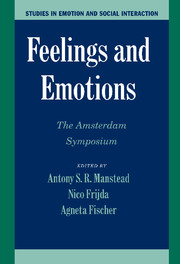
Book contents
- Frontmatter
- Contents
- List of Contributors
- 1Introduction
- PART ITHE NATURE OF FEELINGS AND EMOTIONS
- PART IIBASIC PSYCHOLOGICAL PROCESSES IN FEELINGS AND EMOTIONS
- 8What We Become Emotional About
- 9Feelings Integrate the Central Representation of Appraisal-driven Response Organization in Emotion
- 10Emotions and Action
- 11Basic Affects and the Instinctual Emotional Systems of the Brain
- 12Exposure Effects
- 13Feeling States in Emotion
- PART IIIFEELINGS AND EMOTIONS: THE PLACE OF PLEASURE
- PART IVFEELINGS AND EMOTIONS IN THEIR SOCIOCULTURAL CONTEXT
- PART VFEELINGS, EMOTIONS, AND MORALITY
- Subject Index
- Author Index
- Plate section
- References
10 - Emotions and Action
Published online by Cambridge University Press: 05 June 2012

Book contents
- Frontmatter
- Contents
- List of Contributors
- 1Introduction
- PART ITHE NATURE OF FEELINGS AND EMOTIONS
- PART IIBASIC PSYCHOLOGICAL PROCESSES IN FEELINGS AND EMOTIONS
- 8What We Become Emotional About
- 9Feelings Integrate the Central Representation of Appraisal-driven Response Organization in Emotion
- 10Emotions and Action
- 11Basic Affects and the Instinctual Emotional Systems of the Brain
- 12Exposure Effects
- 13Feeling States in Emotion
- PART IIIFEELINGS AND EMOTIONS: THE PLACE OF PLEASURE
- PART IVFEELINGS AND EMOTIONS IN THEIR SOCIOCULTURAL CONTEXT
- PART VFEELINGS, EMOTIONS, AND MORALITY
- Subject Index
- Author Index
- Plate section
- References

HTML view is not available for this content. However, as you have access to this content, a full PDF is available via the 'Save PDF' action button.
Summary
ABSTRACT
This chapter discusses the relationships between emotion and action. Emotion, by its very nature, is change in action readiness to maintain or change one's relationship to an object or event. Motivation, or motivational change, is one of the key aspects of emotions.
Even so, action follows only under certain conditions, including the presence and availability of an action repertoire, an equilibrium of the costs and benefits of action, and the presence of resources and motivation to consider the costs and benefits.
There are trade-offs between selection from the repertoire and the cost-benefit aspects. The repertoire usually includes low-effort actions that considerably expand the influence of emotions on action.
Obviously, emotions have very much to do with action. One would say that emotions exist for the sake of action, for dealing with the environment. Yet, the relationship between emotion and action is variable. There is much emotion without action; there is also much action without obvious emotion. How to understand the relationships?
In this chapter, I shall do two things. First, I argue that motivation for action – changes in motivation, and motivational processes – is part and parcel of what we mean by emotions. Little theory exists, however, to account for it. Second, I explore the conditions under which those motivations do and do not actually lead to action.
Information
- Type
- Chapter
- Information
- Feelings and EmotionsThe Amsterdam Symposium, pp. 158 - 173Publisher: Cambridge University PressPrint publication year: 2004
References
Ajzen, I. (1989). Attitude structure and behavior. In A. R. Pratkanis, S. J. Breckler, and A. G. Greenwald (Eds.), Attitude structure and function (pp. 241–274). Hillsdale, NJ: Erlbaum
Averill, J. R. (1982). Anger and aggression: An essay on emotion. New York: Springer
, & (1967). Weapons as aggression-eliciting stimuli. Journal of Personality and Social Psychology, 7, 202–207CrossRefGoogle Scholar
Berridge, K. C. (1999). Pleasure, pain, desire, and dread: Hidden core processes of emotion. In D. Kahneman, E. Diener, and N. Schwarz, (Eds.), Foundations of hedonic psychology: Scientific perspectives on enjoyment and suffering (pp. 525–557). New York: Sage
Block, G., & Drucker, M. (1992). Rescuers: Portraits of moral courage in the Holocaust. New York: TV Books
Boiten, F. A. (1993a). Emotional breathing patterns. Ph.D. thesis, University of Amsterdam
(1993b). Component analysis of task related respiratory patterns. International Journal of Psychophysiology, 15, 91–104CrossRefGoogle Scholar
Brehm, J., & Self, E. (1989). The intensity of motivation. In M. R. Rosenzweig and L. W. Porter (Eds.), Annual Review of Psychology, 40. Palo Alto: Annual Reviews, IncCrossRef
Browning, C. R. (1993). Ordinary men: Reserve police battalion 101 and the Final Solution in Poland. New York: Harper Perennial
Chesnais, J.-C. (1981), Histoire de la violence. Paris: Robert Laffont
Corsini, S., & Rimé, B. (2001). Emotional events and the symbolic universe. Proceedings, Feelings and Emotions, The Amsterdam Symposium
Cosmides, L., & Tooby, J. (2000). Evolutionary psychology and the emotions. In M. Lewis and J. M. Haviland (Eds.), Handbook of emotions, Second Edition (pp. 91–115). New York: Guilford
Davitz, J. R. (1969). The language of emotion. New York: Academic Press
De Waal, F. B. M. (1996). Good natured: The origins of right anbd wrong in humans and other animals. Cambridge, MA.: Harvard University Press
De Waal, F. B. M. & Aureli, F. (1997). Conflict resolution and distress alleviation in monkeys and apes. Annals of the New York Academy of Sciences. Vol. 807: The integrative neurobiology of affiliation (317–328)
Draghi-Lorenz, R. (2001). Young infants are capable of non-basic emotions. Ph.D. thesis, University of Portsmouth
Elster, J. (1999). Alchemies of the mind. Cambridge: Cambridge University Press
Frank, R. H. (1988). Passions within reason: The strategic role of the emotions. New York: Norton
(2001). The role of positive emotions in positive psychology: The broaden-and-build theory of positive emotions. American Psychologist, 56, 218–226CrossRefGoogle ScholarPubMed
Freeman, W. J. (2000). Emotion is essential to all intentional behavior. In M. D. Lewis and I. Granic (Eds.), Emotion, development, and self-organisation (pp. 209–235). New York: Cambridge University PressCrossRef
Frijda, N. H. (1986). The emotions. Cambridge: Cambridge University Press
Frijda, N. H. (1994). The Lex Talionis: On vengeance. In S. H. M. Van Goozen, N. E. Van de Poll, and J. A. Sergeant (Eds.), Emotions: Essays on emotion theory (pp. 263–290). Hillsdale, NJ: Erlbaum
Frijda, N. H.; Markam, S.; Sato, K.; & Wiers, R. (1995). Emotion and emotion words. In J. A. Russell, J. M. Fernández-Dols, A. S. R. Manstead, and J. Wellenkamp (Eds.), Everyday conceptions of emotion (pp. 121–144). Dordrecht: KluwerCrossRef
Frijda, N. H.; Mesquita, B.; Sonnemans, J.; & Van Goozen, S. (1991). The duration of affective phenomena, or emotions, sentiments and passions. In K. Strongman (Ed.), International Review of Emotion and Motivation (pp. 187–225). New York: Wiley
Frijda, N. H., & Zeelenberg, M. (2001). Appraisal: What is the dependent? In A. Schorr, K. R. Scherer, and T. Johnston (Eds.), Appraisal processes in emotion: Theory, methods, research (pp. 141–156). Oxford: Oxford University Press
Gallistel, C. R. (1980). The organization of action: A new synthesis. Hillsdale: Erlbaum
, & (1950). Der Reafferenzprinzip. Wechselwirkung zwischen Zentralnervensystem und Peripherie. Naturwissenschaften, 37, 464–475CrossRefGoogle Scholar
Horowitz, M. J. (1992). Stress response syndromes. (3d ed.). Northvale, NJ: Jason Aronson
Kreitler, H., & Kreitler, S. (1972). Psychology of the arts. Durham, NC: Duke University Press
, & (2002). Consciousness and emotion experience: A theoretical framework. Psychological Review, 109, 219–259CrossRefGoogle Scholar
Miller, W. I. (1993). Humiliation. Ithaca, NY: Cornell University Press
Mook, D. G. (1996). Motivation: The organization of action (2d ed.). New York: Norton
Panksepp, J. (1998). Affective neuroscience. Oxford: Oxford University Press
Piaget, J. (1976). Le comportement moteur de l'évolution. Paris: Gallimard. (English translation: Behavior and evolution. New York, Random House, 1978.)
; ; ; & (1992). Long-lasting cognitive and social consequences of emotion: Social sharing and rumination. European Review of Social Psychology, 3, 225–258CrossRefGoogle Scholar
Roseman, I. J. (2001). A model of appraisal in the emotion system: Integrating theory, research, and applications. In K. R. Scherer, A. Schorr, and T. Johnstone (Eds.), Appraisal processes in emotion: Theory, methods, research. New York: Oxford University Press
(1988). Shame and conformity: The deference emotion system. American Sociological Review, 53, 395–406CrossRefGoogle Scholar
Scherer, K. R. (2001). Appraisal considered as a process of multilevel sequential checking. In K. R. Scherer, A. Schorr, and T. Johnstone (Eds.), Appraisal processes in emotion: Theory, methods, research (pp. 92–120). New York: Oxford University Press
, & (1995). The determinants of subjective emotional intensity. Cognition and Emotion, 9, 483–507CrossRefGoogle Scholar
(1977). Homeostasis, discrepancy, dissonance: A theory of motives and motivation. Motivation and Emotion, 1, 103–138Google Scholar
(1995). Motor development: A new synthesis. American Psychologist, 50, 79–95CrossRefGoogle ScholarPubMed
Tomkins, S. S. (1962). Affect: Imagery and consciousness. Vol. 1, The positive affects. New York: Springer
Tucker, D. M.; Deryberry, D.; & Luu, P. (2000). Anatomy and physiology of human emotions: Vertical integration of brain stem, limbic, and cortical systems. In J. C. Borod (Ed.), The neuropsychology of emotion (pp. 56–79). New York: Oxford University Press
Varela, F. J.; Thompson, E.; & Rosch, E. (1991). The embodied mind. Cambridge, MA: MIT Press
Weiss, J. M.; Glazer, H. I.; & Poherecky, L. A. (1976). Coping behavior and neurochemical changes: An alternative explanation for the original “learned helplessness” experiments. In A. Serban and A. Kling (Eds.), Animal models in human psychobiology (pp. 141–173). New York: Plenum PressCrossRef
Zimbardo, P. G. (1970). The human choice: Individuation reason and order versus deindividuation, impulse and chaos. In W. J. Arnold and D. Levine (Eds.), Nebraska symposium on motivation 1969, Vol. 16. Lincoln: University of Nebraska Press
Accessibility standard: Unknown
Why this information is here
This section outlines the accessibility features of this content - including support for screen readers, full keyboard navigation and high-contrast display options. This may not be relevant for you.Accessibility Information
Accessibility compliance for the PDF of this chapter is currently unknown and may be updated in the future.
 You have Access
- 149
- Cited by