Book contents
- Frontmatter
- Contents
- List of Contributors
- 1Introduction
- PART ITHE NATURE OF FEELINGS AND EMOTIONS
- PART IIBASIC PSYCHOLOGICAL PROCESSES IN FEELINGS AND EMOTIONS
- 8What We Become Emotional About
- 9Feelings Integrate the Central Representation of Appraisal-driven Response Organization in Emotion
- 10Emotions and Action
- 11Basic Affects and the Instinctual Emotional Systems of the Brain
- 12Exposure Effects
- 13Feeling States in Emotion
- PART IIIFEELINGS AND EMOTIONS: THE PLACE OF PLEASURE
- PART IVFEELINGS AND EMOTIONS IN THEIR SOCIOCULTURAL CONTEXT
- PART VFEELINGS, EMOTIONS, AND MORALITY
- Subject Index
- Author Index
- Plate section
- References
13 - Feeling States in Emotion
Functional Imaging Evidence
Published online by Cambridge University Press: 05 June 2012

Book contents
- Frontmatter
- Contents
- List of Contributors
- 1Introduction
- PART ITHE NATURE OF FEELINGS AND EMOTIONS
- PART IIBASIC PSYCHOLOGICAL PROCESSES IN FEELINGS AND EMOTIONS
- 8What We Become Emotional About
- 9Feelings Integrate the Central Representation of Appraisal-driven Response Organization in Emotion
- 10Emotions and Action
- 11Basic Affects and the Instinctual Emotional Systems of the Brain
- 12Exposure Effects
- 13Feeling States in Emotion
- PART IIIFEELINGS AND EMOTIONS: THE PLACE OF PLEASURE
- PART IVFEELINGS AND EMOTIONS IN THEIR SOCIOCULTURAL CONTEXT
- PART VFEELINGS, EMOTIONS, AND MORALITY
- Subject Index
- Author Index
- Plate section
- References

HTML view is not available for this content. However, as you have access to this content, a full PDF is available via the 'Save PDF' action button.
Summary
ABSTRACT
An essential feature of emotional states is their association with change in autonomic function. The importance of these changes lies in the fact that in many theoretical accounts of emotion the realization of autonomic states is a primary means through which feeling states are realized. The issue addressed in this chapter is how the brain generates and represents autonomic states of the organism and their importance in feeling states. A distinction will be drawn between brain systems that mediate relatively automatic responses to emotional stimuli and systems that are involved in what can be termed conscious feeling states. These distinctions will be illustrated by observations from functional neuroimaging and patients with focal brain lesions and pathology of the autonomic nervous system.
Despite the impact of William James at the end of the nineteenth century, for the best part of several decades in the middle of the twentieth century, neuroscientists treated “emotion” and “feeling” as interchangeable terms. This approach to the language of emotion, coupled with the behaviorist movement prevalent in twentieth century psychology, meant that the neuroscientific study of emotion was grossly neglected, often seen as conceptually ragged and its practitioners as pursuing “soft science” (Damasio, 1999; Damasio, 1994; Damasio, 1998; LeDoux, 1996; LeDoux, 2000). Recent efforts, however, have put the study of emotion center stage in understanding the workings of the brain, proposing roles in cognition (Zajonc, 1980), decision making (Damasio, 1994), perception (Anderson & Phelps, 2001), and even consciousness (Panksepp, 1998; Damasio, 1999).
Information
- Type
- Chapter
- Information
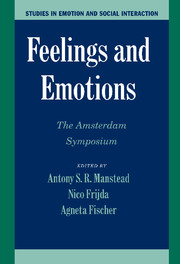
- Feelings and EmotionsThe Amsterdam Symposium, pp. 204 - 220Publisher: Cambridge University PressPrint publication year: 2004
References
; & (1999). A role for the human amygdala in recognizing emotional arousal from unpleasant stimuli. Psychological Science 10, 167–171CrossRefGoogle Scholar
; ; ; & (1994). Impaired recognition of emotion in facial expressions following bilateral damage to the human amygdala. Nature 372, 669–672CrossRefGoogle ScholarPubMed
; ; ; & (1995). Fear and the human amygdala. Journal of Neuroscience 15, 5879–5891CrossRefGoogle ScholarPubMed
; ; ; ; ; ; ; ; & (1999). Recognition of facial emotion in nine individuals with bilateral amygdala damage. Neuropsychologia 37, 1111–1117CrossRefGoogle ScholarPubMed
, & (1984). Amygdalo-cortical projections in the monkey (Macaca fascicularis). Journal of Comparative Neurology 230, 465–496CrossRefGoogle Scholar
Amaral, D. G.; Price, J. L.; Pitkänen, A.; & Carmichael, S. T. (1992). Anatomical organization of the primate amygdaloid complex. In J. P. Aggleton, (Ed.), The amygdala: Neurobiological aspects of emotion, memory, and mental dysfunction (pp. 1–66). New York: Wiley-Liss
, & (2001). Lesions of the human amygdala impair enhanced perception of emotionally salient events. Nature 411, 305–309CrossRefGoogle ScholarPubMed
; ; ; & (1997). Deciding advantageously before knowing the advantageous strategy. Science 275, 1293–1295CrossRefGoogle ScholarPubMed
; ; ; ; ; & (1995). Double dissociation of conditioning and declarative knowledge relative to the amygdala and hippocampus in humans. Science 269, 1115–1118CrossRefGoogle ScholarPubMed
; ; ; & (1996). Failure to respond autonomically to anticipated future outcomes following damage to prefrontal cortex. Cerebral Cortex 6, 215–225CrossRefGoogle ScholarPubMed
; ; ; ; & (1999). Dissociable neural responses to facial expressions of sadness and anger. Brain 122, 883–893CrossRefGoogle ScholarPubMed
; ; ; ; ; ; ; ; & (1996). Response and habituation of the human amygdala during visual processing of facial expression. Neuron 17, 875–887CrossRefGoogle ScholarPubMed
; ; ; ; ; ; ; ; ; , et al. (1998). Face processing impairments after encephalitis: Amygdala damage and recognition of fear. Neuropsychologia 36, 59–70CrossRefGoogle Scholar
, & (2000). Classical fear conditioning in functional neuroimaging. Current Opinion Neurobiology 10, 219–223CrossRefGoogle ScholarPubMed
; ; ; & (1999). Amygdala–hippocampal involvement in human aversive trace conditioning revealed through event–related functional magnetic resonance imaging. Journal of Neuroscience 19, 10869–10876CrossRefGoogle ScholarPubMed
; ; ; & (1998). Brain systems mediating aversive conditioning: An event-related fMRI study. Neuron 20, 947–957CrossRefGoogle ScholarPubMed
; ; ; ; & (2000).Impaired recognition and experience of disgust following brain injury. Nature Neuroscience 3, 1077–1078CrossRefGoogle ScholarPubMed
; ; & (2001). Neuropsychology of fear and loathing. Nature Reviews Neuroscience 2, 352–363CrossRefGoogle ScholarPubMed
; ; ; ; & (2000a). Cerebral correlates of autonomic cardiovascular arousal: A functional neuroimaging investigation in humans. Journal of Physiology 523, 259–270CrossRefGoogle Scholar
; ; ; & (2000b). Neural activity relating to generation and representation of galvanic skin conductance responses: A functional magnetic resonance imaging study. Journal of Neuroscience 20, 3033–3040CrossRefGoogle Scholar
; ; & (2001a). Neural activity in the human brain relating to uncertainty and arousal during anticipation. Neuron 29, 537–545CrossRefGoogle Scholar
; ; & (2001b). Neuroanatomical basis for first- and second-order representations of bodily states. Nature Neuroscience 4, 207–212CrossRefGoogle Scholar
; ; ; ; & (2001c). Brain activity during biofeedback relaxation: A functional neuroimaging investigation. Brain 124, 1003–1012CrossRefGoogle Scholar
Damasio, A. (1999). The feeling of what happens: Body and emotion in the making of consciousness. New York: Harcourt Brace
Damasio, A. R. (1994). Descartes' error: Emotion, reason and the human brain. New York: G. P. Putnam's Sons
(1998). Emotion in the perspective of an integrated nervous system. Brain Research Reviews 26, 83–86CrossRefGoogle ScholarPubMed
; ; ; ; ; ; & (2000). Subcortical and cortical brain activity during the feeling of self-generated emotions. Nature Neuroscience 3, 1049–1056CrossRefGoogle ScholarPubMed
Davis, M. (1992). The amygdala and conditioned fear. In J. P. Aggleton (Ed.), The amygdala: Neurobiological Aspects of Emotion, Memory and Mental Dysfunction, (pp. 225–306). New York: Wiley-Liss
; ; & (2001). Crossmodal binding of fear in voice and face. Proceedings of the National Academy of Sciences U S A 98, 10006–10010CrossRefGoogle Scholar
Ekman, P., & Friesen, W. V. (1975). Pictures of facial affect. Palo Alto, CA: Consulting Psychologists Press
, & (2000). The cognitive and emotional effects of amygdala damage. Neurocase 6, 435–450CrossRefGoogle Scholar
; ; ; ; ; & (1998). Functional neuroanatomical correlates of electrodermal activity: A positron emission tomographic study. Psychophysiology 35, 179–185CrossRefGoogle ScholarPubMed
; ; ; ; ; & (1996). The trouble with cognitive subtraction. Neuroimage 4, 97–104CrossRefGoogle ScholarPubMed
; ; ; ; ; & (1995). Brain activity during transient sadness and happiness in healthy women. American Journal of Psychiatry 152, 341–351Google ScholarPubMed
; ; ; ; ; ; ; ; & (2001). Explicit and incidental facial expression processing: An fMRI study. Neuroimage 14, 465–473CrossRefGoogle Scholar
; ; ; ; & (1997). Impaired recognition of disgust in Huntington's disease gene carriers. Brain 120, 2029–2038CrossRefGoogle ScholarPubMed
; ; & (2000). Modulating emotional responses: Effects of a neocortical network on the limbic system. Neuroreport 11, 43–48CrossRefGoogle ScholarPubMed
; ; ; ; & (1998). Human amygdala activation during conditioned fear acquisition and extinction: A mixed-trial fMRI study. Neuron 20, 937–945CrossRefGoogle ScholarPubMed
; ; ; & (1995). Impaired fear conditioning following unilateral temporal lobectomy in humans. Journal of Neuroscience 15, 6846–6855CrossRefGoogle ScholarPubMed
; ; ; & (1997a). Neural activation during selective attention to subjective emotional responses. Neuroreport 8, 3969–3972CrossRefGoogle Scholar
; ; ; ; & (1997b). Neuroanatomical correlates of happiness, sadness, and disgust. American Journal of Psychiatry 154, 926–933Google Scholar
LeDoux, J. E. (1996). The emotional brain. New York.: Simon and Schuster
(2000). Emotion circuits in the brain. Annual Reviews in Neuroscience 23, 155–184CrossRefGoogle Scholar
; ; ; & (2001). Differential extrageniculostriate and amygdala responses to presentation of emotional faces in a cortically blind field. Brain 124, 1241–1252CrossRefGoogle Scholar
; ; ; ; ; ; & (1998a). A neuromodulatory role for the human amygdala in processing emotional facial expressions. Brain 121, 47–57CrossRefGoogle Scholar
; ; ; ; ; ; & (1996). A differential neural response in the human amygdala to fearful and happy facial expressions. Nature 383, 812–815CrossRefGoogle ScholarPubMed
; ; & (1998b). Conscious and unconscious emotional learning in the human amygdala. Nature 393, 467–470CrossRefGoogle Scholar
; ; ; ; & (2001). Representation of pleasant and aversive taste in the human brain. Journal of Neurophysiology 85, 1315–1321CrossRefGoogle ScholarPubMed
(1998). The periconscious substrates of consciousness: Affective states and the evolutionary origins of the SELF. Journal of Consciousness Studies 5, 566–582Google Scholar
; ; ; ; ; ; ; ; ; & (1998). Neural responses to facial and vocal expressions of fear and disgust. Proceedings of the Royal Society of London Series B: Biological Sciences 265, 1809–1817CrossRefGoogle ScholarPubMed
; ; ; ; ; ; ; ; ; , et al. (1997). A specific neural substrate for perceiving facial expressions of disgust. Nature 389, 495–498CrossRefGoogle ScholarPubMed
; ; ; ; & (2001). Feeling or features: Different sensitivity to emotion in high-order visual cortex and amygdala. Neuron 32, 747–757CrossRefGoogle ScholarPubMed
, & (2001). Impaired perception of facial emotions following bilateral damage to the anterior temporal lobe. Neuropsychology 15, 30–38CrossRefGoogle ScholarPubMed
; ; ; & (1998). Neural structures associated with recognition of facial expressions of basic emotions. Proceedings of the Royal Society of London Series B: Biological Sciences 265, 1927–1931CrossRefGoogle ScholarPubMed
; ; ; & (2001). Effects of attention and emotion on face processing in the human brain. An event-related fMRI study. Neuron 30, 829–841CrossRefGoogle Scholar
; ; ; ; ; & (1998). Masked presentations of emotional facial expressions modulate amygdala activity without explicit knowledge. Journal of Neuroscience 18, 411–418CrossRefGoogle ScholarPubMed
; ; ; & (1996). Facial expression processing after amygdalotomy. Neuropsychologia 34, 31–39CrossRefGoogle ScholarPubMed
(1980). Feeling and thinking: Preferences need no inferences. American Psychologist 35, 151–175CrossRefGoogle Scholar
Accessibility standard: Unknown
Why this information is here
This section outlines the accessibility features of this content - including support for screen readers, full keyboard navigation and high-contrast display options. This may not be relevant for you.Accessibility Information
Accessibility compliance for the PDF of this chapter is currently unknown and may be updated in the future.
 You have Access