Book contents
- Frontmatter
- Contents
- List of Contributors
- 1Introduction
- PART ITHE NATURE OF FEELINGS AND EMOTIONS
- PART IIBASIC PSYCHOLOGICAL PROCESSES IN FEELINGS AND EMOTIONS
- PART IIIFEELINGS AND EMOTIONS: THE PLACE OF PLEASURE
- PART IVFEELINGS AND EMOTIONS IN THEIR SOCIOCULTURAL CONTEXT
- PART VFEELINGS, EMOTIONS, AND MORALITY
- 22On the Possibility of Animal Empathy
- 23Emotional Gifts and “You First” Micropolitics
- 24Introducing Moral Emotions into Models of Rational Choice
- 25Virtue and Emotional Demeanor
- 26Epilogue
- Subject Index
- Author Index
- Plate section
- References
25 - Virtue and Emotional Demeanor
Published online by Cambridge University Press: 05 June 2012

Book contents
- Frontmatter
- Contents
- List of Contributors
- 1Introduction
- PART ITHE NATURE OF FEELINGS AND EMOTIONS
- PART IIBASIC PSYCHOLOGICAL PROCESSES IN FEELINGS AND EMOTIONS
- PART IIIFEELINGS AND EMOTIONS: THE PLACE OF PLEASURE
- PART IVFEELINGS AND EMOTIONS IN THEIR SOCIOCULTURAL CONTEXT
- PART VFEELINGS, EMOTIONS, AND MORALITY
- 22On the Possibility of Animal Empathy
- 23Emotional Gifts and “You First” Micropolitics
- 24Introducing Moral Emotions into Models of Rational Choice
- 25Virtue and Emotional Demeanor
- 26Epilogue
- Subject Index
- Author Index
- Plate section
- References

HTML view is not available for this content. However, as you have access to this content, a full PDF is available via the 'Save PDF' action button.
Summary
The gestures which we sometimes call empty are perhaps in fact the fullest things of all.
(Erving Goffman, 1967)ABSTRACT
I argue in this chapter that emotional demeanor (especially in facial expression) is often a crucial way we show moral regard for others. I explore the extent to which such expression is subject to control and consider the problem of insincerity in posing facial expressions. For a robust discussion of these issues, I turn to Seneca's De Beneficiis (On Doing Kindnesses). Seneca's concerns in this work overlap in significant ways with those of Erving Goffman in his classic account of deference rituals.
INTRODUCTION
When we think about moral character we sometimes focus on faces and bodies. In particular, we think about emotional attitude and how it is conveyed in physical and facial comportment. So we talk about “a look of concern,” “a compassionate embrace,” “a reassuring smile,” “an empathetic tone of voice.” What is salient is emotional demeanor, or, to adapt a Kantian phrase, the “emotional aesthetic” of virtue (Kant, 1964, 405).
I emphasize “adapt,” for Kant is a controversial figure to appeal to in matters of the emotions. On an orthodox reading, his notion of an emotional “aesthetic” of virtue is meant to keep emotion at arm's length from morality, construed more narrowly in terms of willed action.
Information
- Type
- Chapter
- Information
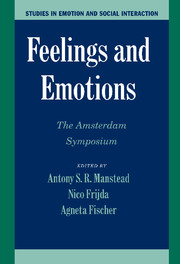
- Feelings and EmotionsThe Amsterdam Symposium, pp. 441 - 454Publisher: Cambridge University PressPrint publication year: 2004
References
Aristotle. Nicomachean ethics. (1992). Trans. D. Ross. Rev. J. L. Ackrill and J. O. Urmson. Oxford: Oxford University Press
Baron-Cohen, S. (1999). Mind blindness. Cambridge, MA: MIT Press
Brazelton, T. B., & Cramer, B. G. (1990). The earliest relationship. Reading, MA: Addison-Wesley
Butterworth, G. (1991). The ontogeny and phylogeny of joint visual attention. In A. Whiten (Ed.), Natural theories of mind (pp. 223–232). Cambridge, MA: Blackwell
Cooper, J., & J. R. Procopé (Eds.). (1995). Seneca: Moral and political essays. Cambridge: Cambridge University Press
DeSousa, R. (1988). Emotion and self-deception. In B. McLaughlin and A. O. Rorty (Eds.), Perspectives on self-deception (pp. 324–341). Berkeley: University of California Press
Ekman, P. (Ed.). (1982). Emotion in the human face. 2d ed. Cambridge: Cambridge University Press
Fischer, J. M. (Ed.). (1986). Moral responsibility. Ithaca, NY: Cornell University Press
Fisher, J. M., & Ravizza, M. (Eds.). (1993). Perspectives on moral responsibility. Ithaca, NY: Cornell University Press
Goffman, E. (1967). The nature of deference and demeanor. In Interaction ritual: Essays on face-to-face behavior. Garden City, NY: Anchor Books
Greenspan, S. (1989). The development of the ego: Implication for personality theory, psychopathology, and the psychotherapeutic process. Madison, CT: International Universities Press
Izard, C. (1971). The face of emotion. New York: Meredith Corporation
Kant, Immanuel. (1963a). Anthropology from a pragmatic point of view. Trans. Mary Gregor. The Hague: Nijoff
Kant, Immanuel. (1963b). Lectures on ethics. Trans. Louis Infield. Indianapolis, IN: Hackett
Kant, Immanuel. (1964). Metaphysic of morals, Part ⅱ: The doctrine of virtue. Trans. Mary Gregor. Philadelphia: University of Pennsylvania Press
Klinnert, M. D.; Campos, J. J.; Sorce, F. I.; Emde, R. N.; & Svejda, M. J. (1983). Social referencing: Emotional expressions as behavior regulators. In R. Plutchik and H. Kellerman (Eds.), Emotion: Theory, research, and experience, Vol. 2: Emotions in early development (pp. 57–86). Orlando, FL: Academic Press
Mahler, M.; Pine, F.; & Bergman, A. (1975). The psychological birth of the human infant. New York: Basic Books
; ; ; & (1989). The development of emotion expression during the first two years of life. Monographs of the Society for Research in Child Development, 54, 7–8CrossRefGoogle ScholarPubMed
, & (1992). The development of a capacity for imagination in early childhood. The Psychoanalytic Study of the Child, 47, 23–47CrossRefGoogle ScholarPubMed
Schore, A. (1994). Affect regulation and the origins of self. Hillsdale, NJ: Lawrence Erlbaum Associates
Sherman, N. (1997). Making a necessity of virtue: Aristotle and Kant on virtue. Cambridge: Cambridge University Press
Sherman, N. (1999). Taking responsibility for our emotions. In E. F. Paul, F. D. Miller, & J. Paul (Eds.), Responsibility (pp. 294–321). Cambridge: Cambridge University PressCrossRef
Sherman, N. (2000). Emotional agents. In M. Levine (Ed.), The analytic Freud (pp. 154–176). New York: Routledge
Sherman, N. (Forthcoming). Of Manners and Morals, Christopher Gill (Ed.). Oxford: Oxford University Press
Spitz, R. (1965). The first year of life. Madison, CT: International Universities Press
Sroufe, A. (1995). Emotional development. New York: Cambridge University Press
Stern, D. (1974). Mother and infant at play: The dyadic interaction involving facial, vocal, and gaze behavior. In M. Lewis and L. Rosenblum (Eds.), The effect of the infant on its caregiver (pp. 187–213). New York: Wiley
Stern, D. (1985). The interpersonal world of the infant: A view from psychoanalysis and developmental psychology. New York: Basic Books
; ; & (1988). Inhibiting and facilitating conditions of the human smile: A nonobtrusive test of the facial feedback hypothesis. Journal of Personality and Social Psychology, 45, 768–777CrossRefGoogle Scholar
Tomkins, S. S. (1962). Affect, imagery, consciousness. 2 vols. New York: Springer
Tomkins, S. S. (1982). Affect theory. In P. Ekman (Ed.), Emotion in the human face (2d ed., pp. 353–395). Cambridge: Cambridge University Press
Accessibility standard: Unknown
Why this information is here
This section outlines the accessibility features of this content - including support for screen readers, full keyboard navigation and high-contrast display options. This may not be relevant for you.Accessibility Information
Accessibility compliance for the PDF of this chapter is currently unknown and may be updated in the future.
 You have Access