Book contents
- Fluvial Megafans on Earth and Mars
- Fluvial Megafans on Earth and Mars
- Copyright page
- Contents
- Contributors
- Foreword
- Part IIntroduction
- 1Megafans as Major Continental Landforms
- 2A Global Megafans Map
- Part IIRegional Studies
- Part IIIApplications in Other Sciences
- Part IVMegafans in World Landscapes
- Index
- References
2 - A Global Megafans Map
from Part I - Introduction
Published online by Cambridge University Press: 30 April 2023

Book contents
- Fluvial Megafans on Earth and Mars
- Fluvial Megafans on Earth and Mars
- Copyright page
- Contents
- Contributors
- Foreword
- Part IIntroduction
- 1Megafans as Major Continental Landforms
- 2A Global Megafans Map
- Part IIRegional Studies
- Part IIIApplications in Other Sciences
- Part IVMegafans in World Landscapes
- Index
- References
Summary
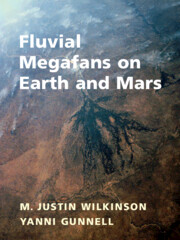
Using a variety of remotely-sensed data, a worldwide survey of river-generated megafans is presented. Thus far, 272 partial cones reaching minimum lengths and widths of 80 km and 40 km, respectively, have been identified. They all indicate large areas of fluvially-laid sediment distant from present or past shorelines. This more than doubles prior counts of fans of these dimensions, partly as a result of using a different set of criteria. All are visible either as pristine or degraded features, and it is likely that more will be found as older, more eroded individual occurrences are identified. The greatest numbers are found in Asia (n = 87), from Iraq to the clusters of megafans on the south flank of the Himalaya, and also in central Asia. Africa displays a similar number (n = 87), almost all related to relatively low-relief topographic swells. In South America (n = 60), most megafans are found clustered along the east flanks of the Andes Mountains and include the longest known example (704 km). Few occur in Europe (n = 9) or North America (n = 1), in both cases as a result of incisional fluvial regimes operating almost continent wide. Australia hosts 28 megafans. River-generated fans with smaller dimensions are numerous on all continents, however.
Information
- Type
- Chapter
- Information
- Fluvial Megafans on Earth and Mars , pp. 13 - 20Publisher: Cambridge University PressPrint publication year: 2023
References
Burke, K. and Gunnell, Y. (2008). The African Erosion Surface: A Continental-scale Synthesis of Geomorphology, Tectonics, and environmental Change over the Past 180 Million Years. Geological Society of America Memoir, 201, 66 pp.Google Scholar
Burke, K. and Wilkinson, M. J. (2016). Landscape evolution in Africa during the Cenozoic and Quaternary—the legacy and limitations of Lester C. King. Canadian Journal of Earth Sciences, 53, 1089–1102.Google Scholar
Earth Sciences and Remote Sensing Unit, NASA Johnson Space Center. https://eol.jsc.nasa.gov/ (accessed February 2022)Google Scholar
Hartley, A. J., Weissmann, G. S., Nichols, G. J., and Warwick, G. L. (2010a). Large distributive fluvial systems: characteristics, distribution, and controls on development. Journal of Sedimentary Research, 80, 167–183.CrossRefGoogle Scholar
Hartley, A. J., Weissmann, G. S., Nichols, G. J., and Scuderi, L. A. (2010b). Fluvial form in modern continental sedimentary basins: distributive fluvial systems: reply. Geology, 38, e231.Google Scholar
Iriondo, M. H. (1987). Geomorfolgía y Cuaternario de la Provincia Santa Fé (Argentina). D’Orbignyana (Corrientes, Argentina), 4, 54 pp.Google Scholar
Kreslavsky, M. A. and Head, J. W. (1999). Kilometer-scale slopes on Mars and their correlation with geologic units: initial results from Mars Orbiter Laser Altimeter (MOLA) data. Journal of Geophysical Research, 104, 21,911–21,924.Google Scholar
Kreslavsky, M. A. and Head, J. W. (2002). Kilometer-scale roughness of Mars’ surface: results from MOLA data analysis. Journal of Geophysical Research, 105, 26,695–26,712.Google Scholar
Latrubesse, E. M. (2015). Large rivers, megafans and other Quaternary avulsive fluvial systems: a potential “who’s who” in the geological record. Earth-Science Reviews, 146, 1–30.Google Scholar
Weissmann, G. S., Hartley, A. J., Nichols, G. J., et al. (2011). Alluvial facies distributions in continental sedimentary basins—distributive fluvial systems. In Davidson, S. K, Leleu, S., and North, C. P, eds., From River to Rock Record: The Preservation of Fluvial Sediments and their Subsequent Interpretation. SEPM Special Publication, 97, 327–355.Google Scholar
Weissmann, G. S., Hartley, A. J., Scuderi, L. A., et al. (2015). Fluvial geomorphic elements in modern sedimentary basins and their potential preservation in the rock record: a review. Geomorphology, 250, 187–219.Google Scholar
Wilkinson, M. J., Marshall, L. G., Lundberg, J. G., and Kreslavsky, M. H. (2010). Megafan environments in northern South America and their impact on Amazon Neogene aquatic ecosystems. In Hoorn, C. and Wesselingh, F. P., eds., Amazonia, Landscape and Species Evolution: A Look into the Past. Blackwell, London, 162–184.Google Scholar
Willett, S. D., McCoy, S. W., and Beeson, H. W. (2018). Transience of North American High Plains landscape and its impact on surface water. Nature, 561, 528–532.CrossRefGoogle ScholarPubMed
Accessibility standard: Unknown
Why this information is here
This section outlines the accessibility features of this content - including support for screen readers, full keyboard navigation and high-contrast display options. This may not be relevant for you.Accessibility Information
Accessibility compliance for the HTML of this chapter is currently unknown and may be updated in the future.