Book contents
- Frontmatter
- Contents
- Illustrations
- Acknowledgments
- Foreword
- Abbreviations
- MAP 0.1. Africa, 1947. (Map by Philip Schwartzberg, Meridian Mapping, Minneapolis.)
- MAP 0.2. Africa, 2011. (Map by Philip Schwartzberg, Meridian Mapping, Minneapolis.)
- Introduction
- 1Nationalism, Decolonization, and the Cold War, 1945–1991
- 2Egypt and Algeria Radical Nationalism, Nonalignment, and External Intervention in North Africa, 1952–1973
- 3The Congo Crisis, 1960–1965
- 4War and Decolonization in Portugal's African Empire, 1961–1975
- 5White-Minority Rule in Southern Africa, 1960–1990
- 6Conflict in the Horn, 1952–1993
- 7France's Private African Domain, 1947–1991
- 8From the Cold War to the War on Terror, 1991–2010
- Conclusion
- Index
- References
4 - War and Decolonization in Portugal's African Empire, 1961–1975
Published online by Cambridge University Press: 05 February 2013

Book contents
- Frontmatter
- Contents
- Illustrations
- Acknowledgments
- Foreword
- Abbreviations
- MAP 0.1. Africa, 1947. (Map by Philip Schwartzberg, Meridian Mapping, Minneapolis.)
- MAP 0.2. Africa, 2011. (Map by Philip Schwartzberg, Meridian Mapping, Minneapolis.)
- Introduction
- 1Nationalism, Decolonization, and the Cold War, 1945–1991
- 2Egypt and Algeria Radical Nationalism, Nonalignment, and External Intervention in North Africa, 1952–1973
- 3The Congo Crisis, 1960–1965
- 4War and Decolonization in Portugal's African Empire, 1961–1975
- 5White-Minority Rule in Southern Africa, 1960–1990
- 6Conflict in the Horn, 1952–1993
- 7France's Private African Domain, 1947–1991
- 8From the Cold War to the War on Terror, 1991–2010
- Conclusion
- Index
- References
Summary
While its NATO allies focused on the Congo, Portugal had its own African concerns. By the early 1960s, it was clear that France, Britain, and Belgium could maintain neocolonial economic relationships with their African colonies without the hassles of political control. With growing demands for economic development and burgeoning political unrest, independence had become an attractive option for both colonizer and colonized. For Portugal, ruled by the fascist dictatorship of António Salazar since 1932, African independence was out of the question. In contrast to its northern European counterparts, Portugal was an impoverished country with an underdeveloped economy. However, it maintained the illusion of grandeur with significant African possessions: Portuguese Guinea and the strategically important island of Cape Verde in West Africa and its environs; the islands of São Tomé and Príncipe off the coast of Central Africa; and Mozambique and Angola in Southern Africa. Without the cheap labor and raw materials that resulted from a harsh forced labor regime, Portugal's industries would not be profitable. Unable to compete in an unprotected market, Portugal was determined to retain political control of its colonies. With the exception of their settler colonies, France, Britain, and Belgium generally acquiesced to political independence without armed struggle. Portugal, in contrast, considered its colonial possessions to be overseas provinces akin to French Algeria and waged devastating colonial wars to retain them. This chapter examines the national liberation movements and external actors in Portugal's three mainland colonies; the transformations in American policy toward its NATO ally; and the contours of the struggles in Portuguese Guinea, Mozambique, and Angola.
Information
- Type
- Chapter
- Information
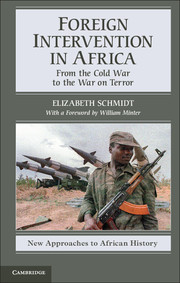
- Foreign Intervention in AfricaFrom the Cold War to the War on Terror, pp. 78 - 101Publisher: Cambridge University PressPrint publication year: 2013
References
For this chapter, four books are especially recommended. Two offer detailed histories of Portuguese colonialism in Africa: , The Third Portuguese Empire, 1825–1975: A Study in Economic Imperialism (Dover, NH: Manchester University Press, 1985) and M. D. D. Newitt, Portugal in Africa: The Last Hundred Years (London: Longman, 1981). Two focus on foreign intervention during the decolonization process. For a comprehensive archive-based assessment of Cuba's role in Angolan decolonization and shifting U.S. and Soviet policies, see Piero Gleijeses, Conflicting Missions: Havana, Washington, and Africa, 1959–1976 (Chapel Hill: University of North Carolina Press, 2002). For a firsthand account of American involvement, written by the CIA's Angola Task Force chief, see John Stockwell, In Search of Enemies: A CIA Story (New York: W. W. Norton, 1978).Google Scholar
Several important works focus on the United States, Portugal, and African decolonization. Portuguese Africa and the West (New York: Monthly Review Press, 1972) examines Portuguese colonialism, the liberation movements, and U.S. and Western government policies and business interests. Witney Schneidman's Engaging Africa: Washington and the Fall of Portugal's Colonial Empire (Lanham, MD: University Press of American, 2004) focuses on U.S.-Portuguese relations during the decolonization period. Two recommended books pertain to the Kennedy and Johnson administrations’ Africa policies, with a significant focus on the Portuguese colonies: Richard D. Mahoney, JFK: Ordeal in Africa (New York: Oxford University Press, 1983) and Thomas J. Noer, Cold War and Black Liberation: The United States and White Rule in Africa, 1948–1968 (Columbia: University of Missouri Press, 1985). For an in-depth assessment of Kennedy's top Africa official, see Noer's Soapy: A Biography of G. Mennen Williams (Ann Arbor: University of Michigan Press, 2006). For the Ford administration's policies toward Portugal's African colonies, see Stockwell (mentioned above) and works by two of Ford's top Africa officials: Donald Easum, Hard Times for the Africa Bureau, 1974–1976: A Diplomatic Adventure Story (Chapel Hill, NC: American Diplomacy Publishers, June 7, 2010), and Nathaniel Davis, “The Angola Decision of 1975: A Personal Memoir,” Foreign Affairs 57, no. 1 (Fall 1978): 109–24.Google Scholar
The Nordic countries were among the few Western states to support African liberation struggles. For insight into Nordic involvement in the Portuguese colonies, see the , National Liberation in Southern Africa: The Role of the Nordic Countries, .
For Portuguese Guinea (Guinea-Bissau), a number of important works focus on the revolutionary period. For writings by PAIGC Secretary-General Amílcar Cabral, see , Return to the Source: Selected Speeches of Amilcar Cabral (New York: Monthly Review Press, 1973) and Cabral's Unity and Struggle: Speeches and Writings, trans. Michael Wolfers (New York: Monthly Review Press, 1979). Patrick Chabal assesses Cabral and the PAIGC in Amílcar Cabral: Revolutionary Leadership and People's War (New York: Cambridge University Press, 1983). For firsthand accounts by scholars who traveled with the PAIGC during the liberation war, see Gérard Chaliand, Armed Struggle in Africa: With the Guerrillas in “Portuguese” Guinea, trans. David Rattray and Robert Leonhardt (New York: Monthly Review Press, 1969); Basil Davidson, The Liberation of Guiné: Aspects of an African Revolution (Baltimore, MD: Penguin Books, 1969); and Stephanie Urdang, Fighting Two Colonialisms: Women in Guinea-Bissau (New York: Monthly Review Press, 1979). Other scholars have produced more recent assessments of the liberation struggle, focusing on political mobilization, life in the liberated areas, and Portuguese counterinsurgency. See especially Lars Rudebeck, Guinea-Bissau: A Study of Political Mobilization (Uppsala, Sweden: Scandinavian Institute of African Studies, 1974) and Mustafah Dhada, Warriors at Work: How Guinea Was Really Set Free (Niwot: University Press of Colorado, 1993).Google Scholar
For Mozambique, three histories of colonialism and the liberation struggle are especially recommended: , A History of Mozambique (Bloomington: Indiana University Press, 1995); Allen Isaacman and Barbara Isaacman, Mozambique: From Colonialism to Revolution, 1900–1982 (Boulder, CO: Westview Press, 1983); and Barry Munslow, Mozambique: The Revolution and Its Origins (New York: Longman, 1983). For the political writings of FRELIMO's first two presidents, see Eduardo Mondlane's The Struggle for Mozambique (Baltimore, MD: Penguin, 1969) and Barry Munslow's Samora Machel: An African Revolutionary (London, Zed Books, 1985), which includes selected speeches and writings.Google Scholar
For Angola, a highly readable general history is In the Eye of the Storm: Angola's People (Garden City, NY: Anchor Books, 1973). The classic history of the independence struggle is John A. Marcum's two-volume work: The Angolan Revolution, which includes The Anatomy of an Explosion (1950–1962), vol. 1 (Cambridge, MA: MIT Press, 1969), and Exile Politics and Guerrilla Warfare (1962–1976), vol. 2 (Cambridge, MA: MIT Press, 1978). Two more recent works provide additional understanding of the relationships between the liberation movements and the tensions that were exploited by outside powers: Franz-Wilhelm Heimer, The Decolonization Conflict in Angola, 1974–76: An Essay in Political Sociology (Geneva: Institut Universitaire de Hautes Études Internationales, 1979) and Fernando Andresen Guimarães, The Origins of the Angolan Civil War: Foreign Intervention and Domestic Political Conflict (New York: St. Martin's Press, 1998). For documents revealing the collaboration of UNITA and the Portuguese military against the MPLA, see William Minter, ed., Operation Timber: Pages from the Savimbi Dossier (Trenton, NJ: Africa World Press, 1988). The impact of foreign intervention in the decolonization process is explored in Gleijeses, Stockwell, and Guimarães (mentioned above). Finally, Polish journalist Ryszard Kapuscinski provides a powerful firsthand account of the last months of colonial rule and the onset of civil war in Another Day of Life, trans. William R. Brand and Katarzyna Mroczkowska-Brand (San Diego, CA: Harcourt Brace Jovanovich, 1986).Google Scholar
, “Second Address before the United Nations,” in Return to the Source: Selected Speeches by Amilcar Cabral, ed. Africa Information Service (New York: Monthly Review Press, 1973), 19Google Scholar
, “Study in Response to National Security Study Memorandum 39: Southern Africa,” December 9, 1969, in South Africa and the United States: The Declassified History, ed. Kenneth Mokoena (New York: New Press, 1993), 209, 211Google Scholar
, “Tell No Lies, Claim No Easy Victories,” in , Revolution in Guinea: Selected Texts, trans. and ed. Richard Handyside (New York: Monthly Review Press, 1969), 89Google Scholar
, “An Ill Wind? Rethinking the Angolan Crisis and the Portuguese Revolution, 1974--1976,” Itinerario 26, no. 2 (July 2002), 22Google Scholar
Accessibility standard: Unknown
Why this information is here
This section outlines the accessibility features of this content - including support for screen readers, full keyboard navigation and high-contrast display options. This may not be relevant for you.Accessibility Information
Accessibility compliance for the PDF of this chapter is currently unknown and may be updated in the future.