
Skip to main content Accessibility help
×
  • Cited by 6
    • Show more authors
    • You may already have access via personal or institutional login
    • Select format
    • Publisher:
      Cambridge University Press
      Publication date:
      08 December 2017
      28 December 2017
      ISBN:
      9781316084243
      9781107085497
      9781107449701
      Dimensions:
      (228 x 152 mm)
      Weight & Pages:
      0.71kg, 362 Pages
      Dimensions:
      (229 x 152 mm)
      Weight & Pages:
      0.5kg, 364 Pages
    You may already have access via personal or institutional login
  • Selected: Digital
    Add to cart View cart Buy from Cambridge.org

    Book description

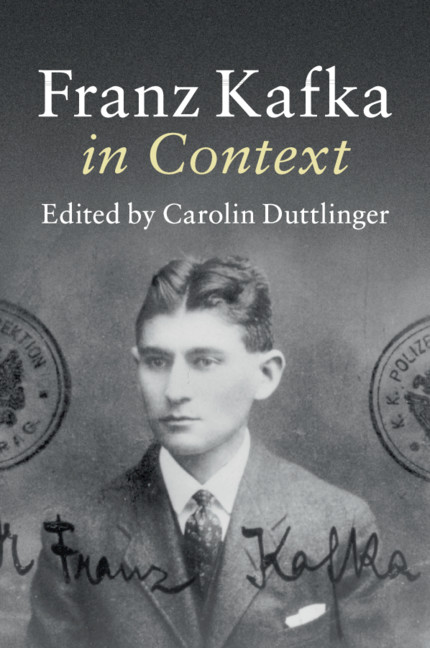
    Franz Kafka (1883–1924) lived through one of the most turbulent periods in modern history, witnessing a world war, the dissolution of an empire and the foundation of a new nation state. But the early twentieth century was also a time of social progress and aesthetic experimentation. Kafka's novels and short stories reflect their author's keen but critical engagement with the big questions of his time, and yet often Kafka is still cast as a solitary figure with little or no connection to his age. Franz Kafka in Context aims to redress this perception. In thirty-five short, accessible essays, leading international scholars explore Kafka's personal and working life, his reception of art and culture, his engagement with political and social issues, and his ongoing reception and influence. Together they offer a nuanced and historically grounded image of a writer whose work continues to fascinate readers from all backgrounds.

    Reviews

    '… tightly argued essays by some of today's foremost scholars.'

    Source: The Times Literary Supplement

    'Few recent books on Kafka have been as informative as this collection of essays, which looks at the many ways one can approach Kafka’s writings. … This review cannot do justice to the scope and value of Duttlinger’s collection. Highly recommended.'

    R. C. Conrad Source: Choice

    Refine List

    Actions for selected content:

    Select all | Deselect all
    • View selected items
    • Export citations
    • Download PDF (zip)
    • Save to Kindle
    • Save to Dropbox
    • Save to Google Drive

    Save Search

    You can save your searches here and later view and run them again in "My saved searches".

    Please provide a title, maximum of 40 characters.
    ×

    Contents


    Page 2 of 2


    Page 2 of 2


    Further Reading

    1

    1 Family

    Alt, P.-A., Franz Kafka: Der ewige Sohn (Munich: C. H. Beck, 2005)
    Brod, M., Franz Kafka: A Biography, trans. Roberts, G. H. and Winston, R., second enlarged edition (New York: Schocken Books, 1960)
    Binder, H., Kafkas Welt: Eine Lebenschronik in Bildern (Reinbek: Rowohlt Verlag, 2008)
    Koch, H.-G. (ed.), ‘Als Kafka mir entgegen kam…’: Erinnerungen an Franz Kafka (Berlin: Wagenbach, 2013)
    Northey, A., Kafka's Relatives: Their Lives and His Writing (New Haven, CT and London: Yale University Press, 1991)
    Stach, R., Kafka: The Decisive Years, trans. Frisch, S. (Princeton University Press, 2013)
    Stach, R., Kafka: The Years of Insight, trans. Frisch, S. (Princeton University Press, 2015)
    Stach, R., Kafka: The Early Years, trans. Frisch, S. (Princeton University Press, 2017)
    Wagenbach, K., Kafka, trans. E. Osers (Cambridge, MA: Harvard University Press, 2003)
    2

    2 Friendship

    Alt, P.-A., Franz Kafka: Der ewige Sohn (Munich: C. H. Beck, 2005)
    Stach, R., Kafka: The Decisive Years, trans. Frisch, S. (Princeton University Press, 2013)
    Stach, R., Kafka: The Years of Insight, trans. Frisch, S. (Princeton University Press, 2015)
    Stach, R., Kafka: The Early Years, trans. Frisch, S. (Princeton University Press, 2017)
    3

    3 Women

    Buber-Neumann, M., Milena, trans. Manheim, R. (London: Collins-Harvill, 1988)
    Diamant, K., Kafka's Last Love: The Mystery of Dora Diamant (London: Secker and Warburg, 2003)
    Hayes, K. (ed.), The Journalism of Milena Jesenská: A Critical Voice in Interwar Central Europe (Oxford: Berghahn, 2001)
    Jesenká, M., Ich hätte zu antworten tage- und nächtelang: Die Briefe von Milena, ed. Wagnerova, A. (Frankfurt am Main: Fischer, 1999)
    Kotlandova Koenig, D., ‘Moderate and Sensible: Higher Education and the Czech Women's Rights Movement’, Central European Review, 1, no. 14 (1999), www.ce-review.org/99/14/koenig14art.html
    Pawel, E., The Nightmare of Reason: A Life of Franz Kafka (London: Collins Harvill, 1988)
    4

    4 Work

    Corngold, S., ‘Kafka and the Ministry of Writing’ in Corngold, S., Greenberg, J. and Wagner, B. (eds.), The Office Writings, trans. Patton, E. with Hein, R. (Princeton University Press, 2008), pp. 1–18
    Posner, R. A., ‘Kafka: The Writer as Lawyer’, Columbia Law Review, 207 (2010), 207–15
    Wagner, B., ‘Kafkas Poetik des Unfalls’ in Kassung, C. (ed.), Die Unordung der Dinge: Eine Wissens- und Mediengeschichte des Unfalls (Bielefeld: Transcript, 2009), pp. 421–54
    Wolf, B., ‘Die Nacht des Bürokraten: F. K.s statistische Schreibweise’, Deutsche Vierteljahrsschrift für Literaturwissenschaft und Geistesgeschichte, 80 (2006), 97–127
    Zilcosky, J., ‘“Samsa war Reisender”: Trains, Trauma, and the Unreadable Body’ in Corngold, S. and Gross, R. V. (eds.), Kafka for the Twenty-First Century (Rochester, NY: Camden House, 2011), pp. 179–206
    5

    5 Health and Illness

    Anderson, M. M., Kafka's Clothes: Ornament and Aestheticism in the Habsburg Fin de Siècle (Oxford: Clarendon Press, 1992)
    Barton, S., Healthy Living in the Alps: The Origins of Winter Tourism Switzerland, 1860–1914 (Manchester University Press, 2008)
    Gilman, S., ‘Kafka und Krankheit’ in von Jagow, B. and Jahraus, O. (eds.), Kafka Handbuch (Göttingen: Vandenhoeck & Ruprecht, 2008), pp. 114–20
    Gradman, C., ‘Robert Koch and the Pressures of Scientific Research: Tuberculosis and Tuberculin’, Medical History, 45, no. 1 (2001), 1–32
    Türk, J., Die Immunität der Literatur (Frankfurt am Main: Fischer, 2011)
    Zadoff, M., Next Year in Marienbad: The Lost Worlds of Jewish Spa Culture (Philadelphia, PA: University of Pennsylvania Press, 2012)
    6

    6 Writing

    Binder, H., Kafka: Der Schaffensprozeß (Frankfurt am Main: Suhrkamp, 1983)
    Fromm, W., ‘Schaffensprozess’ in Engel, M. and Auerochs, B. (eds.), Kafka-Handbuch (Stuttgart: Metzler, 2010), pp. 428–37
    Harmann, M., ‘Die Ästhetik der Andeutung: K.s Streichungen im Schreibprozeß’, Neue Rundschau, 112, no. 2 (2001), 104–23
    Neumann, G., ‘Der verschleppte Prozeß: Literarisches Schaffen zwischen Schreibstrom und Werkidol’, Poetica, 14 (1982), 92–111
    Pasley, M., ‘Der Schreibakt und das Geschriebene: Zur Frage der Entstehung von Kafkas Texten’ in David, C. (ed.), Franz Kafka: Themen und Probleme (Göttingen: Vandenhoeck & Ruprecht, 1980), pp. 9–25
    Reuß, R., ‘Running Texts, Stunning Drafts’ in Corngold, S. and Gross, R. V. (eds.), Kafka for the Twenty-First Century (Rochester, NY: Camden House, 2011), pp. 24–47
    Schuster, M., Franz Kafkas Handschrift zum ‘Schloss’ (Heidelberg: Winter, 2012)
    7

    7 Style

    Coetzee, J. M., ‘Kafka: Translators on Trial’ (review of The Castle, trans. Harman, M.), New York Review of Books, 14 May 1998, 14–17
    Cohn, D., ‘Kafka's Eternal Present: Narrative Tense in “Ein Landarzt” and other First-Person Stories’, Publications of the Modern Languages Association of America, 83 (1968), 144–50
    Koelb, C., Kafka's Rhetoric: The Passion of Reading (Ithaca, NY and London: Cornell University Press, 1989)
    Müller-Seidel, W., ‘Kafkas Begriff des Schreibens und die moderne Literatur’, Zeitschrift für Literaturwissenschaft und Linguistik, 17, no. 68 (1987), 104–21
    White, J. J., ‘Endings and Non-Endings in Kafka's Fiction’ in Kuna, F. (ed.), Franz Kafka: Semi-Centenary Perspectives (London: Elek, 1976), pp. 146–66
    8

    8 Literary Modernism

    Anderson, M. M., Kafka's Clothes: Ornament and Aestheticism in the Habsburg Fin de Siècle (Oxford: Clarendon Press, 1992)
    Corngold, S., Lambent Traces: Franz Kafka (Princeton University Press, 2004)
    Engel, M. and Auerochs, B. (eds.), Kafka-Handbuch (Stuttgart: Metzler, 2010)
    Huyssen, A., Miniature Metropolis: Literature in an Age of Photography and Film (Harvard University Press, 2015)
    Sokel, W. H., The Myth of Power and the Self: Essays on Franz Kafka (Detroit, MI: Wayne State University Press, 2002)
    9

    9 Kafka's Reading

    Dodd, W. J., Kafka and Dostoyevsky: The Shaping of Influence (London: Macmillan, 1992)
    Engel, M. and Lamping, D. (eds.), Franz Kafka und die Weltliteratur (Göttingen: Vandenhoeck & Ruprecht, 2006)
    Peters, F. G., ‘Kafka and Kleist: A Literary Relationship’, Oxford German Studies, 1 (1966), 114–62
    Rohde, B., ‘Und blätterte ein wenig in der Bibel’: Studien zu Franz Kafkas Bibellektüre und ihren Auswirkungen auf sein Werk (Würzburg: Königshausen & Neumann, 2002)
    Tedlock, E. W., ‘Kafka's Imitation of David Copperfield’, Comparative Literature, 7 (1955), 52–62
    10

    10 Gesture

    Agamben, G., ‘Notes on Gesture’, in Agamben, G., Means Without End: Notes on Politics (Minneapolis, MN: University of Minnesota Press, 2000), pp. 49–60
    Benjamin, W., ‘Franz Kafka: On the Tenth Anniversary of His Death’, in Jennings, M. W., Eiland, H. and Smith, G. (eds.), R. Livingstone (trans.), Walter Benjamin: Selected Writings, 4 vols. (Cambridge, MA: The Belknap Press of Harvard University Press, 2002–6), vol. ii.2, pp. 794–818
    Klages, L., Ausdrucksbewegung und Gestaltungskraft: Grundlegung der Wissenschaft vom Ausdruck (Leipzig: Barth, 1923)
    Lack, E., Kafkas bewegte Körper: Die Tagebücher und Briefe als Laboratorien von Bewegung (Munich: Fink, 2009)
    Nitschke, C., ‘Evidenz und Verrätselung: Gesten und Logical Turn in Kafkas Betrachtung’ in Duttlinger, C. (ed.), Kafkas ‘Betrachtung’: Neue Lektüren (Freiburg: Rombach, 2014), pp. 141–64
    Puchner, M., ‘Kafka's Antitheatrical Gestures’, The Germanic Review: Literature, Culture, Theory, 78, no. 3 (2003), 177–93
    Schiffermüller, I., Franz Kafkas Gesten: Studien zur Entstellung der menschlichen Sprache (Tübingen: Francke, 2011)
    Warburg, A., The Renewal of Pagan Antiquity: Contributions to the Cultural History of the European Renaissance (Los Angeles, CA: Getty Research Institute for the History of Art and the Humanities, 1999)
    Weber, S., ‘Going Along for the Ride. Violence and Gesture: Agamben Reading Benjamin Reading Kafka Reading Cervantes’, The Germanic Review: Literature, Culture, Theory, 81, no. 1 (2006), 65–83
    Wundt, W., Elements of Folk Psychology: Outlines of a Psychological History of the Development of Mankind (London: G. Allen & Unwin, Macmillan, 1916)
    11

    11 Performance and Recitation

    Beck, E. T., Kafka and the Yiddish Theater: Its Impact on his Work (Madison, WI: University of Wisconsin Press, 1971)
    Massino, G., Franz Kafka, Jizchak Löwy und das jiddische Theater (Frankfurt am Main: Stroemfeld/Nexus, 2007)
    Müller, L., ‘Die Unruhe eines Westjuden: Franz Kafka, das jiddische Theater und die Unübersetzbarkeit des Jargons’, brücken. Germanistisches Jahrbuch Tschechien – Slowakei, 15 (2007), 149–80
    Müller, L., Die zweite Stimme: Vortragskunst von Goethe bis Kafka (Berlin: Wagenbach, 2007)
    Puchner, M., ‘Kafka and the Theater’, The Germanic Review, 78, no. 3 (2003), 163–5
    12

    12 Film

    Alt, P.-A., Kafka und der Film: Über kinematographisches Erzählen (Munich: C. H. Beck, 2009)
    Duttlinger, C., Kafka and Photography (Oxford University Press, 2007)
    Gunning, T., ‘The Cinema of Attraction: Early Film, its Spectator, and the Avantgarde’ in Elsaesser, T. (ed.), Early Cinema: Space, Frame, Narrative (London: BFI Publishing, 1990), pp. 229–35
    Kreimeier, K., Traum und Exzess: Die Kulturgeschichte des frühen Kinos (Wien: Zsolnay, 2011)
    Zischler, H., Kafka geht ins Kino (Reinbek: Rowohlt, 1996); Kafka Goes to the Movies, trans. S. H. Gillespie (University of Chicago Press, 2003)
    13

    13 Photography

    Duttlinger, C., Kafka and Photography (Oxford University Press, 2007)
    Milne, E., Letters, Postcards, Email: Technologies of Presence (New York: Routledge, 2010)
    Skopec, R., ‘Bohemia, Moravia and Slovakia’, History of Photography, 2 (1978), 141–53
    Wagenbach, K., Kafka: Bilder aus seinem Leben, second edition (Berlin: Wagenbach, 1994)
    Witkovsky, M. (ed.), Foto: Modernity in Central Europe, 1918–1945 (Washington, DC: National Gallery of Art, 2007)
    Zischler, H., Kafka geht ins Kino (Reinbek: Rowohlt, 1996); Kafka Goes to the Movies, trans. S. H. Gillespie (University of Chicago Press, 2003)
    14

    14 Music

    Caduff, C., ‘Der gottverlorene Ton: Musik in Texten von Kleist, Kafka und Anne Duden’ in Sorg, R. and Würffel, B. (eds.), Gott und Götze in der Literatur der Moderne (Munich: Fink, 1999), pp. 245–57
    Daiber, J., Kafka und der Lärm: Klanglandschaften der frühen Moderne (Münster: Mentis, 2015)
    Kafka and Music. Special issue of Journal of the Kafka Society of America: New International Series, 28, nos. 1–2 (2004)
    Kittler, W., ‘His Master's Voice: Zur Funktion der Musik im Werk Franz Kafkas’ in Kittler, W. and Neumann, G. (eds.), Franz Kafka: Schriftverkehr (Freiburg: Rombach, 1990), pp. 383–91
    Lubkoll, C., ‘Dies ist kein Pfeifen: Musik und Negation in Franz Kafkas Erzählung “Josefine, die Sängerin oder Das Volk der Mäuse”’, Deutsche Vierteljahrsschrift für Literaturwissenschaft und Geistesgeschichte, 66 (1992), 748–64
    Neumann, G., ‘Kafka und die Musik’ in Kittler, W. and Neumann, G. (eds.). Franz Kafka: Schriftverkehr (Freiburg: Rombach, 1990), pp. 391–9
    15

    15 Architecture

    Eisenman, P., Eisenman Inside Out: Selected Writings 1963–1988 (New Haven, CT: Yale University Press, 2004)
    Lefebvre, H., The Production of Space, fourteenth edition (Oxford and Cambridge, MA: Blackwell, 2001)
    Mallgrave, H. F., Gottfried Semper: Architect of the Nineteenth Century (New Haven, CT and London: Yale University Press, 1996)
    Mühlmann, H., The Nature of Cultures: A Blueprint for a Theory of Culture Genetics (Heidelberg: Springer, 1996)
    Neumeyer, F. (ed.), Quellentexte zur Architekturtheorie (Munich: Prestel, 2002)
    Rahmani, A. B., Kafka's Architectures: Doors, Rooms and Windows of an Intricate Edifice (Jefferson, NC: McFarland & Company, 2015)
    Thiel, R., Anarchitektur: Lektüren zur Architektur-Kritik bei Franz Kafka (Berlin: Vorwerk 8, 2011)
    16

    16 Prague: History and Culture

    Čapková, K., Czechs, Germans, Jews? National Identity and the Jews of Bohemia (New York: Berghahn Books, 2012)
    Cohen, G. B., The Politics of Ethnic Survival: Germans in Prague 1861–1914 (Princeton University Press, 1981)
    Kieval, H. J., The Making of Czech Jewry: National Conflict and Jewish Society in Bohemia, 1870–1918 (Oxford University Press, 1988)
    Kieval, H. J., Languages of Community: The Jewish Experience in the Czech Lands (Berkeley, CA: University of California Press, 2000)
    Nekula, M., Franz Kafka and his Prague Contexts: Studies in Language and Literature (Prague: Karolinum, 2016)
    Spector, S., Prague Territories: National Conflict and Cultural Innovation in Franz Kafka's Fin de Siècle (Berkeley, CA: University of California Press, 2000)
    17

    17 Czech Language and Literature

    Čermák, J., ‘Die Kafka-Rezeption in Böhmen (1913–1949)’ in Krolop, K. and Zimmermann, H.-D. (eds.), Kafka und Prag (Berlin and New York: De Gruyter, 1994), pp. 217–37
    Chitnis, R. A., ‘Putting Granny in a Home: Czech Writers and the Village in Kafka's Lifetime’ in Engel, M. and Robertson, R. (eds.), Kafka: Prag und der erste Weltkrieg/Prague and the First World War, Oxford Kafka Studies (Würzburg: Königshausen & Neumann, 2013), vol. ii, pp. 107–25
    Kosík, K., ‘Hašek and Kafka, 1883–1922/23’, in Matejka, L. and Stolz, B. (eds.), Cross Currents: A Yearbook of Central European Culture (Ann Arbor, MI: Michigan Slavic Publications, 1983), vol. ii, pp. 127–36
    Wutsdorff, I., ‘Dá se mluvit o pražské moderně? Poznámky ke komparaci česko- a německojazyčné literatury’ in Kubiček, T. and Wiendl, J. (eds.), Moderna/moderny (Olomouc: Palacký University, 2013), pp. 23–35
    Zusi, P., ‘States of Shock: Kafka and Richard Weiner’ in Engel, M. and Robertson, R. (eds.), Kafka: Prag und der erste Weltkrieg/Prague and the First World War, Oxford Kafka Studies (Würzburg: Königshausen & Neumann, 2015), vol. ii, pp. 127–42
    18

    18 The First World War

    Engel, M. and Robertson, R. (eds.), Kafka: Prag und der erste Weltkrieg/Prague and the First World War, Oxford Kafka Studies (Würzburg: Königshausen & Neumann, 2015)
    Kieval, H. J., The Making of Czech Jewry: National Conflict and Jewish Society in Bohemia 1870–1918 (Oxford University Press, 1988)
    Kučera, R., Rationed Life: Science, Everyday Life, and Working-Class Politics in the Bohemian Lands, 1914–1918 (New York: Berghahn 2016)
    Mommsen, H., Kováč, D., Malíř, J. and Marková, M. (eds.), První světová válka a vztahy mezi Čechy, Slováky a Němci [The First World War and Relations between the Czechs, Slovaks and Germans] (Brno: Matice moravská, 2000)
    Robertson, R., Kafka: Judaism, Politics and Literature (Oxford: Clarendon Press 1985)
    Šedivy, I., Češi, české země a velká válka 1914–1918 [The Czechs, the Bohemian Lands and the Great War 1914–1918] (Prague: NLN, 2001)
    19

    19 Travel, Colonialism and Exoticism

    Dunker, A., ‘Kolonialismus in der Literatur des 20. Jahrhunderts: Am Beispiel von Hugo von Hofmannsthal, Gottfried Benn, Franz Kafka, Friedrich Glauser, Hermann Hesse, Arno Schmidt und Hubert Fichte’ in Dürbeck, G. and Dunker, A. (eds.), Postkoloniale Germanistik: Bestandsaufnahme, theoretische Perspektiven, Lektüren (Bielefeld: Aisthesis, 2014), pp. 271–327 (pp. 289–98 on Kafka)
    Goebel, R. J., ‘Kafka and Postcolonial Critique: Der Verschollene, “In der Strafkolonie”, “Beim Bau der chinesischen Mauer”’ in Rolleston, J. (ed.), A Companion to the Works of Franz Kafka (Rochester, NY: Camden House, 2006), pp. 187–212
    Honold, A. ‘Berichte von der Menschenschau: Kafka und die Ausstellung des Fremden’ in Bay, H. and Hamann, C. (eds.), Odradeks Lachen: Fremdheit bei Kafka (Freiburg: Rombach, 2006), pp. 305–24
    Patrut, I.-K., ‘Kafkas “Poetik des Anderen”, kolonialer Diskurs und postkolonialer Kanon in Europa’ in Uerlings, H. and Patrut, I.-K. (eds.), Postkolonialismus und Kanon (Bielefeld: Aisthesis, 2012), pp. 261–88
    Zilcosky, J., Kafka's Travels: Exoticism, Colonialism, and the Traffic of Writing (New York: Palgrave Macmillan, 2003)
    20

    20 Law

    Emmel, H., Das Gericht in der deutschen Literatur des 20. Jahrhunderts (Bern and Munich: Francke, 1963)
    Heidsieck, A., The Intellectual Contexts of Kafka's Fiction: Philosophy, Law, Religion (Columbia, SC: Camden House, 1994)
    Kirchberger, L., Franz Kafka's Use of Law in Fiction: A New Interpretation of ‘In der Strafkolonie’, ‘Der Prozess’, and ‘Das Schloss’ (New York: Peter Lang, 1993)
    Lloyd, D., The Idea of Law (Baltimore, MD: Penguin, 1964)
    Strejcek, G., Franz Kafka und die Unfallversicherung: Grenzgänger des Rechts und der Weltliteratur (Vienna: Wiener Universitätsverlag, 2006)
    21

    21 Philosophy

    Born, J., Kafkas Bibliothek: Ein beschreibendes Verzeichnis. (Frankfurt am Main: Fischer, 1990)
    Bridgwater, P., Kafka and Nietzsche (Bonn: Bouvier, 1974)
    Bukdahl, J., Søren Kierkegaard and the Common Man, trans. Kirmmse, B. H. (Grand Rapids, MI: Eerdmans, 2001)
    Haecker, Th., ‘F. Blei und Kierkegaard’, Der Brenner, 4, no. 10 (1914), 457–65
    Heidler, I., Der Verleger Eugen Diederichs und seine Welt (1896–1930) (Wiesbaden: Harrassowitz, 1998)
    Irina, N., ‘Franz Kafka: Reading Kierkegaard’ in Stewart, J. (ed.), Kierkegaard's Influence on Literature, Criticism and Art. Volume I: The Germanophone World (Farnham: Ashgate, 2013), pp. 115–39
    Kierkegaard, S., Buch des Richters: Seine Tagebücher 1833–1855, ed. Gottsched, H. (Leipzig: Eugen Diederichs, 1905)
    Kierkegaard, S., Fear and Trembling. Kierkegaard's Writings, ed. Hong, H. V. and Hong, E. H. (Princeton University Press, 1983), vol. vi
    Morgan, B., ‘Kierkegaard in the German-Speaking World During the Early 20th-Century’ in Engel, M. and Robertson, R. (eds.), Kafka und die Religion in der Moderne/Kafka, Religion, and Modernity (Würzburg: Königshausen & Neumann, 2014), pp. 71–92
    Oschmann, D., ‘Philosophie’ in Engel, M. and Auerochs, B. (eds.), Kafka-Handbuch (Stuttgart: Metzler, 2010), pp. 59–64
    22

    22 Religion

    Agamben, G., Homo Sacer: Sovereign Power and Bare Life (Stanford University Press, 1998)
    Alter, R., Necessary Angels: Tradition and Modernity in Kafka, Benjamin, and Scholem (Cambridge, MA: Harvard University Press, 1991)
    Benjamin, W., ‘Franz Kafka: On the Tenth Anniversary of His Death’ in Jennings, M. W., Eiland, H. and Smith, G. (eds.), Livingstone, R. (trans.), Walter Benjamin: Selected Writings, 1927–1934 (Cambridge, MA: Harvard University Press, 1999), vol. ii, pp. 794–818
    Brod, M. and Schopeps, H. J., Im Streit um Kafka und das Judentum (Königstein/Ts: Jüdischer Verlag bei Athenäum, 1985)
    Engel, M. and Robertson, R. (eds.), Kafka und die Religion in der Moderne/Kafka, Religion, and Modernity (Würzburg: Königshausen & Neumann, 2014)
    Neumann, G., ‘Umkehrung und Ablenkung: Franz Kafkas “gleitendes Paradox”’, Deutsche Vierteljahrsschrift für Literaturwissenschaft und Geistesgeschichte, 42 (1968), 702–44; reprinted in Politzer, H. (ed.), Franz Kafka (Darmstadt: Wissenschaftliche Buchgesellschaft, 1973), pp. 459–515
    23

    23 Judaism and Zionism

    Alter, R., Necessary Angels: Tradition and Modernity in Kafka, Benjamin, and Scholem (Cambridge, MA: Harvard University Press, 1991)
    Bruce, I., Kafka and Cultural Zionism: Dates in Palestine (Madison, WI: University of Wisconsin Press, 2007)
    Gelber, M. H. (ed.), Kafka, Zionism, and Beyond (Tübingen: Max Niemeyer, 2004)
    Liska, V., When Kafka Says We: Uncommon Communities in German-Jewish Literature (Bloomington, IN: Indiana University Press, 2009)
    Miron, D., From Continuity to Contiguity: Toward a New Jewish Literary Thinking (Stanford University Press, 2010)
    24

    24 Psychology and Psychoanalysis

    Alt, P.-A., Franz Kafka: Der ewige Sohn (Munich: Beck, 2005)
    Anz, T., ‘Psychoanalyse’ in Engel, M. and Auerochs, B. (eds.), Kafka-Handbuch (Stuttgart: Metzler, 2010), pp. 65–72
    Bell, M., The German Tradition of Psychology in Literature and Thought, 1700–1840 (Cambridge University Press, 2005)
    Gundlach, H. U. K., ‘Germany’ in Baker, D. D. (ed.), The Oxford Handbook of the History of Psychology: Global Perspectives (Oxford University Press, 2012), pp. 255–88
    Ryan, J., The Vanishing Subject: Early Psychology and Literary Modernism (University of Chicago Press, 1991)
    Smith, B., ‘Brentano and Kafka’, Axiomathes, 8 (1997), 83–104
    25

    25 Gender and Sexuality

    Boa, E., Kafka: Gender, Class, and Race in the Letters and Fictions (Oxford: Clarendon Press, 1996)
    Friedländer, S., Franz Kafka: The Poet of Shame and Guilt (New Haven and London: Yale University Press, 2013)
    Gilman, S. L., Franz Kafka: The Jewish Patient (New York: Routledge, 1995)
    Mosse, G. L., Nationalism and Sexuality: Respectability and Abnormal Sexuality in Modern Europe (New York: Fertig, 1985)
    Stach, R., ‘Kafka's Egoless Woman: Otto Weininger's “Sex and Character”’ in Anderson, M. M. (ed.), Reading Kafka: Prague, Politics and the Fin de Siècle (New York: Schocken Books, 1989), pp. 149–69
    Stach, R., Kafka: The Early Years, trans. Frisch, S. (Princeton University Press, 2017)
    26

    26 The City

    Alter, R., Imagined Cities and the Language of the Novel (New Haven, CT and London: Yale University Press, 2005)
    Frisby, D., Fragments of Modernity: Theories of Modernity in the Work of Simmel, Kracauer and Benjamin (London: Routledge, 2013)
    Goebel, R. J., ‘The Exploration of the Modern City in The Trial’ in Preece, J. (ed.), Cambridge Companion to Franz Kafka (Cambridge University Press, 2002), pp. 42–60
    Spector, S., Prague Territories: National Conflict and Cultural Innovation in Franz Kafka's Fin de Siècle (Berkeley, CA: California University Press, 2000)
    Tambing, J., Lost in the American City: Dickens, James and Kafka (Basingstoke: Palgrave Macmillan, 2001)
    27

    27 Childhood, Pedagogy and Education

    Key, E., The Century of the Child, trans. Maro, F. (New York and London: G. P. Putnam's Sons, 1909)
    Robertson, R., ‘Children and Childhood in Kafka's Work’, in Duttlinger, C. (ed.), Kafkas ‘Betrachtung’: Neue Lektüren (Freiburg: Rombach, 2014), pp. 179–99
    Rutschky, K. (ed.), Schwarze Pädagogik: Quellen zur Naturgeschichte der bürgerlichen Erziehung (Berlin: Ullstein, 1997)
    Schatzman, M., Soul Murder: Persecution in the Family (London: Allen Lane, 1973)
    Stach, R., Kafka: The Early Years, trans. Frisch, S. (Princeton University Press, 2017)
    28

    28 Ethnography and Anthropology

    Gess, N., Primitives Denken: Kinder und Wahnsinnige in der literarischen Moderne (Müller, Musil, Benn, Benjamin) (Munich: Fink, 2013)
    Gess, N. (ed.), Literarischer Primitivismus (Berlin: De Gruyter, 2012)
    Goebel, R. J., Constructing China: Kafka's Orientalist Discourse (Columbia, SC: Camden Hause, 1997)
    Kohn, M., ‘Kafka's Critique of Colonialism’, Theory & Event, 8, no. 3 (2005)
    Pan, D., Primitive Renaissance: Rethinking German Expressionism (Lincoln, NE: University of Nebraska Press, 2001)
    Zilcoskcy, J., Kafka's Travels: Exoticism, Colonialism, and the Traffic of Writing (New York: Palgrave Macmillan, 2003)
    Zink, J., ‘Rotpeter als Bororo: Drei Erzählungen Franz Kafkas vor dem Hintergrund eines “Literarischen Primitivismus” um 1900’ (PhD dissertation, University of Würzburg, 2005)
    29

    29 Early Critical Reception

    Beicken, P., Franz Kafka: Eine kritische Einführung in die Forschung (Frankfurt am Main: Atheneion, 1974)
    Born, J. (ed.), Franz Kafka: Kritik und Rezeption zu seinen Lebzeiten, 1912–1924 (Frankfurt am Main: Fischer, 1979)
    Ermath, M. (ed.), Kurt Wolff: A Portrait in Essays and Letters, trans. Schneider, D. (University of Chicago Press, 1991)
    Fromm, W., ‘Kafka-Rezeption’ in von Jagow, B. and Jahraus, O. (eds.), Kafka Handbuch (Göttingen: Vandenhoeck & Ruprecht, 2008), pp. 250–72
    Karl, F. R., ‘Early Years of Achievement in an Age of Hostility’ in Franz Kafka: Representative Man (New York: Ticknor and Fields, 1991), pp. 234–308
    Rubin, A. A., ‘Kafka's German-Jewish Reception as Mirror of Modernity’ (PhD dissertation, City University of New York, 2014), CUNY Academic Works. http://academicworks.cuny.edu/gc_etds/376/
    30

    30 Critical Theory

    Adorno, T. W., ‘Notes on Kafka’ in Adorno, T. W., Prisms, trans. Weber, S. and Weber, S. (Cambridge, MA: MIT Press, 1981), pp. 243–71
    Benjamin, W., ‘Franz Kafka: “Beim Bau der chinesischen Mauer”’ in Jennings, M. W., Eiland, H. and Smith, G. (eds.), R. Livingstone (trans.),Walter Benjamin: Selected Writings 1927–1934 (Cambridge, MA: Harvard University Press, 1999), vol. ii, pp. 494–500
    Benjamin, W., ‘Franz Kafka: On the Tenth Anniversary of His Death’ in Jennings, M. W., Eiland, H and Smith, G. (eds.), R. Livingstone (trans.), Walter Benjamin: Selected Writings, 1927–1934 (Cambridge, MA: Harvard University Press, 1999), vol. ii, pp. 794–818
    Corngold, S., ‘Adorno's “Notes on Kafka”: A Critical Reconstruction’ in Corngold, S., Lambent Traces: Franz Kafka (Princeton University Press, 2004), pp. 158–75
    Frisby, D., Fragments of Modernity: Theories of Modernity in the Work of Simmel, Kracauer, and Benjamin (Cambridge, MA: MIT Press, 1986)
    Hamacher, W., ‘The Gesture in the Name: On Benjamin and Kafka’ in Hamacher, W., Premises: Essays on Philosophy and Literature from Kant to Celan, trans. Fenves, P. (Stanford University Press, 1996), pp. 294–336
    Kracauer, S., ‘Franz Kafka’ in Kracauer, S., The Mass Ornament: Weimar Essays, trans. Levin, T. Y. (Cambridge, MA: Harvard University Press, 1995), pp. 267–78
    31

    31 Deconstruction

    Bernheimer, C., Flaubert and Kafka: Studies in Psychopoetic Structure (New Haven, CT and London: Yale University Press, 1982)
    Corngold, S., ‘Ritardando in Das Schloß (The Castle)’ in Wilke, S. (ed.), From Kafka to Sebald: Modernism and Narrative Form (London: Continuum, 2012), pp. 11–26
    Culler, J., On Deconstruction: Theory and Criticism after Structuralism (Ithaca, NY: Cornell University Press, 1982)
    Derrida, J., ‘Before the Law’ in Attridge, D. (ed.), Jacques Derrida: Acts of Literature (New York: Routledge, 1992), pp. 181–220
    Hamacher, W., ‘The Gesture in the Name: On Benjamin and Kafka’ in Hamacher, W., Premises: Essays on Philosophy and Literature from Kant to Celan, trans. Fenves, P. (Stanford University Press, 1996), pp. 294–336
    Sussman, H., Franz Kafka: Geometrician of Metaphor (Madison, WI: Coda Press, 1979)
    32

    32 Reading Kafka

    Greve, A., ‘The Human Body and the Human Being in “Die Verwandlung”’ in Lothe, J., Sandberg, B. and Speirs, R. (eds.), Franz Kafka: Narration, Rhetoric, and Reading (Columbus, OH: Ohio State University Press, 2011), pp. 40–57
    Phelan, J., ‘Progression, Speed, and Judgment in “Das Urteil”’ in Lothe, J., Sandberg, B. and Speirs, R. (eds.), Franz Kafka: Narration, Rhetoric, and Reading (Columbus, OH: Ohio State University Press, 2011), pp. 22–39
    Proulx, T. and Heine, S. J., ‘Connections from Kafka: Exposure to Meaning Threats Improves Implicit Learning of Artificial Grammar’, Psychological Science, 20 (2009), 1125–31
    Troscianko, E. T., ‘First-Person and Second-Generation Perspectives on Starvation in Kafka's “Ein Hungerkünstler”’, Style, 48 (2013), 331–48
    Troscianko, E. T., ‘Reading Kafka Enactively’, Paragraph, 37 (2014), 37–51
    33

    33 Editions

    Corngold, S., and Gross, R. V. (eds.), Kafka for the Twenty-First Century (Rochester, NY: Camden House, 2011)
    Gray, R. T., et al. A Franz Kafka Encyclopedia (Westport, CT: Greenwood, 2005)
    Koelb, C., Kafka: A Guide for the Perplexed (London: Continuum, 2010)
    Robertson, R., Kafka: A Very Short Introduction (Oxford University Press, 2004)
    Rolleston, J. (ed.), A Companion to the Works of Franz Kafka (Rochester, NY: Camden House, 2002)
    Stach, R., Kafka: The Decisive Years, trans. Frisch, S. (Princeton University Press, 2013)
    34

    34 Translation

    Coetzee, J. M., ‘Translating Kafka’, in Coetzee, J. M., Stranger Shores: Literary Essays 1986–1999 (New York and London: Viking, 2001), pp. 74–87
    Damrosch, D., ‘Kafka Comes Home’, in Damrosch, D., What is World Literature? (Princeton University Press, 2003), pp. 187–208
    Durrani, O., ‘Editions, Translations, Adaptations’ in Preece, J. (ed.), The Cambridge Companion to Kafka (Cambridge University Press, 2002), pp. 206–25
    Gray, R., ‘But Kafka Wrote in German’ in Flores, A. (ed.), The Kafka Debate (New York: Gordian Press, 1977), pp. 242–52
    Harman, M., ‘Digging the Pit of Babel: Retranslating Franz Kafka's Castle’, New Literary History, 27 (1996), 291–311
    Kundera, M., ‘A Sentence’ in Kundera, M., Testaments Betrayed: An Essay in Nine Parts, trans. Asher, L. (New York: Harper Collins, 1995), pp. 101–20
    Woods, M., Kafka Translated: How Translators have Shaped our Reading of Kafka (London: Bloomsbury, 2014)
    35

    35 Film Adaptations

    Jeffrey, A., ‘Soderbergh's Kafka: In Retrospect’, Post Script, 31, no. 1 (2011), 26–39
    Brady, M. and Hughes, H., ‘Kafka Adapted to Film’ in Preece, J. (ed.), The Cambridge Companion to Kafka (Cambridge University Press, 2002), pp. 226–41
    Holmes, D., ‘Literature on the Small Screen: Michael Haneke's Television Adaptations of Josef Roth's Die Rebellion and Kafka's Das Schloß’ in Preece, J., Finlay, F. and Owen, R. J. (eds.), New German Literature: Life-Writing and Dialogue with the Arts (Bern: Peter Lang, 2007), pp. 107–22
    Pohland, V., ‘Trains of Traffic: Kafka's Novels into Film’, Journal of the Kafka Society of America, 24, no. 1–2 (2000), 54–74
    Vatulescu, C., ‘The Medium on Trial: Orson Welles Takes on Kafka and Cinema’, Literature Film Quarterly, 41, no. 1 (2013), 52–66

    Metrics

    Altmetric attention score

    Full text views

    Total number of HTML views: 0
    Total number of PDF views: 0 *
    Loading metrics...

    Book summary page views

    Total views: 0 *
    Loading metrics...

    * Views captured on Cambridge Core between #date#. This data will be updated every 24 hours.

    Usage data cannot currently be displayed.

    Accessibility standard: Unknown

    Why this information is here

    This section outlines the accessibility features of this content - including support for screen readers, full keyboard navigation and high-contrast display options. This may not be relevant for you.

    Accessibility Information

    Accessibility compliance for the HTML of this book is currently unknown and may be updated in the future.
