Book contents
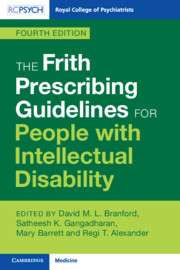
- The Frith Prescribing Guidelines for People with Intellectual Disability
- Reviews
- The Frith Prescribing Guidelines for People with Intellectual Disability
- Copyright page
- Contents
- Contributors
- Foreword
- Preface
- Acknowledgements
- Chapter 1Intellectual Disability
- Chapter 2Prescribing Practice
- Chapter 3Physical Health Monitoring
- Chapter 4Mental Health Conditions in People with Intellectual Disability
- Chapter 5Trauma in People with Intellectual Disability
- Chapter 6Anxiety Disorders
- Chapter 7Depression
- Chapter 8Bipolar Disorders
- Chapter 9Schizophrenia
- Chapter 10Aggression and Self-Injurious Behaviour
- Chapter 11Personality Disorders
- Chapter 12Sexual Offences and Paraphilias
- Chapter 13Substance Use Disorders
- Chapter 14Attention Deficit Hyperactivity Disorder
- Chapter 15Autism
- Chapter 16Sleep Disorders
- Chapter 17Epilepsy
- Chapter 18Dementia
- Chapter 19Eating and Drinking Difficulties
- Chapter 20Children and Adolescents
- Chapter 21Prescribing for Health Issues in Women with Intellectual Disability
- Chapter 22Older People
- Index
- References
Chapter 10 - Aggression and Self-Injurious Behaviour
Published online by Cambridge University Press: 07 November 2024

Book contents
- The Frith Prescribing Guidelines for People with Intellectual Disability
- Reviews
- The Frith Prescribing Guidelines for People with Intellectual Disability
- Copyright page
- Contents
- Contributors
- Foreword
- Preface
- Acknowledgements
- Chapter 1Intellectual Disability
- Chapter 2Prescribing Practice
- Chapter 3Physical Health Monitoring
- Chapter 4Mental Health Conditions in People with Intellectual Disability
- Chapter 5Trauma in People with Intellectual Disability
- Chapter 6Anxiety Disorders
- Chapter 7Depression
- Chapter 8Bipolar Disorders
- Chapter 9Schizophrenia
- Chapter 10Aggression and Self-Injurious Behaviour
- Chapter 11Personality Disorders
- Chapter 12Sexual Offences and Paraphilias
- Chapter 13Substance Use Disorders
- Chapter 14Attention Deficit Hyperactivity Disorder
- Chapter 15Autism
- Chapter 16Sleep Disorders
- Chapter 17Epilepsy
- Chapter 18Dementia
- Chapter 19Eating and Drinking Difficulties
- Chapter 20Children and Adolescents
- Chapter 21Prescribing for Health Issues in Women with Intellectual Disability
- Chapter 22Older People
- Index
- References
Summary
Aggression is often defined with reference to the intended consequences of an act exhibited by a person, or as any behaviour exhibited by a person where they intentionally acted to cause harm to another. Behaviours which cause harm but without associated intent tend not to be defined as aggression. Some people with intellectual disability may engage in behaviours with intent to cause harm to another, while for others, especially those with severe to profound intellectual disability, an absence of intent may exist. Aggressive behaviour exhibited by people with intellectual disability can take the form of verbal threats, physical aggression directed towards others including punching, kicking, slapping and biting, amongst other behaviours, as well as property damage and destruction. Aggressive behaviour can cause serious harm to others which may be life-threatening and result in social exclusion and a reduced quality of life. This chapter provides an overview of severe aggression and self-injurious behaviour relevant to people with disorders of intellectual development, and focuses on the evidence base for the various challenging behaviours and whether there is benefit from medication or alternative approaches.
Keywords
Information
- Type
- Chapter
- Information
- Publisher: Cambridge University PressPrint publication year: 2024
References
Ahmed, Z., Fraser, W., Kerr, M. P., et al. (2000). Reducing antipsychotic medication in people with a learning disability. The British Journal of Psychiatry, 176, 42–6.CrossRefGoogle ScholarPubMed
Aman, M. G., De Smedt, G., Derivan, A., et al. (2002). Double-blind, placebo-controlled study of risperidone for the treatment of disruptive behaviors in children with subaverage intelligence. American Journal of Psychiatry, 159, 1337–46.CrossRefGoogle ScholarPubMed
Amore, M., Bertelli, M., Villani, D., Tamborini, S., & Rossi, M. (2011). Olanzapine vs. risperidone in treating aggressive behaviours in adults with intellectual disability: A single blind study. Journal of Intellectual Disability Research, 55, 210–18.CrossRefGoogle ScholarPubMed
Anderson, C. A., & Bushman, B. J. (2002). Human aggression. Annual Review of Psychology, 53, 27–51.CrossRefGoogle ScholarPubMed
Chan, J., Arnold, S., Webber, L., Riches, V., & Parmenter, T. (2012). Is it time to drop the term ‘Challenging Behaviour’? Learning Disability Practice, 15, 36–8.CrossRefGoogle Scholar
Cohen, D., Raffin, M., Canitano, R., et al. (2013). Risperidone or aripiprazole in children and adolescents with autism and/or intellectual disability: A Bayesian meta-analysis of efficacy and secondary effects. Research in Autism Spectrum Disorders, 7, 167–75.CrossRefGoogle Scholar
Cooper, S. A., Smiley, E., Allan, L. M., et al. (2009a). Adults with intellectual disabilities: prevalence, incidence and remission of self-injurious behaviour, and related factors. Journal of Intellectual Disability Research, 53, 200–16.Google ScholarPubMed
Cooper, S. A., Smiley, E., Jackson, A., et al. (2009b). Adults with intellectual disabilities: prevalence, incidence and remission of aggressive behaviour and related factors. Journal of Intellectual Disability Research, 53, 217–32.Google ScholarPubMed
Cooper, S. J., Reynolds, G. P., Barnes, T., et al. (2016). BAP guidelines on the management of weight gain, metabolic disturbances and cardiovascular risk associated with psychosis and antipsychotic drug treatment. Journal of Psychopharmacology, 30, 717–48.CrossRefGoogle ScholarPubMed
Costello, A., Hudson, E., Morrissey, S., et al. (2022). Management of psychotropic medications in adults with intellectual disability: A scoping review. Annals of Medicine, 54, 2486–99.CrossRefGoogle ScholarPubMed
Craft, M., Ismail, I., Krishnamurti, D., et al. (1987). Lithium in the treatment of aggression in mentally handicapped patients: A double-blind trial. The British Journal of Psychiatry, 150, 685–9.CrossRefGoogle ScholarPubMed
Crocker, A. G., Mercier, C., Allaire, J. F., & Roy, M. E. (2007). Profiles and correlates of aggressive behaviour among adults with intellectual disabilities. Journal of Intellectual Disability Research, 51, 786–801.CrossRefGoogle ScholarPubMed
Crocker, A. G., Mercier, C., Lachapelle, Y., et al. (2006). Prevalence and types of aggressive behaviour among adults with intellectual disabilities. Journal of Intellectual Disability Research, 50, 652–61.CrossRefGoogle ScholarPubMed
Davies, L. E., & Oliver, C. (2016). Self-injury, aggression and destruction in children with severe intellectual disability: Incidence, persistence and novel, predictive behavioural risk markers. Research in Developmental Disabilities, 49–50, 291–301.CrossRefGoogle ScholarPubMed
Davies, L., & Oliver, C. (2013). The age related prevalence of aggression and self-injury in persons with an intellectual disability: A review. Research in Developmental Disabilities, 34, 764–75.CrossRefGoogle ScholarPubMed
Deb, S., Thomas, M., & Bright, C. (2001). Mental disorder in adults with intellectual disability. 2: The rate of behaviour disorders among a community-based population aged between 16 and 64 years. Journal of Intellectual Disability Research, 45, 506–14.Google ScholarPubMed
Denis, J., Van Den Noortgate, W., & Maes, B. (2011). Self-injurious behavior in people with profound intellectual disabilities: A meta-analysis of single-case studies. Research in Developmental Disabilities, 32, 911–23.CrossRefGoogle ScholarPubMed
Dimian, A. F., & Symons, F. J. (2022). A systematic review of risk for the development and persistence of self-injurious behavior in intellectual and developmental disabilities. Clinical Psychology Review, 94, 102158.CrossRefGoogle ScholarPubMed
Heyvaert, M., Maes, B., & Onghena, P. (2010). A meta-analysis of intervention effects on challenging behaviour among persons with intellectual disabilities. Journal of Intellectual Disability Research, 54, 634–49.CrossRefGoogle ScholarPubMed
Heyvaert, M., Maes, B., Van Den Noortgate, W., Kuppens, S., & Onghena, P. (2012). A multilevel meta-analysis of single-case and small-n research on interventions for reducing challenging behavior in persons with intellectual disabilities. Research in Developmental Disabilities, 33, 766–80.CrossRefGoogle ScholarPubMed
Hollander, E., Wasserman, S., Swanson, E. N., et al. (2006). A double-blind placebo-controlled pilot study of olanzapine in childhood/adolescent pervasive developmental disorder. Journal of Child, & Adolescent Psychopharmacology, 16, 541–8.CrossRefGoogle ScholarPubMed
Juneja, D. K., Sultan, A., Juneja, A., & Siddiqui, M. (2019). Lesch–Nyhan syndrome: A rare occurrence. Journal of Behavioral Health, 8, 122–5.CrossRefGoogle Scholar
L’Abbé, Y., & Morin, D. (2001). Comportements Agressifs et Retard Mental: Compréhension et Intervention, 2nd ed. QC, Éditions behaviora.Google Scholar
Mace, F. C., & Mauk, J. E. (1995). Bio‐behavioral diagnosis and treatment of self‐injury. Mental Retardation and Developmental Disabilities Research Reviews, 1, 104–10.CrossRefGoogle Scholar
Mascitelli, A. N., Rojahn, J., Nicolaides, V. C., et al. (2015). The Behaviour Problems Inventory‐Short Form: Reliability and factorial validity in adults with intellectual disabilities. Journal of Applied Research in Intellectual Disabilities, 28, 561–71.CrossRefGoogle ScholarPubMed
McAdam, D. B., Zarcone, J. R., Hellings, J., Napolitano, D. A., & Schroeder, S. R. (2002). Effects of risperidone on aberrant behavior in persons with developmental disabilities: II. Social validity measures. American Journal on Mental Retardation, 107, 261–9.Google ScholarPubMed
McDougle, C. J., Holmes, J. P., Carlson, D. C., et al. (1998). A double-blind, placebo-controlled study of risperidone in adults with autistic disorder and other pervasive developmental disorders. Archives of General Psychiatry, 55, 633–41.CrossRefGoogle ScholarPubMed
Morano, S., Ruiz, S., Hwang, J., et al. (2017). Meta-analysis of single-case treatment effects on self-injurious behavior for individuals with autism and intellectual disabilities. Autism, & Developmental Language Impairments, 2, 2396941516688399.CrossRefGoogle Scholar
National Institute for Health and Care Excellence (2015). Challenging behaviour and learning disabilities: prevention and interventions for people with learning disabilities whose behaviour challenges, National Institute for Health and Care Excellence.Google Scholar
Oliver, C., Licence, L., & Richards, C. (2017). Self-injurious behaviour in people with intellectual disability and autism spectrum disorder. Current Opinion in Psychiatry, 30, 97–101.CrossRefGoogle ScholarPubMed
Rana, F., Gormez, A., & Varghese, S. (2013). Pharmacological interventions for self‐injurious behaviour in adults with intellectual disabilities. Cochrane Database of Systematic Reviews, 4, CD009084.Google Scholar
Rees, J., & Langdon, P. E. (2016). The relationship between problem-solving ability and self-harm amongst people with mild intellectual disabilities. Journal of Applied Research in Intellectual Disabilities, 29, 387–93.CrossRefGoogle ScholarPubMed
Rojahn, J., Rowe, E., Sharber, A., et al. (2012). The Behavior Problems Inventory‐Short Form for individuals with intellectual disabilities: Part I: development and provisional clinical reference data. Journal of Intellectual Disability Research, 56, 527–45.Google ScholarPubMed
Royal College of Psychiatrists (2001). DC-LD: Diagnostic criteria for psychiatric disorders for use with adults with learning disabilities/mental retardation, London, Royal College of Psychiatrists, Occasional Paper OP 48.Google Scholar
Ruedrich, S., Swales, T., Fossaceca, C., Toliver, J., & Rutkowski, A. (1999). Effect of divalproex sodium on aggression and self‐injurious behaviour in adults with intellectual disability: A retrospective review. Journal of Intellectual Disability Research, 43, 105–11.CrossRefGoogle ScholarPubMed
Schroeder, S. R., Marquis, J. G., Reese, R. M., et al. (2014). Risk factors for self-injury, aggression, and stereotyped behavior among young children at risk for intellectual and developmental disabilities. American Journal on Intellectual and Developmental Disabilities, 119, 351–70.CrossRefGoogle ScholarPubMed
Sohanpal, S., Deb, S., Thomas, C., et al. (2007). The effectiveness of antidepressant medication in the management of behaviour problems in adults with intellectual disabilities: A systematic review. Journal of Intellectual Disability Research, 51, 750–65.CrossRefGoogle ScholarPubMed
Tyrer, F., McGrother, C. W., Thorp, C. F., et al. (2006). Physical aggression towards others in adults with learning disabilities: Prevalence and associated factors. Journal of Intellectual Disability Research, 50, 295–304.CrossRefGoogle ScholarPubMed
Tyrer, P., Oliver-Africano, P. C., Ahmed, Z., et al. (2008). Risperidone, haloperidol, and placebo in the treatment of aggressive challenging behaviour in patients with intellectual disability: A randomised controlled trial. The Lancet, 371(9606), 57–63.CrossRefGoogle ScholarPubMed
Zarcone, J. R., Hellings, J. A., Crandall, K., et al. (2001). Effects of risperidone on aberrant behavior of persons with developmental disabilities: I. A double-blind crossover study using multiple measures. American Journal on Mental Retardation, 106, 525–38.Google Scholar
Zarcone, J. R., Lindauer, S. E., Morse, P. S., et al. (2004). Effects of risperidone on destructive behavior of persons with developmental disabilities: III. Functional analysis. American Journal on Mental Retardation, 109, 310–21.Google ScholarPubMed
Accessibility standard: Unknown
Why this information is here
This section outlines the accessibility features of this content - including support for screen readers, full keyboard navigation and high-contrast display options. This may not be relevant for you.Accessibility Information
Accessibility compliance for the HTML of this chapter is currently unknown and may be updated in the future.