Book contents
- Frontmatter
- Contents
- List of Tables
- Preface
- 1Policy-Making Accountability and Democratic Consolidation
- 2Alternative Routes to Policy-Making Accountability
- 3Legacy of the Past
- 4External Accountability and the European Union
- 5Oversight
- 6Decentralized Political Accountability
- 7Public Participation in Policy Making: Government Procedures
- 8Civil Society Groups: Overview
- 9Environmental Advocacy Organizations in Hungary
- 10Student and Youth Organizations in Poland
- 11Democratic Consolidation and Policy-Making Accountability
- Appendix 1
- Appendix 2
- References
- Index
11 - Democratic Consolidation and Policy-Making Accountability
Published online by Cambridge University Press: 23 July 2009

Book contents
- Frontmatter
- Contents
- List of Tables
- Preface
- 1Policy-Making Accountability and Democratic Consolidation
- 2Alternative Routes to Policy-Making Accountability
- 3Legacy of the Past
- 4External Accountability and the European Union
- 5Oversight
- 6Decentralized Political Accountability
- 7Public Participation in Policy Making: Government Procedures
- 8Civil Society Groups: Overview
- 9Environmental Advocacy Organizations in Hungary
- 10Student and Youth Organizations in Poland
- 11Democratic Consolidation and Policy-Making Accountability
- Appendix 1
- Appendix 2
- References
- Index
Summary
Both Poland and Hungary need to create more open and accountable policy-making processes. Political parties and contested elections are central to the democratic structures of both states, but widespread popular distrust of political parties suggests they cannot carry the entire burden of responsible government. Over half the population is dissatisfied with democracy and lacks confidence in parliament. Delegation to professional bureaucrats is not a sufficient response. Even though people have faith in experts, many lack confidence in the civil service and view them as biased and corrupt. Civil service reform can help, but it is mainly a route to performance accountability, not policy-making accountability. It needs to be integrated with reforms designed to improve the policy-making processes of government.
Monitoring and Participation
I have outlined the strengths and weaknesses of five types of monitoring and participation that can enhance policy-making accountability. Four of the five have inherent limits that imply the need to strengthen the fifth type – open-ended participation by citizens and organized groups in government-led processes. The first four are external accountability, accountability inside the central government, decentralized political accountability, and corporatist social dialogue.
The first requires the state to defer to external constraints imposed by international bodies such as the European Union (EU). Although this can provide an effective push toward reform in particular cases, it can provoke a backlash by citizens if extended too far. Citizens may resent being dictated to by outsiders and resist reforms simply because they appear to be imposed.
Information
- Type
- Chapter
- Information
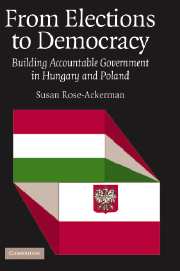
- From Elections to DemocracyBuilding Accountable Government in Hungary and Poland, pp. 216 - 240Publisher: Cambridge University PressPrint publication year: 2005
Accessibility standard: Unknown
Why this information is here
This section outlines the accessibility features of this content - including support for screen readers, full keyboard navigation and high-contrast display options. This may not be relevant for you.Accessibility Information
Accessibility compliance for the PDF of this chapter is currently unknown and may be updated in the future.