Book contents
- Frontmatter
- Contents
- Acknowledgments
- Introduction: Germany's Memory Contests and the Management of the Past
- Positions
- Mediations
- 4Being Translated: Exile, Childhood, and Multilingualism in G.-A. Goldschmidt and W. G. Sebald
- 5“Ein Stück langweiliger als die Wehrmachtsausstellung, aber dafür reprüsentativer”: The Exhibition Fotofeldpost as Riposte to the “Wehrmacht Exhibition”
- 6German Crossroads: Visions of the Past in German Cinema after Reunification
- 7Monika Maron's Pawels Briefe: Photography, Narrative, and the Claims of Postmemory
- Ethnicity/Hybridity
- Memory Politics
- Works Cited
- Notes on the Editors and Contributors
- Index
4 - Being Translated: Exile, Childhood, and Multilingualism in G.-A. Goldschmidt and W. G. Sebald
from Mediations
Published online by Cambridge University Press: 05 February 2013

Book contents
- Frontmatter
- Contents
- Acknowledgments
- Introduction: Germany's Memory Contests and the Management of the Past
- Positions
- Mediations
- 4Being Translated: Exile, Childhood, and Multilingualism in G.-A. Goldschmidt and W. G. Sebald
- 5“Ein Stück langweiliger als die Wehrmachtsausstellung, aber dafür reprüsentativer”: The Exhibition Fotofeldpost as Riposte to the “Wehrmacht Exhibition”
- 6German Crossroads: Visions of the Past in German Cinema after Reunification
- 7Monika Maron's Pawels Briefe: Photography, Narrative, and the Claims of Postmemory
- Ethnicity/Hybridity
- Memory Politics
- Works Cited
- Notes on the Editors and Contributors
- Index
Summary
Current German literature is marked by a new tone in the representation of scenes, events, and figures of the National Socialist period and the Shoah: it diverges from previous ways of coming to terms with the past. This is true not only for younger writers who — like Norbert Gstrein in Die englischen Jahre (The English Years, 1999) or Selbstporträt mit einer Toten (Self-Portait with a Dead Woman, 2000), Marcel Beyer in Spione (Spies, 2000) and Katharina Hacker in Eine Art Liebe (A Form of Love, 2003) — work on a narrative dialectics of memory and imagination, but also for writers of the postwar generation and even for some contemporaries of the events in question. These writers generate literary discourses on cultural memory that focus on the secret, uncanny, and barely accessible parts of history, exposing identity, collective or individual, as a fictional construct. This development in German literature is connected to the way the discourses themselves unfold. I will argue that in certain German literary discourses it is the “Germanness” of the discourse itself that is at stake. In pursuing this line of thought, I will examine texts written during the 1990s by Georges-Arthur Goldschmidt and W. G. Sebald. While these two authors write about completely different experiences and life circumstances (determined by their years of birth, 1928 and 1944), they nevertheless treat the same subject: emigration and exile. In both cases, the treatment of this subject affects the very diction of the texts.
Information
- Type
- Chapter
- Information
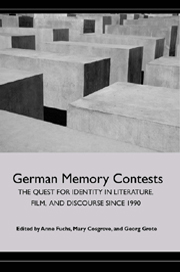
- German Memory ContestsThe Quest for Identity in Literature, Film, and Discourse since 1990, pp. 87 - 106Publisher: Boydell & BrewerPrint publication year: 2006
Accessibility standard: Unknown
Why this information is here
This section outlines the accessibility features of this content - including support for screen readers, full keyboard navigation and high-contrast display options. This may not be relevant for you.Accessibility Information
Accessibility compliance for the PDF of this chapter is currently unknown and may be updated in the future.