Book contents
- Frontmatter
- Contents
- Acknowledgments
- Introduction: Germany's Memory Contests and the Management of the Past
- Positions
- Mediations
- Ethnicity/Hybridity
- Memory Politics
- 11The Anxiety of German Influence: Affiliation, Rejection, and Jewish Identity in W. G. Sebald's Work
- 12Between “Restauration” and “Nierentisch”: The 1950s in Ludwig Harig, F. C. Delius, and Thomas Hettche
- 13On Forgetting and Remembering: The New Right since German Unification
- 14A Heimat in Ruins and the Ruins as Heimat: W. G. Sebald's Luftkrieg und Literatur
- Works Cited
- Notes on the Editors and Contributors
- Index
13 - On Forgetting and Remembering: The New Right since German Unification
from Memory Politics
Published online by Cambridge University Press: 05 February 2013

Book contents
- Frontmatter
- Contents
- Acknowledgments
- Introduction: Germany's Memory Contests and the Management of the Past
- Positions
- Mediations
- Ethnicity/Hybridity
- Memory Politics
- 11The Anxiety of German Influence: Affiliation, Rejection, and Jewish Identity in W. G. Sebald's Work
- 12Between “Restauration” and “Nierentisch”: The 1950s in Ludwig Harig, F. C. Delius, and Thomas Hettche
- 13On Forgetting and Remembering: The New Right since German Unification
- 14A Heimat in Ruins and the Ruins as Heimat: W. G. Sebald's Luftkrieg und Literatur
- Works Cited
- Notes on the Editors and Contributors
- Index
Summary
The New Right and Postmemory
Located at the intersection of culture and politics and to the right of mainstream conservatism, the New Right in Germany today provides an interesting case study in forgetting and remembering. What kind of collective political and cultural memory is the New Right trying to construct, and how much of a turning point was German unification for this construction? The New Right has seen generational change among its own ranks since it came into existence at the end of the sixties, and a key question of postmemory — what happens to the memory of National Socialism with the passing of the generations that experienced it directly? — has a particular relevance for the New Right since some of the figures associated with its early years rejected National Socialism only after a period of direct support and involvement with it. The answers to these questions are complicated by the fact that the New Right is a political and a cultural movement, and the relationship between its political and cultural dimensions is far from harmonious. New Right culture was meant to function as a political resource, providing a set of values as the foundation for a New Right program. By the start of the seventies it had become apparent to advocates of a self-assertive German nationalism that the Right needed to give itself an intellectual dimension that would help it gain broad public support in the pre-political sphere before it could expect electoral success.
Information
- Type
- Chapter
- Information
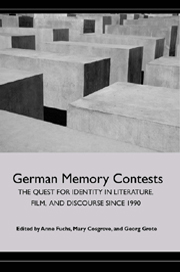
- German Memory ContestsThe Quest for Identity in Literature, Film, and Discourse since 1990, pp. 271 - 286Publisher: Boydell & BrewerPrint publication year: 2006
Accessibility standard: Unknown
Why this information is here
This section outlines the accessibility features of this content - including support for screen readers, full keyboard navigation and high-contrast display options. This may not be relevant for you.Accessibility Information
Accessibility compliance for the PDF of this chapter is currently unknown and may be updated in the future.