

When the Anglo-American theatre manager and actor Maurice E. Bandmann died of enteric fever at the Colonial Hospital in Gibraltar on 9 March 1922, shortly before his fiftieth birthday, the event was reported across the English-speaking world from Madras to Singapore and from Cairo to Hong Kong, with many newspapers carrying lengthy obituaries. The Times of India called him ‘the pioneer of musical comedy in this part of the world’, having ‘brought to the East some forty or fifty companies’.Footnote 1 The Straits Times in Singapore claimed that ‘he inaugurated the system that will remain as a monument to his memory in theatrical circles’.Footnote 2 The Era, London’s theatrical trade paper, emphasized ‘the fine plays and well-equipped companies he presented [which] became famous in all parts of the world, many stars appearing under his management, and the Bandman Opera Company, with all the latest musical comedy successes, was exceedingly popular everywhere in the East’.Footnote 3 As these statements indicate, Maurice Bandmann was at the time considered a key figure in what will be called in this book the globalization of theatre. For over two decades, Bandmann was a household name in the theatre world, a guarantor of quality itinerant theatrical entertainment and especially of musical comedy, performed by the legendary Bandmann Opera Company. The Bandmann Circuit, as it was known, extended from Gibraltar to Tokyo and included more than two dozen towns and cities across the Asian continent as well as occasional forays to the West Indies and even South America. In terms of sheer reach and territory covered, Bandmann was a global theatrical entrepreneur, who, while certainly concentrating on English-speaking settlements, also performed regularly in Japan to Japanese audiences, before Chinese in Shanghai and Peking and in numerous cities where audiences were linguistically mixed.
Yet the ‘monument to his memory’ remained short-lived, scarcely surviving beyond the closure of his companies. Despite his global reach and ubiquitous presence in the theatrical world of late colonialism, today he is largely forgotten, his name at best a footnote in the annals of musical comedy or Indian and Japanese theatre history. Although historiographical amnesia is common in theatre over the years and linked among other things to the ephemeral nature of theatrical performance, the Bandmann case is a special one because of the spatial and temporal extent of his presence. While theatrical touring outside the United Kingdom at the height of the age of empire was common, Bandmann developed it on a scale that was unprecedented. Western-style theatre reached places it had never been before and with a regularity that was new. This was transnational, flexible, highly mobile, tightly organized commercial theatre dependent on and responsive to culturally diverse and geographically dispersed publics.
Maurice Edward Bandmann was born in New York in 1872 as the second child of two prominent actor-managers, Daniel E. Bandmann and Millicent Bandmann-Palmer. After completing his schooling at a classical German Gymnasium in Wiesbaden, Bandmann entered the acting profession, touring with both his father in the United States and his mother in the United Kingdom. Although he quickly became an accomplished actor, he became known in theatrical circles in the 1890s as the youngest actor-manager in the business. It is his managerial career that marks a new phase in the organization of theatrical touring. Within a few years, he controlled four separate troupes in Britain and in 1897 joined forces with Malcolm Wallace to form the English Comedy Company to tour Gibraltar, Tangiers, Malta and Egypt, the first stage in building the circuit that was to extend east all the way to Japan and then westwards across the Atlantic to the West Indies.
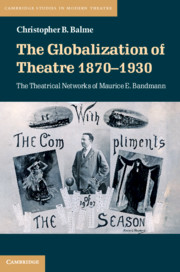
After a first and somewhat unsuccessful foray into India in 1901, which coincided with the death of Queen Victoria and hence a temporary lack of interest in musical comedy, Bandmann took a light opera company to the West Indies. In 1902, he embarked on a tour to South America extending from Brazil to Peru, with a return route that included Halifax, Nova Scotia. In 1905, Bandmann resumed operations in India and made Calcutta his headquarters; here he rapidly established a ‘circuit’, which by his own account took in ‘Gibraltar, Malta, Egypt, India, Burmah, with the Malay States, the Straits Settlements, China, Japan, Java and Philippine Islands’.Footnote 4 A calendar he issued to prospective theatres along the route in 1906 already figured him as a ‘global player’ positioned between ships, trains and different theatrical genres, his hand resting nonchalantly on a globe (see cover jacket). Bandmann built, owned, managed or leased numerous theatres along his circuit, thus extending commercial control over all aspects of theatre production and reception.
A stranger to modesty and an expert in self-advertisement, for over twenty years Bandmann and his name stood for high-quality theatrical entertainment aimed at European and local audiences alike. As a Singapore paper noted in 1906, ‘the name of Bandmann is a sort of guinea stamp among itinerant theatrical circles’.Footnote 5 In 1900 he floated the Mediterranean and the East Entertainment Syndicate, his first joint-stock company. This was followed in 1914 by the Bandman Varieties Ltd, and some years later by the Bandman Eastern Circuit Ltd (he dropped the second, Germanic-looking ‘n’ from his name because of the war), which controlled his many interests, including cinema distribution. These were public companies listed on the Indian stock exchange.Footnote 6 Upon his premature death in 1922, his personal fortune was assessed at around £33,000, the equivalent of just under £1 million in today’s currency, a modest fortune perhaps by impresario standards, but a fortune nonetheless. Despite his death, Bandman Varieties and the Bandman Eastern Circuit companies continued to operate in India well into the 1930s.
This book will focus on Bandmann’s transnational theatrical networks and how they emerged, functioned and ultimately dissolved in the context of early globalization. These networks were based on theatrical touring, perhaps the most under-researched of the various manifestations of transnational, even global, theatre in the period under scrutiny. The focus of this book is threefold. Firstly, this volume covers the relational structures created by theatrical circuits operating around the turn of the century that were transitioning from the almost moribund actor-manager model to complex, syndicated systems of theatrical entrepreneurship such as the theatrical circuit established by Bandmann. Secondly, the book examines how theatre responded to and participated in the processes known as the first phase of globalization – roughly the period extending from the opening of the Suez Canal in 1869 to the outbreak of the First World War in 1914. Aided by technological developments such as steamships, railways and telegraphic communication, this period saw an almost unprecedented expansion of peoples, empires and economic activity that led quite literally to global connectivity, with many parallels to current conceptions of globalization. It also saw an unprecedented expansion of theatre-building, the provision of theatrical infrastructure in which Bandmann was heavily involved. The third area concerns how spectators and performers responded to and were involved in this kind of theatrical globalization under conditions of mobility. For the former group the question is how did highly heterogeneous publics respond to the theatrical repertoire on offer? For the latter we need to ask how theatrical labour was organized under conditions of extreme duress – situations of propinquity lasting between eighteen months and two years – which sometimes resulted in legal action by employees and management.
These heterogeneous factors will be framed within the coordinates of network theory, a primarily sociological approach which is now beginning to be adapted for historical research. It offers a way to comprehend and analyse a complex of phenomena that combined affective (familial) interaction, commerce, theatrical repertoire, continual mobility, the politics of locality and legal disputes. Each of these elements comprises nodes in the network of performers on the move. If we apply the usual criteria for justifying arts-based research – the innovation and creativity of the artist and works – then Bandmann’s companies provide little to interest the humanities scholar: his repertoire was derivative, essentially touring versions of London hits. The originality and uniqueness of the Bandmann enterprise was the network itself – its complex pattern of interconnected elements that had to mesh to succeed. The remarkable achievement is the sheer extent and complexity of a network that extended geographically from London to Japan and was held together by shipping timetables, a constant stream of telegrams, contracts, shifting jurisdictions and an indefatigable manager at the centre.
Theatrical Networks
The material presented in this book is almost entirely absent from theatre histories, lexica and archives. Why is this? And perhaps more importantly, how can one examine this material in such a way that its dynamics and interconnections become visible? I propose that network theory can offer a fruitful avenue for historiographical recuperation. There are, of course, as many network theories as there are networks: social, technological, biological, political and economic, to name only some. What connects most of these quite disparate concepts and theories is a common emphasis on relational structures. By definition, relational structures are changing configurations of agents and nodes that constitute relay points around which communication and interaction take place. Relational structures are dependent on the actions of other agents in the network. Some forms of network analysis attempt to plot these interconnections visually to demonstrate degrees of connectivity and tend to privilege aggregated data demonstrating multiple connections and correlations. Such connections take precedence over monocausal factors such as class, sex, clan membership or individual agency. This has been termed the ‘anticategorical imperative’, an approach which rejects attempts to explain human behaviour or social processes ‘solely in terms of the categorical attributes of actors, whether individual or collective’.Footnote 7 This book will draw on two main strands of network theory and methodology: historical network analysis and actor-network theory (often playfully abbreviated as ANT).Footnote 8
Historical network analysis adapts social network theory and applies it to historical phenomena. The former draws on both mathematical and economic approaches that have led in turn to the emergence of a branch of sociology which employs network theory as an analytical tool to explain economic behaviour. Sociologists such as Mark Granovetter have argued that networks can be divided into strong (homophilic) and weak (heterophilic) types. Strong networks such as extended families evince a high degree of homophily, a tendency to gravitate to people similar to ourselves. Granovetter’s and many subsequent studies have, however, demonstrated that, generally speaking, heterophilic (or weak) ties are the more beneficial because a predominance of homophilic ties would lead to a highly fragmented world. In a society with relatively few weak ties, ‘new ideas will spread slowly, scientific endeavours will be handicapped, and subgroups separated by race, ethnicity, geography, or other characteristics will have difficulty reaching a modus vivendi’.Footnote 9 In contrast, heterophilic networks, because of their reliance on weak ties, can much more easily form connections with other networks, a precondition for innovation and adaptation.
Almost all network theories work with concepts of nodes, edges and hubs (or their terminological equivalents). Nodes are entities (people, events, places, etc.) that stand in a relation of connectedness to other nodes. These connective relations are known as ‘edges’. Hubs are usually understood as nodes with a particularly high degree of connectedness: they have an unusually large number of edges. Because edges can differ greatly in their intensity and degree of importance for a network, they are differentiated according to three main categories of centrality: degree centrality refers to the number of edges radiating from a specific node; betweenness centrality designates the importance of a specific node in a network (usually the number of connections it enables); while closeness centrality refers to the proximity of a node to other nodes (this might influence a person’s access to information). According to Freeman, a high degree of betweenness centrality is necessary to control communication, which is of key importance, for example, to both a mother of a family and a theatrical entrepreneur.Footnote 10
In his book The Square and the Tower: Networks and Power, from the Freemasons to Facebook, historian Niall Ferguson gives historical network analysis a new urgency. He offers an incisive review of network theory, both mathematical and sociological, before arriving at an over-simplified (as he states) distinction between hierarchies and networks.Footnote 11 His argument is the following: very broadly, historians have been overly focused on hierarchical structures because these leave behind the kinds of archives that historians like to study, whereas networks generally do not. Networks, on the other hand, tend to be more creative than hierarchies; we should expect a network-driven disruption of hierarchies that cannot reform themselves. Ferguson is aware that hierarchies are just a particular form of network with the special feature that they form nodes and edges in vertical rather than horizontal structures that index power and control. If we are looking for innovation, then we should be looking at the points of contact between diverse networks. His broad historical argument is that hierarchies are the dominant mode of governmentality between 1790 and 1970, the so-called corporate age. Recent times – since the 1970s – have seen a reassertion of network structures.
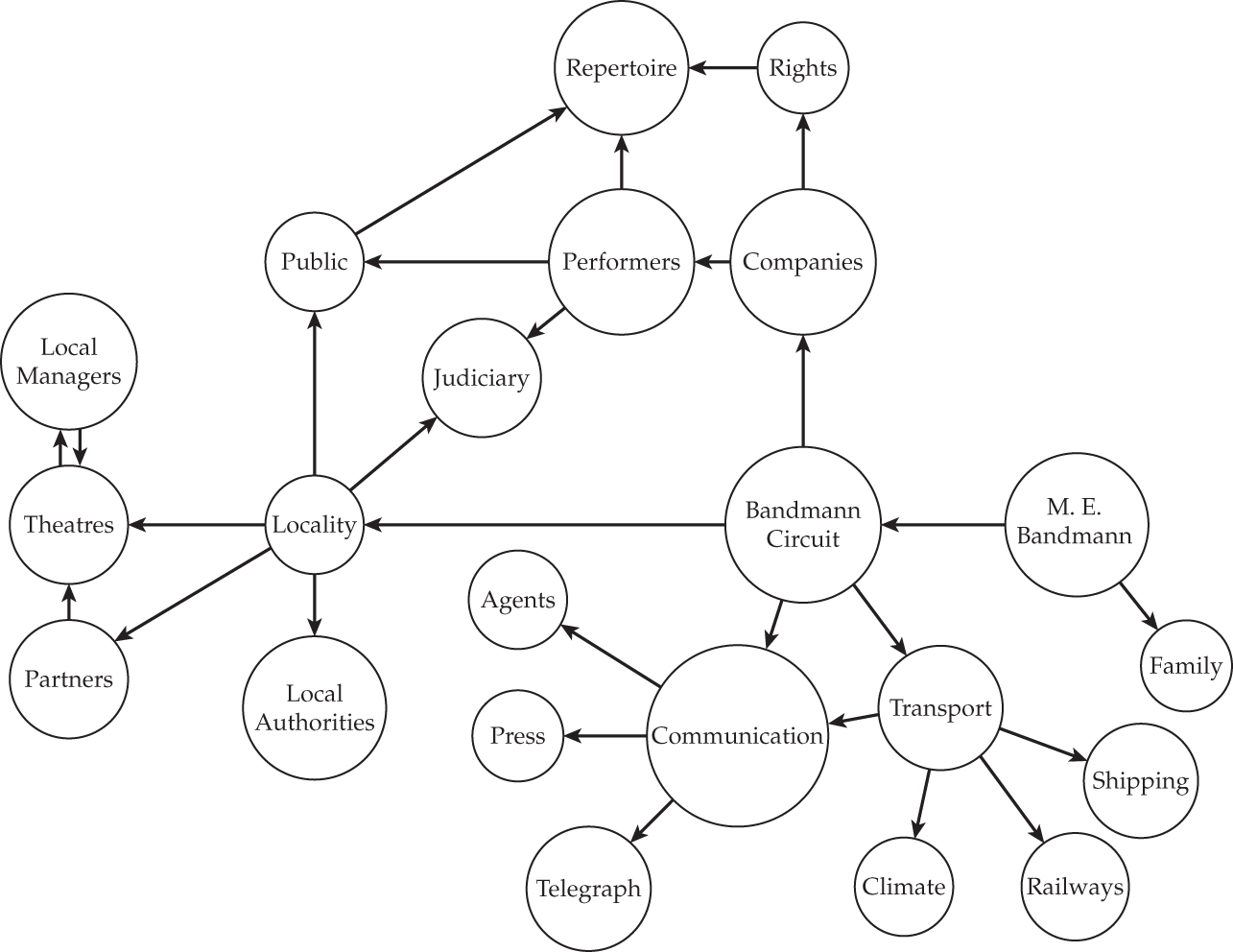
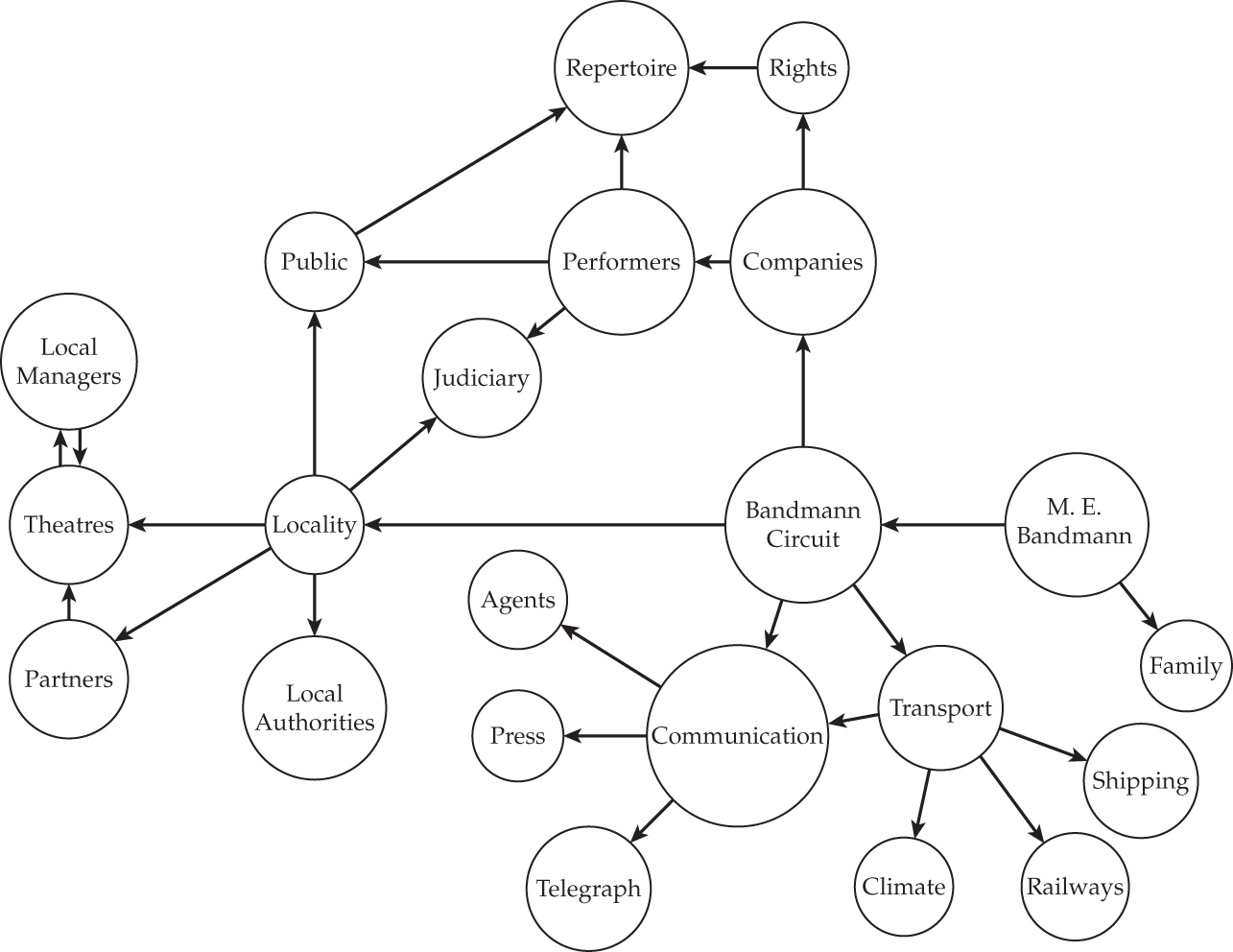
Aided by a growing selection of software, network analysis has become famous for its ability to visualize large amounts of data in order to demonstrate the various connections that exist between nodes: not only their relations to one another but also the degree or intensity of the relations.Footnote 12 Numerous studies have demonstrated the potential of visualizations to represent ‘centrality’ as previously defined. Historical network analysis enables us to plot ties, relations and connections. The argument put forward here is that the Bandmann Circuit was a complex network predicated on weak ties. We can see that the circuit, if we view it as a network and not just as a succession of ports of call, had multifarious edges (Fig. I.1). It intersected not just with the performers in the troupe but with venues, copyright holders, the stock market, colonial and municipal officials, and business partners. The elucidation of these varied and often complex connections is a central task of this book.
A visualization of the Bandmann Circuit emphasizing its betweenness centrality.
Historical network analysis has, however, some shortcomings. It does not model diachronic change well, nor is it particularly sensitive to interpretive ambiguity. The latter feature is one of the strengths of actor-network theory. Actor-network theory, or ANT, is a particular variant of social network analysis that emerged in the 1970s in the field of the sociology of science, or what is now known as science studies. It is linked to a group of French sociologists, the best known of whom is Bruno Latour, but also includes Michel Callon and the English sociologist John Law. Broadly and abstractly speaking, and at the risk of some simplification, ANT looks at interconnected networks of exchange known as actor networks. Actor networks consist in turn of interrelated nodes and actants in which human beings are as much relational effects as initiating, all-controlling subjects.Footnote 13 The revolutionary and controversial move of ANT has been to make non-social entities – microbes and scallops, to cite two famous examples – into actors. From objects being acted upon by conventional social actors (i.e. human beings), they were re-conceptualized as part of a network in which, under certain circumstances, they are seen to have considerable agency. The multiple perspectives and descriptive imperatives of ANT can help us rethink the complex relationships between theatrical trading, imperial formations and an understanding of what it meant to circulate and perform theatre in the first age of globalization.
Theatre and performance studies have engaged energetically with ANT in recent years as opposed to historical network analysis, which has largely been ignored. This is probably because, as Laura Smith-Doerr and Walter Powell argue, actor-network theory ‘stresses the process of translation, in which problems are redefined, supporters mobilized, and ideas and practices transformed in the process of interpretation’ (my emphasis).Footnote 14 Marlis Schweitzer and Leo Cabranes-Grant have both demonstrated how actor-network theory can be productively employed for theatre history. In her book Transatlantic Broadway: The Infrastructural Politics of Global Performance, Schweitzer examines ‘the transnational performances of ocean liners, piers, telegraph cables, telegrams, typewriters, office spaces, newspapers, and postcards’ and asks how these objects, ‘as participants in a series of complicated networks, transformed the machinery of US theatre as well as the everyday practices of those who produced and consumed it’.Footnote 15 Cabranes-Grant has demonstrated persuasively how ANT can be harnessed to explain ‘ethnographically’ historical intercultural encounters – in this case in early modern Mexico. Both Schweitzer and Cabranes-Grant recognize that Latour’s interest in the performative aspect of actor networks, where agents modify a relation in the act of connection, is especially productive for theatre and performance studies. For Cabranes-Grant, Latour’s actor-network theory is attractive ‘because it portrays the social as poiesis, a series of labors. ANT provides a methodology of transitions, a critical discourse in which cultural structures are manifestations of flow: not closure.’Footnote 16
Methodologically, actor-network theory can be considered a form of ethnography where techniques and practices of fieldwork and participant observation are applied to contemporary society and its many fields. Latour states that ANT is ‘simply another way of being faithful to the insights of ethnomethodology’.Footnote 17 Darryl Cressman refers to ANT’s ‘ethnographic bent: micro-level studies of the labs and boardrooms tracing how actors exert influence over the trajectory of scientific and technical innovation’.Footnote 18 Since ethnography tends to focus on the present, the question poses itself how theatre historians can extend such insights gathered from present-day laboratories and boardrooms and make them useful for their concerns. And does not ANT have tautological implications for theatre, not the least of which is the term ‘actor’, but more so because theatre is intrinsically ‘social’ on account of its conditions of collaborative production and collective reception? If we simply revisit the usual objects of theatre research – plays, performances, performers, audiences and occasionally theatre buildings – then there is a real danger that we simply reformulate old insights with new metaphors. A more productive application of actor-network theory would require a recalibration of epistemological assumptions regarding why we do not know anything about Maurice E. Bandmann and his global activities. If the person did not register in the theatre historical archive, then perhaps his circuit might. An ANT perspective would force us to concern ourselves more with the network than with the biographical person of Maurice Edward Bandmann. As Schweitzer states, an actor-network approach leads to a concern with objects and processes such as shipping and railway networks. To her list we could add newspapers, advance agents, the colonial judiciary, storms and tropical heat.Footnote 19 Actants would include texts, companies of performers, contracts and even courts, all of which acted upon each other in ‘webs of relations’.Footnote 20
Although one has not needed network theory to study Shakespeare, for example, the same cannot be said, I argue, for Maurice Bandmann’s now forgotten ‘circuit’ and indeed the whole branch of itinerant theatrical activity, which is also largely overlooked and often not even recorded in our theatre archives.Footnote 21 While we can certainly map the activities of Bandmann and his many colleagues onto commonly understood historical processes such as commodification, imperial expansion and colonial power structures, in this book they will be viewed from the perspective of connectivity.Footnote 22 In the chapter entitled ‘First Move: Localizing the Global’ of his book Reassembling the Social, Latour emphasizes the importance of examining connectivity itself:
We have to lay continuous connections leading from one local interaction to the other places, times, and agencies through which a local site is made to do something. This means that we have to follow the path indicated by the process of delegation or translation.Footnote 23
‘Translation’ is a technical term in ANT vocabulary and refers to a relation that ‘induces two mediators into coexisting’.Footnote 24 Mediators in turn transform and modify the elements they carry (as opposed to intermediaries, which do not). ANT is in this sense a theory that tries to analyse in precise terms the manifold dynamics of how various entities relate to one another in different degrees of intensity and transformative agency.
Following this perspective, we need to conceptualize itinerant theatre such as the Bandmann Circuit as a set of interconnected nodes that together constitute the relay points or ‘edges’ for these associations. We can try and map these nodes and their forms of agency; this means that ‘connections, vehicles and attachments are brought into the foreground’.Footnote 25 We must try and conceptualize this network of associations across time and space spanning thousands of miles, interacting in more than two dozen locales, each regulated by a different legal system, cultural mores, audience tastes and compositions.
Actor-network theory is not just something that is ‘applied’ to a pre-existing object of research; research itself constitutes an actor network in its own right. Prior to the accessibility of digital technology, it could be argued, the Bandmann Circuit did not exist historiographically. The type of research to be described in this book has only been made possible with the digital revolution and the advent of digitalized newspapers, books and other resources, which enable peripatetic artists to be tracked. This technology ultimately prescribes what is discoverable and knowable and thus is also a key ‘actor’.
In order to examine Bandmann’s circuit (and the many others like it), it is necessary to investigate the different nodes that were required for it to function at all. Besides the managerial role of Bandmann himself, which was obviously crucial but ultimately not essential (his circuit continued to function, albeit in an attenuated form, after his death), it is more productive to try and grasp if not the totality at least the multiaxial nature of the system and its various nodes. These can be represented as in Fig. I.1. In this conceptualization of a theatrical network, it is not exclusively the person Maurice E. Bandmann who forms the central node, but rather the circuit itself, although he certainly saw himself in this role. The biographical person Bandmann is only one fulcrum exerting pressure on the rest of the network.
Of central importance for any actor network are what Latour terms ‘mediators’, as mentioned earlier. These are transporters of meaning that ‘transform, translate, distort and modify the meaning or the elements they are supposed to carry’.Footnote 26 In this sense they should be distinguished from ‘intermediaries’, where there is no such distortion and modification. In Latour’s terminology, an intermediary is a ‘black box’ where input equals output and no modification takes place.Footnote 27 In both cases, the function of a mediator can be human or non-human: a scientific panel of experts can be an intermediary, or a machine such as a computer can be a mediator. Concepts such as ‘mediators’ carry major epistemological implications. A conventional way of looking at touring theatre such as the Bandmann Circuit would be to regard the passage of productions along it and measure their degree of modification and ‘distortion’ from the originating source – the original Gaiety production in London – to their versions in Bombay or Calcutta or Yokohama. Our object of interest would be, then, the local production of meaning, whether colonial or indigenous or some mixture of the two.
A less conventional and more networked way of looking at touring practices would examine certain mediators in terms of the connectivity the Bandmann Circuit exerted on the social fabric of the many communities it interacted with on a regular basis. This is clearly a difficult question to answer in the light of a complete dearth of research into Bandmann’s activities. Following ANT terminology, it would be necessary to understand a term such as ‘social fabric’ quite literally as a kind of texture of interwoven connections and associations. The diagram of the Bandmann Circuit gives an indication of the different weaves or nodes in this fabric. I propose, therefore, to discuss familiar topics of theatre history – repertoire, theatre buildings, publics and actors – but also some less familiar ones such as enterprise capitalism, incorporated companies and litigation, from the perspective of ‘mediation’ in the ANT sense of the term. In each case, I suggest, such mediators or mediation processes can be seen to ‘translate, distort and modify meaning’, not in a pejorative sense but as factors that cast light on the social dynamics of touring theatre in the first age of globalization.
Transnational Theatre in the First Age of Globalization
Many historians regard the period between 1870 and 1914 as a ‘first phase of globalization’ in as much as it evinces many parallels with current uses of the term, even though the word ‘globalization’ does not appear until the 1960s.Footnote 28 The watershed for this reading of world history is, according to Michael Geyer and Charles Bright, the worldwide ‘processes of unsettlement’ emerging in the mid- to late nineteenth century, which saw an accelerating ‘mobilization of peoples, things, ideas, and images and their diffusion in space and time’ and the efforts of both local rulers and global regimes (empires) to ‘settle’ them.Footnote 29 The tensions ensuing from these dynamic processes form a central focus of the discipline of global history. Concomitant with these tensions are technological advancements such as the laying of telegraph lines, the introduction of fast steamships and the growing networks of colonial and administrative centres, as well as the rapid spread of newspapers, which all combined to create the prerequisites for globalization in almost the present sense: a compression of time and space, movement towards standardization and a growing sensation of being part of an interconnected world.
The importance of technological innovations for theatrical touring was already evident to contemporaries. In his preface to Daniel Bandmann’s account of his three-and-a-half-year world tour in the 1880s, Barnard Gisby highlights the effects of technological innovation on travel and theatre:
Science has wrought marvels… . Steam and electricity … have revolutionized conceptions and thoughts in relation to the world, encircling it with a network of appliances that makes communication and travel between the most distant places possible, so that with a not very considerable amount of money and a few months of leisure the most ordinary mortal may become a rival of Captain Cook.Footnote 30
But beyond these ‘appliances’, Gisby develops an idea of globalization avant la lettre when he argues that modern science, through its discoveries, explorations, inventions, and adaptations of natural forces, ‘has … made man conscious of the limitations of the world as a whole … that humanity lives and moves and has its being in a very small place; that the orb which is its home is “cribbed, cabined, and confined” – an atom-world in the immensities of space and the eons of eternity’.Footnote 31 This is essentially an early formulation of the familiar globalization topos of the shrinking world that reappears with each technological shift.
Parallel with these demographic and technological changes, theatre too began to internationalize or ‘globalize’. This pattern was repeated throughout many of the former and existing colonial empires, particularly in South East Asia and Latin America. In addition to the construction of permanent theatre spaces, the same period saw a massive expansion of theatrical touring, which began to be organized on an industrial scale and brought European-style theatre to all of those parts of the globe that could be reached by steamship or rail or a combination of both. Telegraph networks, countless local newspapers and syndicated news agencies provided the communications infrastructure enabling the touring companies to find their audiences. The same networks that brought European troupes to Asia and South America also enabled movement in other directions as Japanese troupes came to the United States and Europe, Chinese opera moved around the Pacific rimFootnote 32 and Parsi theatre spread throughout the Indian subcontinent and into South East Asia, where it generated local variants (bangsawan in Malay regions and komedi stambul and likay in the Dutch East Indies).Footnote 33 Manila became a hub for opera and European music in the second half of the nineteenth century, providing highly trained singers and musicians for the burgeoning Western-style music culture around the Pacific Rim.Footnote 34
The rapid spread of theatre in this period was largely the work of theatrical managers, entrepreneurs and agents, who established networks for dissemination of the theatrical traffic. Of these players, Bandmann was the most prominent because he developed theatrical touring on a hitherto unimagined scale. Although he drew most of his productions from London, the centre of his operations was not the British capital, however, but rather India, where he had his headquarters in Calcutta, and during the First World War, in Cairo. His operations represent a significant shift towards the globalization of theatre. The period immediately pre-dating the First World War saw a major change in theatrical touring, which reflected the economic structures of capitalism in the age of empire. Prior to this time, it was, of course, quite normal practice to tour theatre. Its organizational form was based, however, on the actor-manager, an almost premodern business model in as much as at the close of the nineteenth century it did not differ greatly from the touring English or Italian troupes of the late sixteenth and early seventeenth centuries. It was characterized by strong familial ties, often a husband and wife as the lead performers and business managers in personal union, supported by about a dozen performers. The geographical reach was mostly limited to particular regions, with companies seldom leaving the borders of the United Kingdom. Bandmann’s theatre, on the other hand, was organized along the principles of joint-stock companies with limited liability. Its range was not regional or national but instead global and conditioned by continual mobility.
Theatre under Conditions of Mobility
Touring theatre is predicated on mobility, which by definition poses challenges both to those producing and those receiving it as well as for theatre historians trying to study it. Mobility follows logically from the processes of ‘unsettlement’, characteristic of nineteenth-century globalization. The dominant epistemological paradigm in theatre studies has been to privilege locality in its depth and boundedness, assuming a stable, albeit by no means homogeneous, cultural matrix: Shakespeare’s London or Molière’s Paris connote a symmetrical relationship between place, performance and performers. It is clear that the theatrical landscape traversed by Bandmann and his companies was anything but culturally homogeneous; it was characterized by extreme cultural mobility.
Theatre historian Nic Leonhardt has argued that this period saw the emergence of a new ‘theatrical geography’ and a reconfiguration of the global ‘theatrescape’. The latter term she adapts from Arjun Appadurai’s famous global ‘scapes’, with which he conceptualizes the flow of ideas, media, finance and people across national boundaries as symptoms of the globalization of the 1990s.Footnote 35 Concretely, theatrescapes in the context of early globalization correspond to Appadurai’s ‘mediascapes’ and refer to the ‘relational dynamics of a worldwide distribution of theatre as well as the global or transnational cultural mobility of theatrical performers, artists and managers since the mid-nineteenth century’.Footnote 36 Leonhardt also draws on Stephen Greenblatt’s much-cited ‘manifesto’ on cultural mobility, with its five principles: literalness, attention to hidden as well as conspicuous movement, contact zones, the tension between individual agency and structural restraint, and the sensation of rootedness.Footnote 37 At the centre of these new theatrescapes are the diverse publics with whom ultimately cultural mobility needed to engage.
Central to the present analysis are the third and fifth ‘pillars’ of Greenblatt’s manifesto: the former concerns ‘contact zones’ and ‘mobilisers’, while the latter addresses the sensation of ‘rootedness’. Contact zones are places, locales or relay stations where cultural goods are exchanged. They constitute interfaces where groups of people with different religious, ethnic and social backgrounds meet and interact. Vital to the sustainability of contact zones are so-called mobilizers that pass through them. These are agents and intermediaries who facilitate contact and catalyse the exchange of cultural goods. Diplomats provide one example of mobilizers; merchants, who profit from contact zones economically, are another. Itinerant troupes, with their entourage of actors, musicians, make-up artists and technicians as well as the local theatre owners, agents and journalists, also fulfilled such ‘mobilising functions’. The fifth pillar of Greenblatt’s mobility manifesto stresses the importance of rootedness. He argues that mobility studies are subject to a paradox: ‘it is impossible to understand mobility without also understanding the glacial weight of what appears bounded and static’. Moreover, culturally mobile platforms often, in a somewhat contradictory manner, ‘produce results that are strikingly enmeshed in particular times and places and local cultures’.Footnote 38 The dialectical relationship between mobility and stasis that underpins the concept of cultural mobility is also at the heart of itinerant theatre and its publics.
Volume Outline
Each chapter in the book examines a node in the theatrical network and how it contributed to ensuring the efficacy of the whole. The first chapter will situate Maurice E. Bandmann’s activities in the context of his family network. He was the child of two itinerant and prominent actors, Daniel E. Bandmann and Millicent Bandmann-Palmer, while his older sister, Lily Bandmann, also became an actor and spent her professional life touring the British provinces with her husband, William Maclaren. Both his parents and his sister adhered to the actor-manager model. Theatrical families were often informal unions, peripatetic and sometimes dysfunctional, ending often in separation, divorce and highly publicized litigation. Theatrical families in this sense often defied prevailing moral standards. Following the ‘actors’ in the double sense of performers and nodes of a network, theatrical families of the Bandmann kind were both affective as well as economic networks, held together at least initially by bonds of emotional attraction and, later, economic dependency. What distinguishes the theatrical family network from other models of the time is the extreme mobility required of it. Both Maurice and his sister, Lily, were born on tour, and both spent most of their lives on the road. Both married within the profession and combined symbiotically theatrical and marital activity.
The family as an economic unit also points towards Chapter 2, where the economic and organizational aspects will be examined. One of the main arguments of this book is that Maurice E. Bandmann shifted to a new, ‘modern’ managerial model, compared to that practised by his parents and sister who plied their theatrical trade on the old model. Theatrical production under conditions of liberal capitalism, risk-management, investment, and incorporated, limited liability companies was the norm in a period and culture where state support for the theatre was known only as peculiar continental habit. The special nature of Bandmann’s operations was its vast extent, operating in at least three empires and a score of countries. The transnational nature of the circuit meant that he needed to coordinate various questions of commercial and copyright law, local partnerships, communication with the press, corporate identity, logistics and the leasing, and on occasions even construction, of theatres. To operate his business, Bandmann required intermediaries and mediators of different kinds; these included advance agents, local newspapers and theatre owners. Of these intermediaries, business partnerships were perhaps the most important, as they connected the peripatetic entrepreneur with the culture of the locale, which became a distinguishing characteristic of the Bandmann network. The partnerships Bandmann entered into in Bombay, Calcutta and Cairo, where his operations were physically based, were particularly important. In order to build the Royal Opera House in Bombay, he formed a partnership with a Parsi coal merchant and entrepreneur, Jehangir Framji Karaka. In Calcutta, where he co-owned two large theatres – the Empire and the Theatre Royal – Bandmann formed a partnership with an Armenian-born property investor, Arratoon Stephen. Later he alternately joined forces and competed with Calcutta-based Parsi merchant Jamshedji Framji Madan (1857–1923), who was also expanding his operations with theatrical performances and was to establish the foundations of a local film industry. In Cairo he entered into a partnership with the Italian ‘Chevalier’ Augusto Dalbagni (1874–1951), who had been an Egyptian resident since the 1890s and had established himself as an impresario.
Chapter 3 examines the politics of locality for Bandmann’s itinerant operations. The Bandmann Circuit comprised roughly two dozen towns and cities that the companies visited on a regular basis. If the commercial operations were on one level largely de-spatialized (the companies played largely the same repertoire wherever they performed), each locality required specific knowledge; the infrastructure was highly disparate, and the local politics varied in the extreme. This chapter investigates some of these localities, selected both for their cultural specificities and their micropolitics.
As mentioned earlier, localizing the global in terms of network theory requires a perspective that sees locality not just in splendid isolation but also as a set of interconnected nodes combining both entrepreneurial and political dynamics. From this perspective, the port of call Singapore is important both as one colonial city among many and also as an entrepôt enabling the distribution of opium exports. Bombay and Calcutta as well as Alexandria and Cairo could be seen in these terms, broadly understood. Both the Indian cities were important in their own right as major cities with relatively large theatre-going populations, but they were also important as stopping-off points for extended tours throughout the Indian subcontinent. Coming from the West, Bombay was usually the first port of call where the repertoire and new performers were tested. Its response was invariably reported in the press both inland and further along the circuit. In Japan, Yokohama had the same function.
Bandmann’s engagement with the colonial project took place mainly at the micropolitical local level. The term ‘micropolitics’ is borrowed from organizational sociology, where it referred initially to the political dynamics of institutional change within organizations.Footnote 39 Today, historians apply the term to any manner of political dealings outside the established fields of political activity which are predicated on the use of personal relationships and networks. In several chapters it will be demonstrated how Bandmann cultivated relationships with business people, colonial officials and others in order to advance his theatrical business. This micropolitical level of dealings with local entrepreneurs, the press and colonial institutions is made explicit not just in Chapter 3 but in others too, especially Chapter 2 (‘Mobile Enterprises’); Chapter 6, which focuses on theatre and the law in the context of colonial regimes; and Chapter 7, on infrastructure. The term will be glossed in more detail in Chapter 3. Because micropolitics often revolve around personal relationships, network analysis provides an accurate method for mapping these structures of power and influence.
Bandmann also utilized a particular theatrical form of micropolitical networking – namely the organization of performances or ceremonies where guests representing positions of influence were accorded special prominence or even integrated into the performance. These could be either gala performances, often for a charitable cause, or (more spectacularly) foundation stone–laying ceremonies to mark the construction of Bandmann’s new theatres. These events, which were invariably reported in the local and even international press in great detail, demonstrate networking through performance, where the normally invisible nodes and edges are made manifest. Two examples will be analysed in detail: in Chapter 3, a gala performance at the Kursaal Theatre in Cairo in 1919, where the guests included personages and groups ranging from General Allenby to a delegation of Greek sailors; in Chapter 7, the widely reported foundation-stone ceremony of the Royal Opera House in Bombay in 1911. Such evenemential performance networks were designed to both signal and strengthen support for the theatrical enterprise.
Chapter 4 examines the specifics of repertoire and the publics it targeted. The Bandmann repertoire was highly varied and specialized, with each troupe representing a different genre: musical comedy, comedy, drama, variety shows. These catered in turn to pre-existing patterns of taste, derived mainly from British theatre-going practices. At the height of his activities, Bandmann had several companies moving around the globe in a chain of changing genres and repertoires. Although in reality the operation was not quite as seamless as he envisaged, the rotation system was in fact implemented. The Bandmann Opera Company ‘never breaks up’, as he explained it; performers were simply rotated in and out, often joining the company in Colombo or Bombay. This was a significant innovation compared to most stock companies, which were assembled and disbanded for a specific tour.Footnote 40 The repertoire of a company could consist of up to two dozen different works, half of which might be performed in one locale over the course of a two-week run. A fourteen-week season in Calcutta, with its population of over a million, was the longest period that a Bandmann company remained in one place. A normal sojourn in most cities comprised a week to ten days at most.
Repertoire will be examined from several perspectives. As a question of genre, it is necessary to revisit some of the largely forgotten works of the late Victorian and Edwardian period: melodramas such as Sign of the Cross, Trilby or The Manxman, and (importantly) the musical comedies derived from the George Edwardes stable, which provided ample opportunities to highlight often scantily clad ‘girls’ or exotic ladies in overtly Orientalist works such as The Geisha or The Mousmé, both performed in Japan to enthusiastic Japanese audiences. Repertoire was a question of intellectual property, as its composition was determined as much by access to and control of copyright as by questions of taste. Most importantly perhaps, repertoire had to be calibrated to the tastes of culturally heterogeneous and spatially dispersed publics, extending from Gibraltar to Yokohama, the West Indies and South America. Although the repertoire was drawn from Edwardian theatre culture, the performances were frequented by Europeans and non-Europeans alike – indeed, patronization by the latter guaranteed the commercial success of the whole enterprise.
Bandmann’s performers were both literally and metaphorically ‘transported’ (Chapter 5). Studying the work of actors and performers in an actor network has a somewhat tautological ring, yet they composed the centre of the rotation system, the most visible of the bodies being moved around the circuit.Footnote 41 If actor-network theory has become (in)famous for theorizing the agency of objects as well as or even instead of human beings, it can also be used to reposition the human performer as an agent in a network. Sometimes these performers were quite literarily ‘objectified’ as subjects of erotic desire; at other times they exerted considerable agency by litigating against their employer, Maurice E. Bandmann, who also litigated against his performers, as we will see in Chapter 6. Performers were both essential and unreliable: they fell ill, argued, jumped ship, married on tour and demanded pay increases.
The act of touring highlights performers both as individuals and as collectives. The experience of being on the move for up to eighteen months, on occasions even longer, and travelling through diverse climate zones and currency regimes constituted the norm. The performers can be understood as ‘mediators’ in ANT terminology – that is as transporters of meaning that modify, even distort, the meaning or the elements they are supposed to carry. This certainly holds true for the leading, virtuosic actors such as Henry Dallas, Harry Cole, Florence Beech and Georgie Corlass, who created loyal followings along the circuit and guaranteed full houses as much as the plays or operas on offer. In collective terms, we need to see the larger company, which included musicians, musical directors and stagehands as a form of theatrical labour. The touring system required extraordinary versatility on the part of the performers in both the dramatic and operatic comedies. Theatrical touring also created and fostered intimate relations, as especially the younger chorus girls were seen as marriageable commodities who attracted a largely male audience and who regularly deserted the company to marry (usually) wealthy colonials. Bandmann’s companies provided a constant supply of young women in the notoriously male-centred colonial communities.
Chapter 6 will examine the law and litigation. There are many connections one could trace in Bandmann’s case: his interaction with the judicial system as he became embroiled in a series of legal disputes with partners and performers, his contacts with colonial bureaucracy, and the importance of modern communication systems to facilitate the movement of people and intellectual property around the globe. Bandmann’s career is punctuated throughout by court cases, and in particular litigation. These disputes were often reported at great length in the press (and frequently reprinted) and provide insights not only into theatrical contract law but often performance practices. They also included questions of copyright, its infringement and enforcement during a period when copyright on dramatic works was attaining international reach.
The performance of law across time and space can be seen as a necessary agent in the circulation of theatre on the move. Exercising the law in colonial contexts meant by definition that law was ‘multi-jurisdictional’, often having to accommodate cultural as well as spatial differences.Footnote 42 English magistrates in Calcutta would pass judgement on English actors in India over their breach of contract with Bengali-Jewish managers by interpreting Indian law against English legal precedents. The ‘common places’ of the law, theorized and examined by Patricia Ewick and Susan S. Silbey, are extended here to what could be termed legal heterotopias, as the disputes invariably took place outside the ‘common places’ of law, and a court in Cairo might rule on questions of infidelity committed on tour in Northern India.Footnote 43 The concern in this chapter will be less with the ‘niceties’ of legal rulings than with the light the trials themselves shed on the circulation process and the follow-on effects of the theatrical networks. Broadly speaking, public trials both stabilized and destabilized the networks. Bandmann’s propensity to litigate against his own performers, even though often unsuccessfully, suggests that such court cases served as a disciplinary measure to ensure compliance. The potential for destabilization was equally pronounced, as negative rulings (and there were many) could rewrite the loosely codified practices of theatrical touring.
Bandmann’s concern with infrastructure and cinema is the subject of Chapter 7. Perhaps the clearest sign of deepening locality was investment in theatre buildings. In the early phase of his touring operations, Bandmann was hampered by inadequate performance spaces. Often they were just town halls rather than purpose-built theatre houses. Investing capital in a building rather than just leasing the theatre as a warehouse became a characteristic of Bandmann’s activities. In most of the major ports of call, he publicly espoused the need for high-quality theatre buildings. In 1908, he built the Empire Theatre in Calcutta and, three years later, the Royal Opera House in Bombay. The latter, after a chequered history of refurbishment as a cinema and then closure, has been totally renovated and restored to its original condition as a working theatre. The former was refurbished as a cinema and renamed the Roxy, still operating today under that name. The functional shift from theatre to cinema had already been prefigured by Bandmann himself. His last infrastructural investment was the renovation of a cinema in Gibraltar: its opening in February 1922 came only days before his death.
The final chapter, Chapter 8, will discuss Bandmann’s legacy both in terms of communicative memory over time and the fields in which his companies had an effect beyond the performances themselves. Large-scale theatrical touring of the Bandmann companies did not long survive his death. Whether this demise was occasioned by the loss of the charismatic entrepreneur or by wider economic forces that would have made this process inevitable is a question that needs to be weighed up. The most obvious legacy can be seen in the theatres he built in Bombay and Calcutta, although the Bandmann connection is largely unknown in the latter city. An analysis of his traces on the Internet can give a provisional, if continually shifting, snapshot of his current historiographical status. A final section will summarize the historiographical journey behind this book, combining as it does family genealogy, formal archival research and countless hours scanning digitalized newspapers that continually throw up new traces. From ubiquity to oblivion is but one step in theatre history; the task now is to slowly reclaim what has been lost.