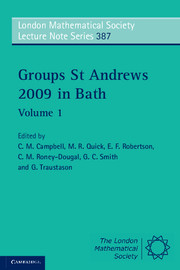
Book contents
- Frontmatter
- Contents
- Introduction
- A speech in honour of John Cannon and Derek Holt
- Finite groups of Lie type and their representations
- Iterated monodromy groups
- Engel elements in groups
- Some classes of finite semigroups with kite-like egg-boxes of D-classes
- Structure of finite groups having few conjugacy class sizes
- Group theory in cryptography
- A survey of recent results in groups and orderings: word problems, embeddings and amalgamations
- A survey on the minimum genus and maximum order problems for bordered Klein surfaces
- On one-relator quotients of the modular group
- Miscellaneous results on supersolvable groups
- Automorphisms of products of finite groups
- A rational property of the irreducible characters of a finite group
- Automotives
- On n-abelian groups and their generalizations
- Computing with matrix groups over infinite fields
- Trends in infinite dimensional linear groups
- Engel conditions on orderable groups and in combinatorial problems (a survey)
- References
A survey on the minimum genus and maximum order problems for bordered Klein surfaces
Published online by Cambridge University Press: 05 July 2011

Book contents
- Frontmatter
- Contents
- Introduction
- A speech in honour of John Cannon and Derek Holt
- Finite groups of Lie type and their representations
- Iterated monodromy groups
- Engel elements in groups
- Some classes of finite semigroups with kite-like egg-boxes of D-classes
- Structure of finite groups having few conjugacy class sizes
- Group theory in cryptography
- A survey of recent results in groups and orderings: word problems, embeddings and amalgamations
- A survey on the minimum genus and maximum order problems for bordered Klein surfaces
- On one-relator quotients of the modular group
- Miscellaneous results on supersolvable groups
- Automorphisms of products of finite groups
- A rational property of the irreducible characters of a finite group
- Automotives
- On n-abelian groups and their generalizations
- Computing with matrix groups over infinite fields
- Trends in infinite dimensional linear groups
- Engel conditions on orderable groups and in combinatorial problems (a survey)
- References
Summary
Abstract
Every finite group acts as a group of automorphisms of some compact bordered Klein surface of algebraic genus g ≥ 2. The same group G may act on different genera and so it is natural to look for the minimum genus on which G acts. This is the minimum genus problem for the group G. On the other hand, for a fixed integer g ≥ 2, there are finitely many abstract groups acting as a group of automorphisms of some compact bordered Klein surface of algebraic genus g. The condition g ≥ 2 assures that all such groups are finite. So it makes sense to look for the largest order of groups G acting on some surface of genus g when g is fixed and G runs over a prescribed family F of groups. This is the maximum order problem for the family F. There is a significant amount of research dealing with these two problems (or with some of their variations), and the corresponding results are scattered in the literature. The purpose of this survey is to gather some of these results, paying special attention to important families of finite groups.
Introduction
A natural extension of the definition of a compact Riemann surface, which is orientable and has no boundary, is to allow dianalytic transition functions, that is, functions which are either analytic or the composite of complex conjugation with an analytic function.
Information
- Type
- Chapter
- Information
- Groups St Andrews 2009 in Bath , pp. 161 - 182Publisher: Cambridge University PressPrint publication year: 2011
References
[All81] , Real elliptic curves, North-Holland Mathematics Studies, 54. Notas de Matemática, 81. North-Holland Publishing Co., Amsterdam-New York, 1981.Google Scholar
[AG71] , , Foundations of the theory of Klein surfaces, Lecture Notes in Math. 219, Springer-Verlag (1971).
[BCT03] , , , Groups acting on bordered Klein surfaces with maximal symmetry, in Groups St Andrews 2001 in Oxford, Vol. 1 ( et al., eds.), London Math. Soc. Lecture Note Ser. 304 (CUP, Cambridge 2003), 50–58.Google Scholar
[BEG86] , , , Automorphism groups of real algebraic curves of genus 3, Proc. Japan Acad. 62 (1986), 40–42.Google Scholar
[BEGG90] , , , , Automorphism Groups of Compact Bordered Klein Surfaces, Lecture Notes in Math. 1439, Springer-Verlag, Berlin, 1990.
[BEGM89] , , , , Minimal genus of Klein surfaces admitting an automorphism of a given order, Arch. Math. (Basel) 52 (1989), no. 2, 191–202.Google Scholar
[BG84] , , Automorphism groups of algebraic curves of ℝn of genus 2, Arch. Math. (Basel) 42 (1984), 229–237.Google Scholar
[BGM95] , , , Minimum topological genus of compact bordered Klein surfaces admitting a prime-power automorphism, Glasgow Math. J. 37 (1995), no. 2, 221–232.Google Scholar
[BG90] , , On nilpotent groups of automorphisms of compact Klein surfaces, Proc. Amer. Math. Soc. 108 (3), 1990, 749–759.Google Scholar
[BM89] , , A remark on NEC groups representing surfaces with boundary, Bull. London Math. Soc. 21 (1989), no. 3, 263–266.Google Scholar
[Buj88] , Topological types of Klein surfaces with a maximum order automorphism, Glasgow Math. J. 30 (1988), no. 1, 87–96. Corrigendum: Glasgow Math. J.30, (1988), no. 3, 369.Google Scholar
[Cano] , Ph. D. Thesis, in preparation.
[Con80] , Generators for alternating and symmetric groups, J. London Math. Soc. (2) 22 (1980), 75–86.Google Scholar
[EM04] , , The real genus of the groups C2m × Dn (Spanish), Mathematical contributions in honor of Professor Enrique Outerelo Domínguez (Spanish), 171–182, Homen. Univ. Complut., Editorial Complutense, Madrid, 2004.
[EM06] , , The real genus of cyclic by dihedral and dihedral by dihedral groups, J. Algebra 296 (2006), 145–156.Google Scholar
[EM08] , , The real genus of the alternating groups, Rev. Mat. Iberoamericana 24 (2008), 865–894.Google Scholar
[GM82] , , Bordered Klein surfaces with maximal symmetry, Trans. Amer. Math. Soc. 274 (1982), 265–283.Google Scholar
[Gro92] , On soluble groups of automorphisms of non-orientable Klein surfaces, Fund. Math. 14 (1992), 215–227.Google Scholar
[Har66] , Cyclic groups of automorphisms of a compact Riemann surface, Quart. J. Math. 17 (1966), 86–97.Google Scholar
[KW04] , , Real genus of minimal non nilpotent groups, J. Algebra 281 (2004), 150–160.Google Scholar
[May75] , Automorphisms of compact Klein surfaces with boundary, Pacific J. Math. 59 (1975), no. 1, 199–210.Google Scholar
[May77a] , Cyclic automorphism groups of compact bordered Klein surfaces, Houston J. Math. 3 (1977), 395–405.Google Scholar
[May77b] , A bound for the number of automorphisms of a compact Klein surface with boundary, Proc. Amer. Math. Soc. 63 (1977), 273–280.Google Scholar
[May77c] , Large automorphisms groups of compact Klein surfaces with boundary I, Glasgow Math. J. 18 (1977), 1–10.Google Scholar
[May80] , Maximal symmetry and fully wound coverings, Proc. Amer. Math. Soc. 79 (1980), 23–31.Google Scholar
[May84] , The species of Klein surfaces with maximal symmetry of low genus, Pacific J. Math. 111 (1984), 371–394.Google Scholar
[May87] , Nilpotent automorphism groups of bordered Klein surfaces, Proc. Amer. Math. Soc. 101 (1987), 287–292.Google Scholar
[May91] , Complex doubles of bordered Klein surfaces with maximal symmetry, Glasgow Math. J. 33 (1991), 61–67.Google Scholar
[May93] , Finite groups acting on bordered surfaces and the real genus of a group, Rocky Mountain J. Math. 23 (1993), no. 2, 707–724.Google Scholar
[May94b] , Finite metacyclic groups acting on bordered surfaces, Glasgow Math. J. 36 (1994), 233–240.Google Scholar
[May94c] , A lower bound for the real genus of a finite group, Canad. J. Math. 46 (1994), 1275–1286.Google Scholar
[May98] , Finite 3-groups acting on bordered surfaces, Glasgow Math. J. 40 (1998), no. 3, 463–472.Google Scholar
[May01] , Real genus actions of finite simple groups, Rocky Mountain J. Math. 31 (2001), 539–551.Google Scholar
[May07c] , The real genus of groups of odd order, Rocky Mountain J. Math. 37 (2007), no. 4, 1251–1269.Google Scholar
[May09a] , The real genus of direct products Zn × G, Houston J. Math. 35 (2009), 23–37.Google Scholar
[May09b] , The groups of real genus ρ ≤ 16, Rocky Mountain J. Math., 39 (2009), no. 5, 1573–1595.Google Scholar
[McC90] , Minimal genus of abelian actions on Klein surfaces with boundary. Math. Z. 205 (1990), 421–436.Google Scholar
[Per07] , Automorphism groups of compact bordered Klein surfaces with invariant subsets, Manuscripta Math. 122 (2007), no. 2, 163–172.Google Scholar
[Sin87] , PSL(2,q) as an image of the extended modular group with aplications of group actions on surfaces, Proc. Edinburgh Math. Soc. (2) 30 (1987), 143–151.Google Scholar
Accessibility standard: Unknown
Why this information is here
This section outlines the accessibility features of this content - including support for screen readers, full keyboard navigation and high-contrast display options. This may not be relevant for you.Accessibility Information
Accessibility compliance for the PDF of this chapter is currently unknown and may be updated in the future.