Book contents
- Frontmatter
- Contents
- List of Abbreviations
- Introduction
- Part 1Danzig, Center of the Universe
- Part 2From Danzig to the Global Stage: Grass's Fiction of the 1970s and 1980s
- 5Örtlich betäubt / Local Anaesthetic
- 6Aus dem Tagebuch einer Schnecke / From the Diary of a Snail
- 7Der Butt / The Flounder
- 8Das Treffen in Telgte / The Meeting at Telgte
- 9Kopfgeburten oder Die Deutschen sterben aus / Headbirths or The Germans Are Dying Out
- 10Die Rättin / The Rat
- 11Zunge zeigen / Show Your Tongue
- Part 3After Reunification: Old Problems and New Beginnings
- Epilogue
- Works Cited
- Index
10 - Die Rättin / The Rat
from Part 2 - From Danzig to the Global Stage: Grass's Fiction of the 1970s and 1980s
Published online by Cambridge University Press: 05 February 2013

Book contents
- Frontmatter
- Contents
- List of Abbreviations
- Introduction
- Part 1Danzig, Center of the Universe
- Part 2From Danzig to the Global Stage: Grass's Fiction of the 1970s and 1980s
- 5Örtlich betäubt / Local Anaesthetic
- 6Aus dem Tagebuch einer Schnecke / From the Diary of a Snail
- 7Der Butt / The Flounder
- 8Das Treffen in Telgte / The Meeting at Telgte
- 9Kopfgeburten oder Die Deutschen sterben aus / Headbirths or The Germans Are Dying Out
- 10Die Rättin / The Rat
- 11Zunge zeigen / Show Your Tongue
- Part 3After Reunification: Old Problems and New Beginnings
- Epilogue
- Works Cited
- Index
Summary
A “Catastrophic” Book
IN NOVEMBER/DECEMBER 1985 Die Zeit published the first and fourth chapters of Die Rättin, Grass's new prose narrative of indeterminate genre (the author deliberately omits any classification), and the Berlin newspaper Der Tagesspiegel serialized it (see H. L. Arnold 1997, 160). The printing of the first chapter in Die Zeit was accompanied by a brief but highly laudatory review from the pen of Fritz Raddatz (1985) who praised the book as a work of fiction of extraordinary power and unfettered imagination that presents a prophecy of doom of global dimensions and still manages to create suspense despite its complicated structure. The narrative, available in bookstores at the beginning of March 1986, pertains, it has been argued, to the category of “Katastrophenliteratur” prevalent in the 1980s, a period named “Orwell's Decade,” and seems to be the “literary expression” of the “doomsday scenario” (O'Neill 1987a, 213) that Grass projected in his Rome address of November 1982, “Die Vernichtung der Menschheit hat begonnen” (WA 9:830–34; “The Destruction of Mankind Has Begun”). Literary texts dealing with (anticipated) catastrophes on a major scale, such as Christa Wolf's Kassandra (1983; Cassandra, 1984) and even more so Grass's dark vision about the future of humankind in Die Rättin, appeared to be vindicated by, for example, the world's worst nuclear power accident at the reactor at Chernobyl in the Ukraine, then part of the former USSR, in April 1986 (see H. L. Arnold 1997, 159; Ignée's 1986 contribution on Die Rättin appeared, not entirely coincidentally, in a volume devoted to the apocalypse in twentieth-century literature).
Information
- Type
- Chapter
- Information
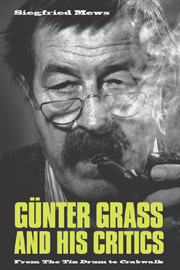
- Günter Grass and his CriticsFrom 'The Tin Drum' to 'Crabwalk', pp. 204 - 234Publisher: Boydell & BrewerPrint publication year: 2008
Accessibility standard: Unknown
Why this information is here
This section outlines the accessibility features of this content - including support for screen readers, full keyboard navigation and high-contrast display options. This may not be relevant for you.Accessibility Information
Accessibility compliance for the PDF of this chapter is currently unknown and may be updated in the future.