Skip to main content Accessibility help
×
Hostname: page-component-7b7567c8c-7pwfn Total loading time: 0 Render date: 2026-11-17T07:19:07.136Z Has data issue: false hasContentIssue false

Introduction

Published online by Cambridge University Press:  12 September 2018

A. M. Bowie
Affiliation:
University of Oxford
Get access

Summary

The main fault of the Odyssey is that at many points the narrative content is drawn out to excessive length. At these points one feels that the monumental singer is consciously and almost painfully elaborating his material so as to make a great poem which will match the scale of the Iliad…It is in conversations between some of the main characters – between the suitors and Telemachus, or the disguised Odysseus and Eumaeus or later Penelope herself – that a certain lack of tension, an excessive leisureliness, become intrusive.

Thus wrote Geoffrey Kirk sixty years ago, expressing a view which is still alive in the way that the second half of the poem tends to be less prized and studied than the first. Recent criticism has however moved to an assessment of the Odyssey which is closer to Aristotle's summary, where the sensational aspects of books 6–12 are ignored:

A man is away from home for many years, jealously watched by Poseidon, and has lost his followers; moreover, at home his affairs are such that his property is being wasted by suitors and plots are being laid against his son; he comes home in dire distress, and after disclosing himself makes an attack and destroys his enemies without being killed himself. That is what is proper to the action; the rest of the poem is episodes.

Information

Access options

Get access to the full version of this content by using one of the access options below. (Log in options will check for institutional or personal access. Content may require purchase if you do not have access.)

Book purchase

Temporarily unavailable

Save book to Kindle

To save this book to your Kindle, first ensure no-reply@cambridge.org is added to your Approved Personal Document E-mail List under your Personal Document Settings on the Manage Your Content and Devices page of your Amazon account. Then enter the ‘name’ part of your Kindle email address below. Find out more about saving to your Kindle.

Note you can select to save to either the @free.kindle.com or @kindle.com variations. ‘@free.kindle.com’ emails are free but can only be saved to your device when it is connected to wi-fi. ‘@kindle.com’ emails can be delivered even when you are not connected to wi-fi, but note that service fees apply.

Find out more about the Kindle Personal Document Service.

  • Introduction
  • Homer
  • Edited by A. M. Bowie, University of Oxford
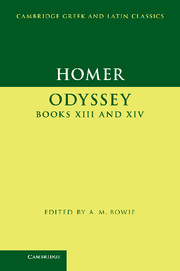
  • Book: Homer: <I>Odyssey Books XIII and XIV</I>
  • Online publication: 12 September 2018
  • Chapter DOI: https://doi.org/10.1017/CBO9781139032506.002
Available formats
×

Save book to Dropbox

To save content items to your account, please confirm that you agree to abide by our usage policies. If this is the first time you use this feature, you will be asked to authorise Cambridge Core to connect with your account. Find out more about saving content to Dropbox.

  • Introduction
  • Homer
  • Edited by A. M. Bowie, University of Oxford
  • Book: Homer: <I>Odyssey Books XIII and XIV</I>
  • Online publication: 12 September 2018
  • Chapter DOI: https://doi.org/10.1017/CBO9781139032506.002
Available formats
×

Save book to Google Drive

To save content items to your account, please confirm that you agree to abide by our usage policies. If this is the first time you use this feature, you will be asked to authorise Cambridge Core to connect with your account. Find out more about saving content to Google Drive.

  • Introduction
  • Homer
  • Edited by A. M. Bowie, University of Oxford
  • Book: Homer: <I>Odyssey Books XIII and XIV</I>
  • Online publication: 12 September 2018
  • Chapter DOI: https://doi.org/10.1017/CBO9781139032506.002
Available formats
×