Skip to main content Accessibility help
×
Hostname: page-component-7b7567c8c-wxvwp Total loading time: 0 Render date: 2026-11-18T02:22:11.591Z Has data issue: false hasContentIssue false

Preface

Published online by Cambridge University Press:  28 May 2018

Deborah Steiner
Affiliation:
Columbia University, New York
Get access

Summary

Homer's Odyssey tells a familiar story: a hero, a veteran of the Trojan War, returns home after ten trial-filled years of wandering in exotic lands only to find his halls occupied by 108 carousing youths who court his wife in the hope that the lawful husband and master has perished abroad. And yet for all the simplicity of its tale, the poet's technique is brilliantly intricate; from the notorious tease of the opening line which hides the epic hero's name, to the sudden threat of retaliation from the dead suitors' kin in the closing episode, the composition uses flashbacks and internal narratives, dramatic irony, doubling, and retardation devices to keep us wondering how exactly affairs in Ithaca will be resolved. It is a work that, not surprisingly, has exercised a lasting fascination from archaic through to contemporary times, and that has been re-imagined in countless forms, visual, verbal and musical among them.

If another study of the Odyssey needs no justification, then the choice to focus on books 17 and 18 may prompt the question ‘why these?’ One reason is the sheer diversity and tonal range of the two books' contents, which run from the burlesque comedy of the boxing match between the disguised Odysseus and the parasite Irus to the charged moment when the hero re-enters his home after his twenty years' absence and first sets eyes on his wife.

Information

Access options

Get access to the full version of this content by using one of the access options below. (Log in options will check for institutional or personal access. Content may require purchase if you do not have access.)

Book purchase

Temporarily unavailable

Save book to Kindle

To save this book to your Kindle, first ensure no-reply@cambridge.org is added to your Approved Personal Document E-mail List under your Personal Document Settings on the Manage Your Content and Devices page of your Amazon account. Then enter the ‘name’ part of your Kindle email address below. Find out more about saving to your Kindle.

Note you can select to save to either the @free.kindle.com or @kindle.com variations. ‘@free.kindle.com’ emails are free but can only be saved to your device when it is connected to wi-fi. ‘@kindle.com’ emails can be delivered even when you are not connected to wi-fi, but note that service fees apply.

Find out more about the Kindle Personal Document Service.

  • Preface
  • Homer
  • Edited by Deborah Steiner, Columbia University, New York
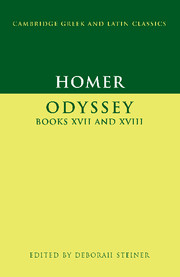
  • Book: Homer: <I>Odyssey</I> Books XVII-XVIII
  • Online publication: 28 May 2018
  • Chapter DOI: https://doi.org/10.1017/CBO9780511780660.001
Available formats
×

Save book to Dropbox

To save content items to your account, please confirm that you agree to abide by our usage policies. If this is the first time you use this feature, you will be asked to authorise Cambridge Core to connect with your account. Find out more about saving content to Dropbox.

  • Preface
  • Homer
  • Edited by Deborah Steiner, Columbia University, New York
  • Book: Homer: <I>Odyssey</I> Books XVII-XVIII
  • Online publication: 28 May 2018
  • Chapter DOI: https://doi.org/10.1017/CBO9780511780660.001
Available formats
×

Save book to Google Drive

To save content items to your account, please confirm that you agree to abide by our usage policies. If this is the first time you use this feature, you will be asked to authorise Cambridge Core to connect with your account. Find out more about saving content to Google Drive.

  • Preface
  • Homer
  • Edited by Deborah Steiner, Columbia University, New York
  • Book: Homer: <I>Odyssey</I> Books XVII-XVIII
  • Online publication: 28 May 2018
  • Chapter DOI: https://doi.org/10.1017/CBO9780511780660.001
Available formats
×