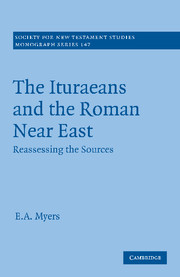
Book contents
- Frontmatter
- Contents
- List of illustrations
- Preface
- List of abbreviations
- Introduction
- 1Early scholarship
- 2Literary texts
- 3Archaeology
- 4Coins
- 5Inscriptions
- 6Ituraeans and identity
- 7The Ituraeans in history
- 8Conclusions
- Appendix 1Two small finds and the Ituraeans
- Appendix 2Inscriptions relevant to the Roman auxiliary units
- Bibliography
- Index
Summary
The Golan and its Pottery
They made all your planks
of fir trees from Senir;
they took a cedar from Lebanon
to make a mast for you.
Of oaks of Bashan
they made your oars;
they made your deck of pines from
the coasts of Cyprus,
inlaid with ivory.
Ezek. 27.5–6In his Lamentation over Tyre, the writer here captures an essential quality of three geographic regions as they were known in antiquity. Each was recognized for its own unique woods: the fir trees of Senir (Mt Hermon), the great cedars of the Lebanon range and the oak forests of the Bashan. In biblical terminology, the Bashan is always preceded by the definite article and expresses the meaning of smooth or stoneless plain. To the Romans it was known as Batanaea, although Batanaea was only part of what comprised the Bashan of antiquity. Along with ancient Gaulanitis, Trachonitis and Auranitis, Batanaea forms part of the volcanic basalt region which lies to the south of modern Syria, and includes part of northern Jordan. The ancient names verify distinct districts within a varied and complex landscape. The uplands were known as Auranitis, today the modern Jebel Druze or Jebel al-‘Arab, and is composed of a mountainous central region unsuitable for agriculture. Its northern area provided good agricultural conditions where two cities, Philippopolis and Maximianopolis, developed. The lava flows which extended to the north-west formed the rugged, desolate landscape of ancient Trachonitis, known today as the Leja.
Information
- Type
- Chapter
- Information
- The Ituraeans and the Roman Near EastReassessing the Sources, pp. 42 - 101Publisher: Cambridge University PressPrint publication year: 2010
Accessibility standard: Unknown
Why this information is here
This section outlines the accessibility features of this content - including support for screen readers, full keyboard navigation and high-contrast display options. This may not be relevant for you.Accessibility Information
Accessibility compliance for the PDF of this chapter is currently unknown and may be updated in the future.