This book explores the intermedial influence of John Milton in nineteenth-century literature and visual culture, in order to state anew the way Milton’s texts were used by writers and artists in the period between the height of British Romanticism and early twentieth-century critical debates about the value of Paradise Lost. My aims are twofold: first, to expand our understanding of the impact of Milton’s writing in a period that, compared with that preceding it, has received relatively little attention; second, to develop an intermedial understanding of influence – one that disrupts linear narratives of literary tradition. The marks that Milton’s writing have made on visual culture from the seventeenth century onwards are well established, as is his significant role in shaping British literary culture.1 My central argument in this book is that these two strands of Milton’s inheritance should be placed more directly in dialogue with each other. Addressing the connections between Milton’s own works and those produced by his readers, in both word and image, reveals new ways that Milton’s nineteenth-century readers engage with his writing, though they are perhaps not always the ‘fit audience’ that he had in mind.2 Analysing Milton’s influence in the nineteenth century across image and text, my case studies range from late Romanticism to the end of the Victorian period, with a focus on the years 1820–1900. I attend to Miltonic ideas and images in the writing of four major figures – Mary Shelley, Herman Melville, A. C. Swinburne and Thomas Hardy – and read their works in dialogue with artists including John Martin, J. M. W. Turner and William Blake.
Central to this project is the interweaving of studies of reception (which focus on readers), literary influence (which focus on writers) and illustration (which focus on artists). My approach recognises that nineteenth-century writers and artists are not just readers of Milton; they are readers and spectators responding to each other’s work concurrently. I therefore envisage the conversations taking place across media in this book as not linear but triangular. Underpinning this intermedial method is the assertion that while one text might also be ‘mediated’ for later readers (who may also be writers) by a text or image that interprets or comments on it, those readers may still be engaging deeply with the text itself – this is often the case with Paradise Lost, a text that the Victorians knew well. For example, in my reading of Swinburne I argue that while he sees Milton through Blake’s poetry and illustrations of Milton, he reads Milton directly at the same time: Swinburne’s allusions to Blake and Milton then get mixed together in what I consider a ‘commingling’ of the two figures, across image and text. At other points, we see artists and writers engaging with the same elements of Milton’s writing, with the form of their response shaped by the media in which they work: Martin, I will suggest, offers a visual counterpart to Shelley’s textual exploration of Miltonic temporality, celebrating the same aspects of Paradise Lost in his mezzotint illustrations. Whilst they respond to earlier works, texts and artworks produced in the visual and material culture of the nineteenth century also exist in dialogue with each other. In the chapters below, I explore several different key relationships across media, and in doing so uncover a rich sample of intermedial responses to Milton.
This book contributes to a growing body of scholarship that attends to Milton’s intermedial afterlives, represented in the recent collections Global Milton and Visual Art, edited by Angelica Duran and Mario Murgia (2021); Women (Re)Writing Milton, edited by Mandy Green and Sharihan Al-Akhras (2021); and Milton across Borders and Media, edited by Islam Issa and Angelica Duran (2023).3 Joseph Wittreich, in his chapter in Global Milton and Visual Art, claims that the work of Milton’s illustrators ‘has been of late woefully neglected’, noting important exceptions in the work of Wendy Furman-Adams and Virginia James Tufte, who in turn build on the earlier work of Marcia Pointon.4 This is despite the fact that, as Furman-Adams and Tufte write, Paradise Lost is ‘the most widely illustrated book in European history’ following the Bible.5 Partly because of their renewed energy for attending to Milton’s influence on visual culture, these collections also disrupt linear narratives of literary influence. For example, Wittreich’s discussion of how Milton’s treatment of sexuality and gender is expanded or suppressed through translations and illustrations points to Blake as an example of an illustrator who, by amplifying the eroticism in Milton’s epic, exerts ‘powerful influence on continental illustrators of Milton and on the proliferating translations of Paradise Lost’.6 There is particular value, I suggest, in focusing on intermedial responses to Milton in the nineteenth century, a period in which illustrated books proliferate.
This book can also be situated in a broader recent critical trend in Victorian studies towards intermedial reception studies. The project is aligned with scholarship such as Tom Mole’s work on the Victorian reception of the Romantics across different media, What the Victorians Made of Romanticism: Material Artifacts, Cultural Practices, and Reception History (2017).7 Though Mole’s materials are different, the broader theoretical framing of his project is akin to my own, as he writes that ‘the reception of literature is not itself always literary or literary-critical but happens across several media’; ‘the reception of literary works’ is ‘intermedial’ because it ‘often involves their remediation into other media, both “old” and “new,” and requires us to think in terms of a media ecology’.8 To some extent, the readings I present in this book also contribute to an understanding of the Victorian reception of Romanticism. We will often see in the chapters below illustrations of Milton designed in the late eighteenth century or very early nineteenth century – sometimes reproduced in later editions – having a continued, or even delayed, effect on what readers find in Milton. For example, in Chapter 4, I discuss a shift in illustration of Milton’s expulsion from Eden that occurs at the start of the nineteenth century, as illustrators of Paradise Lost move away from biblical iconographic tradition and instead attend closely to the details of Milton’s epic. We then see writers such as Hardy (and George Eliot) in the later years of the century responding to that change. In discussions of the Victorian Milton, Romanticism is often positioned as a mediating force, and his literary influence is read through the writing of Romantic poets in particular.9 Looking beyond the poetic tradition, to the intersections between literary and visual-material culture more broadly, reveals other ways in which the visual culture of the late eighteenth and early nineteenth century established ways of responding to Milton that shaped the way that later readers (who were also writers) would respond to texts. Although many of the intermedial dialogues I discuss in this book involve Victorian literary responses to Romantic illustration, this does not mean Milton is entirely mediated for them by the Romantics: the Victorians are still reading his words.
I.1 Milton in Visual Culture: Illustration and Beyond
Illustrations are the visual artworks that most obviously contribute to the reception and influence of texts, functioning as interpretations of those texts while shaping as they often do the responses of future readers. Illustrations also have the capacity to work against the text they illustrate – to disagree with it, offer alternatives; to expand upon the text by speaking where texts are silent; to affirm or consolidate what is suggested by the writer. It is illustration of Paradise Lost in particular that Kester Svendsen refers to when writing that ‘the critical history of a great literary work is incomplete unless it incorporates inferences from the interpretation put upon the masterpiece by artists’.10 This book treats illustrations in this manner, as ‘interpretation put upon the [literary] masterpiece by artists’, but it also considers the generative potential in reading those visual interpretations alongside literary works that are responsive to both earlier literary works and their illustrations. Yet ‘illustrations can function as both window blinds and windows’; in some instances an illustration ‘functions correctively’ to the poem, and/or ‘persist[s] as a controlling force in its interpretation’.11 In the nineteenth century, illustrations were sometimes seen as competing with their source text: Wordsworth’s 1846 sonnet ‘Illustrated Books and Newspapers’ has been read as a key expression of Romantic resistance to the way that ‘the increasingly popular illustrated book engaged the eye rather than the mind and imagination’, as Gillen D’Arcy Wood puts it.12 Yet the Victorian period saw an explosion of book illustration, and engagement with the book as a visual-material object. Furman-Adams and Tufte have written widely on Milton’s illustrators, particularly his female illustrators, strengthening and complicating ecofeminist readings of Paradise Lost. One key example is Jane Giraud’s The Flowers of Milton (1846), which illustrates passages from Paradise Lost and reveals in its renditions of Milton’s flowers a recognition of the way Milton presents Nature as ‘a fragile and woundable system – one dependent upon human resolve’.13 Notably, this Victorian text offers the first illustrations of and visual interpretation of Milton by a female artist.
Considering Milton’s influence in relation to visual culture in the nineteenth century does not only involve attending to illustrations designed for and published in editions of Milton’s poetry. By the 1820s, Milton’s writing was enmeshed in a network of visual responses that both mediated it through images and spectacles and celebrated it as a text. Beyond the printed page, scholars have identified Milton’s central role in the emergence of visual technologies and popular spectacles often called ‘proto-cinematic’, from the eighteenth century onwards. This approach involves attending to the seeming conflict between Milton’s concern with the unrepresentable and the generative potential of his visual imagination: in relation to the latter, scholars repeatedly return to Sergei Eisenstein’s claim that Paradise Lost was ‘a first-rate school in which to study montage and audio-visual relationships’.14 Eric C. Brown outlines Milton’s place in early ‘protocinematic’ visual spectacles in Milton on Film (2015), in which he notes that ‘from the earliest proto-cinematic inventions, Milton has figured as the quintessential subject of increasingly spectacular visual entertainment: mechanical pantomimes and spectacles in the eighteenth century, panoramas, dioramas, musical extravaganzas, and magic lantern shows [including phantasmagorias] in the nineteenth’.15 Philippe Jacques de Loutherbourg’s Eidophusikon, for example, was a theatrical entertainment that first opened in London in 1781, privileging special lighting effects to bring to life scenes such as the building of Pandemonium. In the mid-nineteenth century, spectacular theatrical performances in Paris and New York used the latest stage technology to dramatically recreate Milton’s Deluge (sometimes unsuccessfully).16 These spectacular entertainments are connected to the history of Milton illustration: Brown suggests that it was ‘thanks largely to the engravings of Martin and Gustave Doré’ that ‘Paradise Lost became a favorite subject of Victorian laternists’. He notes that Martin’s 1825 mezzotint engravings for Paradise Lost served as the principal inspiration for both Robert Burford’s London panorama of Pandemonium in 1829, and R. G. Bachelder’s world tour of a Paradise Lost panorama beginning in 1865 (which he claimed counted amongst its audience the residents of Buckingham Palace, Queen Victoria included).17
The later decades of the eighteenth century witnessed the establishment of several galleries focused on literary works, which emerged alongside a burgeoning market for illustrated publications and prints. Key examples include John Boydell’s successful Shakespeare Gallery, which launched in 1789 and remained open for sixteen years; Thomas Macklin’s British Poets Gallery, which opened in 1788; and Henry Fuseli’s less successful Milton Gallery, first opened in 1799.18 Luisa Calè’s Fuseli’s Milton Gallery: ‘Turning Readers into Spectators’ (2006) also begins with Eisenstein, contrasting his ‘filmic eye’ with ideas of ‘Romantic anti-pictorialism’. Calè’s book then theorises the intermedial space of the literary gallery and its ‘cinematic effects’, arguing that the relationship established between Fuseli’s paintings of scenes from Paradise Lost in the gallery itself created a ‘montage’ effect, and that gallery catalogues made visitors at once readers and spectators, so that ‘the intermedial environments of the literary galleries call into question twentieth-century disciplinary boundaries’.19 The presence of these literary galleries points to a number of ways in which visual and textual experience intersected in the long nineteenth century.
Designs produced for the literary galleries that initially took the form of oil paintings were reproduced in print, published within illustrated books and sold separately, and as critics such as Calè have shown, this practice was an important part of the commercial functioning of the galleries.20 Ian Haywood notes that this process involves, ‘in Genettian terms’, the ‘transform[ation]’ of image ‘from an external epitext into an internal peritext’, but also that ‘reproductive prints’ were a ‘precondition of [the] existence’ of the paintings that they reproduced.21 Illustrations therefore moved between public and private worlds, and it is worth noting that domestic contact with illustrations of literary works was not always enclosed in books: both Charlotte Brontë and Melville had engraved prints of Martin’s work hanging on the walls of their homes.22 As the example of Melville suggests, the increasing circulation of print materials in this period allows for connections to be made across both periods and national boundaries.
The mobility of images doesn’t end with the publication of engravings reproducing the paintings of the galleries; illustrations also moved in and out of books, and from the mid-eighteenth century up to the end of the nineteenth century, even those prints that were designed for specific editions had a tendency to escape the books they were made for, through the popular practice of extra-illustration. Extra-illustration, strictly speaking, involves taking apart a book in order to add a collection of prints or other visual material before rebinding it, often resulting in an object significantly larger than the original volume, depending on the number of illustrations added.23 Through this process, as Calè puts it, ‘books became the collectors’ paper galleries’.24 When the craze for extra-illustrating books began, it led to ‘the dismemberment of many old books that happened to contain portrait engravings’, a problem that, ‘by the end of the eighteenth century and through much of the nineteenth … was largely corrected by the masses of modern prints reproducing old prints, paintings, and drawings that began to be issued by London print dealers specifically to meet the needs of extra-illustrators’.25 At later dates, prints and drawings were also removed from extra-illustrated books, usually in order to be sold; some extra-illustrated books have therefore served as temporary homes for prints that may have been published in one book, removed to be collected in another, and then ended up as isolated prints.26 The disruptive process of extra-illustration emphasises the reader’s active part in engaging with illustration. Indeed, H. J. Jackson refers to instances in which collectors may be required ‘to take a beloved book and work with it, getting to know it still more intimately in the process’.27 Extra-illustration perhaps allays some of Wordsworth’s concerns about illustration, expressed in ‘Illustrated Books and Newspapers’, leading to passive and unimaginative reading practices.
In this book, illustrations and extra-illustrations are considered as part of a broader set of paratextual additions to, and commentaries on, literary works, which reveal lines of influence and dialogue between writers and artists. Alongside illustrations, I consider the way that texts are framed for and by readers through epigraphs (in Chapter 1) and binding practices (in the Epilogue), as well as ways in which readers materially respond to texts through extra-illustration and the addition of marginalia. The two are connected, as evidenced by the fact that Jackson’s discussion of extra-illustration noted above is included in her study of marginalia. She compares the two practices, writing that both ‘can be thought of as a reader’s personal contribution to a book, and as constituting a form of comment and evaluation’, but also pointing to their overlapping nature in practice: ‘many extra-illustrated books alco contain readers’ notes; many annotated books are also extra-illustrated’.28 I examine instances of both extra-illustration and annotation of Milton’s writing in the chapters below, with a particular focus on Melville and Hardy’s extensive annotations in their copies of Milton.
My approach to literary influence is grounded in detailed close reading of texts, but also attends to material interactions with the codex, therefore blurring the distinction between text and book. In How to Do Things with Books in Victorian Britain (2012), Leah Price discusses the division in Victorian literary culture between book collectors and readers, arguing that Victorian writers often showed disdain for those who engaged with books as objects to be displayed rather than as texts to be read. Price suggests that the Victorians particularly ‘identified themselves as text-lovers in proportion as they distinguished themselves from book-lovers’.29 Yet Swinburne, my focus in Chapter 3, is one important example of a Victorian book- and text-lover. More recently, Andrew Stauffer’s Book Traces (2021) examines the centrality of marking books and recording reading on the page in Victorian culture. Stauffer’s study asks ‘in what sense … the individual book [can] – as an instance of a specific, case-bound case history – speak within a larger framework of cultural analysis’.30 Several of the annotated books I address have a different emphasis because they contain the marginalia of noted writers. Yet I also address individual books not associated with known figures – such as extra-illustrated Bibles and editions of Paradise Lost, and a volume of Milton’s poems bound in human skin discussed in the Epilogue – and in these cases take them as generally representative of the culture out of which they emerge, a culture in which the illustrated book reached new heights of popularity, and one that was deeply familiar with Milton’s writing as text.
Though most of the artists whose work I engage with in this book are, amongst their other activities, illustrators of Milton (Martin, Turner, Blake), I do not treat illustration as the only form of visual artwork that responds to and shapes ways of using Milton: sculpture and other forms of painting feature too. I consider encounters with the Miltonic in the space of the gallery, both past and present: I argue that an instance of Swinburne’s ekphrastic renditions of sculpture is informed by both Milton and illustrations of Milton; I discuss two Victorian paintings in the same room of the Walker Gallery, Liverpool, in relation to Shelley’s Miltonic The Last Man. Turner illustrated Milton’s works, but my analysis of his paintings in Chapter 2 focuses not on his illustrations of Paradise Lost, but on his seascapes and their articulation of a powerful passivity in the context of the Miltonic sublime (and, in turn, their significance for Melville). At several points, we see that Milton’s importance in visual culture relates to his influence on the development of British aesthetic tradition in eighteenth-century theorisations of the sublime.
In her introduction to George Eliot’s Dialogue with John Milton (2003), Anna K. Nardo lays the groundwork for her discussion of Eliot’s response to Milton by examining Victorian portraits of Milton himself and narrative paintings that demonstrate a fascination with stories about his life. Nardo looks to visual artworks of the period to build a picture of the version of Milton known by Eliot and her readers: for example, in George Romney’s painting Milton and His Daughters (1793), ‘the illuminated face of one daughter and the bent back of another suggest that they too have a story to tell’.31 Julia Thomas writes of the ‘two genres that dominated Victorian Britain’, illustration and narrative painting, that they ‘crossed the boundary between text and image’ in a number of ways, experienced by the Victorians as ‘part of the web of practices and discourses that circulated in their rich multi-media culture’.32 This book seeks to rethink Milton’s literary influence by placing the writing of some of his most famous nineteenth-century readers in dialogue with illuminating examples of that ‘rich multi-media culture’.
I.2 Metaphors of Influence
John Milton is like a ghost, or like a troll, or like a father, or like God, or like a rib, or like a silkworm, or like a dairy cow, or like the sun, or like hair, or like Adam, or like electricity. It has long been a habit of critics to explain Milton’s creative production and literary influence through metaphor, often drawn from his own writing. The nineteenth century produced some memorable comparisons to explain Milton’s genius. In Capital, Karl Marx uses Milton to explain the difference between the productive and unproductive labourer: the former ‘turns out work for his publisher in factory style’, whereas ‘Milton produced Paradise Lost as a silkworm produces silk, as the activation of his own nature.’33 The image of Milton as silkworm both complements and contrasts the description of Milton waiting for his Amanuensis in the mornings as a dairy cow needing to be milked, as recalled by Cyriack Skinner: ‘hee waking early (as is the use of temperate men) had commonly a good Stock of Verses ready against his Amanuensis came; which if it happened to bee later than ordinary, hee would complain, Saying hee wanted to bee milkd’.34 Less concerned with whether Paradise Lost is more like silk or milk, in 1846 Walter Savage Landor uses the Miltonic image of the creation of Eve to describe Milton’s influence and he applies it additionally to the generative power of Shakespeare. He writes, ‘A rib of Shakespeare would have made a Milton; the same portion of Milton, all poets born ever since.’35
Milton provides the conceptual materials for a wealth of critical readings of his own work, particularly in relation to nineteenth-century texts. In Milton and the Victorians (2009), Erik Gray notes that critics ‘seem to agree that the influence of Milton can most fruitfully be understood through models drawn from Milton’s own work’.36 Drawing metaphors of influence from Milton’s poetry implies that Milton is the only writer able to provide the language in which to adequately account for the significance of his work, but it also often suggests more about Milton’s readers than the workings of influence itself: Miltonists are usually fans of Milton, and so are drawn to the language of their preferred poet to express their sense of his influence. Harold Bloom famously positions Milton as the patriarchal God against whom the rebellious Romantic poet-son must battle, like Satan.37 Sandra M. Gilbert and Susan Gubar see Milton in similar terms: in order to understand a tradition of women writing in the nineteenth-century, they turn to Eve as the representative transgressive figure, or Milton’s daughters, frustrated by the demands of their father.38 Gilbert and Gubar make use of Virginia Woolf’s famous description at the end of A Room of One’s Own (1929): Woolf declares that women writers should ‘look past Milton’s bogy, for no human being should shut out the view’.39 ‘Bogy’ is slightly ambiguous in its meaning, but I see Woolf’s Milton as more of a troll than a ghost, especially as he threatens to ‘shut out the view’ and therefore seems solid, substantial. But what Woolf is also asserting here is that although he may seem to be haunting literary culture, we should recognise that Milton is in fact a ‘human being’, not a supernatural being. Woolf’s ‘bogy’ recalls the words of John Keats a century earlier, who writes of Milton as a ghost in ‘On Seeing a Lock of Milton’s Hair’ (1818), whose speaker exclaims ‘Thy Spirit never slumbers, / But rolls about our ears’ (ll. 3–4).40 Keats is more ambivalent than Woolf: yes, Milton’s ghost poses a problem for the poets who come after him (as he puts it himself, ‘life to him would be death to me’), but the feelings this confrontation prompts are – in this poem, anyway – awe rather than despair.41
More recently, scholars have been drawn to Miltonic models that convey a sense of his influence as varied and diffusive, rather than agonistic, as in Bloom’s model of literary influence. Lucy Newlyn argues for the coexistence and potential conflict between two ways of understanding Milton in the Romantic period: he is in one sense the deified patriarch, an idea created and compounded through the association of Milton with his poetry (sublimity, God); in another sense, allusions to Milton in the writing of the canonical Romantic poets, the Big Six, demonstrates a reading of Milton as ‘negatively capable’ and Paradise Lost as a powerfully indeterminate text.42 Following Newlyn, Gray presents a reading of the Victorian Milton as characterised by duality. For the Victorians, Gray argues, Milton is diffuse – powerfully present through his absence. Gray uses the image of hair to illustrate a theory of influence in which hair, part of the body with a ‘dual nature’, both ‘intensely personal or peculiar and also interpersonal and alienable’, resembles Milton’s literary presence for (and power over) the Victorians.43 Hair holds a strange relationship to selfhood, as it both belongs to us and is beyond us. Part of Gray’s argument is that Milton’s work is already ‘classic’ to the Victorians; Paradise Lost is a text you don’t need to have read to be familiar with. I would add that this status of the classic functions partly through the diffuse responses to the text elsewhere in culture, particularly via illustrations. As Thomas notes, illustration can, by ‘signifying the worth of great literature’, play a part in constructing the canon.44
John T. Shawcross goes beyond this two-pronged Milton to something even more diffusive, arguing that Milton’s influence is best expressed through an ‘apt Miltonic image’ from the seventh book of Paradise Lost: the sun ‘shedding sweet influence’ provides light directly, as ‘all the horizon round’ is ‘Invested with bright rays’; this light also illuminates indirectly, via the moon, who ‘with full face borrowing her light’ from the sun, ‘With thousand lesser lights dividual holds’ (VII. 370–84).45 Shawcross proposes an image of Milton’s influence as generative, rather than combative. The sun shedding sweet influence combines a suggestion of hierarchy (the sun is the larger, life-giving force, illuminating ‘lesser lights’) and a more democratic understanding of Milton’s influential texts as ‘pregnant with provoked thoughts, as influence that anyone can use literally or through adaptation’. The implications for agency are mixed: the text is available to be used, but Milton’s cultural power is also underscored by this comparison with the life-giving sun. Significantly, Shawcross also highlights that this diffusive sense of Milton’s influence does not ‘prioritise … literature to the exclusion of other disciplines’ – he looks beyond poetry to include illustration and other media, signalling the recent shift in Milton studies more broadly.
This is a book that shares much with, and benefits from, the perspectives of Shawcross, Gray and Newlyn, but does not disregard the usefulness of applying a Bloomian model to those poets who do produce and sustain an idea of Milton as deified patriarch who needs to be in some way overcome. I would not deny, for example, that, for Keats, Milton represented the best of poetry and was a figure whose greatness made writing more difficult for the poets who followed. The essential theoretical claim that this book shares with many writers on Milton and influence is that our understanding of both Milton’s poetry and those works that are in dialogue with Milton can be strengthened and deepened by attending to that dialogue, and that doing so does not equate to asserting a hierarchy of literary value with Milton at the top and all other, later writers and artists beneath him.
As is tradition, I make use of an image drawn from Milton’s own writing to frame the readings presented in the chapters below. However, rather than offering one single metaphor to encapsulate Milton’s intermedial influence, I instead take my guiding image from the pattern of one of Milton’s epic devices: the simile. This is not to suggest that only Milton could produce the language in which to articulate his own influence: we do not need Milton’s use of the epic simile to understand his nineteenth-century legacy, but it helps. Though debate continues about the meaning and function of Milton’s epic similes in Paradise Lost, scholars are generally in agreement that Milton’s use of the simile is distinctive and significant to the meaning of the poem. Milton’s similes involve a piling up of detail that leaves the reader with an indistinct image of the comparison that is being made. For example, take the comparison of Satan to the Leviathan in Book I: here he lies ‘prone on the flood’, and is first compared to ‘Titanian, or Earth-born, that warred on Jove, / Briarios or Typhon, whom the den / By ancient Tarsus held, or that sea-beast / Leviathan’ (I. 195–201). The critical discussions of the meanings of this simile are extensive: for my purposes, all we need note here is the way the alternative comparisons initially seem to take us further away from a clear picture of Satan and his size, rather than clarifying the image. One reading of Milton’s Satan as Leviathan – though it is not one that aligns itself with an intentional theological principle – would be to see these disparate similes and accumulation of seemingly paradoxical comparisons building a picture of Satanic sublimity through obscured description.
Nineteenth-century readers were attentive to this element of Milton’s writing and made use of its effects. Gray reads Christina Rossetti’s lists of similes in Goblin Market in dialogue with Milton: as Milton combines catalogues and similes in distinct ways, Rossetti’s are similarly ‘overtly self-defeating’.46 He gives us, for example, Rossetti’s description of Laura as stretching ‘her gleaming neck / Like a rush-imbedded swan, / Like a lily from the beck, / Like a moonlit poplar branch, / Like a vessel at the launch / When its last restraint is gone’ (ll. 81–86). Gray sees this catalogue of similes as creating a purposeful lack of clarity, where Laura, like Milton’s Satan, is ‘drowned in a surfeit of superimposed images’. The sense that arises from both Milton’s and Rossetti’s use of lists of alternative metaphors is that each comparison is insufficient on its own. Critical interpretations of the similes often reach a point of understanding by addressing and embracing – not disregarding – each element of the extended simile, even where these elements produce conflicts.47
What I suggest is useful in writing on the Miltonic simile for conceptualising his influence is the recognition of a need to consider seeming contradictions in order to uncover a full understanding. In a discussion of the key word ‘or’ in Milton’s poetry, Leslie Brisman writes that ‘“or” acknowledges the experiential and moral burdens of choice, while the word “and” can signal a suspect desire to hold on to the fullness in the fallen world’.48 Milton’s nineteenth-century readers – both artists and writers – express a sense of self-consciousness about their status as living in the fallen world, as we will see in the chapters below. My suggestion is then that to understand the place of Milton in the period, we are justified in embracing the ‘fullness in the fallen world’ and its contradictions: Milton is like a ghost, and like a troll, and like a father, and like God, and like a rib, and like a silkworm, and like a dairy cow, and like the sun, and like hair, and like electricity, and like Adam.
I.3 Milton after 1825
James Eli Adams begins his History of Victorian Literature with the year 1824, and the story of a fourteen-year-old Alfred Tennyson carving the words ‘Byron is Dead’ onto a stone; the death of Byron ‘seemed and seems to mark the end of an era’, Adams writes, with the years leading up to Victoria’s ascension to the throne in 1837 seeming ‘an eerie twilight’, ‘an interregnum’, ‘an awkward gap’.49 At the same time, Adams queries the periodisation that separates the Romantic John Keats (born in October 1795) from the Victorian Thomas Carlyle (born in December 1795). There are other good reasons to begin in the 1820s, as both Gray and James G. Nelson do in the two book-length studies that focus on Milton’s influence in the Victorian period. Both point to the publication of Milton’s De doctrina christiana in 1825 as marking a shift in the reception and reputation of the poet.50 Nelson notes that this publication ‘initiated a relatively silent but certain change in sentiment on the part of many devout people’ – Edward Dowden writes in 1900 that from 1825 ‘Paradise Lost could no longer be considered a safe soporific for Sunday afternoons’.51 Prompted by the publication of De doctrina christiana, Thomas Babington Macaulay’s essay on Milton also arrived in 1825: it is from Macaulay’s essay that I draw the image of Milton as electricity, developed further in Chapter 2 (Macaulay writes that Milton ‘electrifies the mind through conductors’).52 Yet critics are not necessarily in agreement about how far Milton’s respectability was damaged by the publication of De doctrina christiana: Nardo writes that ‘Paradise Lost, along with Pilgrim’s Progress, was one of the few storybooks allowed to children on the Victorian Sunday’.53 Evidence for its ‘controversial’ impact can be found in one of Landor’s ‘Imaginary Conversations’, in which he envisions Milton speaking with Andrew Marvell about De doctrina christiana: ‘My opinions in theology have undergone a change. What they are will be known hereafter; I have written them in Latin, and I shall leave them behind me. For I would not anger any on this side of the grave. Resentment and controversy cool in the churchyard.’54 In Chapter 3 of this book, I pay particular attention to potential Victorian afterlives of Milton’s heresies. What this discussion also suggests is that in the nineteenth century Milton is not just read in relation to Paradise Lost. Swinburne, the focus of Chapter 3, asserted this himself in ‘Short Notes on English Poets’: ‘“to appraise Milton” is not merely “to appraise Paradise Lost”’.55 Along with the discovery of De doctrina christiana in the 1820s, Milton’s other prose writings take on new significance. Tessa C. Parslow has recently discussed Charlotte Brontë’s engagement with the divorce pamphlets, for example, and Karley Adney makes a similar argument for Thomas Hardy’s use of ‘Miltonic Principles’ related to marriage and divorce in Jude the Obscure.56 Though this book does focus on Paradise Lost as Milton’s magnum opus, it also attends to Milton’s nineteenth-century readers as readers of the prose works, Paradise Regained, Samson Agonistes, the sonnets, and Comus.
One of the most famous nineteenth-century readers of Comus is Charles Darwin, as Gillian Beer has shown us in Darwin’s Plots. Beer writes that ‘Darwin’s crucial insight into the mechanism of evolutionary change’ resulted, at least in part, ‘from his reading of the one book he never left behind during his expeditions from the Beagle: The Poetical Works of John Milton’.57 If Milton’s influence on such a prominent Victorian thinker has been thoroughly established, why is our sense of Milton’s presence in Victorian culture still so uncertain? Perhaps it is because ways of thinking about influence have been too readily constricted to separate spheres of cultural production. Nonetheless, scholars continue to reveal the extent of Milton’s influence in the emerging and developing nineteenth-century sciences of evolutionary biology, geology and astronomy.58
In work on Milton and the nineteenth century more generally there has been a critical imbalance, with much more attention paid to the period 1770–1830 than the following sixty years.59 In the shadow of the Romantics, who overtly claimed Milton as one of their own, Milton’s presence in the mid and late nineteenth century can appear muted. Introductory commentaries on the reception history of Milton often focus on the Romantics and the critical controversies of the early twentieth century, leaving the years 1820–1900 as seeming comparatively unworthy of analysis: much like the period 1824–37, the Victorian period is itself a kind of ‘awkward gap’ in studies of Milton’s influence. For example, in John Milton: Life, Writing, Reputation (2010), edited by Paul Hammond and Blair Worden, the chapter on ‘Milton and the Romantics’ is immediately followed by a chapter on ‘Milton in the Twentieth Century’.60 In Roy Flannagan’s chapter on Milton criticism in A Concise Companion to Milton (2007), the discussion of David Masson’s mammoth six-volume Life of John Milton (1859–80) finds itself in a section titled ‘Toward the Twentieth Century’.61 At the time of writing, the Wikipedia page on ‘John Milton’s reception history’ (admittedly far from comprehensive) has a section titled ‘Victorian’ under which we find just the four words ‘this section is empty’.62 Yet scholars are increasingly writing against the narrative that Milton fades away with the deaths of Keats, Shelley and Byron in the 1820s, only to be revived a hundred years later as a bullseye for the target practice of T. S. Eliot. As I have mentioned, the work of critics such as Gray (including not only his book Milton and the Victorians but also a chapter on ‘Victorian Miltons’ featured in 2013’s The Oxford Handbook of Victorian Poetry) and Nardo have, in the last two decades, sought to discover a narrative about Milton’s fortunes in the Victorian period. Both note that one characterising feature of the Victorian response to Milton is an increased attention to Milton’s life, to ‘Milton the man’.
Milton’s biography is explored across multiple media in Victorian culture, demonstrating the value of attending to Milton’s nineteenth-century presence in the visual and material as well as the textual. As Nelson writes, ‘throughout most of the nineteenth century Milton was the model of the poet whose life was mirrored in his work’.63 Eliot, Nardo tells us, considered that ‘every schoolboy’ knew the ‘stories’ of ‘the principal phases of Milton’s life’; these principal phases represented Milton primarily as either a lover or a father, and were key to the growth of the ‘cult of Milton’ across the eighteenth and nineteenth centuries.64 (For Eliot’s Dorothea, in Middlemarch, the two become confused, with painful consequences.) As noted above, Nardo discusses the way these stories from Milton’s life were represented in the visual culture of the period, usually in narrative painting reproduced as engravings, and the interest in Milton the man is also partly expressed in the nineteenth-century tradition of fictionalising Milton in literature. Biographies such as Masson’s sit alongside an array of imagined representations of Milton’s life: Walter Savage Landor’s Imaginary Conversations (1824–53), Edward Bulwer-Lytton’s ‘Milton’ (1831), the play Milton at Rome (1851), John Milton and His Times by German writer Max Ring (translated in 1868), and The Maiden and Married Life of Mary Powell, afterwards Mistress Milton (1855) by Anne Manning. Manning’s novel was so successful as to grant a sequel, Deborah’s Diary (1860), written from the perspective of one of Milton’s daughters. These two texts ‘reframed the debate by imagining what stories the women in Milton’s household might have to tell’, introducing the idea that Milton’s daughters might not have both responded in the same way to their father and his demands, giving them a sense of independent existence within the mythology of the Victorian Milton.65
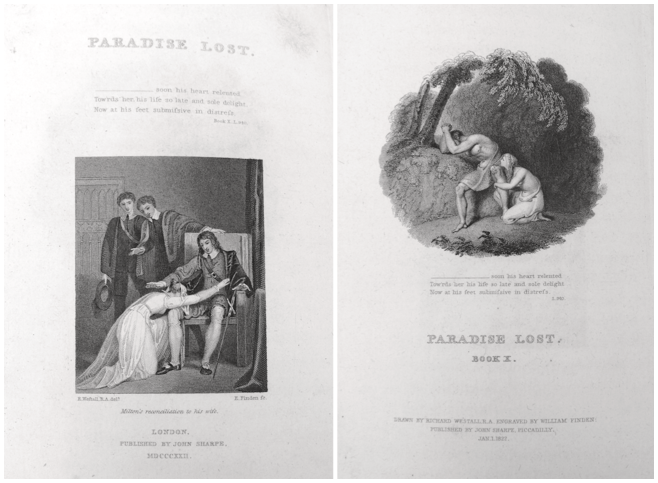
The association of Milton’s poetry with his life asserted by his nineteenth-century readers is made explicit in the material interventions they made in their copies of Milton’s writing – particularly Paradise Lost – through which they actively respond to the implicit suggestions of illustrations. One illuminating example can be found at the Huntington Library in San Marino, California: an extra-illustrated copy of Paradise Lost, first published in 1826 with illustrations by John Martin, rebound with further illustrations by artists such as Francis Hayman, Thomas Stothard and J. M. W. Turner inserted in the 1850s.66 The first volume of this two-volume set – both of which contain varied illustrations of Paradise Lost – additionally ends and begins each chapter with engravings depicting moments in Milton’s life. These are largely illustrations of Milton with his daughters, or portraits of Milton, but also included are illustrations of his home and his meeting with Galileo. The most interesting of the extra-illustrations are a pair of insertions in the second volume: two engravings after Richard Westall (from an edition published by John Sharpe, 1822) are placed in immediate succession (see Figure I.1). The organisational pattern established elsewhere in the extra-illustrated volume, to group biographical illustrations at the end of each chapter, collapses. The first image shows Mary Powell – Milton’s first wife – atoning at his feet; the second presents a strikingly similar engraving, illustrating the moment after the Fall where Eve atones at the feet of Adam. Both are accompanied by lines from Book X: ‘soon his heart relented / Towards her, his life so late and sole delight, / Now at his feet submissive in distress’ (X. 940–42). The second image has a reasonably static position in Sharpe’s editions of Paradise Lost, serving as the title page for Book X. The first image, of Milton and his wife reconciling, seems to move around between Sharpe’s 1817, 1821 and 1825 publications, but is usually included either at the beginning of the whole poem or at the beginning of the second volume.67 That nineteenth-century readers saw the two scenes (Mary atoning at the feet of Milton; Eve atoning at the feet of Adam) as bearing some relation to each other is well established: Milton is like Adam.68 Sharpe’s editions already establish the link between these scenes by attaching lines from Book X to each image, but the extra-illustrator’s rearrangement of these plates emphasises and makes more explicit what is already apparent: a commingling of Milton’s life and poetry. This is one example of the way that extra-illustration can confirm the way that readers received illustrated texts, actively engaging with those texts that reinforce associations and reveal interpretations. The 1822 engravings, collected here in an 1826 illustrated edition re-bound in the 1850s, also offer an example of the active engagement with Romantic-period illustrations in the Victorian era, discussed above. One of the aims of this book is to look beyond illustration as an interpretation of its source text, and to consider the ways that images might also mediate the experience of texts for later readers – as evidence suggests, many of the most attentive readers of Milton are writers.
William Finden after Richard Westall, ‘Milton’s Reconciliation to His Wife’ and ‘Paradise Lost, Book X’. Published in Paradise Lost (J. Sharpe, 1822) and inserted into John Milton, The Paradise Lost of Milton with Illustrations by John Martin, 2 vols. (Septimus Prowett, 1826), vol. II. RB 110034, The Huntington Library, San Marino, California.
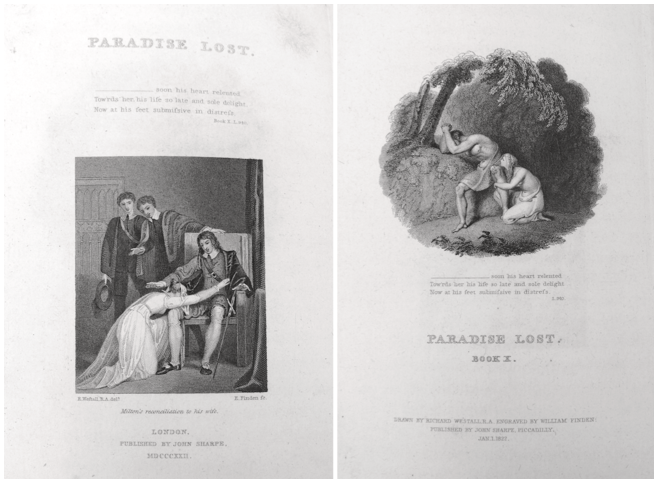
Figure I.1 Long description
Above the engraving showing Milton and his wife, the title 'Paradise Lost' is included with three lines from the poem: 'soon his heart relented / Tow'rds her, his life so late and sole delight. / Now at his feet submissive in distress.' (Book X, L. 940). Underneath the engraving are the names of the designer (R. Westall) and engraver (E. Finden), the title, 'Milton's reconciliation to his wife' and the publisher's details (London, Published by John Sharpe, MDCCCXXII). The same quotation from Paradise Lost and the same publication details are given under the second engraving.
I.4 Intermedial Readings
This book addresses the work of nineteenth-century writers and artists roughly chronologically. This is not to convey a sense of progression or development in appearances of the Miltonic throughout the nineteenth century (though such an argument is, I am sure, possible), but simply because Milton’s readers in the late nineteenth century were also readers of the literature of the earlier nineteenth century, and were familiar with the visual productions of previous generations. A chronological approach allows for a sense of conceptual exchange between these figures. Melville had read Shelley, and owned prints by Martin; Hardy wrote an elegy for Swinburne, and much admired his work. Throughout I acknowledge the fact that Milton is a voice among many for these novelists, poets, critics, painters, and engravers. Though each chapter has a distinct literary focus and a visual counterpart, there are also points of connection between the visual materials from chapter to chapter: Martin and Blake, two of the most engaged illustrators of Milton working in the long nineteenth century, reappear across chapters.
Chapter 1 explores apocalyptic images and texts from the 1820s in relation to Miltonic temporality and loss; I focus on Mary Shelley’s engagement with Milton in The Last Man (1826), in dialogue with the oil paintings and mezzotints of Martin, including his apocalypse paintings and illustrations of Paradise Lost. The Last Man has attracted renewed attention in recent years, in light of our global experience of pandemic and environmental collapse. Like Adams’s History of Victorian Literature, this book also starts with the death of Byron. Shelley prophetically wrote in her journal when news reached England of Byron’s death: ‘The last man! Yes I may well describe that solitary being’s feelings, feeling myself as the last relic of a beloved race, my companions, extinct before me.’69 The chapter attends to materials surrounding Shelley’s novel, ranging from paratextual materials such as the epigraph and fictional author’s introduction, to Shelley’s use of Milton in journal entries written across the same period. Shelley’s novel and these surrounding materials show her using the language and temporality of Paradise Lost to imagine apocalyptic grief. Shelley’s blending of personal loss and universal catastrophe draws on and positions itself against Milton’s vision of prophecy and apocalypse in Paradise Lost, responding to a similar concern with loss in Milton’s poetry. This argument attends not just to Shelley’s use of allusion, but to narrative technique: the fragmented form in which she explores these ideas can be related to a persistent and Miltonic multiplicity. Shelley both uses and resists fragmentation – and likewise both uses and subverts the Miltonic ontological model – in portrayals of her late husband, as part of a project of revivification and memorialisation that challenges more conventional public narratives.
The chapter begins by addressing Shelley’s novel as a point of connection between two paintings in Liverpool’s Walker Gallery: Martin’s The Last Man (1849) and Louis Édouard Fournier’s The Funeral of Shelley (1889). The gallery in question first opened in 1877, with a collection dating back to 1819, speaking to the growth of museum culture in the nineteenth century, which came along with new ways of looking for the masses.70 Although Fournier’s painting did not join the collection until 1905, the argument in this chapter relates to scholarship noted above regarding the growth of a gallery culture that opened up new ways of engaging with Milton from the end of the eighteenth century onwards. One example of ways in which new developments in exhibiting artworks can shape meaning is the display of Martin’s paintings lit by gaslight, discussed in this chapter; the setting in which the paintings are viewed then recalls the very daemonic world being depicted (for example, his imaginative construction of Satan’s Pandemonium, also lit by gas). Though Shelley’s The Last Man and Martin’s The Last Man share a title and similarly reflect a trend for the apocalyptic in the early decades of the nineteenth century, I suggest that it is Martin’s illustrations of Paradise Lost that parallel Shelley’s uses of Milton in the 1820s. As Martin’s images use light and dark to represent the temporality of Paradise Lost (where events occur in narrative time, but are also beyond narrative time), Shelley’s novel echoes moments in Paradise Lost where the strangeness of Miltonic temporality is revealed.
As Chapter 1 responds to the structuring of Miltonic time through darkness and light, Chapter 2 turns to Miltonic passivity and power: to articulate this in the language of Milton’s sonnets, this is a movement from ‘when I consider how my light is spent’ to ‘those also serve who only stand and wait’.71 In the second chapter, I trace Macaulay’s electric metaphor for influence in the work of Melville and Turner. In line with recent innovations in scholarship on science and literature, I propose that the experimentation in electricity in the early nineteenth century produces a useful metaphor of influence as electricity. The transfer of Miltonic ideas figured as the transfer of energy is linked to revivification, so that the monster of Frankenstein becomes a model of Galvanic influence: readers are made of what they read, and are electrified by their reading. Melville and Turner, I suggest, are important conductors for Miltonic ideas and energy. I demonstrate their shared investment in a ‘passive power’, a meeting point of Christian heroism and the Miltonic sublime, which is manifest visually as a vortex. Critics have acknowledged the centrality of a powerful weakness in Milton’s thought, and I trace interest in this notion of strength characterised by weakness in Melville’s fiction and marginalia, and anecdotal appendages that supplement Turner’s paintings. Drawing on the ‘indirect’ nature of the metaphor of suggestive shock shifts attention to influence revealed through the paratext. I read Melville’s marginalia and his interest in Turner’s paintings to explore his uses of Milton to conceptualise passivity as strangely powerful.
In writing about Melville in relation to Milton and Turner, I focus on his transatlantic relationship with British writers and artists, rather than discussing Milton’s influence on American literature of the nineteenth century (this despite the fact that Melville writes in his manifesto for American literature that ‘believe it or not England, after all, is, in many things, an alien to us’).72 The transatlantic connection rests partly on Melville’s visits to England, but also is materially embedded in the circulation and collection of engraved prints.
Chapter 3 turns to the mixture of classical and Christian thought in the works of Milton and Swinburne, focusing on the treatment of the erotic body in Paradise Lost and Poems and Ballads. I first look at interpoetical references to Milton in Swinburne’s republican poetry, where he is overtly positioned as a politically and culturally significant figure associated with virtue and liberty. For both Milton and Swinburne, questions of liberty are addressed through bodily violence: we see this through a comparison of Milton’s sonnet on the massacre of Piedmont and Swinburne’s ‘Les Noyades’. Drawing on this connection between liberty and bodily disfigurement, I then turn to consider more subtle intertextual links between Milton and Swinburne. This chapter engages with a growing body of scholarship reading the queer possibilities in Milton’s writing, highlighting in particular the distinctive treatment of gender and sexuality in Paradise Lost. In Milton’s rewriting of Genesis, we find a pervasive metaphysics of androgyny and permeable boundaries, which can be connected to the central concern with bodily indeterminacy in Swinburne’s poetic project. Where Swinburne’s depiction of the desiring body has been primarily linked to the influence of Charles Baudelaire and Sappho (and Greek notions of eros more generally), Milton’s texts offer a supplementary and significant erotic model. There are, of course, important differences between the treatment of sexuality and gender in Milton and Swinburne; I suggest that those differences are due to different understandings of the relationship between liberty and theology, but the treatment of the erotic body is nonetheless determined for both poets by their commitment to liberty. Both engage with the establishment of bodily boundaries and a desire that cannot be fully satiated: Milton presents this as a result of the conditions necessary for liberty, of free will, which allows for the transgressions of Satan and the first parents; Swinburne presents it as in conflict with liberty, a punishment created by a tyrannical God.
I suggest in this chapter that Swinburne’s engagement with Milton is particularly expressed in acts of intermedial ekphrasis. Ekphrasis, the translation of visual artworks into text, is of course always intermedial, but what I want to draw attention to by combining these words is the commingling of image and text as sources in Swinburne’s poetry: in describing artworks, he draws on literary tradition, and in alluding to literary texts, he describes images. For example, I read moments in Swinburne’s poetry as allusions to Milton’s words in Paradise Lost at the same time as they transform Blake’s illustrations of Paradise Lost – Blake being, of course, another important figure in Swinburne’s poetic development.
In Chapter 4, I read the fiction of Thomas Hardy alongside biblical illustration and iconographic tradition to reveal both Hardy’s Miltonic debt and his literary idiosyncrasy. Hardy’s repeated readings of Milton contributed to the establishment of both his poetic vocabulary and a career-long engagement with Miltonic ideas. I focus first on his use of shifting perspective – what we might call proto-cinematic, as discussed above – to show that the way relationships between character and landscape are constructed in Hardy’s writing involves Miltonic shifts in spatio-temporal scale. These Wessex landscapes create a backdrop against which the Fall is re-lived by his characters, particularly his female characters, who identify themselves within a cyclical Miltonic genealogy.
In following Hardy’s characters’ own identification with Adam and Eve, I address how this identification is complicated by Hardy’s allusions to Milton in ‘handed moments’, his engagement with a Miltonic focus on the hand. I argue that Hardy’s use of hands intentionally recalls Paradise Lost to recreate an unstable Eden in Wessex, revealing a persistent engagement with Milton’s system of significant touch. This reading of Milton and Hardy responds to a recent ‘manual turn’ in Victorian studies: in this scholarship Hardy and Milton have both played a role, but for the most part separately (and Milton only in a minor way).73 Comparing illustrations of Paradise Lost with those of the Bible reveals the complex function of haptic moments in Paradise Lost, and highlights the ways in which Milton’s text changes how the Bible is illustrated in the nineteenth century. I argue in this chapter that although, as Shawcross notes, ‘Many in the eighteenth century and later seem to have learned their Bible not from the Bible itself but from Paradise Lost and, for a few, from Paradise Regain’d,’ writers like Hardy who are sensitive to the power of allusion make subtle distinctions between their use of Milton and Christian thought more generally.74 I show that Hardy and Milton have a somewhat paradoxical shared idiosyncrasy in a common use of trivial moments of hand-touching and hand-holding. I suggest that Hardy deserves a central place in studies of Milton’s influence in the later years of the nineteenth century.
In each chapter, then, I read a nineteenth-century literary text or texts in relation to one or more visual counterparts in order to address diffuse responses to Milton beyond and through the literary. I offer a model of reading that attends to intermedial influence, and I argue that traditional models of influence can be disrupted in useful ways by reading literature alongside the visual. What these chapters aim to do is to show the cross-pollination of image and text in the nineteenth-century legacy of Milton’s poetry: the influence of Milton’s poetry is found in the visual culture of the nineteenth century, but those visual responses concurrently contribute to the literary reception of Milton. A study of Milton’s legacy in nineteenth-century culture benefits from attention to the visual culture that forms the world in which both acts of reading and literary production occurred.