Book contents
- Frontmatter
- Contents
- Preface
- Introduction
- ICOMPULSION AND THE WILL: THREE ANCIENT TRADITIONS
- IINEED AS COMPULSION: THE SCHOLASTIC PARADIGM
- 4Loans and usury
- 5Price and market manipulation
- 6Need and the will in buying and selling
- 7Labor and wages
- IIIREJECTION AND REVIVAL IN POSTSCHOLASTIC THOUGHT
- Bibliography
- Index
7 - Labor and wages
Published online by Cambridge University Press: 13 March 2010

Book contents
- Frontmatter
- Contents
- Preface
- Introduction
- ICOMPULSION AND THE WILL: THREE ANCIENT TRADITIONS
- IINEED AS COMPULSION: THE SCHOLASTIC PARADIGM
- 4Loans and usury
- 5Price and market manipulation
- 6Need and the will in buying and selling
- 7Labor and wages
- IIIREJECTION AND REVIVAL IN POSTSCHOLASTIC THOUGHT
- Bibliography
- Index
Summary
Scholastic approaches to labor
“The Law further ordains merciful conduct toward hired workmen because of their poverty. Their wages should be paid without delay, and they must not be wronged in any of their rights; they must receive their pay according to their work.” These words, written in the late twelfth century, are those of Moses Maimonides in the Guide for the Perplexed. There is an echo of them in the Summa theologiae of Thomas Aquinas: “Laborers who hire out their work are poor people who seek their sustenance from their daily toil, and therefore the law wisely ordains that their wages be paid promptly, lest they should lack food.” The remark is merely made by way of reply to an objection concerning the suitability of one of the judicial precepts of Leviticus. The economic conditions of contemporary wage earners are not addressed for their own sake and the subject is not pursued further, but even such passing reference to it is rare in medieval scholastic sources. It was not until the fifteenth century that systematic attention began to be paid to the question of the just wage. The paucity of early source material on wages is all the more remarkable when compared with the wealth of thirteenth- and fourteenth-century literature on justice in the exchange of commodities and the lending of money.
Information
- Type
- Chapter
- Information
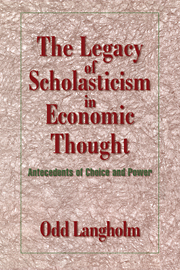
- The Legacy of Scholasticism in Economic ThoughtAntecedents of Choice and Power, pp. 118 - 136Publisher: Cambridge University PressPrint publication year: 1998
Accessibility standard: Unknown
Why this information is here
This section outlines the accessibility features of this content - including support for screen readers, full keyboard navigation and high-contrast display options. This may not be relevant for you.Accessibility Information
Accessibility compliance for the PDF of this chapter is currently unknown and may be updated in the future.