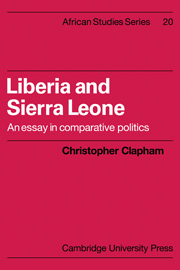
Book contents
- Frontmatter
- Contents
- List of maps, tables and figures
- Preface
- Map ALiberia and Sierra Leone in West Africa
- 1Political Comparison
- 2Historical Summary
- 3Resources
- 4Rules
- 5Political Allocation at the Centre
- 6Centre and Periphery
- 7Aspects of Political Economy
- 8Concluding Review
- Statistical Appendix
- Bibliographical Note
- Notes
- Index
8 - Concluding Review
Published online by Cambridge University Press: 15 January 2010

Book contents
- Frontmatter
- Contents
- List of maps, tables and figures
- Preface
- Map ALiberia and Sierra Leone in West Africa
- 1Political Comparison
- 2Historical Summary
- 3Resources
- 4Rules
- 5Political Allocation at the Centre
- 6Centre and Periphery
- 7Aspects of Political Economy
- 8Concluding Review
- Statistical Appendix
- Bibliographical Note
- Notes
- Index
Summary
SIMILARITY AND DIFFERENCE
For all the contrasts between Sierra Leone and Liberia which this essay has been concerned to point out, any comparison of the two countries must start by emphasising their similarities. It is the similarities which make the two countries readily comparable in the first place, placing them in a common context in which differences stand out in such a way that their origins can be located.
These similarities chiefly belong to the first level of political comparison distinguished in the introduction, that of resources. In particular they derive from the resources, common in some degree to all developing countries, which have resulted from western penetration. Firstly, the states themselves were established through external imposition, and thus acquired the administrative apparatus through which this imposition could be managed. Secondly, their economies were drastically reshaped by involvement in the external market, resulting both in the penetration of the internal economy by actors from outside, and in the use of the state apparatus as an intermediary – through its powers of taxation, regulation and produce-marketing – between internal and external producers and markets. Thirdly, the skills and occupations which these political and economic structures called for were such that only a very small proportion of the population could acquire them, and thus attain positions of political influence. The skills were for the most part introduced ones – as lawyers, administrators, army officers – which thus required western education, which was necessarily limited to a few. The institutions and job opportunities which the economy and political structure could support were likewise restricted.
These common features of underdeveloped political systems have been reinforced in Liberia and Sierra Leone.
Information
- Type
- Chapter
- Information
- Liberia and Sierra LeoneAn Essay in Comparative Politics, pp. 120 - 129Publisher: Cambridge University PressPrint publication year: 1976
Accessibility standard: Unknown
Why this information is here
This section outlines the accessibility features of this content - including support for screen readers, full keyboard navigation and high-contrast display options. This may not be relevant for you.Accessibility Information
Accessibility compliance for the PDF of this chapter is currently unknown and may be updated in the future.