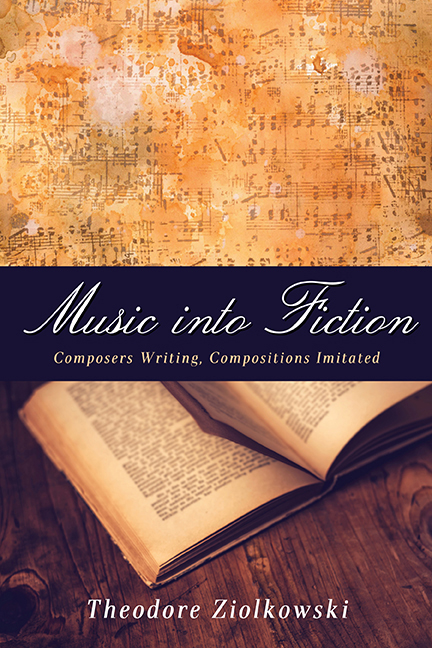
Music into Fiction

-
Select format
-
- Publisher:
- Boydell & Brewer
- Publication date:
- 09 May 2017
- 01 February 2017
- ISBN:
- 9781782049173
- 9781571139733
- Dimensions:
- Weight & Pages:
- Dimensions:
- Weight & Pages:
- Subjects:
- Music, Music: General Interest
You may already have access via personal or institutional login- Subjects:
- Music, Music: General Interest
Show more authors 
You may already have access via personal or institutional login
Book description
This book deals with three aspects that have been neglected in the burgeoning field of music and literature. The "First Movement" of the book considers writers from German Romanticism to the present who, like Robert Schumann, first saw themselves as writers before they turned to composition, or, like E. T. A. Hoffmann and Anthony Burgess, sought careers in music before becoming writers. It also considers the few operatic composers, such as Richard Wagner and Arnold Schoenberg, who wrote their own libretti. The "Second Movement" turns to literary works based specifically on musical compositions. This group includes, first and more generally, prose works whose author chose a specific musical form such as sonata or fugue as an organizational model. And second, it includes novels based structurally or thematically on specific compositions, such as Bach's Goldberg Variations. The "Finale" concludes with a unique case: efforts by modern composers to render musically the compositions described in detail by Thomas Mann in his novel Doktor Faustus. This book, which addresses itself to readers interested generally in music and literature and is written in a reader-friendly style, draws attention to unexplored dimensions of the music-literature relationship and to the sometimes unrecognized talents of certain writers and composers.
Theodore Ziolkowski is ProfessorEmeritus of German and Comparative Literature, Princeton University.
Contents
Contents
Metrics
Full text views
Full text views helpTotal number of HTML views: 0
Total number of PDF views: 0 *
 Loading metrics...
* Views captured on Cambridge Core between #date#. This data will be updated every 24 hours.
Usage data cannot currently be displayed.
Accessibility standard: Unknown
Why this information is here
This section outlines the accessibility features of this content - including support for screen readers, full keyboard navigation and high-contrast display options. This may not be relevant for you.
Accessibility Information
Accessibility compliance for the PDF of this book is currently unknown and may be updated in the future.