About Studies in German Literature Linguistics and Culture
This is Camden House’s general German studies series, in which numerous titles have appeared since the early 1980s. It welcomes a broad range of topics and approaches - from traditional, narrowly literary studies on one hand to forays into cultural studies and cultural history on the other, from approaches based on traditional close reading to those emphasizing theory, from feminist to postmodern to multicultural. All periods of German culture and literature are fair game, from medieval Spielmannsepen to currently emerging writers of the twenty-first century.
To save content items to your account,
please confirm that you agree to abide by our usage policies.
If this is the first time you use this feature, you will be asked to authorise Cambridge Core to connect with your account.
Find out more about saving content to .
To save content items to your Kindle, first ensure no-reply@cambridge.org
is added to your Approved Personal Document E-mail List under your Personal Document Settings
on the Manage Your Content and Devices page of your Amazon account. Then enter the ‘name’ part
of your Kindle email address below.
Find out more about saving to your Kindle.
Note you can select to save to either the @free.kindle.com or @kindle.com variations.
‘@free.kindle.com’ emails are free but can only be saved to your device when it is connected to wi-fi.
‘@kindle.com’ emails can be delivered even when you are not connected to wi-fi, but note that service fees apply.
The first critical anthology of major programmatic texts of cultural journalism from the crucial period known in Germany as the Vormärz, the time before the March Revolutions of 1848.
Cultural journalism-a broad category of periodical writing encompassing criticism, reporting on the arts, popular culture, politics, and society-was one of the most dynamic fields of German intellectual activity in the nineteenth century, particularly during the crucial period in Germany's history known as the Vormärz, leading up to the March revolutions of 1848. Many of the most prominent German writers, among them Heinrich Heine, Ludwig Börne and Goethe, were active in cultural journalism during this period of increasing nationalism and clamor for a unified, democratic Germany on one hand and absolutist repression, including censorship, on the other.
This critical anthology is the first collection, in English or German, of major programmatic texts of German cultural journalism from the period. It provides complete texts or excerpts, many for the first time in English, along with critical introductions to each text by a leading scholar in German Studies or a related field. It reveals the richness and dynamism of the period's discussion of the status and function of journalism and its significance for politics, aesthetics, historiography and philosophy. Of interest to scholars in German Studies, media and book history, and those working on the history of political journalism, the book is also well suited for undergraduate and graduate courses on European literature, history and media studies.
Presents Stifter's multi-faceted oeuvre to both a German Studies and non-specialized Anglophone audience, showing today's readers the relevance of its concerns.
The canonical nineteenth-century Austrian writer Adalbert Stifter (1805-1868), long considered a staid stylist - if not mannerist - and a conservative-bourgeois apologist, has recently become the subject of more vibrant literary-theoretical approaches. While Stifter is primarily known for his fictional prose, including two lengthy novels (Der Nachsommer [Indian Summer] and Witiko) and numerous novella-length narratives, he also wrote dozens of cultural-political and scientific essays. Moreover, his professional activity in the Austrian school system and his diverse publications in the realm of pedagogy not only shed interpretive light on his literary production but also inform enduring debates on education reform and the intellectual-historical question of Bildung. This volume covers a wide range of texts and topics within Stifter's oeuvre. With respect to literary-historical coverage, it extends from his earliest tale Der Condor (The Condor, 1840) to his posthumously published chronicle Aus dem bairischen Walde (From the Bavarian Forest, 1868); in terms of genre, it embraces his novels and novellas, his essayistic work, and even his landscape paintings; finally, it pursues a host of deeper problems and thematic strands that permeate his texts and make them relevant to readers today. These include (neo-)conservatism, social unrest, law and order, ecology, climatology, bioregionalism, and the Anthropocene.
Presents Wagner as a serious philosopher and offers a fresh perspective on the Ring and its unique fusion of myth, human drama, and philosophical insight.
Few figures of the nineteenth century were more influential than Richard Wagner, and few works of art have the scope and historical significance of The Ring of the Nibelung. Wagner himself said that it expressed his entire philosophy of life. Yet little attention has been paid to him as a philosopher, aesthetic theories aside. Instead, the Ring has been viewed in the light of Schopenhauer, Feuerbach, or even Hegel. Wagner's own ideas do not deserve this neglect, and this book addresses that omission. It starts with the more widely read philosophers of his day, such as Fichte; in their context Wagner's often fragmentary thoughts reveal a coherent "materialist idealism" that constitutes a late but significant contribution to Classical German philosophy. His acute social and psychological insights are still relevant, and so is the philosophical history that he saw prefigured in Greek tragedy.
Wagner's philosophy also illuminates the structure of the Ring and offers fresh insights into the characters and conflicts of that endlessly interpretable work. Approachable and engagingly written, balancing narrative, philosophical analysis, and a detailed consideration of the Ring's four music dramas, The Philosopher's Ring shows the cycle to be a work of unparalleled philosophical depth, one reason that it continues to challenge audiences even now, a century and a half after its premiere.
Provides the English-speaking reader with a comprehensive guide to the fiction of Alfred Döblin, a major figure in German and European literary modernism.
Alfred Döblin was born into a Jewish family in 1878 and grew to become a leading German literary figure before he had to flee from the Nazis in 1933. His big-city novel Berlin Alexanderplatz (1929) is often compared to Joyce's Ulysses, but Döblin had been exploring modern narrative techniques since the early 1900s, and his themes were entirely his own. In view of the highly diverse character of his fictions and their settings-ranging from Europe to China and South America, and from the sixteenth century to the twenty-seventh-the first four chapters of this book present them according to broad thematic concerns-Person, Power, Nature and Culture-rather than chronological sequence. The aim is to encourage readers to identify aspects of his writing that they would like to investigate further for themselves.
The introduction provides initial orientation in Döblin's early thinking and the way he conceived the writer's task, and that is followed by a concise description of his family background and his subsequent personal biography. The final two chapters focus respectively on the development of his skill in the deployment of specific narrative techniques and on how historical circumstances affected his philosophical and religious orientation in the course of his adult life, from the language skepticism of his early years and his professed agnosticism in the 1920s to his late conversion to Catholicism.
First English translation of an unjustly overlooked novel by the great German realist novelist Theodor Fontane.
Set in Austria and Hungary in the 1870s, this novel is the story of Count Adam Petöfy, a lifelong bachelor, who at age seventy, unexpectedly proposes marriage to a young actress, Franziska Franz. He explains that he is only looking for companionship and affectionate regard - apart from this, he will give Franziska carte blanche. Despite their differences of age, class, and background, they marry. Adam takes Franziska, now Countess Petöfy, from Vienna to his family's ancestral estates in the Hungarian countryside. Here they begin their new life: a life of ease and privilege - but later, of struggles which neither has anticipated.
Count Petöfy has been a neglected book, even in Germany, and has been overshadowed by Fontane's celebrated "Berlin" novels, such as Effi Briest. This first-ever English translation will allow a wider audience to read and study Count Petöfy for its exploration of missteps and the limits of self-realization, of questions of gender and social convention, of honour and duty; and for a narrative craft that reveals and conceals at the same time. The translation is bookended by contributions from two noted Fontane scholars: a contextualizing introduction by Brian Tucker, who has written on Count Petöfy before, and an afterword by Helen Chambers on the novel's relationship to the novelist's other works.
First complete English translation of Mann's uncannily insightful wartime anti-Nazi radio addresses, once again urgently topical in the context of the current worldwide rise of anti-democratic movements.
Upon Hitler's rise to power in 1933, the great German writer Thomas Mann, 1929 Nobel Prize laureate on the strength of his monumental novels Buddenbrooks and The Magic Mountain, chose exile, eventually moving to the United States in 1938. An early critic of National Socialism, he gave over 150 public lectures with titles such as "The Coming Victory of Democracy." From 1940 to 1945, he authored and narrated a series of anti-Nazi radio addresses that were broadcast to Germany by the BBC; German listeners risked severe punishment.
Mann's radio addresses constitute his most sustained contribution to the Allied war effort. In them, he comments on the progress of the war, contrasts fascism with democracy, measures Hitler against Roosevelt, and counters German propaganda with international consensus, lies with facts. After initially encouraging the Germans to resist the Nazi regime, Mann prepares them for the consequences of defeat, but also instills hope in them for future reconciliation with the community of nations.
Today, when democracy is again endangered in much of the world, Mann's antifascist radio addresses have once again acquired urgency. This edition presents for the first time English translations of all of Mann's 58 radio addresses, with a foreword by Mann's grandson Frido Mann, an introduction by leading Mann scholar Hans Rudolf Vaget, careful annotations and a selection of photographs.
This volume explores the representation of political, racial, sexual, and environmental trauma in German-language graphic narratives, which has thus far received little scholarly attention.
In recent decades, as graphic novels have exploded in popularity and have increasingly been engaged with by scholarship, there has been a marked increase in comics that deal with traumatic experiences. These experiences arise variously from warfare, genocide, terrorism, racism, sexual violence, domestic violence, illness, disability, migration, natural disasters, or climate-change, among other causes. Indeed, scholars including Hillary Chute and Gillian Whitlock have argued that graphic narratives are particularly well-suited to portraying traumatic experiences through the lens of individual memories.
This edited volume builds on the emergent body of work on the representation of trauma in graphic narratives, but focuses exclusively on German-language graphic narratives, whose exploration of trauma has so far received little scholarly attention. Essays dealing with theoretical and conceptual concerns are joined by analyses of individual creators of graphic narratives, including Olivia Vieweg and Volker Reiche. In addition, there are transcribed conversations among the contributors to the graphic story compilation But I Live, Miriam Libicki, Gilad Seliktar, and Barbara Yelin, and between Birgit Weyhe, creator of the graphic narratives Madgermanes and Rude Girl, and the Germanist Priscilla Layne, who is the model for the main character in the latter book. A final essay looks back further with a critical appraisal of the poet Rolf-Dieter Brinkmann's sampling of comics in his late 1960s Popliteratur works.
Surveys the considerable nineteenth-century American discourse on and response to the writings of the German dramatist, critic, art theorist, and theological thinker.
Gotthold Ephraim Lessing (1729-1781) was a leading figure in the humanist revival in German culture that culminated in Weimar Classicism. His plays and drama criticism mark the rise of middle-class forms and values and influenced contemporaries and successors alike. His work in art theory still stimulates discussion, while his liberal theological writing has had a perhaps even greater impact. In the US, Lessing first drew major attention during the German craze of the early nineteenth century and achieved his greatest fame during the third quarter of the century. His drama criticism and views on theology and the arts became entrenched in a robust American discourse about those subjects. Many Americans thought of him less as a historical figure than as a virtual contemporary.
This book surveys critical commentary on Lessing published in prominent journals and periodicals from 1796 to the end of the nineteenth century, a period before the professionalization of literary scholarship in America, when individuals of varying professional backgrounds routinely assessed foreign writers in the context of their own national experience. Chapters focus on the unfolding of Lessing's presence in the US, on broad assessments of his life and work, and, respectively, on American responses to his fables and epigrams, his plays and drama criticism, his art-historical and -theoretical writing, and his theological work.
Brings to light an important and unconventional teacher of literature whose way of thinking and method are relevant in German Studies and beyond, particularly in view of the present crisis of the humanities.
At a time when enrollment in the humanities is said to be in "free fall" (Nathan Heller, The New Yorker, 2/27/2023), the figure of Andrew Jaszi offers an alternative vision of what a literary education might look like. Jaszi was a Hungarian-born philosopher and literary scholar in the German Department at the University of California, Berkeley, from 1948 to 1985. His accessible, jargon-free approach, a method he developed through analogy with Goethe's unique way of doing science, attracted students of diverse backgrounds and majors to his classes, while also winning acclaim from colleagues who compared him to Wittgenstein and Buber.
Drawing on a set of previously unknown tape recordings of Jaszi's seminars, this book offers readers the opportunity to witness this legendary teacher in action. The book's immediate benefit is the illumination provided by Jaszi's original interpretations of Goethe's Faust and Kafka's "The Judgment." More broadly, it illustrates the transformative, whole-self education Jaszi advocated and himself embodied, one that runs counter to the technocratic imperatives of our time. Ultimately, the book's goal is to make better known an important literary thinker and an unconventional teacher of German Studies, the value of whose work extends beyond a single discipline to humanities education in general, with special bearing on its present crisis and potential future.
Shows, contrary to the traditional view, that the major authors of German literary realism not only thematized environmental transformation but that it was central to their aesthetics.
In nineteenth-century Europe, and particularly in Germany, the industrial revolution led to air and water pollution, urban and industrial sprawl, and the physical reconstitution of natural landscapes. This book investigates the relationship between environmental degradation and German Realist aesthetics, challenging a longstanding argument in the scholarship that German Realism largely occluded urban and industrial realities by demonstrating that its major authors-Adalbert Stifter, Wilhelm Raabe, Theodor Storm, and Theodor Fontane-not only thematized environmental matters, but that environmental transformation became the very condition for their texts' reflections on the aesthetic representation of reality.
German Realist aesthetics in this sense are thus inseparable from environmental aesthetics. Environmental aesthetics, in turn, are inseparable from environmental politics, connected as they are to problems such as the loss of individual livelihoods, displacement of communities, and the legal and ethical standing of animals, plants and landscapes. By exploring how these problems appear in the fiction of the period, Alexander Phillips's book situates the literature in a longer genealogy of environmentalism and ecological aesthetics beyond Germany. That genealogy includes the early twentieth-century "Nature Fakers" debate in the United States, twentieth-century nature writing and contemporary ecocritical theory.
A reassessment of the controversial, yet still influential nineteenth-century German philosopher that explores the contentious issue of whether he was, as his critics frequently claim, a nihilist.
Demonstrates, contrary to conventional wisdom, that European modernism developed not only in the great metropolitan centers, but also in provincial cities such as Jena.
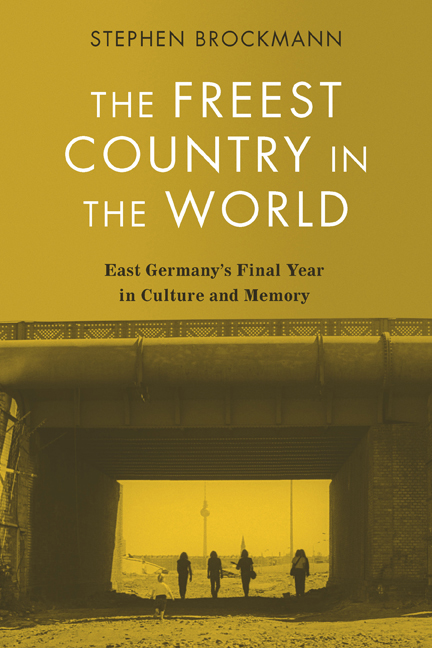
Shows that while the GDR is generally seen as - and mostly was - an oppressive and unfree country, from late 1989 until autumn 1990 it was the 'freest country in the world': the dictatorship had disappeared while the welfare system remained.
A collection of new essays bringing into view the push and pull of the national and the international in the German-language cultural field of the period.
A new translation of Rilke's great work with close readings of each of the ten elegies elucidating how their poetic attributes constitute their meaning.
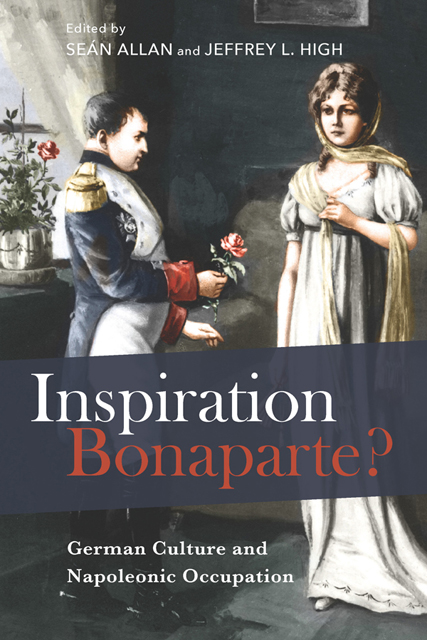
Two hundred years after his death, Napoleon Bonaparte (1769-1821) continues to resonate as a fascinating, ambivalent, and polarizing figure. Differences of opinion as to whether Bonaparte should be viewed as the executor of the principles of the French Revolution or as the figure who was principally responsible for their corruption are as pronounced today as they were at the beginning of the nineteenth century. Contributing to what had been an uneasy German relationship with the French Revolution, the rise of Bonaparte was accompanied by a pattern of Franco-German hostilities that inspired both enthusiastic support and outraged dissent in the German-speaking states.
The fourteen essays that comprise Inspiration Bonaparte? examine the mythologization of Napoleon in German literature of the nineteenth and twentieth centuries and explore the significant impact of Napoleonic occupation on a broad range of fields including philosophy, painting, politics, the sciences, education, and film. As the contributions from leading scholars emphasize, the contradictory attitudes toward Bonaparte held by so many prominent German thinkers are a reflection of his enduring status as a figure through whom the trauma of shattered late-Enlightenment expectations of sociopolitical progress and evolving concepts of identity politics is mediated.