About Studies in German Literature Linguistics and Culture
This is Camden House’s general German studies series, in which numerous titles have appeared since the early 1980s. It welcomes a broad range of topics and approaches - from traditional, narrowly literary studies on one hand to forays into cultural studies and cultural history on the other, from approaches based on traditional close reading to those emphasizing theory, from feminist to postmodern to multicultural. All periods of German culture and literature are fair game, from medieval Spielmannsepen to currently emerging writers of the twenty-first century.
To save content items to your account,
please confirm that you agree to abide by our usage policies.
If this is the first time you use this feature, you will be asked to authorise Cambridge Core to connect with your account.
Find out more about saving content to .
To save content items to your Kindle, first ensure no-reply@cambridge.org
is added to your Approved Personal Document E-mail List under your Personal Document Settings
on the Manage Your Content and Devices page of your Amazon account. Then enter the ‘name’ part
of your Kindle email address below.
Find out more about saving to your Kindle.
Note you can select to save to either the @free.kindle.com or @kindle.com variations.
‘@free.kindle.com’ emails are free but can only be saved to your device when it is connected to wi-fi.
‘@kindle.com’ emails can be delivered even when you are not connected to wi-fi, but note that service fees apply.
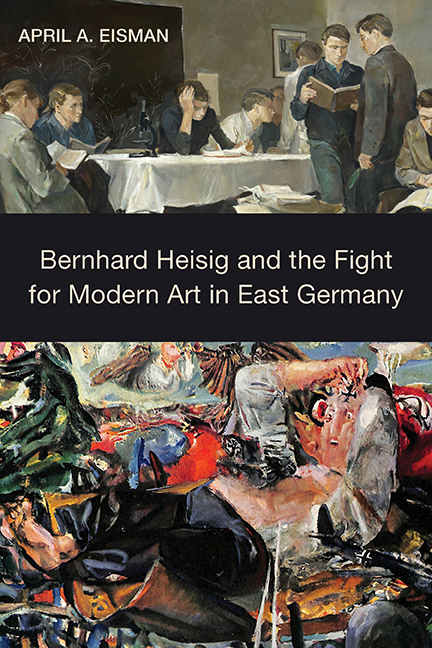
One of the first books to extend the currently burgeoning scholarship on East Germany to the visual arts, revealing that painting, like literature and film, was a space of contestation.
Explores the storytelling of Anna Seghers and other 20th-century writers who faced the tensions between aesthetics and politically conscious writing, between conformity and resistance.
The prominent scholar-contributors to this volume share their experiences developing the field of US German Studies and their thoughts on literature and interdisciplinarity, pluralism and diversity, and transatlantic dialogue.
This is the first English translation of the memoirs of the great German-Jewish theater producer Ernst Josef Aufricht (in German 1966, rpt. 1998). The title alludes to Brecht and Weill's Threepenny Opera, the premiere of which was produced by Aufricht at his Theater am Schiffbauerdamm in Berlin in 1928, launching Brecht and Weill to worldwide fame. Aufricht's book is most notable for its insider's account of the Berlin theater scene from the great days of the late 1920s and early 30s. Its range, however, from school years and the military to his time as an actor and then producer, the rise of the Nazis, and finally long years of exile in France and America, gives the picture of a complex individual with a talent for survival and a winningly understated sense of humor. The book will be of interest to an academic audience, but its reflections on a period of momentous artistic and political events will expand its appeal to a wider group: those interested in twentieth-century German history, music and theater history, as well as the general reader. Benjamin Bloch is a clinical psychologist who grew up speaking German at home with his native German father and studied German and English Literature at Oberlin College. Marc Silberman is Emeritus Professor of German at the University of Wisconsin.
The many fictional suicides in the literature of the German Democratic Republic have been greatly misunderstood. The common assumption is that authoritarian oppression in East Germany led to an anomalous abundance of real suicides, so that fictional suicides in GDR literature constitute a simple, realistic reflection of East German society. Robert Blankenship challenges this assumption by providing both a history of suicide in GDR literature and close readings of individual texts, revealing that suicides in GDR literature, rather than simply reflecting historical suicides, contain rich literary attributes such as intertextuality, haunting, epistolarity, and unorthodox narrative strategies. Such literariness offered subversive potential beyond suggesting that real people killed themselves in a communist country. This first book-length study of fictional suicides in East German literature provides insight into the complex and dynamic rhetoric of the GDR. Blankenship's underlying claim is that GDR literature ought to be read as literature, with literary methodology, not despite the country's politically and rhetorically charged nature, but precisely because of it. Suicide in East German Literature will be of interest to scholars of GDR literature, humanities-oriented scholars of suicide, and those who are interested in the complex relationship between literature and history.Robert Blankenship is Assistant Professor of German at California State University, Long Beach.
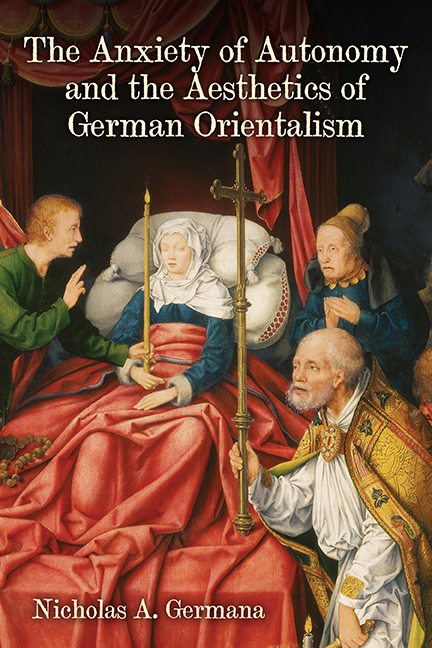
German orientalism has been understood, variously, as a form of latent colonialism, as a quest for academic hegemony in Europe, and as an effort to diagnose and treat the ills of modern Western culture. Nicholas Germana identifies a different impetus for orientalism in German thought, seeing it as an effort to come to grips with the Other within German society at the turn of the nineteenth century and within the dynamics of subjectivity itself.Drawing largely on work by feminist scholars, the book uncovers an anxiety at the core of Kantian and post-Kantian thought, thus shedding light on its derogation (or elevation) of Oriental cultures. Kant's philosophy of freedom is a construction of modern, Western masculinity. Reason, which alone can make freedom possible, subverts and orders chaotic nature and protects the rational subject from the enervating influences of the senses and the imagination. The feminized, sexually charged Orient is a threat to the historical achievement of Western male rationality.Germana's book emphasizes aesthetics in the German orientalist discourse, a subject that has received little attention to date. In this tradition of German thought, aesthetics became a form of spiritual anthropology, ordering and classifying societies, races, and genders in terms of their ability to master the senses and the imagination, forces that undermine rational autonomy, the very source of human (i.e., masculine) dignity.Nicholas A. Germana is Professor of History at Keene State College, New Hampshire.
Hugo Bettauer's The Blue Stain, a novel of racial mixing and "passing," starts and ends in Georgia but also takes the reader to Vienna and New York. First published in 1922, the novel tells the story of Carletto, son of a white European academic and an African American daughter of former slaves, who, having passed as white in Europe and fled to America after losing his fortune, resists being seen as "black" before ultimately accepting that identity and joining the early movement for civil rights. Never before translated into English, this is the first novel in which a German-speaking European author addresses early twentieth-century racial politics in the United States - not only in the South but also in the North. There is an irony, however: while Bettauer's narrative aims to sanction a white/European egalitarianism with respect to race, it nevertheless exhibits its own brand of racism by asserting that African Americans need extensive enculturation before they are to be valued as human beings. The novel therefore serves as a unique historical account of transnational and transcultural racial attitudes of the period that continue to reverberate in our present globalized world.Hugo Bettauer (1872-1925) was a prolific Austrian writer and journalist, a very early victim of the Nazis. Peter Höyng is Associate Professor of German Studies at Emory University. Chauncey J. Mellor is Professor of German at the University of Tennessee, Knoxville. Kenneth R. Janken is Professor of African American and Diaspora Studies at the University of North Carolina, Chapel Hill.
Argues on the evidence of nine major German novels that literature and business have in common a reliance on language, understood in a creative, performative, and rhetorical sense.
In the German-speaking world there has been a new wave - intensifying since 2007 - of autobiographically inspired writing on illness and disability, death and dying. Nina Schmidt's book takes such writing seriously as literature, examining how the authors of such personal narratives come to write of their experiences between the poles of cliché and exceptionality. Identifying shortcomings in the approaches taken thus far to such texts, she makes suggestions as to how to better read such narratives from the stance of literary scholarship, then demonstrates the value of a literary disability studies approach to such writing with close readings of Charlotte Roche's Schoßgebete (2011), Kathrin Schmidt's Du stirbst nicht (2009), Verena Stefan's Fremdschläfer (2007), and - in the final, comparative chapter - Christoph Schlingensief's So schön wie hier kanns im Himmel gar nicht sein! Tagebuch einer Krebserkrankung (2009) and Wolfgang Herrndorf's blog-cum-book Arbeit und Struktur (2010-13). Schmidt shows that authors dealing with illness and disability do so with an awareness of their precarious subject position in the public eye, a position they negotiate creatively. Writing the liminal experience of serious illness along the borders of genre, moving between fictional and autobiographical modes, they carve out spaces from which they speak up and share their personal stories in the realm of literature, to political ends.Nina Schmidt is a postdoctoral researcher in the Friedrich Schlegel School of Literary Studies at the Freie Universität Berlin.
Best known for his collaborations with Bertolt Brecht, composer Hanns Eisler also set nineteenth-century German poetry to music that both absorbs and disturbs the Lieder tradition. This book traces Eisler's art songs (German: Kunstlieder) through twentieth-century political crises from World War I to Nazi-era exile and from Eisler's postwar deportation from the U.S. to the ideological pressures he faced in the early German Democratic Republic. His art songs are presented not as an escape from the "dark times" Brecht lamented but rather as a way to intervene in the nationalist appropriation of aesthetic material.This book follows a chronological arc from Eisler's early Morgenstern songs to his Lied-like setting of Brecht's 1939 "To Those Who Come After" and his treatment of Hölderlin's poetry in the 1940s Hollywood Songbook; the final two chapters focus on Eisler's Goethe settings in the early GDR, followed by his late Serious Songs recalling Brahms in their reflective approach. In its combination of textual and musicological analysis, this book balances technical and lay vocabulary to reach readers with or without musical background. The author's practical perspective as a singer also informs the book, as she addresses not only what Eisler asks of the voice but also the challenge of evoking both intimacy and distance in his politically fraught art songs.Heidi Hart holds a PhD in German Studies from Duke University. She is an instructor in the College of Humanities and Social Sciences at Utah State University.
Social-injustice dilemmas such as poverty, unemployment, and racism are subjects of continuing debate in European societies and in Germany in particular, as solutions are difficult and progress often comes slowly. Such discussions are not limited to opposing newspaper editorials, position papers, or legislative forums, however; creative works expound on these topics as well, but their contributions to the debate are often marginalized. This collection of new essays explores how contemporary German-language literary, dramatic, filmic, musical, and street artists are grappling with social-justice issues that affect Germany and the wider world, surveying more than a decade's worth of works of German literature and art in light of the recent paradigm shift in cultural criticism called the "ethical turn." Central themes include the legacy of the politically engaged 1968 generation, eastern Germany and the process of unification, widening economic disparity as a result of political policies and recession, and problems of integration and inclusivity for ethnic and religious minorities as migration to Germany has increased.
Contributors: Monika Albrecht, Olaf Berwald, Robert Blankenship, Laurel Cohen-Pfister, Jack Davis, Bastian Heinsohn, Axel Hildebrandt, Deborah Janson, Karolin Machtans, Ralf Remshardt, Alexandra Simon-López, Patricia Anne Simpson, Maria Stehle, Jill E. Twark.
Jill E. Twark is Associate Professor of German at East Carolina University. Axel Hildebrandt is Associate Professor of German at Moravian College.
The concentration camp at Dachau was the first established by the Nazis, opened shortly after Hitler came to power in 1933. It first held political prisoners, but later also forced laborers, Soviet POWs, Jews, and other "undesirables." More than 30,000 deaths were documented there, with many more unrecorded. In the midst of the horror, some inmates turned to poetry to provide comfort, to preserve their sense of humanity, or to document their experiences. Some were or would later become established poets; others were prominent politicians or theologians; still others were ordinary men and women. This anthology contains 68 poems by 32 inmates of Dachau, in 10 different original languages and facing-page English translation, along with short biographies. A prologue by Walter Jens and an introduction by Dorothea Heiser from the original German edition are joined here by a foreword by Stuart Taberner of the University of Leeds. All the poems, having arisen in the experience or memory of extreme human suffering, are testimonies to the persistence of the humanity and creativity of the individual. They are also a warning not to forget the darkest chapter of history and a challenge to the future not to allow it to be repeated. Dorothea Heiser holds an MA from the University of Freiburg. Stuart Taberner is Professor of Contemporary German Literature, Culture, and Society at the University of Leeds.
For women, according to the contemporary Austrian dramatist Elfriede Jelinek, writing for the theater is an act of transgression. The idea that drama as a grand public genre resists women writers has become established in recent scholarship. But Jelinek herself has won the Büchner Prize, the most prestigious award in German letters, and there is a wealth of dramatic work by women from the 20th century and before: both facts seem to contradict the notion of women's exclusion from drama. So why has drama by women appear to have been written against the odds, and why has it, until very recently, been missing from literary histories? This book looks in detail at women's playwriting in German between 1860 and 1945, and at its reception by critics. Many of the works considered have never before been analyzed by modern scholarship; others, notably the plays of Marieluise Fleisser and Else Lasker-Schüler, are well known, but are read here for the first time in the context of earlier dramatic work by women. Sarah Colvin seeks modes of reading that do justice both to the dramatic texts as 'performance' texts, and to the sense of 'otherness' experienced by the woman writer in a male-dominated literary and theatrical environment. She concludes that an understanding of the techniques developed by women playwrights of the nineteenth and early twentieth centuries can enrich our reading not only of Fleisser and Lasker, but of contemporary dramatists such as Jelinek. If all the world's a stage, playwrights can theoretically be seen as in control of the world they create; this book asks to what extent women dramatists manage to use the space of the drama to reflect the world that 'they' experience. Sarah Colvin is Reader in German at the University of Edinburgh.
Writers of sixteenth-century German popular literature took great interest in describing, debating, commenting on, and prescribing gender roles, and discourses of gender can be traced in texts of all kinds from this period. This book focuses on popular works by Georg Wickram, Jakob Frey, Martin Montanus, and Johann Fischart, all of whom published novels, joke books, plays and/or moral treatises on marriage and family life in Strasbourg in the sixteenth century. Their works express not only their own ideas on women's roles as wives and mothers, but also societal values at a time of religious, political, and cultural change. The view of gender issues provided by these writers is not a simple one, as they ascribed widely varying characteristics to 'woman' and her relationship to 'man.' The book thus analyzes the social and cultural construction of the concept of 'woman' as indicated not only by the narrators' comments, but also by the relationships and roles of men and women characters in the narratives. Overall, the focus is on the disparities that persisted in the sixteenth-century discourse of gender, confusing all attempts to arrive at definitive gender roles. In the end, the study argues for something that can best be described as a 'flowing continuity' or a 'continuous flow' in the discourses that form the sixteenth-century concepts of 'woman' and 'man.' Elisabeth Wåghäll-Nivre is associate professor of German at Växjö University, Sweden.
High modernism is accepted shorthand for the core phase of literary modernism in the 1920s, when Eliot, Joyce, Pound, Woolf, Mann, Kafka, Proust, Gide, and others published pivotal works. While there is consensus about the term's meaning, the value and significance of the works it designates are highly contested. For advocates who helped establish its place in the canon, the works of high modernism mark the culmination of literature as high art, while other critics see them as elitist, inaccessible, patriarchal, imperialist, reactionary. Despite this wide range of judgments, all take for granted that high modernism's main features are aestheticist: formal innovation and detachment from history, society, and politics. This book reconsiders that supposition, arguing that high modernist texts epitomize performativity, that is, that they transcend the quiescence of literary aesthetics and affect the extratextual world. Writers such as Kafka, Woolf, Mann, and Faulkner privilege form not as an end in itself but as a means to empower the sociopolitical function of literature. By exploring the performative role of literary works fromthe 1920s, this book provides a more nuanced understanding of high modernism and resituates it within literary history. Joshua Kavaloski is Associate Professor and Director of the German Studies Program at Drew University.
In 1970 Ulrike Meinhof abandoned a career as a political journalist to join the Red Army Faction; captured as a terrorist along with other members of the group in 1972, she died an unexplained death in a high-security prison in 1976. A charismatic spokesperson for the RAF, she has often come near to being idealized as a freedom fighter, despite her use of extreme violence. In an effort to understand how terrorism takes root, Sarah Colvin seeks a dispassionate view of Meinhof and a period when West Germany was declaring its own "war on terror." Ulrike Meinhof always remained a writer, and this book focuses on the role of language in her development and that of the RAF: how Meinhof came to justify violence to the point of murder, creating an identity for the RAF as resistance fighters in an imagined state of war that was reinforced by the state's adoption of what Andreas Musolff has called 'war terminology.' But its all-powerful identity as a fighting group eroded the RAF's empathy with other human beings - even those it once claimed to be 'fighting for.' It became a closed unit, self-justifying and immobilized by its own conviction that everything it did must be right. This is the first specialized study of Meinhof and the RAF in English - which is remarkable given the current interest in the topic in both Europe and the U.S. Sarah Colvin is Professor and Eudo C. Mason Chair of the German Department at the University of Edinburgh, UK.
Nelly Sachs (1891-1970) has long been regarded as one of the most significant Holocaust poets. Her conception of language and words as a landscape has been understood by scholars and critics as an exilic ersatz Heimat for the lost German homeland of a displaced poet. This reading, however, is based entirely on her postwar poems. Such an isolated approach to her complex body of work is increasingly historically problematic; it is also at odds with Sachs's generally cyclical poetic process. In 'The Space of Words', Jennifer Hoyer offers the first sustained critical analysis of Sachs's largely unanalyzed prewar poetry and prose, as well as the first analysis that examines structural and thematic ties between the prewar works and the Nobel-Prize-winning postwar poetry. Through close readings of both Sachs's prewar and postwar works, Hoyer reveals a diasporic rather than exilic conception of the landscape of language, a position of constant wandering rather than static longing for return. This diasporic poetics promotes the intellectual and linguistic power of the wanderer and opens new insights into Sachs's essential significance as a Holocaust poet and a twentieth-century German-Jewish writer wary of the link of literary language to geopolitics and the narrative of nations. Jennifer Hoyer is Assistant Professor of German at the University of Arkansas.
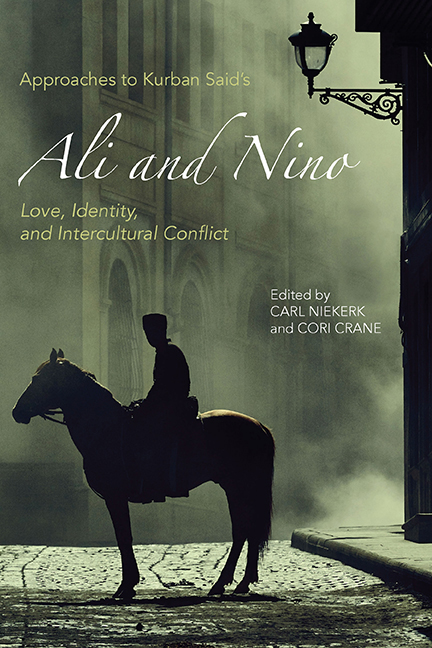
Ali and Nino is a novel published in German in 1937 under the alias "Kurban Said," a love story between a Muslim man and a Christian woman set in Baku, Azerbaijan, during World War I and the country's brief independence. It was a major success, translated into several other languages, but was forgotten by the end of World War II. Recent research by the journalist Tom Reiss has revealed the identity of the author as Lev/Leo Nussimbaum (1905-1942), a Jewish man born in Baku who converted to Islam, worked as a journalist in Berlin, and died forgotten in exile. Reiss's discovery has spurred new interest in the novel, as has the fact that the book prefigures today's perceived conflicts between East and West or Islam and Christianity, but also suggests a more peaceful model of intercultural living in multiethnic Baku's melting pot of Islam, Judaism, and Christianity. The present volume collects twelve new essays on different aspects of the text by scholars from a variety of disciplines and cultural backgrounds. It is intended to showcase the suitability of Ali and Nino for inclusion in a curriculum focused on German, world literature, or area studies, and to suggest a variety of approaches to the novel while also appealing to its fans.Contributors: Sara Abdoullah-Zadeh, Cori Crane, Chase Dimock, Christine Rapp Dombrowski, Elizabeth Weber Edwards, Anja Haensch, Kamaal Haque, Lisabeth Hock, Ruchama Johnston-Bloom, Carl Niekerk, Elke Pfitzinger, Soraya Saatchi, Daniel Schreiner, Azade Seyhan.Carl Niekerk is Professor of German with affiliate appointments in French, Comparative and World Literature, and Jewish Studies at the University of Illinois at Urbana-Champaign. Cori Crane is Assistant Professor in the Department of Germanic Studies at the University of Texas at Austin.