About Studies in German Literature Linguistics and Culture
This is Camden House’s general German studies series, in which numerous titles have appeared since the early 1980s. It welcomes a broad range of topics and approaches - from traditional, narrowly literary studies on one hand to forays into cultural studies and cultural history on the other, from approaches based on traditional close reading to those emphasizing theory, from feminist to postmodern to multicultural. All periods of German culture and literature are fair game, from medieval Spielmannsepen to currently emerging writers of the twenty-first century.
To save content items to your account,
please confirm that you agree to abide by our usage policies.
If this is the first time you use this feature, you will be asked to authorise Cambridge Core to connect with your account.
Find out more about saving content to .
To save content items to your Kindle, first ensure no-reply@cambridge.org
is added to your Approved Personal Document E-mail List under your Personal Document Settings
on the Manage Your Content and Devices page of your Amazon account. Then enter the ‘name’ part
of your Kindle email address below.
Find out more about saving to your Kindle.
Note you can select to save to either the @free.kindle.com or @kindle.com variations.
‘@free.kindle.com’ emails are free but can only be saved to your device when it is connected to wi-fi.
‘@kindle.com’ emails can be delivered even when you are not connected to wi-fi, but note that service fees apply.
The communist secret police services of Central and Eastern Europe kept detailed records not only of their victims but also of the vast networks of informants and collaborators upon whom their totalitarian systems depended. These records, now open to the public in many former Eastern Bloc countries, reflect a textually mediated reality that has defined and shaped the lives of former victims and informers, creating a tension between official records and personal memories. Exploring this tension between a textually and technically mediated past and the subject/victim's reclaiming and retrospective interpretation of that past in biography is the goal of this volume. While victims' secret police files have often been examined as a type of unauthorized archival life writing, the contributors tothis volume are among the first to analyze the fragmentary and sometimes remedial nature of these biographies and to examine the subject/victims' rewriting and remediation of them in various creativeforms. Essays focus, variously, on the files of the East German Stasi, the Romanian Securitate (in relation to Transylvanian Germans in Romania), and the Hungarian State Security Agency.
Contributors: Carol Anne Costabile-Heming, Ulrike Garde, Valentina Glajar, Yuliya Komska, Alison Lewis, Corina L. Petrescu, Annie Ring, Aniko Szucs.
Valentina Glajar is Professor of German at Texas State University, San Marcos. Alison Lewis is Professor of German in the School of Languages and Linguistics, The University of Melbourne, Australia. Corina L. Petrescu is Associate Professorof German at the University of Mississippi.
Stefan George (1868-1933) is along with Hugo von Hofmannsthal and Rainer Maria Rilke one of the pre-eminent German poets of the twentieth century. He also had an important, albeit controversial and provocative role in German cultural history. It is generally agreed that he played a significant part in the transition of German literature to Modernism, particularly in poetry. At the same time he was an outspoken critic of modernity. He believed that only an all-encompassing cultural renewal could save modern man. Although George is often linked with the l'art pour l'art movement, and although his artistic consciousness was formed by European aestheticism, his poetry and the writings that emerged from the poets and intellectuals he gathered around him in the George Circle are above all a scathing commentary on the political, social, and cultural situation in Germany at the turn of the century. George, who was imbued with the idea of the poet as a prophet and priest, saw himself as the Messiah of a New Hellenism and a New Reich led by an intellectual and aesthetic elite consisting of men who were bonded together through their allegiance to a charismatic leader. Some of the values that George proclaimed, among them a glorification of power, of heroism and self-sacrifice, were seized upon by the National Socialists, and subsequently his writings and those of his circle were considered by some to be proto-fascist. It did not help his reputation that after the Second World War much of the criticism of his works was practiced by uncritical, hagiographic George worshippers. In recent years, however, there has been a renewed and unbiased interest among scholars and critics in George and his circle. The wide-ranging and original essays in this volume explore anew George's poetry and his contribution to Modernism, the relation between his vision of a New Reich and fascist ideology, and his importance as a cultural critic.
Jens Rieckmann is Professor of German at the University of California, Irvine.
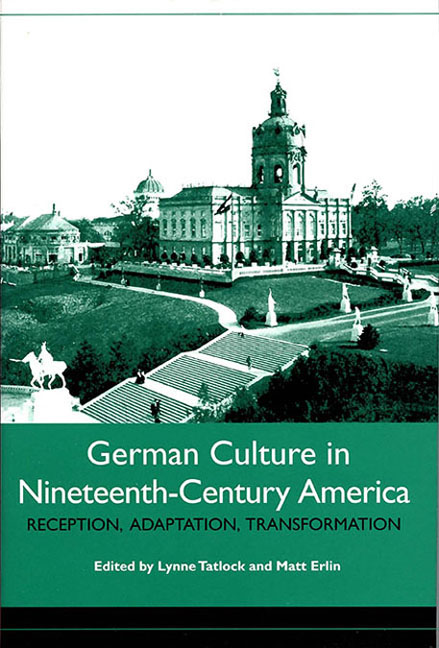
Building on recent trends in the humanities and especially on scholarship done under the rubric of cultural transfer, this volume emphasizes the processes by which Americans took up, responded to, and transformed German cultural material for their own purposes. The fourteen essays by scholars from the US and Germany treat such topics as translation, the reading of German literature in America, the adaptation of German ideas and educational ideals, the reception and transformation of European genres of writing, and the status of the "German" and the "European" in celebrations of American culture and criticisms of American racism. The volume contributes to the ongoing re-conception of American culture as significantly informed by non-English-speaking European cultures. It also participates in the efforts of historians and literary scholars to re-theorize the construction of national cultures. Questions regarding hybridity, cultural agency, and strategies of acculturation have long been at the center of postcolonial studies, but as this volume demonstrates, these phenomena are not merely operative in encounters between colonizers and colonized: they are also fundamental to the early American reception and appropriation of German cultural materials.
Contributors: Hinrich C. Seeba, Eric Ames, Claudia Liebrand, Paul Michael Lützeler, Kirsten Belgum, Robert C. Holub, Jeffrey Grossman, Jeffrey L. Sammons, Linda Rugg, Gerhild Scholz Williams, Gerhard Weiss, Lorie Vanchena.
Lynne Tatlock is Hortense and Tobias Lewin Distinguished Professor in the Humanities andMatt Erlin is Assistant Professor in the Department of Germanic Languages and Literatures, both at Washington University in St. Louis.
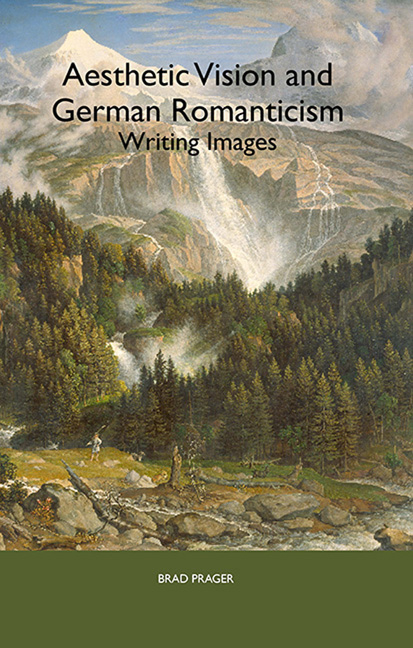
The work of the groundbreaking writers and artists of German Romanticism -- including the writers Tieck, Brentano, and Eichendorff and the artists Caspar David Friedrich and Philipp Otto Runge -- followed from the philosophical arguments of the German Idealists, who placed emphasis on exploring the subjective space of the imagination. The Romantic perspective was a form of engagement with Idealist discourses, especially Kant's Critique of Pure Reason and Fichte's Science of Knowledge. Through an aggressive, speculative reading of Kant, the Romantics abandoned the binary distinction between the palpable outer world and the ungraspable space of the mind's eye and were therefore compelled to develop new terms for understanding the distinction between "internal" and "external." In this light, Brad Prager urges a reassessment of some of Romanticism's major oppositional tropes, contending that binaries such as "self and other," "symbol and allegory," and "light and dark," should be understood as alternatives to Lessing's distinction between interior and exterior worlds. Prager thus crosses the boundaries between philosophy, literature, and art history to explore German Romantic writing about visual experience, examining the interplay of text and image in the formulation of Romantic epistemology.
Brad Prager is Associate Professor of German at the University of Missouri, Columbia.
The novel, according to standard scholarly narratives, depicts an individual's path to maturity. Scholarship on the rise of the novel in Germany and in Europe more broadly, from Watt to Moretti, has essentially collapsed the genre into the individualist Bildungsroman, exemplified by a narrow canon. This study challenges and nuances these narratives, first by expanding the focus from the individual to the family, second by broadening the field of novels treated to include not only canonical works but also so-called "trivial literature," and third, by reading novels alongside contemporarybiological, legal, and pedagogical texts. This perspective reveals that the novel and the family around 1800 were mutually constitutive and that the two together were instrumental in the developmentof conceptions of individuality, kinship, and society that are still relevant today. Sarah Vandegrift Eldridge reads novels by Goethe, Wolzogen, Engel, Karoline Fischer, August Lafontaine, and Brentano, showing that they exhibit varying degrees of "imaginative didacticism": suggestions not of what to think and feel, but that thinking and feeling in reaction to literature are centralto cultural practices of self-reflection and development. The family is a crucial locus for this practice, and reading novels together with non-literary texts illuminates how they experiment productively with the infinite possibilities presented by the relationships they portray.
Sarah Vandegrift Eldridge is Assistant Professor of German at the University of Tennessee, Knoxville.
Never has a mountain occupied the German imagination longer and more thoroughly than Nanga Parbat (8,125m), the world's ninth-highest peak, located in the extreme western part of the Himalaya chain inpresent-day Pakistan. Repeatedly referred to in the 1930s as the German "mountain of destiny," over a period of roughly two decades from 1932 to 1953 Nanga Parbat became not only the destination of six German mountaineering expeditions, but also the quintessential German "mountain of the mind" onto whose slopes German mountaineers, mountaineering officials, politicians, writers, and filmmakers projected some of the most pressing social, political, and cultural concerns of their times. This book is a detailed study of that process: of the initial motivations of post-World War I mountaineers for attempting to scale one of the tallest mountains in the world, of the appropriation of this epic mountaineering challenge by National Socialism, of the reappropriation of the Nanga Parbat project during the early years of the German Federal Republic. And most important - since to date such an approach is almost completely absent from existing studies of Himalaya mountaineering of this era - it is a study of the means and mechanisms, the texts and contexts employed for communicating these high-altitude mountaineering exploits to the German public and thereby inscribing Nanga Parbat into the German imagination.
Harald Höbusch is Associate Professor of German and Associate Chair of the Department of Modern and Classical Languages, Literatures and Cultures at the University of Kentucky.
Rainer Maria Rilke, the most famous (and important) German language poet of the twentieth century - a master to be ranked with Goethe and Heine - wrote the New Poems of 1907 and 1908 in transition from his late-nineteenth-century style. They mark his appearance as a lyrical, metaphysical poet of the modernist sensibility, often using traditional forms like the sonnet to explore the inner essence, the deep heart, of things - often, quite literally, things. Influenced by his time spent as Rodin's secretary, Rilke turned to quotidian life and sought to artistically redeem it in all its possibilities. His exquisite use of meter and rhyme marks him as a "formalist" and yet a contemporary of Eliot and the later Yeats, so this translation follows, as closely as English allows, the formal properties of the original poems, in a line-for-line version, while trying to capture the spare diction and direct idioms of modernism.
Len Krisak is a recipient of the Richard Wilbur, Robert Penn Warren, and Robert Frost prizes in poetry. He has published more than five hundred poems, including translations from the Latin, Greek, Spanish, Italian, Russian, and German.
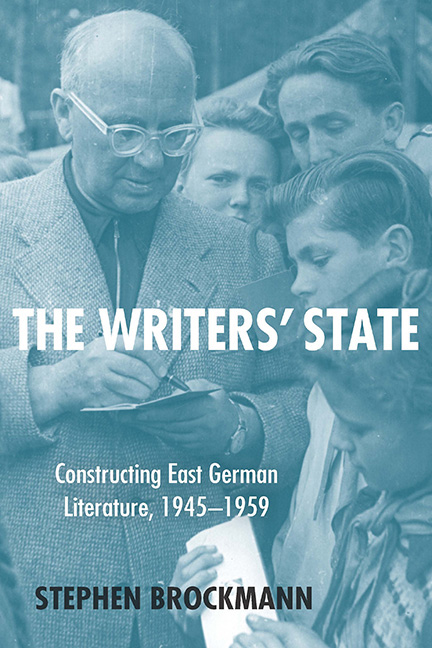
Twenty-five years after the demise of the German Democratic Republic, there is perhaps more scholarship being produced on all aspects of that country than ever. This is true also in the field of literary studies, but especially in English-language literary scholarship there has been a strong imbalance toward a focus on the last three decades of GDR literature. The literature of the earlier GDR has mostly been dismissed or ignored by scholars, as the discontinuities between the early and late GDR have been emphasized over the considerable continuities. This book seeks to redress that state of affairs, examining the literature produced from the very beginnings of what became the GDR through the 1950s. In doing so it applies to GDR literature the insight gained by scholars over the past few decades that the immediate postwar period was more complex, more meaningful, and more rewarding of study than it was long deemed to be. Far from all being mere propaganda or rote socialist realism, the literature of the early GDR has much to tell us about the budding socialist state, even as it goes far in explaining the developments in the later GDR.
Stephen Brockmann is Professor of German at Carnegie Mellon University.
Destroying human habitat and taking human lives, disasters, be they natural, man-made, or a combination, threaten large populations, even entire nations and societies. They also disrupt the existing order and cause discontinuity in our sense of self and our perceptions of the world. To restore order, not only must human beings be rescued and affected areas rebuilt, but the reality of the catastrophe must also be transformed into narrative. The essays in this collection examine representations of disaster in literature, film, and mass media in German and international contexts, exploring the nexus between disruption and recovery through narrative from the eighteenth century to the present. Topics include the Lisbon earthquake, the Paris Commune, the Hamburg and Dresden fire-bombings in the Second World War, nuclear disasters in Alexander Kluge's films, the filmic aesthetics of catastrophe, Yoko Tawada's lectures on the Fukushima disaster and Christa Wolf's novel Störfall in light of that same disaster, Joseph Haslinger and the tsunami of 2004, traditions regarding avalanche disaster in the Tyrol, and the problems and implications of defining disaster.
Contributors:Carol Anne Costabile-Heming, Yasemin Dayioglu-Yücel, Janine Hartman, Jan Hinrichsen, Claudia Jerzak, Lars Koch, Franz Mauelshagen, Tanja Nusser, Torsten Pflugmacher, Christoph Weber.
Katharina Gerstenberger is Professor and Chair of the Department of Languages and Literature at the University of Utah. Tanja Nusser is DAAD Visiting Associate Professor of German at the University of Cincinnati.
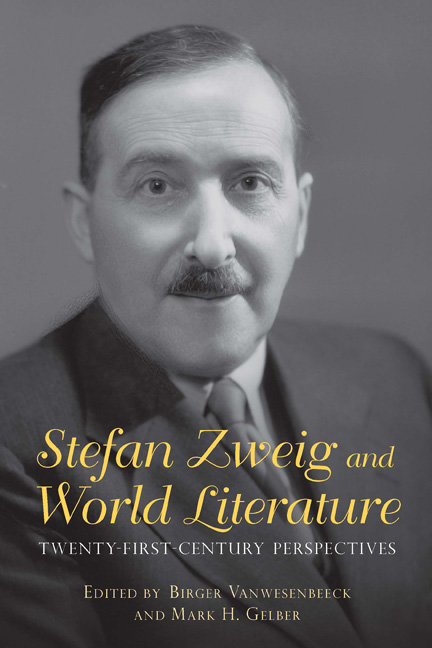
The twenty-first century has seen a renewed surge of cultural and critical interest in the works of the Austrian-Jewish author Stefan Zweig (1881-1942), who was among the most-read and -acclaimed authors worldwide in the 1920s and 1930s but after 1945 fell into critical disfavor and relative obscurity. The resurgence in interest in Zweig and his works is attested to by, among other things, new English translations and editions of his works; a Brazilian motion picture and a best-selling French novel about his final days; and a renewed debate surrounding the literary quality of his work in the London Review of Books. This global return to Zweig calls for a critical reassessment of his legacy and works, which the current collection of essays provides by approaching them from a global perspective as opposed to the narrow European focus through which they have been traditionally approached. Together, the introduction and twelve essays engage the totality of Zweig's published and unpublished works from his drama and his fiction to his letters and his biographies, and from his literary and art criticism to his autobiography. Contributors: Jeffrey B. Berlin, Richard Benson, Darién J. Davis, Marlen Eckl, Mark H. Gelber, Robert Kelz, Klemens Renoldner, Birger Vanwesenbeeck, John Warren, Klaus Weissenberger, Robert Weldon Whalen, Geoffrey Winthrop-Young. Birger Vanwesenbeeck is Assistant Professor of English at the State University of New York-Fredonia. Mark H. Gelber is Professor of German at Ben-Gurion University of the Negev, Israel.
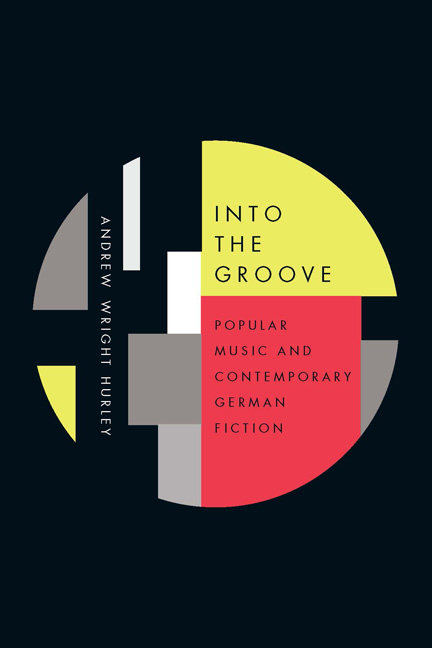
In Germany between the mid-1990s and the mid-2000s there was an unprecedented 'confusion of the spheres' of literature and popular music. Popular musicians 'crossed over' into the literary field, editors and writers called for contemporary German literature to become more like popular music, writers attempted to borrow structural aspects from music or paid new attention to popular music at the thematic level. Others sought to raise their profiles by means of performance models taken from the popular music field. This book sets out to make sense of this situation. It argues for more inclusive and detailed attention to what it calls 'musico-centric fiction', for which it discerns intellectual precursors going back to the 1960s and also identifies examples written since the turn of the millennium, after the would-be death of 'pop literature'. In doing so, it focuses on fiction and paratextual interventions by authors including Peter Handke, Rolf Dieter Brinkmann, Rainald Goetz, Andreas Neumeister, Thomas Meinecke, Matthias Politycki, Frank Goosen, Benjamin von Stuckrad-Barre, Thomas Brussig, Karen Duve, and Kerstin Grether. Andrew W. Hurley is Senior Lecturer in German and Cultural Studies at the University of Technology, Sydney, Australia.
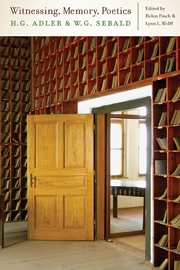
Since 1945, authors and scholars have intensely debated what form literary fiction about the Holocaust should take. The works of H. G. Adler (1910-1988) and W. G. Sebald (1944-2001), two modernist scholar-poets who settled in England but never met, present new ways of reconceptualizing the nature of witnessing, literary testimony, and the possibility of a "poetics" after Auschwitz. Adler, a Czech Jew who survived Theresienstadt and Auschwitz, was a prolific writer of prose and poetry, but his work remained little known until Sebald, possibly the most celebrated German writer of recent years, cited it in his 2001 novel, Austerlitz. Since then, a rediscovery of Adler has been under way. This volume of essays by international experts on Adler and Sebald investigates the connections between the two writers to reveal a new hybrid paradigm of writing about the Holocaust that advances our understanding of the relationship between literature, historiography, and autobiography. In doing so, the volume also reflects on the wider literary-political implications of Holocaust representation, demonstrating the shifting norms in German-language "Holocaust literature." Contributors: Jeremy Adler, Jo Catling, Peter Filkins, Helen Finch, Frank Finlay, Kirstin Gwyer, Katrin Kohl, Michael Krüger, Martin Modlinger, Dora Osborne, Ruth Vogel-Klein, Lynn L. Wolff. Helen Finch is an Academic Fellow in German at the University of Leeds. Lynn L. Wolff is an Alexander von Humboldt Research Fellow in German at the University of Stuttgart.
German-language thinkers such as Kant, Marx, Nietzsche, and Freud are central to modernity. Yet their reception in the English-speaking world has largely depended on translations, a situation that has often hampered full engagement with the rhetorical and philosophical complexity of the German history of ideas. The present volume, the first of its kind, is a response to this situation. After an introduction charting the remarkable flowering of German-language thought since the eighteenth century, it offers extracts -- in the original German -- from sixteen major philosophical texts, with extensive introductions and annotations in English. All extracts are carefully chosen to introduce the individual thinkers while allowing the reader to pursue broader themes such as the fate of reason or the history of modern selfhood. The book offers students and scholars of German a complement to linguistic, historical, and literary study by giving them access to the wealth of German-language philosophy. It represents a new way into the work of a succession of thinkers who have defined modern philosophy and thus remain of crucial relevance today. The philosophers: Immanuel Kant, G. W. F. Hegel, Ludwig Feuerbach, Karl Marx, Arthur Schopenhauer, Friedrich Nietzsche, Sigmund Freud, Martin Heidegger, Walter Benjamin, Georg Lukács, Max Horkheimer and Theodor Adorno, Jürgen Habermas. Henk de Berg is Professor of German at the University of Sheffield. Duncan Large is Professor of German at Swansea University.
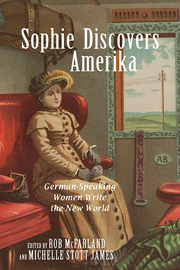
In a 1798 novel by Sophie von La Roche, a European woman swims across a cold North American lake seeking help from the local indigenous tribe to deliver a baby. In a 2008 San Francisco travel guide, Milena Moser, the self-proclaimed "Patron Saint of Desperate Swiss Housewives," ponders the guilty pleasures of a media-saturated world. Wildly disparate, these two texts reveal the historical arc of a much larger literary constellation: the literature of German-speaking women who interact with the New World. In this volume, cultural historians from around the world investigate this unique literary bridge between two hemispheres, focusing on New-World texts written by female authors from Germany, Austria, or Switzerland. Encompassing a broad range of genres including novels, films, travel literature, poetry, erotica, and even photography, the essays include women's experiences across both American continents. Many of the primary literary texts discussed in this volume are available in the online collections of Sophie: A Digital Library of Works by German-Speaking Women (http://sophie.byu.edu/). Contributors: Christiane Arndt, Karin Baumgartner, Ute Bettray, Ulrike Brisson, Carola Daffner, Denise M. Della Rossa, Linda Dietrick, Silke R. Falkner, Maureen O. Gallagher, Nicole Grewling, Monika Hohbein-Deegen, Gabi Kathöfer, Thomas W. Kniesche, Julie Koser, Judith E. Martin, Sarah C. Reed, Christine Rinne, Tom Spencer, Florentine Strzelczyk, David Tingey, Petra Watzke, Chantal Wright. Rob McFarland and Michelle Stott James are both Associate Professors of German at Brigham Young University.
At the end of the Second World War, millions of Germans and Poles fled or were expelled from the border regions of what had been their countries. This monograph examines how, in cold war and post-cold war Europe since the 1970s, writers have responded to memories or postmemories of this traumatic displacement. Friederike Eigler engages with important currents in scholarship -- on "Heimat," the much-debated German concept of "homeland"; on the spatial turnin literary studies; and on German-Polish relations -- arguing for a transnational approach to the legacies of flight and expulsion and for a spatial approach to Heimat. She explores notions of belonging in selected postwarand contemporary German novels, with a comparative look at a Polish novel, Olga Tokarczuk's House of Day, House of Night (1998). Eigler finds dynamic manifestations of place in Tokarczuk's novel, in Horst Bienek's 1972-1982 Gleiwitz tetralogy about the historical border region of Upper Silesia, and in contemporary novels by Reinhard Jirgl, Christoph Hein, Kathrin Schmidt, Tanja Dückers, Olaf Müller, and Sabrina Janesch. In a decisive departure from earlier approaches, Eigler explores how these novels foster an awareness of the regions' multiethnic and multinational histories, unsettling traditional notions of Heimat without altogether abandoning place-based notions of belonging. Friederike Eigler is Professor of German at Georgetown University.
It is by now almost a cliché that the flight and expulsion of Germans from east-central Europe at the end of the Second World War was a taboo topic in the German Democratic Republic. According to this claim, the Socialist Unity Party (SED) suppressed reference to flight and expulsion so as not to upset its socialist neighbors. This book shows that such a view does not hold up to serious scrutiny. While the topic may not have been addressed in the realm of politics or official commemoration, it was picked up again and again in literature, particularly fiction. Representations of flight and expulsion were by no means restricted, as some have asserted, to Christa Wolf's novel Kindheitsmuster: Niven's study documents around 100 novels and short stories published in the GDR that address flight or expulsion. He argues that in the 1950s and early 1960s GDR fiction included many refugee figures. The predominant emphasis was on their integration under socialism rather than their experience of flight and loss of home; nevertheless, flight and to a lesser degree expulsion were depicted, as was their impact on individuals. They continued to be thematized in the late GDR and even, to a degree, after unification. Flight and expulsion, then, were subject to a developing literary discourse in the GDR, a discourse that this book explores. Bill Niven is Professor in Contemporary German History at Nottingham Trent University.
In nineteenth-century Germany, breakthroughs in printing technology and an increasingly literate populace led to an unprecedented print production boom that has long presented scholars with a challenge: how to read it all? This anthology seeks new answers to the scholarly quandary of the abundance of text. Responding to Franco Moretti's call for "distant reading" and modeling a range of innovative approaches to literary-historical analysis informed by theburgeoning field of digital humanities, it asks what happens when we shift our focus from the one to the many, from the work to the network. The thirteen essays in this volume explore the evolving concept of "distant reading" and its application to the analysis of German literature and culture in the long nineteenth century. The contributors consider how new digital technologies enable both the testing of hypotheses and the discovery of patterns and trends, as well as how "distant" and traditional "close" reading can complement each another in hybrid models of analysis that maintain careful attention to detail, but also make calculation, enumeration, and empirical descriptioncritical elements of interpretation. Contributors: Kirsten Belgum, Tobias Boes, Matt Erlin, Fotis Jannidis and Gerhard Lauer, Lutz Koepnick, Todd Kontje, Peter M. McIsaac, Katja Mellmann, Nicolas Pethes, Andrew Piper and Mark Algee-Hewitt, Allen Beye Riddell, Lynne Tatlock, Paul A. Youngman and Ted Carmichael. Matt Erlin is Professor of German and Chair of the Department of Germanic Languages and Literatures, and Lynne Tatlock is Hortense and Tobias Lewin Distinguished Professor in the Humanities, both at Washington University, St. Louis.
In German Studies the literary phenomenon of melancholy, which has a longstanding and diverse history in European letters, has typically been associated with the Early Modern and Baroque periods, Romanticism, and the crisis of modernity. This association, alongside the dominant psychoanalytical view of melancholy in German memory discourses since the 1960s, has led to its neglect as an important literary mode in postwar German literature, a situation the present book seeks to redress by identifying and analyzing epochal postwar works that use melancholy traditions to comment on German history in the aftermath of the Holocaust. It focuses on five writers - Günter Grass, Wolfgang Hildesheimer, Peter Weiss, W. G. Sebald, and Iris Hanika - who reflect on the legacy of Auschwitz as intellectuals trying to negotiate a relationship to the past based on the stigma of belonging to a perpetrator collective (Grass, Sebald, Hanika) or, broadly speaking, to the victim collective (Weiss, Hildesheimer), in order to develop a melancholy ethics of memory for the Holocaust and the Nazi past. It will appeal to scholars and students of German Studies,Comparative Literature, Cultural Studies, Cultural Memory, and Holocaust Studies. Mary Cosgrove is Reader in German at the University of Edinburgh.
Invoking Goethe's name has become fashionable again. With new methods and technologies of reading threatening to render literature virtual and insubstantial, we have the sense that "Goethe's ghosts" - the otherwise neglected voices and traditions that, finding their most trenchant expression in Goethe, inform the Western storehouse of literature - can show us long-forgotten dimensions of literature. Inspired by the distinguished Goethe scholar Jane Brown, whose life's work has called attention to the allegorical modes haunting the mimetic forms that dominate modern literature, the contributors to this volume take a rich variety of approaches to Goethe: cultural studies, history of the book, semiotics, deconstruction, colonial studies, feminism, childhood studies, and eco-criticism. The persistence, omnipresence, and modalities of the "ghosts" they find suggest that more than influence or standards is at issue here. Goethe's work informs current debates on nineteenth-century nationalism, while his Faust increasingly serves to express contemporary culture's anxiety about new technologies. The stubborn reappearance of these revenants testifies to more fundamental issues concerning the status of literature and the task of the reader. As the contributors demonstrate, these questions acquire renewed urgency in writers as diverse as Hegel, Adorno, Benn, Droste-Hülshoff, and Nietzsche. Each of the essays testifies to the enduring salience and presence of Goethe. Contributors: Helmut Ammerlahn, Benjamin Bennett, Richard Block, Dieter Borchmeyer, Franz-Josef Deiters, Richard T. Gray, Martha B. Helfer, Meredith Lee, Clark Muenzer, Andrew Piper, Simon Richter, Jürgen Schroeder, Peter Schwartz, Patricia Simpson, Robert Tobin, David Wellbery, Sabine Wilke. Simon Richter is Professor of German Literature at the University of Pennsylvania. Richard Block is Associate Professor of German at the University of Washington.
After 1945, the purist "medium specificity" of high modernism increasingly yielded to the mixed forms of intermediality. Theodor Adorno dubbed this development a "Verfransung," or "fraying of boundaries," between the arts. TheDifferentiation of Modernism analyzes this phenomenon in German electronic media arts of the late modernist period (1945-1980): in radio plays, film music, and electronic music. The first part of the book begins with a chapteron Adorno's theory of radio as an instrument of democratization, going on to analyze the relationship of the Hörspiel or radio play to electronic music. In the second part, on film music, a chapter on Adorno and Eisler's Composing for the Film sets the parameters for chapters on the film Das Mädchen Rosemarie (1957) and on the music films of Jean-Marie Straub and Danièle Huillet. The third part examines the music of Karlheinz Stockhausen and its relationship to radio, abstract painting, recording technology, and theatrical happenings. The book's central notion of the "differentiation of culture" suggests that late modernism, unlike high modernism, accepted thecontingency of modern mass-media driven society and sought to find new forms for it. Larson Powell is Associate Professor of German at the University of Missouri, Kansas City. He is the author of The Technological Unconscious in German Modernist Literature (Camden House, 2008).