About Studies in German Literature Linguistics and Culture
This is Camden House’s general German studies series, in which numerous titles have appeared since the early 1980s. It welcomes a broad range of topics and approaches - from traditional, narrowly literary studies on one hand to forays into cultural studies and cultural history on the other, from approaches based on traditional close reading to those emphasizing theory, from feminist to postmodern to multicultural. All periods of German culture and literature are fair game, from medieval Spielmannsepen to currently emerging writers of the twenty-first century.
To save content items to your account,
please confirm that you agree to abide by our usage policies.
If this is the first time you use this feature, you will be asked to authorise Cambridge Core to connect with your account.
Find out more about saving content to .
To save content items to your Kindle, first ensure no-reply@cambridge.org
is added to your Approved Personal Document E-mail List under your Personal Document Settings
on the Manage Your Content and Devices page of your Amazon account. Then enter the ‘name’ part
of your Kindle email address below.
Find out more about saving to your Kindle.
Note you can select to save to either the @free.kindle.com or @kindle.com variations.
‘@free.kindle.com’ emails are free but can only be saved to your device when it is connected to wi-fi.
‘@kindle.com’ emails can be delivered even when you are not connected to wi-fi, but note that service fees apply.
Arno Schmidt (1914-1979) is considered one of the most daring and influential writers of postwar Germany; the Germanist Jeremy Adler has called him a 'giant of postwar German literature.' Schmidt was awarded the Fontane Prize in 1964 and the Goethe Prize in 1973, and his early fiction has been translated into English to high critical acclaim, but he is not a well-known figure in the English-speaking world, where his complex work remains at the margins of critical inquiry. Volker Langbehn's book introduces Schmidt to the English-speaking audience, with primary emphasis on his most famous novel, 'Zettel's Traum'. One reviewer called the book an 'elephantine monster' because of its unconventional size (folio format), length (1334 pages and over 10 million characters), and unique presentation of text in the form of notes, typewritten pages, parallel columns, and collages. The novel narrates the life of the main characters, Daniel Pagenstecher, Paul Jacobi and his wife Wilma, and their teenage daughter Franziska. In discussing the life and works of Edgar Allan Poe, the four engage in the problems connected with a translation of Poe. Langbehn's study investigates how literary language can mediate or account for the world of experiences and for concepts. Schmidt's use of unconventional presentation formats challenges us to analyze how we think about reading and writing literary texts. Instead of viewing such texts as a representation of reality, Schmidt's novel destabilizes this unquestioned mode of representation, posing a radical challenge to what contemporary literary criticism defines as literature. No comprehensive study of 'Zettel's Traum' exists in English. Volker Langbehn is associate professor of German at San Francisco State University.
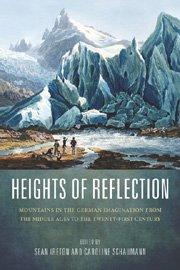
Mountains have always stirred the human imagination, playing a crucial role in the cultural evolution of peoples around the globe and becoming infused with meaning in the process. Beyond their geographical-geological significance, mountains affect the topography of the mind, whether as objects of peril or attraction, of spiritual enlightenment or existential fulfilment, of philosophical contemplation or aesthetic inspiration. This volume challenges the oversimplified assumption that human interaction with mountains is a distinctly modern development, one that began with the empowerment of the individual in the wake of Enlightenment rationalism and Romantic subjectivity. These essays by European and North American scholars examine the lure of mountains in German literature, philosophy, film, music, and culture from the Middle Ages to the present, with a focus on the interaction between humans and the alpine environment. The contributors consider mountains not as mere symbolic tropes or literary metaphors, but as constituting a tangible reality that informs the experiences and ideas of writers, naturalists, philosophers, filmmakers, and composers. Overall, this volume seeks to provide multiple answers to questions regarding the cultural significance of mountains as well as the physical practice of climbing them. Contributors: Peter Arnds, Olaf Berwald, Albrecht Classen, Roger Cook, Scott Denham, Sean Franzel, Christof Hamann, Harald Höbusch, Dan Hooley, Peter Höyng, Sean Ireton, Oliver Lubrich, Anthony Ozturk, Caroline Schaumann, Heather I. Sullivan, Johannes Türk, Sabine Wilke, Wilfried Wilms. Sean Ireton is Associate Professor of German at the University of Missouri. Caroline Schaumann is Associate Professor of German Studies at Emory University.
The award of the Nobel Prize for literature in 1981 has seemingly assured Elias Canetti's place in literary history. But his significance as a cultural critic has not been adequately recognized. The present study redresses this situation in two ways: by mapping the counter-image of human existence, history, and society that informs Canetti's critique of the modern world and its sciences; and by opening up Canetti's hermetic oeuvre by tracing his cryptic and often concealed dialogue with major figures within the Western tradition such as Hobbes, Durkheim, and Freud and contemporaries such as Adorno, Arendt, and Elias. The authors ask how Canetti's alternative vision of man and society relates to important themes of twentieth-century social and civilizational thought even as it calls into question fundamental assumptions of the social and human sciences. In analyses of 'Auto da Fé, Crowds and Power,' and the aphorisms, the authors elucidate key aspects of Canetti's interrogation of human existence and human history across five thematic complexes: individual and social psychology, totalitarian politics, religion and politics, theories of society, and power and culture. They thus trace the movement of Canetti's thought from an apocalyptic sense of crisis to his search for cultural resources to set against the holocaust of European civilization. Johann P. Arnason teaches sociology at La Trobe University, Melbourne and David Roberts is Emeritus Professor of German at Monash University, Melbourne.
Goethe, in association with his younger Romantic compatriots the Schlegels, Novalis, Fichte, and Schelling, struggled with the subject-object dichotomy, and tried to bridge the gap between self and other, consciousness and nature. His theory and practice prefigured the Romantics' determination to display and interrogate the linguistic and cultural structures informing their own thinking and modes of representation-what Goethe calls one's 'Vorstellungsart.' His work exploits, subverts, and supplants inherited conventions and signs, demonstrating with virtuosic irony that literature is a system of texts, pre-texts, and pre-established but dynamic conceptual models. ' Love and Death in Goethe:'One and Double' ' explores Goethe's use, in a wide range of his poetry and prose, of the theme of 'Liebestod' (love and death) and related embodiments of the paradox of unity in duality. Ellis Dye also examines Goethe's use of other themes related to love and death-the 'femme fatale,' the 'vagina dentata, Frau Welt,' the Lorelei, venereal disease, the 'Lustmord'-and considers issues of selfhood and individuation as well as the possibility that the love-death theme contains an implicit gender bias toward the existential fact of personal separateness. Poems, plays, and novels are dealt with, nevertheless, as works of art, not only as illustrations of an idea or as points of intersection in a system of rhetorical conventions, and are examined for intellectual cohesiveness, elegance, and integrity of design as well as special meanings and effects. ' Love and Death in Goethe:'One and Double' ' explores the meaning of the central theme of Romantic poetry in the works of the most important Romantic poet of all. Students of literary culture, both the lay reader and the Goethe specialist, will be enlightened by its approach and find pleasure and instruction in its revelations. Robert Ellis Dye is professor of German at Macalester College.
Thomas Mann's last major novel, 'Doktor Faustus,' revolves around the transformation of traditional German culture into Hitler's fascist Germany, a process that intrigues and confounds thinking people still today. Mann has always been considered an exemplary and authoritative portrayer of German culture, and his opinion on the rise of fascism carries considerable weight. Unfortunately, the novel has always been interpreted as saying the opposite of what it does in fact say. Frances Lee provides a radically new interpretation by relating in a detailed manner to the text of Doktor Faustus the arguments expressed by Mann in his 'Observations of a Non-Political Man' - a book of political essays published in 1918. This approach resolves many of the features that have been seen by critics as flaws or contradictions in the novel. Lee establishes what is actually happening in the novel in its historical setting, showing Mann's view of how the acceptance of fascism occurred and the determining role he attributed to the academic community in bringing about the disaster. Her book will be of interest to both amateur and professional students of Mann, particularly because it points to rich new directions for study. Frances Ann Ray Lee received the Ph.D. in German literature from the University of Toronto in 2005.
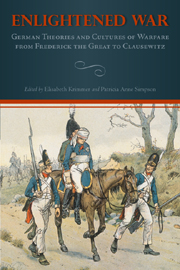
'Enlightened War' investigates the multiple and complex interactions between warfare and Enlightenment thought. Although the Enlightenment is traditionally identified with the ideals of progress, eternal peace, reason, and self-determination, Enlightenment discourse unfolded during a period of prolonged European warfare from the Seven Years' War to the Napoleonic conquest of Europe. The essays in this volume explore the palpable influence of war on eighteenth-century thought and argue for an ideological affinity among war, Enlightenment thought, and its legacy. The essays are interdisciplinary, engaging with history, art history, philosophy, military theory, gender studies, and literature and with historical events and cultural contexts from the early Enlightenment through German Classicism and Romanticism. The volume enriches our understanding of warfare in the eighteenth century and shows how theories and practices of war impacted concepts of subjectivity, national identity, gender, and art. It also sheds light on the contemporary discussion of the legitimacy of violence by juxtaposing theories of war, concepts of revolution, and human rights discourses. Contributors: Johannes Birgfeld, David Colclasure, Sara Eigen Figal, Ute Frevert, Wolf Kittler, Elisabeth Krimmer, Waltraud Maierhofer, Arndt Niebisch, Felix Saure, Galili Shahar, Patricia Anne Simpson, Inge Stephan. Elisabeth Krimmer is Professor of German at the University of California, Davis, and Patricia Anne Simpson is Associate Professor of German Studies at Montana State University.
In 1840, Heinrich Heine, the major German poet of Jewish origin of the age, published a book on Ludwig Börne, the major German political writer of Jewish origin of the period, who had died three years before. Regarded by Heine and others as his best-written book, it was also his most disastrously conceived. Intended to recover the high ground of revolutionary principle and philosophy against the attacks mounted on him by Börne and his supporters, the book was instead met by a storm of outrage from which it seemed Heine's reputation might never recover. In the course of time, the evaluation was reversed; Heine was increasingly celebrated as a true herald of revolution. His vocabulary of Hellenism and Nazarenism, employed for the first time in 'Börne', was transmitted into English usage by Matthew Arnold. But 'Börne' itself is Heine's only major work that has never been fully translated into English. The commentary to the edition clarifies the conflict between the two most prominent German-Jewish public intellectuals of their time, corrects the misapprehensions constantly in circulation about their relationship and the book, and reveals the many peculiarities of the text. Jeffrey L. Sammons is Leavenworth Professor of German Emeritus at Yale University and the author of four books on Heine.
This volume of essays examines the perceived rift between the British and German intellectual and cultural traditions before 1914 and how the resultant war of words both reflects and helped determine historical, political, and, ultimately, military events. This vexed symbiosis is traced first through a survey of popular fiction, from alarmist British and German "invasion novels" to the visions of Erskine Childers and Saki and even P.G. Wodehouse; contrastingly, the "mixed-marriage novels" of von Arnim, Spottiswoode, and Wylie are considered. Further topics include D. H. Lawrence's ambivalent relationship with Germany, Carl Sternheim's coded anti-militarism, H. G. Wells's and Kurd Lasswitz's visions of their countries under Martian invasion, Nietzsche as the embodiment of Prussian warmongering, and the rise in Germany of anglophobic, anti-Spencerian evolutionism. Case histories of the positions of German and English academics in regard to the conflict round out the volume. CONTRIBUTORS: IAIN BOYD WHITE, HELENA RAGG-KIRKBY, RHYS WILLIAMS, INGO CORNILS, NICHOLAS MARTIN, GREGORY MOORE, STEFAN MANZ, ANDREAS HUTHER, HOLGER KLEIN. Fred Bridgham is Senior Lecturer in the Department of German at the University of Leeds.
The German writer Heinrich von Kleist (1777-1811) was an unconventional and often controversial figure in his own day, and has remained so. His ideas on art, politics, and gender relations continue to challenge modern readers, and his complex and radically open texts remain the object of vigorous scholarly debate. Kleist has often been portrayed as a 'poet without a society,' whose writing served as escape from the realities of his social environment. This new study challenges such a view by situating Kleist in relation to the central political and philosophical debates of his momentous age. The study first establishes the German--and Prussian--context of Kleist's day, and then provides a short introduction to Kleist's life, here seen in particular relation to the political world. Developing his argument in relation to Kleist's literary work and essays in a series of close readings, Elystan Griffiths shows how Kleist's writings responded to four pressing political issues: the relationship of national culture and the state; education and social reform; the theory and practice of war; and administration and the delivery of justice. Griffiths sheds fresh light on Kleist's writing by placing emphasis on its intricacy and rich ambiguity, which are often simplified or overlooked in political studies of Kleist. Thus Griffiths furthers the critical understanding of Kleist's political thinking by uncovering crucial tensions between a pragmatic readiness for compromise and a utopian longing for freedom and truth. Elystan Griffiths is a Research Fellow in the Department of German Studies at the University of Birmingham.
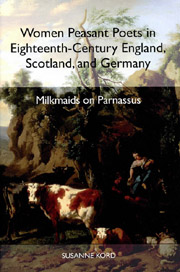
This is the first comparative study of a highly unlikely group of authors: eighteenth-century women peasants in England, Scotland, and Germany, women who, as a rule, received little or no formal education and lived by manual labor, many of them in dire poverty. Among them are the English washerwoman Mary Collier, the English domestic servants Elizabeth Hands and Molly Leapor, the German cowherd Anna Louisa Karsch, the Scottish diarywoman Janet Little, the Scottish domestic servant Christian Milne, and the English milkmaid Ann Cromartie Yearsley. Their literature is here linked with one of the major eighteenth-century aesthetic trends in all three countries, the Natural Genius craze, which culminated in highland primitivism in Scotland and England, and in the 'Sturm und Drang' in Germany. Kord's analysis of the peasant women's works and the bourgeois response enables us to find new answers to questions that have centrally influenced our thinking about what makes art Art. Kord's book provides a fresh look at some of this fascinating literature, and at the roles and attitudes of the lower classes and of women in the Art world of the day. It also advances a revolutionary thesis: that the eighteenth-century bourgeoisie established itself as the dominant cultural class not primarily, as is commonly held, in opposition to aristocratic culture, but more importantly through its dissociation from and suppression of lower-class art forms. SUSANNE KORD is Professor and Head of the Department of German at University College London. Her book 'Little Detours: The Letters and Plays of Luise Gottsched' was published by Camden House in 2000.
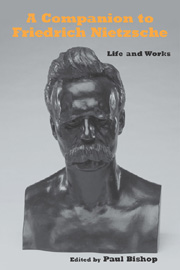
Nietzsche looms over modern literature and thought; according to Gottfried Benn, 'everything my generation discussed, thought through innerly; one could say: suffered; or one could even say: took to the point of exhaustion - all of it had already been said . . . by Nietzsche; all the rest was just exegesis.' Nietzsche's influence on intellectual life today is arguably as great; witness the various societies, journals, and websites and the steady stream of papers, collections, and monographs. This Companion offers new essays from the best Nietzsche scholars, emphasizing the interrelatedness of his life and thought, eschewing a superficial biographical method but taking seriously his claim that great philosophy is 'the self-confession of its author and a kind of unintended and unremarked memoir.' Each essay examines a major work by Nietzsche; together, they offer an advanced introduction for students of German Studies, philosophy, and comparative literature as well as for the lay reader. Re-establishing the links between Nietzsche's philosophical texts and their biographical background, the volume alerts Nietzsche scholars and intellectual historians to the internal development of his thought and the aesthetic construction of his identity as a philosopher. Contributors: Ruth Abbey, Keith Ansell-Pearson, Rebecca Bamford, Paul Bishop, Thomas H. Brobjer, Daniel W. Conway, Adrian Del Caro, Carol Diethe, Michael Allen Gillespie and Keegan F. Callanan, Laurence Lampert, Duncan Large, Martin Liebscher, Martine Prange, Alan D. Schrift. Paul Bishop is Professor of German at the University of Glasgow.
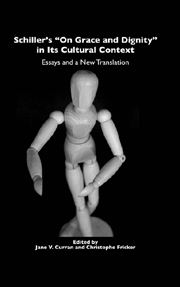
Friedrich Schiller is not only one of the leading poets and dramatists of German Classicism but also an inspiring philosopher. His essay 'über Anmut und Würde' (On Grace and Dignity) marks a radical break with Enlightenment thinking and its morally prescriptive agenda. Here Schiller does not pursue the prevalent interest in the individual artist as genius or in the creative act; instead, he establishes a harmony of mind and body in the aesthetic realm, putting down his thoughts on aesthetics in a systematic way for the first time, building on his own earlier forays into the field and on an intensive study of Kant. The popular essay form allowed Schiller to combine condensed thought with clear and rhetorically effective presentation, but his innovation here is his insistence on a freedom for art that affirms the moral freedom of reason, reuniting the human faculties radically separated by Enlightenment thought. Schiller sees aesthetic autonomy as the way forward for civilization. This is the first English scholarly edition of this pivotal essay, accompanied by the first comprehensive commentary on it. The essays focus on various facets of Schiller's essay and its socio-historical and philosophical context. Schiller's analysis is examined in the light of the thematic context of his plays as well as its surviving influence into the twentieth century. Contributors: Jane Curran, Christophe Fricker, David Pugh, Fritz Heuer, Alan Menhennet. Jane V. Curran is Professor of German at Dalhousie University, Halifax, Nova Scotia. Christophe Fricker is a D. Phil. candidate at St. John's College, Oxford.
This volume collects a wide-ranging set of essays examining Friedrich Nietzsche's engagement with antiquity in all its aspects. It investigates Nietzsche's reaction and response to the concept of "classicism," with particular reference to his work on Greek culture as a philologist in Basel and later as a philosopher of modernity, and to his reception of German classicism in all his texts. The book should be of interest to students of ancient history and classics, philosophy, comparative literature, and Germanistik. Taken together, these papers suggest that classicism is both a more significant, and a more contested, concept for Nietzsche than is often realized, and it demonstrates the need for a return to a close attention to the intellectual-historical context in terms of which Nietzsche saw himself operating. An awareness of the rich variety of academic backgrounds, methodologies, and techniques of reading evinced in these chapters is perhaps the only way for the contemporary scholar to come to grips with what classicism meant for Nietzsche, and hence what Nietzsche means for us today. The book is divided into five sections - 'The Classical Greeks; Pre-Socratics and Pythagoreans, Cynics and Stoics; Nietzsche and the Platonic Tradition; Contestations; and German Classicism' - and constitutes the first major study of Nietzsche and the classical tradition in a quarter of a century. The contributors are Jessica N. Berry, Benjamin Biebuyck, Danny Praet and Isabelle Vanden Poel, Paul Bishop, R. Bracht Branham, Thomas Brobjer, David Campbell, Alan Cardew, Roy Elveton, Christian Emden, Simon Gillham, John Hamilton, Mark Hammond, Albert Henrichs, Dirk t.D. Held, David F. Horkott, Dylan Jaggard, Fiona Jenkins, Anthony K. Jensen, Laurence Lampert, Nicholas Martin, Thomas A. Meyer, Burkhard Meyer-Sickendiek, John S. Moore, Neville Morley, David N. McNeill, James I. Porter, Martin A. Ruehl, Herman Siemens, Barry Stocker, Friedrich Ulfers and Mark Daniel Cohen, and Peter Yates.
The modern novel appeared during the period of secularization and intellectual change that took place between 1660 and 1740. This book examines John Bunyan's'Grace Abounding' and 'The Pilgrim's Progress,' Johann Grimmelshausen's 'Simplicissimus,' Daniel Defoe's 'Robinson Crusoe,' and J. G. Schnabel's 'Insel Felsenburg' as prose works that reflect the stages in this transition. The protagonists in these works try to learn to use language in a pure, uncorrupted way. Their attitudes towards language are founded on their understanding of the Bible, and when they tell their life stories, they follow the structure of the Bible, because they accept it as 'the' paradigmatic story. Thus the Bible becomes a tool to justify the value of telling 'any' story. The authors try to give their own texts some of Scripture's authority by imitating the biblical model, but this leads to problems with closure and other tensions. If Bunyan's explicitly religious works affirm the value of individual narratives as part of a single, universal story, Grimmelshausen's and Defoe's protagonists effectively replace the sacred text with their own powerful, authoritative stories. J. G. Schnabel illustrates the extent of the secularization process in 'Insel Felsenburg' when he defends the entertainment value of escapist fiction and uses the Bible as the fictional foundation of his utopian civilization: arguments about the moral value of narrative give way to the depiction of storytelling as an end in itself. But Bunyan, Grimmelshausen, Defoe, and Schnabel all use positive examples of the transfiguring effect of reading and telling stories, whether sacred or secular, to justify the value of their own works. Janet Bertsch teaches at Wolfson and Trinity College, Cambridge.
Controversial during his lifetime as well as among today's scholars and critics, the German dramatist and writer of novellas Heinrich von Kleist (1777-1811) remains an enigma. Was he a Romantic or a Classic? A conservative or a liberal? What is his status in the literary canon? Because of their enigmatic qualities, Kleist's writings have attracted the attention of critics and theorists from well beyond the narrow confines of German literary studies: comparatists, historians, philosophers, legal scholars, and even musicologists and dance historians. And outside academia his writings are as popular as ever. This book scrutinizes for the first time a key element in Kleist's thought and poetic process: his obsession with the problem of passivity. Scholars have long been attracted to the dynamic, larger-than-life characters in Kleist's fiction and drama, overlooking the fact that Kleist's works often turn on moments of stasis, as these same protagonists are suddenly and sometimes brutally rendered passive. Through a careful, historically grounded, and original investigation incorporating extensive primary research in late-Enlightenment natural philosophy and eighteenth-century medical practices, the study sheds light on these nodal points in Kleist's work, contending that these structures of passivity are so pervasive and so systematic in his work that they can justifiably and profitably be viewed as constituting a kind of poetics. Steven R. Huff is associate professor in the Department of German at Oberlin College.
Goethe has long been enshrined as the greatest German poet, but his admirers have always been uneasy with the idea that he did not produce a great epic poem. A master in all the other genres and modes, it has been felt, should have done so. Arnd Bohm proposes that Goethe did compose an epic poem, which has been hidden in plain view: 'Faust.' Goethe saw that the Faust legends provided the stuff for a national epic: a German hero, a villain (Mephistopheles), a quest (to know all things), a sublime conflict (good versus evil), a love story (via Helen of Troy), and elasticity (all human knowledge could be accommodated by the plot). Bohm reveals the care with which Goethe draws upon such sources as Tasso, Ariosto, Dante, and Vergil. In the microcosm of the 'Auerbachs Keller' episode Faust has the opportunity to find 'what holds the world together in its essence' and to end his quest happily, but he fails. He forgets the future because he cannot remember what epic teaches. His course ends tragically, bringing him back to the origin of epic, as he replicates the Trojans' mistake of presuming to cheat the gods. Arnd Bohm is associate professor of English at Carleton University, Ottawa. Winner of the 2007 CHOICE Outstanding Academic Title Award.
Among historical events of the 20th century, the Holocaust is unrivaled as the subject of both scholarly and literary writing. Literary responses include not only thousands of autobiographical and fictional texts written by survivors, but also, more recently, works by writers who are not survivors but nevertheless feel compelled to write about the Holocaust. Writers from what is known as the 'second generation' have produced texts that express their feeling of being powerfully marked by events of which they have had no direct experience. This book expands the commonly-used definition of 'second-generation literature,' which refers to texts written from the perspective of the children of survivors, to include texts written from the point of view of the children of Nazi perpetrators. With its innovative focus on the literary legacy of both groups, it investigates how second-generation writers employ similar tropes of stigmatization to express their troubled relationships to their parents' histories. Through readings of nine American, German, and French literary texts, Erin McGlothlin demonstrates how an anxiety with signification is manifested in the very structure of second-generation literature, revealing the extent to which the literary texts themselves are marked by the continuing aftershocks of the Holocaust. Erin McGlothlin is assistant professor of German at Washington University in St. Louis.
Brecht's 'Furcht und Elend des Dritten Reiches' (Fear and Misery of the Third Reich) gives a compelling documentary picture of life in Nazi Germany. Close readings of individual scenes are accompanied by a detailed analysis of their role within the play's overall structure. Contrary to the assumption that it is a work of Aristotelian realism, Brecht is shown to employ covert alienation devices that are an integral part of his literary campaign against Third Reich Germany. This first study in English on the subject of Brecht and fascism offers a corrective to the overconcentration on the play's artistic aspects. It considers Brecht's relationship to the Popular Front's campaign against the National Socialist regime. Attention is paid to the play's genesis, and, in the case of 'The Private Life of the Master Race,' to the partial shift from the Third Reich of 1933-38 to the war period predicted in the original 'Furcht und Elend' cycle. The play's central theme of resistance, its propaganda value, and its political and artistic reception are addressed within their historical and ideological framework. The result is a challenging assessment of the play's strengths and limitations as a response to German totalitarianism. John J. White is Emeritus Professor of German and Comparative Literature at King's College London, and Ann White is Senior Lecturer in German at Royal Holloway, University of London.
This study focuses on the complex legacy of the German and Austrian political and cultural presence in East Central Europe in the twentieth century. It contributes to the discussion of 'German' identity in eastern Europe, and has important implications for German, Austrian, and East European studies. It addresses the specific situations of the former Habsburg regions of Bukovina (the Ukraine/Romania), Moravia (the Czech Republic), and Banat (Romania) as illustrated in contemporary literature by German-speaking authors, such as Herta Müller, Erica Pedretti, Gregor von Rezzori, and Edgar Hilsenrath. The works of these authors constitute contrastive historiographic narratives of the multiethnic regions of East-Central Europe under a series of oppressive regimes: first Austrian imperialism, and then German and Romanian fascism in Bukovina; National Socialism in Moravia, and Communism in Romania. Valentina Glajar investigates these narratives as representations of multicultural East Central Europe in German-language literature that show the political and ethnic tensions between Germans and local peoples that marked these regions throughout the 20th century, often with tragic consequences. The study thus expands and diversifies the understanding of German literature and challenges the concept of a homogeneous German identity reaching far beyond the borders of the German-speaking countries. Valentina Glajar is assistant professor of German at Southwest Texas State University.
Joseph Roth was one of the most significant German-language writers of the interwar period, yet few major studies of his work have been published in English. Kati Tonkin's monograph spans Roth's novelistic career, challenging the widely held assumption that his writing can be divided into an early 'socialist' and a later 'monarchist' phase: that his late novels 'Radetzkymarsch' and 'Die Kapuzinergruft' are deeply nostalgic, presenting an idealized picture of the Habsburg Empire, a 'backward-turned utopia.' In contrast, Tonkin reads the later works not as escapist but as attempts to grasp the reasons for the failure of the empire. The historical context in which Roth operated - that of the late empire and its successor states - has been a focus of renewed interest since the end of the Cold War, as Central Europe re-emerges as a region with a distinct historical and cultural identity steeped in multinational Habsburg traditions, and Central European nations accede to the European Union. This book will therefore be of interest to students and scholars of early-20th-century Central European literature, history, and culture; of the socio-cultural environment of the late Habsburg Empire; of Jewish identity in German-speaking Central Europe; and of national identity in the multinational context. Kati Tonkin is Lecturer in German and European Studies at the University of Western Australia.